
DOWNLOAD THE APP


Customer Services
Copyright © 2025 Desertcart Holdings Limited
DOWNLOAD THE APP

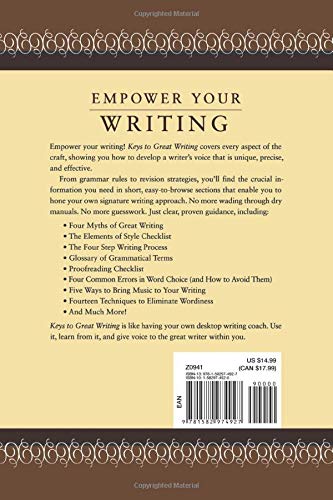
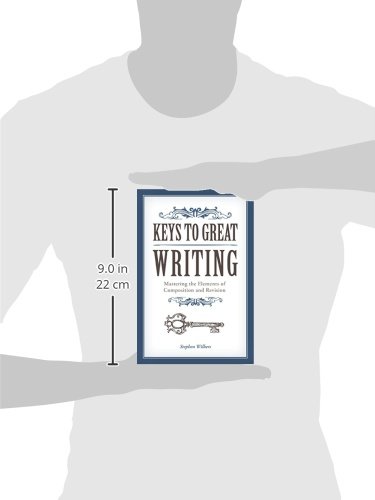
Full description not available
S**ﻦ
Wilbers Outlines the Keys to Great Writing and Then Some
Seminary taught me many lessons, many of which took the form of words. Of course, many words in Greek, Hebrew, and Latin were entirely new to me. But even in English seminary gave me new words to express ideas which were previously unformed and unattended. Writers may find themselves similarly challenged in Stephen Wilbers[1] book: Keys to Great Writing.What are the keys here? Wilbers lists five keys: economy, precision, action, music, and personality. Let me say a few words about each.Economy. “Make every word count.” Wilber illustrates his point by chunking up a poem by Langston Hughes, “Harlem”, and asking the reader to edit it by bracketing out unnecessary verbiage. Then, he brackets the verbiage himself. The word count falls from 112 to 54, but the power in the poem rises as the word count falls (11-13). He then moves on to offer fourteen techniques for eliminating wordiness.My favorite technique was number 5: “Delete ‘hollow’ hedges and meaningless intensifiers” A hollow hedge is an unnecessary qualifier. For example, in the expression, “rather surprised”, the word, surprised, is sufficient which makes the word, rather, a hollow hedge. Likewise, an intensifier normally adds emphasis, but not all emphasis is necessary. For example, the word, very, is everyone’s favorite unnecessary intensifier. Wilber recommends that if the meaning of the expression is unchanged when omitting hedges and intensifiers, then leave them out (21).Precision. “Use the right word.” Prefer action verbs and concrete nouns; appeal to the five senses; be careful with modifiers; avoid sexist language; speak plainly and directly. (37-47).Action. “Use action and movement to engage your reader.” Wilbers reinforces his earlier comments here about action verbs and cautions about pompous nouns—nominalizations. What makes this presentation differ from a typical treatment is that Wilber includes punctuation in this discussion and outlines rules for using both nominalizations and the passive voice. For example, he offers five reasons to use passive voice:To emphasize the receiver of the action.To de-emphasize the performer of the action.To avoid responsibility.To create smooth connections between sentences.To maintain a consistent point of view or sequence of subjects (56-57).His treatment here stresses the principle that a skilled writer uses language forms appropriately rather than blindly following rules.Music. Wilbers advises the reader to “listen to your voice”. Language is simply a representation of the spoken word (67-68).In representing the spoken word, Wilbers classifies punctuate marks into three categories: marks of clarification (hyphens, quotation marks, and parentheses), marks of inflection (question marks and exclamation marks) and marks of separation (periods, commas, semicolons, and dashes) (72). He then offers a rhythmic interpretation of separation marks. Think of a period as a whole note rest; a colon as a three-quarter note rest; a semicolon as a half-note rest; and a comma as a quarter-note rest (73-75).Another important way to represent the spoken word is through using different sentence structures. Wilber classifies twelve sentence types in three broad categories: functional (declarative, interrogative, imperative, and exclamatory) sentences, grammatical (simple, compound, complex, and compound complex) sentences, and rhetorical (periodic, loose, balanced, and antithetical) sentences (89). Some of these sentence types are familiar; others require definition. A sentence type new to me, for example, was a periodic sentence which is defined as a compound sentence where the subordinate clauses precede the main clause creating a sense of expectation. A loose sentence does exactly the opposite having the main clause precede the subordinate clauses (89).Personality. Wilbers advises writers to “be lively, unpredictable, playful, and genuine” (107). For example, Wilbers writes: “A good metaphor has three qualities: aptness, novelty, and simplicity” which might satisfy each of these conditions. (114) More generally, this chapter pulls together elements from the previous chapters and talks about how to use them.The five keys are discussed in the first five of Wilbers’ eleven chapters. The complete list of chapters are:Part One: Keys to Great Writing1. Economy.2. Precision.3. Action.4. Music.5. Personality.Part Two: Elements of Composition6. Purpose.7. Point of View.8. Organization.9. Support.10. Coherence.Part Three: Drafting and Revising11. The Writing Process.Part one described above accounts for 126 of 262 pages, or about half of the book.Part two is perhaps of the most interest to experienced writers. For example, Wilbers reviews six purposes for writing:1. To inform the reader.2. To entertain the reader.3. To persuade the reader.4. To transact business (or accomplish a task).5. To express oneself.6. To create a literary work (131).Note that the first three purposes focus on the reader and the last three focus on the writers—the more that you know about why you write, the more precise the writing will be. Clearly, how you write informs what gets written.Having offered a flavor of Wilbers’ writing, let me sum up.Stephen Wilbers book, Keys to Great Writing, outlines the major themes of writing without narrowing the focus to a particular genre. While this makes his book suitable as a composition textbook for college students, it has an engaging style which does not feel like a textbook. Authors serious about moving their writing style to a higher level will want to take notice.[1] In another review (posting March 8, 2016), I give some back ground on Stephen Wilbers (Wilbers Offers Writing Tips to Remember; [...]
J**N
Words Matter
Words matter. Or, as Bill Hybels says in his nifty book, Axiom: Powerful Leadership Proverbs , "Language Matters."I write a weekly eNews for my nonprofit clients--and review a book a week. So I wondered, what gem-of-a-book should I put on display to celebrate the 200th edition of my eNews? I have a five-foot stack of prospects behind my office door. More choices than a Baskin-Robbins megastore.I decided that words matter--so the winner is a book to empower my writing (maybe yours too). After 200 book reviews, I fear my color commentaries are growing stale. I needed new juice--and Stephen Wilbers' "Keys to Great Writing" quenched that thirst.Wilbers writes a syndicated newspaper column on effective writing. Those weekly insights were my guarantee that his book held promise. It met my test: fast-moving, creative, 50 or more underlined pages. In a word: buried treasure. (Oops. Two words.)Much of the writing we endure today is shockingly bad: website grammar and typos (it's versus its), rushed emails, smudged business letters, boring "From the CEO" columns, news reports with no news--is there no shame?Wilbers begins with a self-assessment on your writing expectations. Set a goal: Level 1: Basic Competence Level 2: Above-Average Competence Level 3: Exceptional Competence Level 4: Extraordinary CompetenceBefore you check Number 4, here's the standard: "To write with such extraordinary insight and beauty that people will be reading what I have written one hundred years from now." (How about...a week from now?)His five keys to great writing will surprise you: Economy, Precision, Action, Music and Personality. Hum along: "One of the most important things you can do to sharpen your style is to reawaken yourself to the sound of your words, to tune your ears to the rhythm and cadence and flow of your language. It is in this context that you should ask, How can I make this music more pleasing to my readers? What techniques can I learn from accomplished writers? What techniques can I discover on my own?"Trust me--no decent book on great writing would dare bore you. This book informs and inspires: how to avoid three common patterns of monotonous sentence structure; why you should follow a long sentence with a short, snappy one; don't stack nouns. And when writing a letter of apology--there's one cardinal rule: "Don't bury your apology."This Minnesota-based writing coach (check out his columns and the "Better Writing in Six Weeks" email course) adds, "Think of the last part of a sentence as a punch line to a joke: It counts more than the beginning and the middle. Your success--both as a writer and a comedian--depends on it."He tackles business writing by helping you wrestle with the six basic purposes for writing, including "to persuade your reader" (think board reports, donor letters and requests for raises). Then (and this is refreshingly on target) think about your audience: Who are they? What do they know? What do they feel? And how can you motivate them? (Four cheers from the Customer Bucket!).Words matter. In The Wall Street Journal's Saturday column, "Word Craft," a new contributor is featured each week on the art of writing and speaking. Hmmm. Must be important to business leaders. (Boring? Not! A recent column by Dilbert cartoonist Scott Adams was hilarious. Notice that I wrote "hilarious," preferable to the worn-out "LOL.")Recently, in The Wall Street Journal's "Word Craft" column, Alexander McCall Smith (author of the No. 1 Ladies' Detective Agency series) comments on the art of writing: "The real aim, of course, is conciseness. Concise prose knows what it wants to say, and says it. It does not embellish, except occasionally, and then for dramatic effect. It is sparing in its use of metaphor. And it is certainly careful in its use of adjectives. Look at the King James Bible, that magnificent repository of English at the height of its beauty. The language used to describe the creation of the world is so simple, so direct. `Let there be light, and there was light.' That sentence has immense power precisely because there are no adjectives. If we fiddle about with it, we lose that. `Let there be light, and there was a sort of matutinal, glowing phenomenon that slowly transfused, etc.' No, that doesn't work."Where do you go for inspiration on effective writing? Words matter. When is the last time you asked for feedback on your speaking and writing?
S**L
Well worth it
I have enjoyed reading this book, it is written in a logical and entertaining way. Has it been useful? Yes indeed; simple and practical explanation and examples of techniques, along with some pointers I had not considered before.This is well worth reading, I think anyone will gain some insight and get solid encouragement for speech writing.
A**R
A reference book for all writers
This book is invaluable. I have the kindle version and it's bookmarked and highlighted to death. If I had a paperback version it would be a mess and very tatty by now.
M**H
Keys to Great Writing
Keys to Great Writing is one of the best information books I have ever read. There is so much knowledge within the pages and it is all laid out in such a way that it was interesting and very easy to understand. I have read it over and over since receiving and I would recommend it to all my writing friends.
S**N
Helpfull
Excellent, easy to follow examples.
A**R
Phenomenal
Buy it. Should be compulsory reading. This book will improve your writing––guaranteed. One of the best purchases, I have made on Amazon.
Trustpilot
1 month ago
5 days ago