
DOWNLOAD THE APP


Customer Services
Copyright © 2025 Desertcart Holdings Limited
DOWNLOAD THE APP
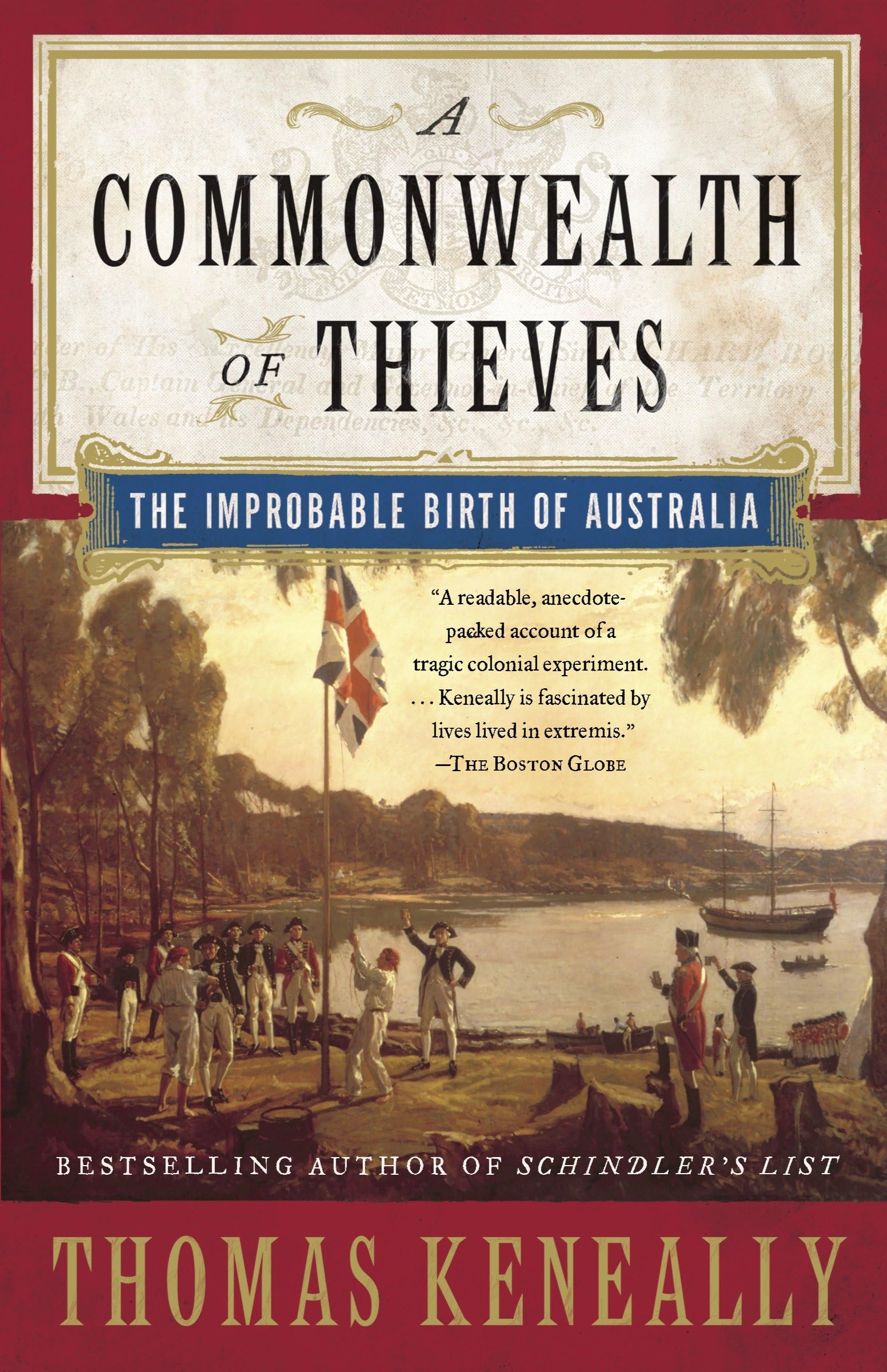
desertcart.com: A Commonwealth of Thieves: The Improbable Birth of Australia: 9781400079568: Keneally, Thomas: Books Review: A Commonwealth of Thieves - Take a motley assortment of thugs, thieves, pickpockets, and prostitutes guarded by a company of red-coated marines and supervised by a handful of bickering officers, set them down half a world away on an unexplored continent, and what do you have? The beginning of a new nation, Australia. Thomas Keneally, author of "Shindler's List" and other books, relates the curious enterprise based on official records and personal journals of some of the participants. There is much specific detail about the men and women of the colony. As exciting a tale as those of the first settlements of Virginia and Massachusetts. Review: Nice historical read - Nice story to read about the history of Australia, always interesting to read about the place and understand why it is the least Asian of the Asian countries.
| ASIN | 140007956X |
| Best Sellers Rank | #649,243 in Books ( See Top 100 in Books ) #42 in Australia & New Zealand History #46 in Oceania History #6,722 in World History (Books) |
| Customer Reviews | 4.1 4.1 out of 5 stars (51) |
| Dimensions | 5.19 x 1.01 x 8 inches |
| Edition | Reprint |
| ISBN-10 | 9781400079568 |
| ISBN-13 | 978-1400079568 |
| Item Weight | 10.4 ounces |
| Language | English |
| Print length | 401 pages |
| Publication date | December 4, 2007 |
| Publisher | Vintage |
E**E
A Commonwealth of Thieves
Take a motley assortment of thugs, thieves, pickpockets, and prostitutes guarded by a company of red-coated marines and supervised by a handful of bickering officers, set them down half a world away on an unexplored continent, and what do you have? The beginning of a new nation, Australia. Thomas Keneally, author of "Shindler's List" and other books, relates the curious enterprise based on official records and personal journals of some of the participants. There is much specific detail about the men and women of the colony. As exciting a tale as those of the first settlements of Virginia and Massachusetts.
B**A
Nice historical read
Nice story to read about the history of Australia, always interesting to read about the place and understand why it is the least Asian of the Asian countries.
W**T
history at it's best
This is an excellent book recommended for those keen on history, and genealogists who often want to see a more colourful picture of the environment in which their ancestors lived.
S**A
Five Stars
Thank you!
T**R
Great Overview of Australias beginnings
Everyone knows about the "convicts" that formed the nucleus of Australia's earliest settlers. Keneally gives us an introduction to the people themselves, what their lives had been like in England, the dangers and challenges they faced to start new lives on what must have seemed a different planet to then. This is an exceptional tale of Humans living on the edge and learning to make the best of it.
2**1
Pretentious and Scattered
It's maddening to read Kenneally's text because you get the sense he's trying so hard for style points that it gets in the way of simple, clear sentences that convey meaningful things. That pretentiousness makes the book hard to enjoy, at least for me. Commonwealth of Thieves is, at least on the surface, an attempt at a social history, but it never really gets very far beneath the surface of the handful of diaries and court records that he uses as primary sources. Large sections of the book read like an endless procession of anecdotes, and it doesn't seem as if there's any attempt to bind these together in the attempt to make any sort of historical point. The individuals, too, are rarely portrayed as being anything but two-dimensional post-colonial caricatures. The British officials are faceless bureaucrats. The prisoners and sailors are peons under the boot of the system, flawed but naturally good. The preacher has delicate sensibilities, which we're supposed to find humorous. The natives are wise in their ancient simplicity. You know the drill: villains and victims. If you want a history that sticks close to the vest of post-colonial stereotypes, then Kenneally wont' be too objectionable for you. If you want a book that explores tough questions or that evaluates the meaning of its content, then this book will leave you disappointed.
S**S
A "European experiment"
The founding of European Australia has suffered [and survived] a wide variety of accounts. Why should another be necessary? Chiefly, because few of those histories approach the level of human interest given that event in this book. The most famous of the other narratives, Hughes' "The Fatal Shore", flogged the inhumanity of the British prison system almost as sternly as colonial commanders did the felons. Keneally's story is far more balanced, since he understands better the situation of the times. He makes no excuses for the British prison system at a time when its major colonial effort was breaking away. For him, it is the human stories he wishes to relate, and with his writing background to help, he succeeds admirably. Keneally has touched on the early years of the Port Jackson [Sydney] convict colony before, most notably in his novel "The Playmaker". Here, shedding fiction for fact, he describes the voyage of the First Fleet, the landing at Botany Bay and the discovery that Cook's description was inadequate and the relocation further along the coast to the "best harbour in the world". In doing so, he brings to life a man not often enough recognized, Arthur Phillip, commander of the Fleet and first Governor of the colony. Phillip's initial success, bringing the crews and convicts nearly intact across vast stretches of ocean, stands in stark contrast to later transports. The Second Fleet proved a scandal of bad planning, mismanagement and inefficiency. Far worse for the potential of the colony's success was the inadequate supply mechanisms. Instead of immediately returning to a supply port, the prison ships went to Asia for tea to return to England. The prisoners and their keepers were left to shift for themselves. Only Phillip's firm, even-handed management of resources kept Port Jackson's population alive - even if at mere survival levels. Unlike the British "Pilgrims" in Massachussetts almost three centuries before, the indigenous peoples around Port Jackson did not step forward to aid the invaders. Keneally describes the various groups of the area, who had been there for millennia, as suspicious and hostile to the Europeans. The invasion had upset a finely balanced network of land occupation and resource allocation. When the Europeans fished or hunted in Aborigine lands, they upset that balance, reducing the Aborigine's resource base. Coupled with the incursion into supplies, the Europeans brought that dreaded scourge, smallpox, into the Australian East Coast. The Aborigines had no idea what smallpox was, nor comprehended why it had been imposed on them, but they knew well its source. Their fear and resentment was well-founded and expressed. Phillip, whose mandate was to establish "friendly and amicable relations" was challenged by forces he, too, had poor knowledge of. However, he persevered, even surviving a spearing without launching a war of retribution. Keneally's balanced approach, in which he shows Aborigines as perplexed and confused over the complexities of European life, is neither overdramatised nor "romantic" and stylised. Two groups of peoples, with little in common but their humaness, interacted in various ways. Clashes and confrontations were inevitable, but Aborigines also moved within the white world as equals. Throughout, Phillip is the key player. As the prison colony passed through times of great deprivation and sickness, Phillip continued to strive for a self-sustaining community. Farms were attempted from the outset, but Eastern Australia's conditions weren't amenable to European methods. Few successful farms were established during Phillip's tenure, but he never ceased to encourage experiment. He was often thwarted by poor soil, Sydney's vagaries of weather and an indifferent population. Most of the prisoners were the scrubs of English cities; farming was as great a mystery to them as was Australia itself. Farming implies permanence, another issue Phillip was forced to cope with. Many of the prisoners, "transported" for seven years to Australia, had already served time in British prisons or the infamous "hulk" ships moored in various harbours. When the time had expired, even though few had the records to prove their sentence expiries, they must be dealt with as free citizens. The number with resources available to return to the British Isles was next to nil and permanent establishments for them had to be devised. Phillip encouraged farming and struggled to arrange for "land grants" for which he had little authority. The making of urban criminals into rural pastoralists was indifferently successful at best. Yet, those people did find ways of making a living. The new settlers also entered into marriages or less formal arrangements, which Phillip turned a blind eye to in order to secure community stability. The "Currency" children, as the ensuing generation was known, established the foundation of the ongoing European Experiment which became today's Australia. Keneally recounts all these developments with consummate skill. This book should be a "first choice" for anyone wishing to learn how a European colony might be established, even if its first citizens laboured under the stigma of "convict" as their origin. [stephen a. haines - Ottawa, Canada]
B**R
Story drags with too much detail
A detailed history of Australia. Book lags with all the info presented.
M**M
Having read A Commonwealth of Thieves: The Story of The Founding of Australia, this review is for the Audio Book edition of the same book, though the labelling for this audio edition bears a slightly different sub title," The Improbable Birth of Australia". With the help of Simon Vance, the noted reader on this unabridged edition of his book, Thomas Keneally takes us through an exceptionally well researched and well balanced account of the first four founding years of his native land. Prior to the American Revolution in 1776, Britain had seen fit to transport convicts to the American Colonies. Now with this means of disposing of it's convicted felons at an end, the decision to transport convicts to New South Wales became an obsession for the penal authorities and eventually a First Fleet of over 700 were sent to the antipodes. Drawing on journals and the many documents of the era, the author gives us a rich insight into the minds of both, officers and convicts to create an audio edition of his book that is well worth a listen. We learn something of the mind of Captain Arthur Phillip, the Naval Officer in charge of the fleet, and on arrival his role as Governor of the new colony. The Marine Officers and men who 'policed' the early settlement and of the convicted men and women too. The struggles of the Aboriginal population are given credence as we listen to accounts of battles and sometimes cold blooded murders of these indigenous folk whose first confrontation with white skinned people must have astounded them. They thought that white skinned people were ghosts. Lack of supplies, famine and disease all feature here as the convicts become colonists. Captain Phillip's maxim being "no slavery in a free land", and many convicts whose prison sentences were served, would now struggle and finally make a new and successful life in what was a wild and dusty land. Thomas Keneally's book of the birth of Australia is brought to life here in a well narrated and characterised account by Simon Vance, whose voice quite pleasing to listen to, brings the main characters to life. With over 12 hours of listening on a 10 CD boxed set this is ideal for those who love audio books in unabridged format. Published in 2006 by Tantor audio. Very Enjoyable.
P**R
Anyone into early Australian life and the opening up of Australia from Sydney then this is a must have. I found it one of those rare books that was very hard to put down once started. Another good read is 'The Fatal Shore' by Robert Hughes.
B**N
I found the book very difficult to keep interested in. I am a bought 1/2 way through. I wanted to understand Australia’s history, however I am sure there are more interesting books out there that do a better job .
Trustpilot
5 days ago
2 weeks ago