🔥 Stay cool, save green, and lead the smart home revolution! 🌿
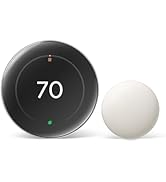
The Google Nest Learning Thermostat (4th Gen, 2024) is a premium smart thermostat designed to optimize home comfort and energy efficiency. Compatible with most 24V heating and cooling systems, it learns your preferences and outdoor conditions to reduce heating bills by 12% and cooling bills by 15%. Featuring a sleek, large borderless display with Dynamic Farsight, it integrates seamlessly with Alexa and Google Home for voice and app control. The included Nest Temperature Sensor enables precise multi-room temperature management, all in an easy-to-install package that requires no C wire in most homes.


| ASIN | B0D5BBYRJM |
| Best Sellers Rank | #19,718 in Tools & Home Improvement ( See Top 100 in Tools & Home Improvement ) #52 in Home Thermostats & Accessories |
| Brand | |
| Color | Grey |
| Customer Reviews | 4.4 4.4 out of 5 stars (795) |
| Date First Available | 6 August 2024 |
| Item Weight | 162 g |
| Material | Aluminum |
| Model Number | GA05169-US |
| Product Dimensions | 0.11 x 0.39 x 0.39 cm; 161.8 g |
| Special Features | Temperature Display |
| Voltage | 24 Volts |
A**N
POOR SERVICE AND BAD QUALITY
Poor service
M**2
Yikes what a neat device! It does learn from your daily movements to adjust either heating or cooling regime when you leave the house. It compensates for outside temps and figures out the time required to meet your set temps when you return to the home. There are many settings for fan timings ( to circulate stall air). To use the devices many features one should use the Google home app which requires WiFi. Should this be a ‘no -no’ it can be easily programmed directed by using the thermostat. Our one negative comment is the price. A Generation 3 unit costs less but lacks conservation features of this unit. Time will tell if the units features will save us energy costs. Google emphasized it will save.
B**.
Works fantastic and looks good. Well worth the money.
A**R
Working great so far! No complaints!
M**A
This is a non-user friendly and disappointing device. And we realized only after the return window that this isn’t a voice assistant (it won’t speak to you or listen to commands). We found the listing to be extremely misleading (and reviews) on this. It looks slick and manages temperature but for a steep price of almost $400, it should have voice assistant capability built in. Wish we could return it. That said, our Ecobee before this was also terrible. The wifi would disconnect multiple times per day (which never happened with other devices), so we never really had the voice assistant feature even though it was built in.
I**R
When one of our 3rd Gen Nest Thermostats stopped working, I decided to replace it with a 4th Generation Nest unit. Oddly, the mounting hardware for the 4th Generation is completely different from the 3rd Generation, which is annoying. The wiring backplate is incompatible, as the 4th Generation has a different electrical connector to the thermostat. One nice thing about the new backplate is that there is a light built into the bubble level which signals voltage on the Rh or Rc wires from the HVAC unit, implying you won't need a dedicated C wire for power. Unfortunately, this is many times not the case for the 4th Generation, lit bubble level or not. When I properly mounted and connected the 4th Generation thermostat, the setup app on my phone reported that there was "no power" on the R wire, even though the bubble level was lit, and I could measure the voltage on a multimeter. There was no way to get around the error message in the app. A call to Google support was completely useless. The support person clearly didn't know why the setup app falsely reported "no power", or whether or not the 4th Generation thermostat required higher voltage on the R wires than the 3rd Generation thermostat for operation without a C wire. An internet search revealed numerous people posting on Reddit and other web sites of the same issue I was having. How could Google support not be aware of this? Depending on your view, the difference between the R wire voltage requirements for the 4th Generation from the 3rd Generation thermostats is either an undocumented design change, or a design flaw. Personally, I consider it a significant design flaw, especially that it is not documented in the setup instructions, and there is no warning of this anywhere in Google's documentation. After spending about two hours removing the 3rd Generation mount, installing the 4th Generation mount, waiting for the callback from Google, and figuring out the root cause myself, I unmounted the 4th Generation Nest, packaged it back up, and returned it. I ordered a new 3rd Generation Nest from Amazon, and it works flawlessly with the HVAC unit. One attraction of the 4th Generation Nest is that the "maintenance band", the temperature variance range at which the AC compressor cycles on and off, is manually programmable, while on the 3rd Generation Nest it is not. There have been complaints that the 3rd Generation Nest's maintenance band is only two degrees F wide, which in some climates and homes cycles the compressor too often, and is blamed for excess wear and premature failure on the compressor. (AC units and heat pumps both use compressors.) So if you have a C wire in your compressor-based system, I recommend trying to use a 4th Generation Nest. Another trick which works with both generations is to use a remote sensor in a different part of the room or another room where the ambient temperature doesn't vary as quickly, to reduce compressor cycling. I use this trick for our 3rd Generation Units, and it also works for 4th Generation thermostats. Note that using a remote sensor this way may require some experimentation to get the desired result, while the feature to manually adjust the maintenance band makes it quicker and simpler. I really like the Google Nest thermostats when they're working the way they're supposed to, but the lack of backward functional capability from the 3rd Generation model to 4th Generation model is inexcusable, since there's no warning about it. And Google support is ineffective in helping less technical buyers. The least Google could do is document the issue properly on their web site.
Trustpilot
1 day ago
3 weeks ago