
DOWNLOAD THE APP


Customer Services
Copyright © 2025 Desertcart Holdings Limited
DOWNLOAD THE APP
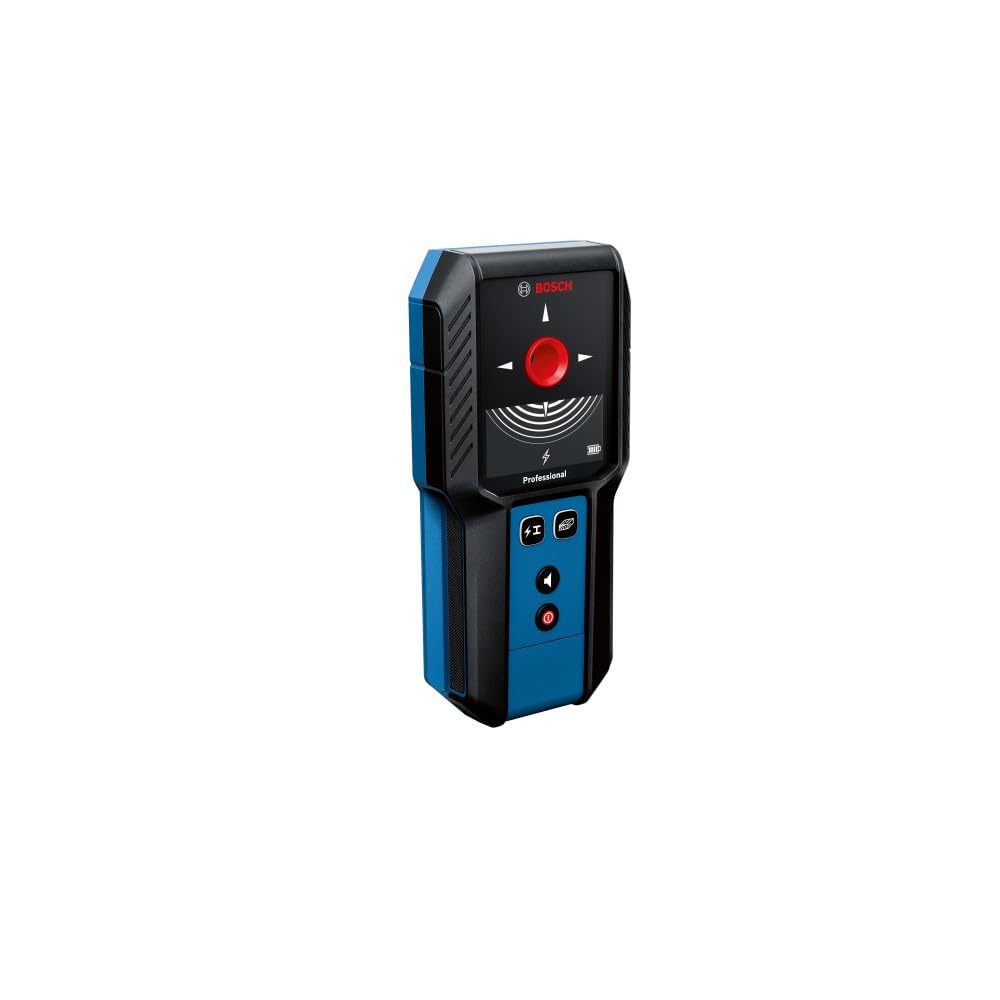
🔍 Scan Smarter, Build Better — The Pro’s Wall Scanner You Can’t Afford to Miss!
The Bosch GMS120-27 is a professional-grade wall scanner designed for electricians, plumbers, and contractors. It accurately detects wood studs up to 1.5", metal framing and pipes up to 4.75", and live AC electrical wiring up to 2" behind drywall. Featuring an intuitive color-coded display, rugged IP54-rated dust and water resistance, and dual power options (AA batteries included or Bosch Li-Ion sold separately), this tool delivers reliable, precise detection on any jobsite. Its built-in marking hole and shock-absorbing casing make it a durable, user-friendly essential for professionals demanding accuracy and efficiency.


| ASIN | B0DBWSSPT2 |
| Adjustable Length | No |
| Are Batteries Required | Yes |
| Batteries Required? | Yes |
| Best Sellers Rank | #11,090 in Tools & Home Improvement ( See Top 100 in Tools & Home Improvement ) #24 in Stud Finders & Scanners |
| Brand | Bosch |
| Brand Name | Bosch |
| Color | Bosch Blue |
| Customer Reviews | 4.0 out of 5 stars 4,508 Reviews |
| Included Components | (1) GMS120-27 Wall Scanner, (2) AA Batteries, (1) Soft Pouch |
| Item Dimensions L x W x H | 7.32"L x 3.4"W x 1.3"H |
| Item Type Name | Detection Tools |
| Item Weight | 0.86 Pounds |
| Manufacturer | BOSCH |
| Manufacturer Warranty Description | Bosch measuring and layout tools are covered by a one year limited warranty with an additional year when you register your tool within eight weeks of purchase - for details,call 1-877-BOSCH99 |
| Material | Plastic |
| Material Type | Plastic |
| Model Number | GMS120-27 |
| Power Source | Battery Powered |
| UPC | 000346817638 |
| Unit Count | 1.0 Count |
S**E
This easy-to-use stud/metal/wire finder is great
I use it for the thick drywall/plaster or wood floors in my house and works much better than the cheaper electronic ones I have used in the past. Most of my 1950s home's walls have drywall coated in plaster and are about 1" thick is most spots so non-electronic and electronic stud finders never worked too well. Remodeled areas of my home also have the standard 5/8" or 1/2" thick drywall and 3/4" thick wood paneling which I use this mostly successfully on. I also used this successfully to detect flood joists beneath wood flooring, copper and galvanized pipes behind cement board/tile and to find rebar in cement. It can detect steel as deep as 4.75" in the wall, wood up to 1.5" and wires up to 2". Using it around the house, I find it works better in the thick walls and wood paneling, especially for finding live wires. In the standard thickness drywalled walls, it does not find electrical wires well but it does find studs and plumbing well. The only downside to this detector is I cannot get it to consistently find electric wires behind 1/2" or 5/8" drywall which is standard on most homes. In most cases, it will not detect them at all but does give a reading sometimes. This is probably due to the finder only being able to detect wires up to 2" deep in the wall. Sometimes wires are not within 2" of the drywall surface. It also cannot detect studs well behind wood paneling which is not surprising. I find it pretty user-friendly, just turn it on, set your mode (wood, metal, electrical) then place it on the wall and give it a second to calibrate. Afterwards, start searching. It will alert you to whatever mode you have it set on with a bar gauge. When you have it on wood mode, it will also alert you to metal and wires which is convenient. It makes noises as you get closer (you can turn the sound off, it is a bit irritating). When you find the center of a stud, pipe or wire, the finder has a convenient holes you can stick a pencil through the mark it. It seems to find wood with the assistance of finding screws/nails and overall, I find its best to scan up and down to find the exact position of the stud, pipe or wire. You probably wont get the exact location on the first bullseye. The finder also has a backlight for the screen when using in dark areas. The finder comes with a 9v battery, carrying case and directions as well. The directions take a little reading. Overall, this is great for finding studs and pipes but 4/5 stars for the general inability to find electrical behind standard thickness drywall. 5 stars for versatility and ease of use. I thought about knocking it down a star for general failure to detect wiring but its scan range for wiring is limited as stated.
I**A
Reliable and Accurate—Finally a Stud Finder That Works
I’ve tried a few budget stud finders in the $20–40 range, and most were unreliable—one didn’t work at all. This one, however, is flawless. It comes with 2 AA batteries, so it’s ready to go right out of the box. It immediately located studs with an audible tone, and also detects wires and metal. I especially love the built-in marking hole in the center—it makes it easy to pencil your spot without guessing. Excellent tool and well worth the price.
L**E
Works on plasterd walls!
This is the only stud finder that has worked with our plastered walls. So grateful to have it.
G**F
Good scanner, but fiddly
I bought this because of the great ratings and reviews here and elsewhere. But I found this tool very fiddly. It has problems with our walls and find electricity and studs where they are not. I have had much more better luck with a cheap stud finder. However, when this tool does read properly, it is very handy, because the target is perfect for centering a mark. Perhaps our walls just have some weird stuff behind them (and it wouldn’t surprise me after what we have seen.
C**O
Bosch Really disappointed me!
Wow! I pity the poor fool trying to make a living using this thing. I own 3 other stud finders and decided to go for, what I perceived to be, the best. I have purchased plenty of fine Bosch tools so I arrived at the conclusion that all of the individuals rating this stud finder so low just didn't know how to use it. Later I would reveal to myself that this was indeed a pompous conclusion. Then I bought one. My background is in Electrical Engineering so I do know a thing or two about how these devices work. I decided to put the Bosch Scanner to the test. First, I scanned a section of wall with three studs on 16 inch centers sheeted with standard 1/2 inch dry wall. This was a relatively simple task as the bays were clear of any pipes, wire or insulation. I used a $15 Zircon, a $25 Zircon and a $20 Stanley to map the area. As expected, all three found the studs accurately. I had been using these 3 units for years and trusted all for this type of scan. I marked the studs on a strip of painters tape about 6 feet long to document the results. Then I attempted to settle the Bosch unit down and let it self calibrate over a known empty bay. The Green Ring lit up and I thought this is sweet! That was it for the excitement. As I moved the unit across the tape the blasted thing beeped and showed center about every 3-4 inches. I tried everything above and below the tape marked with the other stud finder's results. Other Notes: The readability of the LCD display is ridiculous! This one had to be held about 20 degrees above eye level to see anything. Ah, but I thought, If I turn it upside down I will not have to squat to get readings below neck high. I could see it alright, but it was still incorrect and really cumbersome to use upside down. I cannot imagine how Bosch let this thing get on the market. Maybe this was a LEMON but if it was: There are most assuredly too many lemons produced with this model. By the way, the electrical wire sensor never did work even with a loaded circuit of 100 Watts. The metal finder did find the drywall nails, but so can my $1.25 swivel magnet nail finder. I have no embedded ferrous or nonferrous metal pipes in my walls, so to be fair; I could not test this function.
J**R
Not Effective for Stud or Joist Location, Confusing Indicators
I purchased the Bosch GMS 120 based on its claims of detecting wood studs, metals, and live wiring, hoping it would help me locate floor joists through carpet and padding so I could fix a squeaky subfloor. While it can detect metal objects reliably, it struggled to actually identify a wooden stud or joist as advertised. In my case, it was only helpful when I already knew where a screw or nail was located, which defeats the purpose. It could also locate the titanium rod in my wife's leg as well as a couple of staples in my gut from a past surgery but again I already knew where those were. The biggest issue is that the tool provides no clear distinction between the type of metal it senses. In a real house there is plenty of random metal (missed nails, staples, tack strips, etc.), so the GMS 120 ends up lighting up without providing useful information. It does not give confidence that what you're detecting is structurally relevant, or even part of a stud. The red/green/no-light indicator system is also confusing and requires a lot of patience and interpretation compared to other scanners that simply show you the stud or centerline directly. To be fair, I can see how this tool might be valuable for certain trade professions such as electricians or plumbers who need to avoid pipes, conduits, or live wires inside walls and concrete. However, for basic carpentry, finding studs, or home projects, it was not particularly useful. There are other stud finders on the market that perform those tasks much more reliably and with far less guesswork like the one I compared this Bosh product to - Franklin Sensors ProSensor MAX Stud Finder which could effectively find the floor joist and I am keeping the Franklin product. For me, this was a premium-priced tool that did not perform the job it advertised for typical home use. The size was easily a one had operation and it seemed like a durable , well made product. Three stars because it may be excellent for specialized detection, but it falls short as a general-purpose stud finder. I am returning this product but it runs on 2 AA batteries which are included.
W**N
Best One Yet
Most "stud finders" are on the edge of useless. This one from Bosch is about as good as you can get. It requires a sweep back and forth to calibrate, then it will do its thing. There are small pads (teflon maybe) on the back to prevent damage or marks on the wall. The water line and electrical detection features are useful and seem accurate (I'm not punching holes in the wall to confirm). There is also a nice pouch and a quick reference card that stores with the stud finder, making it quick and easy to use when you need it.
A**T
worked to detect piped behing cinderblock
was able to detect piepes behind cinder block.
Trustpilot
1 week ago
5 days ago