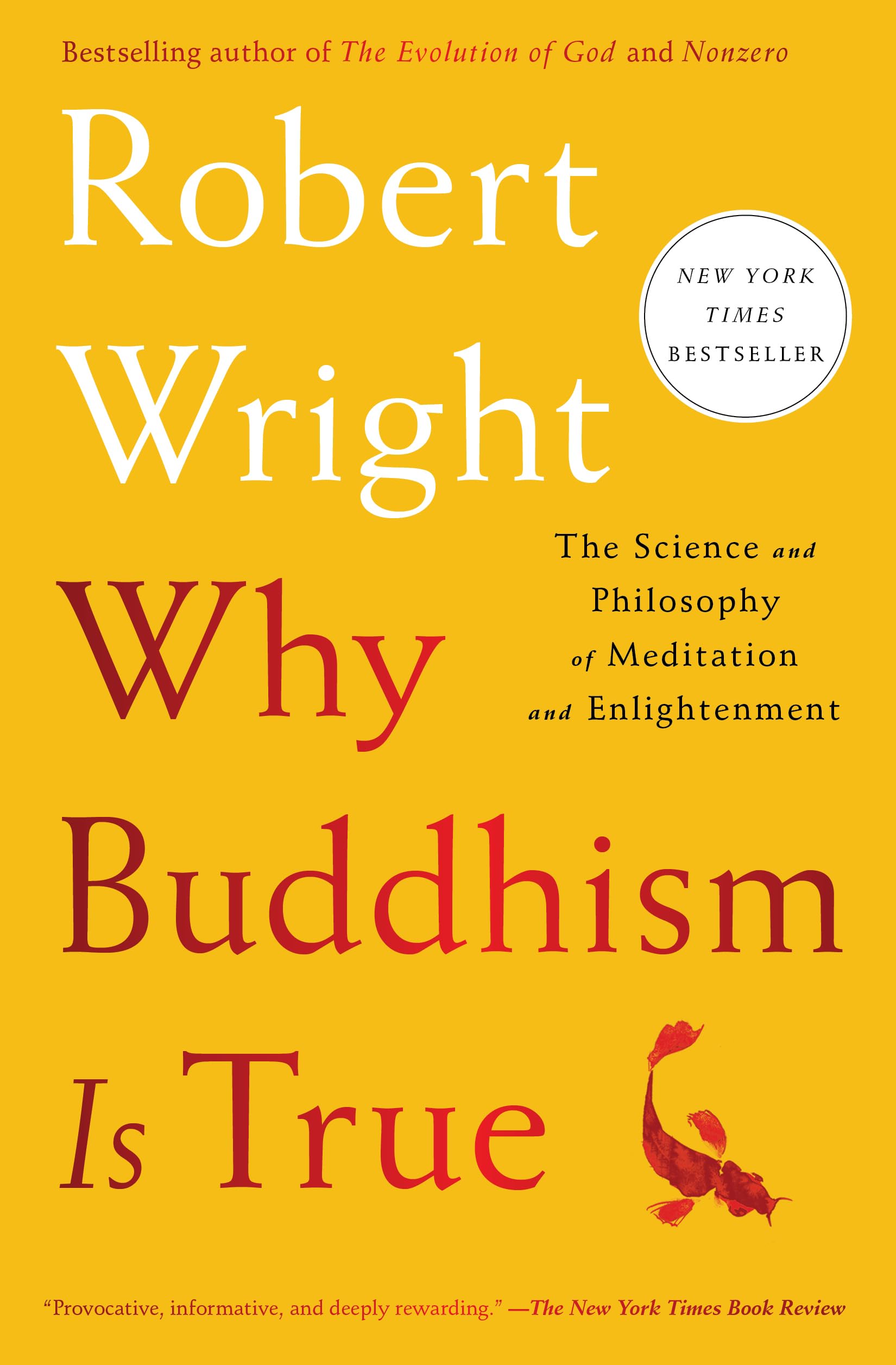
Why Buddhism is True: The Science and Philosophy of Meditation and Enlightenment [Wright, Robert] on desertcart.com. *FREE* shipping on qualifying offers. Why Buddhism is True: The Science and Philosophy of Meditation and Enlightenment Review: 'The Way' for 'The Truth' of evolutionary psychology - As Wright sees it, 'The Truth' of the human condition is to be found in natural selection, as described through evolutionary psychology in his early book The Moral Animal: Why We Are, the Way We Are: The New Science of Evolutionary Psychology . And he argues that this truth is uniquely addressed by 'The Way' of Buddhism, or at least naturalistic Buddhism. This 'secular Buddhism' is Buddhism without reincarnation, spirits or gods. Even the concept of complete or lasting enlightenment is held at arms length. Secular, naturalistic Buddhism rests on a few key ideas: the idea that people don't have an essential 'self' (no-self), the idea that dissatisfaction (dukkha) is caused by the 'hedonic treadmill' of pursuit of pleasure and avoidance of pain, and that meditation can help us to get off this treadmill. The philosophical approach is similar to that of Stephen Batchelor in Confession of a Buddhist Atheist and Secular Buddhism: Imagining the Dharma in an Uncertain World . There is a decidedly Gnostic bent to the writing here, right from the beginning, when the movie The Matrix is cited. Here natural selection is the process which holds us in a state of delusion, warps our perceptions of reality, prevents us from experiencing lasting contentment and satisfaction, and keeps us trapped on the hedonic treadmill. And secular-Buddhism is The Way (the 'red pill') that will liberate us from this endless drama of delusion and frustration. This view of evolution stands in marked contrast with that of Wright's previous book, The Evolution of God (Back Bay Readers' Pick) , in which biological and cultural evolution are instead 'divine' processes by which the Good becomes manifest in the world. (The God-as-Evolution view is also that of the 'Integral' spirituality of Ken Wilber, Steve McIntosh, and others.) Part of this book is dedicated to showing that the key ideas of secular-Buddhism are scientifically true, through discussion of studies in psychology and neuroscience (an approach shared with Waking Up: A Guide to Spirituality Without Religion , by Sam Harris). This would be more convincing if the studies were cited as a way of evaluating Buddhism against competing theories of well-being, such as modern positive psychology, but the book generally avoids this type of direct comparison. This is reflective of the basic approach of secular-Buddhism: the concepts which don't find support in scientific studies, such as reincarnation, or lasting enlightenment, are abandoned or de-emphasized. Secular-Buddhism is reformulating Buddhism to be more consistent with modern psychology, a dynamic which complicates the question of whether science can be used to show that 'Buddhism is True'. Wright expands on the concept of 'no-self' by presenting a 'modular' model of the mind. The idea is that our mind is composed of modules with different goals, desires, and thought patterns. The modules jostle and compete with each other on the subconscious level. Only when one of them carries a sufficiently strong feeling, do we then become aware of its associated thought on a conscious level. While Wright finds some support for this modular model from the Insight Meditation school, and from psychological research, he formulates it through his own preferred perspective of evolutionary psychology (Darwinian competition within the subconscious mind). Interestingly, the model is extended to suggest how mindfulness can improve our 'self'-control, and to weaken the pull of indulgent or addictive behavior. One of the pleasures of The Evolution of God was its detailed historical examples of the ways in which the 'spiritual marketplace' of competing ideas, and the needs of merchants, kings, and rulers all influenced the development of ancient Judaism, Christianity, and Islam. Wright could have also taken this approach with Buddhism, exploring how its history as the state religion of multiple empires has shaped its development over time and place. I was hoping for this, and am disappointed not to find it here. However, Wright instead manages to tackle some pretty subtle philosophical issues, such as the distinction between the Buddhist concept of 'emptiness' (sunyata) and Hindu non-dualism, in a manner that is unusually accessible. He enlivens the discussion with narrative accounts of past conversations and interviews. This book is in many ways a personal account: Wright has found a version of secular-Buddhism that is True for him in his life, and he is bringing us along through his experience and thought process. Unlike many authors on Eastern spirituality, he is in no way trying to present himself as enlightened, or a spiritual teacher or guru. He is refreshingly unpretentious--humorously self-effacing, and transparent about his motivations for writing. And he is a clear writer--he does not try to intimidate us with obtuseness and paradox, even when addressing difficult concepts. The book is not always convincing, but it is engaging, approachable, and thought-provoking. Review: A great book for what it is for me. - I haven't finished the book yet....1 quarter left. I first listened to it as an audio on cd's....loved it and am now reading the book as the audio was a bit too fast paced....found myself going back to listen to the last part as I was distracted so often by my own thoughts. Reading allows me to pause and reflect or acknowledge some confusion and clear it up. The book belongs to the local library and so I have purchased a copy for myself so I can underline and make comments in the margins. My background in Buddhism and meditation is in the Vipassana tradition. Attended retreats from one day long to two weeks long. Retreats with Goenka, Shinzen Young, John Travis....multiple times as wall as a few others whose name escapes me. Have studied extensively in the field reading first Ken Wilber, No Boundry....followed by several books by Krishnamurti, Ram Dass, Stephen Levine, Ramana Maharshi, Joseph Goldstein, Eckhart Tolle, Adyashanti, and many, many others....just to let you where I'm coming from. I really like Wrights style....easy and friendly and honest with a great wit. His non-expert, struggling to understand is helpful when he talks with the Pros at retreats. Very reinforcing and supporting with my background. I like the continual emphasis and reminders about mindfulness. It is simply a very good fit for me. I like the depth he goes into of his understanding or lack of. Seems like a great intro to the system as well, and is very encouraging to people to try a meditation retreat and see what's there for them. I have recommended the book to others and sent a copy to my daughter and am looking forward to discussing it with her.
| Best Sellers Rank | #10,886 in Books ( See Top 100 in Books ) #3 in Evolutionary Psychology (Books) #25 in Buddhism (Books) #101 in Happiness Self-Help |
| Customer Reviews | 4.5 4.5 out of 5 stars (4,787) |
| Dimensions | 5.5 x 0.84 x 8.38 inches |
| Edition | Reprint |
| ISBN-10 | 1439195463 |
| ISBN-13 | 978-1439195468 |
| Item Weight | 2.31 pounds |
| Language | English |
| Print length | 336 pages |
| Publication date | May 8, 2018 |
| Publisher | Simon & Schuster |
F**N
'The Way' for 'The Truth' of evolutionary psychology
As Wright sees it, 'The Truth' of the human condition is to be found in natural selection, as described through evolutionary psychology in his early book The Moral Animal: Why We Are, the Way We Are: The New Science of Evolutionary Psychology . And he argues that this truth is uniquely addressed by 'The Way' of Buddhism, or at least naturalistic Buddhism. This 'secular Buddhism' is Buddhism without reincarnation, spirits or gods. Even the concept of complete or lasting enlightenment is held at arms length. Secular, naturalistic Buddhism rests on a few key ideas: the idea that people don't have an essential 'self' (no-self), the idea that dissatisfaction (dukkha) is caused by the 'hedonic treadmill' of pursuit of pleasure and avoidance of pain, and that meditation can help us to get off this treadmill. The philosophical approach is similar to that of Stephen Batchelor in Confession of a Buddhist Atheist and Secular Buddhism: Imagining the Dharma in an Uncertain World . There is a decidedly Gnostic bent to the writing here, right from the beginning, when the movie The Matrix is cited. Here natural selection is the process which holds us in a state of delusion, warps our perceptions of reality, prevents us from experiencing lasting contentment and satisfaction, and keeps us trapped on the hedonic treadmill. And secular-Buddhism is The Way (the 'red pill') that will liberate us from this endless drama of delusion and frustration. This view of evolution stands in marked contrast with that of Wright's previous book, The Evolution of God (Back Bay Readers' Pick) , in which biological and cultural evolution are instead 'divine' processes by which the Good becomes manifest in the world. (The God-as-Evolution view is also that of the 'Integral' spirituality of Ken Wilber, Steve McIntosh, and others.) Part of this book is dedicated to showing that the key ideas of secular-Buddhism are scientifically true, through discussion of studies in psychology and neuroscience (an approach shared with Waking Up: A Guide to Spirituality Without Religion , by Sam Harris). This would be more convincing if the studies were cited as a way of evaluating Buddhism against competing theories of well-being, such as modern positive psychology, but the book generally avoids this type of direct comparison. This is reflective of the basic approach of secular-Buddhism: the concepts which don't find support in scientific studies, such as reincarnation, or lasting enlightenment, are abandoned or de-emphasized. Secular-Buddhism is reformulating Buddhism to be more consistent with modern psychology, a dynamic which complicates the question of whether science can be used to show that 'Buddhism is True'. Wright expands on the concept of 'no-self' by presenting a 'modular' model of the mind. The idea is that our mind is composed of modules with different goals, desires, and thought patterns. The modules jostle and compete with each other on the subconscious level. Only when one of them carries a sufficiently strong feeling, do we then become aware of its associated thought on a conscious level. While Wright finds some support for this modular model from the Insight Meditation school, and from psychological research, he formulates it through his own preferred perspective of evolutionary psychology (Darwinian competition within the subconscious mind). Interestingly, the model is extended to suggest how mindfulness can improve our 'self'-control, and to weaken the pull of indulgent or addictive behavior. One of the pleasures of The Evolution of God was its detailed historical examples of the ways in which the 'spiritual marketplace' of competing ideas, and the needs of merchants, kings, and rulers all influenced the development of ancient Judaism, Christianity, and Islam. Wright could have also taken this approach with Buddhism, exploring how its history as the state religion of multiple empires has shaped its development over time and place. I was hoping for this, and am disappointed not to find it here. However, Wright instead manages to tackle some pretty subtle philosophical issues, such as the distinction between the Buddhist concept of 'emptiness' (sunyata) and Hindu non-dualism, in a manner that is unusually accessible. He enlivens the discussion with narrative accounts of past conversations and interviews. This book is in many ways a personal account: Wright has found a version of secular-Buddhism that is True for him in his life, and he is bringing us along through his experience and thought process. Unlike many authors on Eastern spirituality, he is in no way trying to present himself as enlightened, or a spiritual teacher or guru. He is refreshingly unpretentious--humorously self-effacing, and transparent about his motivations for writing. And he is a clear writer--he does not try to intimidate us with obtuseness and paradox, even when addressing difficult concepts. The book is not always convincing, but it is engaging, approachable, and thought-provoking.
R**G
A great book for what it is for me.
I haven't finished the book yet....1 quarter left. I first listened to it as an audio on cd's....loved it and am now reading the book as the audio was a bit too fast paced....found myself going back to listen to the last part as I was distracted so often by my own thoughts. Reading allows me to pause and reflect or acknowledge some confusion and clear it up. The book belongs to the local library and so I have purchased a copy for myself so I can underline and make comments in the margins. My background in Buddhism and meditation is in the Vipassana tradition. Attended retreats from one day long to two weeks long. Retreats with Goenka, Shinzen Young, John Travis....multiple times as wall as a few others whose name escapes me. Have studied extensively in the field reading first Ken Wilber, No Boundry....followed by several books by Krishnamurti, Ram Dass, Stephen Levine, Ramana Maharshi, Joseph Goldstein, Eckhart Tolle, Adyashanti, and many, many others....just to let you where I'm coming from. I really like Wrights style....easy and friendly and honest with a great wit. His non-expert, struggling to understand is helpful when he talks with the Pros at retreats. Very reinforcing and supporting with my background. I like the continual emphasis and reminders about mindfulness. It is simply a very good fit for me. I like the depth he goes into of his understanding or lack of. Seems like a great intro to the system as well, and is very encouraging to people to try a meditation retreat and see what's there for them. I have recommended the book to others and sent a copy to my daughter and am looking forward to discussing it with her.
A**R
A pleasant introduction to mindfulness, but more philosophy than science
Robert Wright’s book on Buddhism and meditation is an engaging introduction to some of the central tenets of Buddhism as rooted in basic principles of evolutionary psychology. Given the bad press that evolutionary psychology has received recently as a virtual geyser of just-so stories and flawed statistics, I was initially skeptical of what Wright has to bring to the table. But it turns out that most of the evolutionary psychology he talks about is pretty basic and logical. Wright also describes his own experiences with meditation and conversations with leading Buddhist teachers. One of the central points in the book is how our modern life presents us with stimuli that were useful in our prehistoric environment but which cause us to overreact. Meditation makes us realize this and temper down or eliminate our responses and bring peace to our mind. A good example is road rage; in hunter gatherer societies where almost all of the people you met were part of the same group, being angry at someone who might cut you off when you were traveling would have been a useful trait since you would almost certainly deal with this person again and it would be important to keep track of his transgressions, both as payback and as a signal to other members of the tribe to be war of him. In the modern age, the person who cuts you off on a highway is quite certainly someone who you are never going to encounter again in your life, so why bother being angry with him or her? Another example of a trait that is wrongly wired for the jet age is our gratuitous reaction to sugar; while desirous in a prehistoric environment in which sugar was a scarce resource, this response leads to a world of trouble when directed against donuts and ice cream. One can think of other misguided reactions to all kinds of stimuli, especially on social media, that while being useful thousands of years ago, now simply cause anxiety and rage. In general the book does a good job explaining some of the main messages of Buddhism as experienced through meditation, especially the detachment from the “essence” of an object, the very basic realization of the impermanence of feelings, thoughts, objects and events and the foundational value of mindfulness. As someone who has had a limited but rewarding experience with meditation and mindfulness, I can attest to the remarkable reality of recognizing the fleeting and transitory nature of even deeply held beliefs or strongly felt feelings through mere observation of these thoughts and emotions (next time when you feel or think something strongly, simply watch how strong that thought or feeling remains after some time, after even five minutes). Buddhism is supposed to have emerged from Siddhartha Gautama's epiphany that suffering is the bedrock of the world. Assuming suffering to be the default state of life might point to a rather depressing existence, but it's actually better than assuming happiness as the default state, precisely because states of happiness are often illusory and temporary and therefore actually lead to disappointment and pain. And while meditation does not necessarily help us connect with suffering, it certainly allows us to experience the impermanence of happiness; this experience can lead to a much richer, much more real appreciation of life's changing fortunes, and consequently to a mind that is far more at peace than one which is constantly chasing mirages of joy. For me, the most interesting part of the book was where Wright describes our distracted mind through what is called the modular theory of mind. Many neuroscientists now recognize that far from being monolithic, our brain operates through the workings of different modules that compete with and cooperate with each other. Much of these workings are at an unconscious level. How the modules are exactly delineated and whether they are rigid or fluid are open questions, but as Wright describes, what is becoming increasingly clear is that when our mind wanders, it’s not so much that the mind is wandering as that it’s getting “hijacked” by these unconscious modules, each of which vies with the others for grabbing our attention. There is thus an intricate connection between our conscious and unconscious mind, a connection that even flawed theorists like Freud recognized a long time ago. The utility of things like mindfulness and meditation is that they allow us to observe and thus tame this constant competing dance of modules. Wright does a good job talking about some of the very interesting research from behavioral neuroscience that has confirmed the deep influence of subliminal or unconscious thinking on conscious thoughts and actions. It’s also useful to read about Wright’s own experiences with mindfulness, mostly at week long retreats in beautiful places like Barre, Massachusetts, although he sometimes sound too much like a man who has all the answers; has he ever met a Buddhist master who did not validate his already existing beliefs? It would have been enlightening to read about cases where someone actually punctured his deeply held assumptions. Even less satisfying is Wright’s lack of curiosity regarding what actually happens in our brains when we are meditating; while the book bills itself as an account of the "science and philosophy of meditation", there is much more philosophy here than science. There is a short section describing the impact of meditation in calming the brain’s so-called default mode network (DMN) that is active when we are thinking about ourselves and our past and future, and about other people’s thoughts and behavior. There is now good evidence that the default mode network is much less active and more stable in long-term meditators. But apart from this discussion, those who want to find out about the latest research on the neuroscientific basis of meditation will have to look elsewhere. Ultimately, as Wright says in the last part of the book, having everyone get in touch with themselves by following the way of the Buddha might lead not only to personal enlightenment but would also lead to a world that is much more compassionate, peaceful and productive. While this goal is laudable, it reminds me of that quote about theory and practice; in theory there is no difference between the two, but in practice there is. Generally speaking then, Wright’s book is a pleasant introduction to the benefits of meditation and some of the foundational concepts of Buddhism. I have read something of these topics so there was relatively little in here that was novel for me, but if someone is looking for a good, thought-provoking foray into the basic psychological basis of mindfulness, they could easily do worse than this volume.
K**N
宗教的、儀礼的側面を削ぎ落とし、最新の心理学、脳科学的側面から仏陀の教えの正当性を検証する。 集中力散漫でイラチな著者が悪戦苦闘しながら、悟りに至ることを半ば諦めつつも(?)、瞑想を継続してその効用を説くため妙に説得力がある。retreatでの坐禅中に、先入観(essence)の消失により近所の工事のチェーンソーの雑音が音楽となり、自他の境界が曖昧になることで(not-self)自分の足の痒みと小鳥のさえずりを等値する部分など面白い。 瞑想による個々人の覚醒のみならず、大袈裟に聞こえるかもしれないが最終的には世界平和への道筋までをも考慮。最近のノアハラリ氏の著書とも通ずる部分あり?
M**X
Pretty revealing book with a underwhelming title.
P**O
Got this for my father-in-law who is a Buddhist monk - he was a bit sceptical to start with (because of course, he knows it all already) but when he actually read it he really appreciated this way it lays out Buddism to from a non-Buddhist perspective.
M**A
This book is absolutely amazing. I would ever consider it the best book I’ve ever read. Whenever I felt my feelings getting out of control or making me suffer anyway, I would turn to this reading immediately to calm myself down. Lifechanging!
N**A
Has expected
Trustpilot
2 weeks ago
2 weeks ago