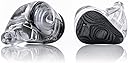
The much anticipated and hyped (among audiophiles) Moondrop X Crinacle DUSK has finally reached general release! I had to wait patiently for mine like many others but the wait was worth it as this product is a considerable step up over its less expensive and similarly priced competition. I am the proud owner of a 2.2 speaker system with full-range subwoofers, a small collection of IEMs and my prized open-back headphones. I mention this not to brag but to explain why I purchased these in the first place, as they're intended for use as the closed-back IEM complement to my speaker system and open-back headphones after dissatisfaction with my previous attempts to match their sound quality. As an owner of the Truthear Nova (worth the money, good bass with EQ, OK mids, wonky treble) and 7Hz Timeless (needs a price drop these days, mondo bass, mids require EQ, quality treble), the hope was that the DUSK with its 2DD + 2BA + 2Planar tribrid driver combination would provide me the best of both worlds and effectively cover the weaknesses of both of these IEMs. I'm no stranger to EQing my equipment to taste and as the DUSK was apparently built around DSP I came prepared to do my own EQing work with my existing equipment, making the included DUSK-DSP cable a non-factor in my decision to purchase this product. I'm pleased to report that I might have actually overshot my expectations, as the DUSK might now be the best audio equipment at my desk! It's a fussy IEM though and needs some support and TLC to hit its full potential. There are essentially two ways to look at the DUSK - as an IEM that needs the DSP cable to sound correct and is compromised without it, or an IEM with a broadly enjoyable tuning built in like any other IEM on the market but with an optional DSP cable that enables alternative tunings that are easily accessible for those unfamiliar with EQ. Most of the marketing around this IEM (including from Crinacle himself!) insists that the "DSP-Default" tuning built into the DUSK-DSP cable is the intended tuning. I would not take this view seriously were it not so popular, coming direct from the collab partner and people were purchasing the DUSK specifically as a high-end IEM with USB-C support, so let's address this first. The problem with this common narrative is that the DUSK-DSP cable, a modified version of Moondrop's FreeDSP cable, is the weak link in the DUSK package. I originally tested this cable briefly to make sure it was working then switched to analog cables to properly acquaint myself with the DUSK. Had I stuck to the DSP cable my opinion of the DUSK would have been much more negative. This cable could be charitably described as "basic" - the EQs that can be set are very simplistic, likely due to the limited processing power available to the DSP chip in the cable, and this EQ cannot be modified without using Moondrop's Link app which is already infamous for needing full write access to your phone to make changes to your connected DUSK, which smacks of sloppy coding practice at best and much more dubious implications at worst. The Parametric EQ system on the cable is limited to eight peak filters that can only be raised or lowered in 1dB increments so the complex fine-tuning you would expect of a product in this price bracket is not possible. After trying to import my own EQ parameters onto the cable, I had a renewed respect for Crinacle's efforts to turn lemons into lemonade with these limitations and at least his patience should be lauded! To be clear, the app is not required to use the cable, as it is shipped with the "DSP-Default" tuning parameters applied at the factory. This is still enough to make meaningful adjustments to the resulting tuning and I was able to impose an approximation of my intended experimental EQ onto the cable but this is a far cry from what I expected when I originally ordered this product. The cable itself is of good quality and doesn't have any memory problems to speak of so it'll simply take the shape you want it to take with no problems, and the cable is decently thick and in the popular braided style. The real dealbreaker problem with the cable though is that it's just not a particularly good source DAC/Amp. It may still outclass a poorly-performing DAC/Amp circuit for on-board computer audio or a mobile phone but performance is much more limited than expected and worse, dependent on what it's plugged into to my surprise! This cable sounds very obviously better on my PC than my phone, which is not what you'd expect when the digital output sent from both devices should be identical. In fact, after acclimating to running my DUSK from my standard desktop audio setup for over a week, the DUSK-DSP cable was a clear and noticable step down in audio quality. The final nail in the coffin though is that directly connecting the DUSK to my phone via analog as I have the luxury of a headphone jack on it still gets me better sound quality - and that's taking into account that the impedance of my headphone jack is high enough to blunt the treble on the DUSK. This is also after switching to a custom EQ that mimics the one I developed for the DUSK on my PC so the tuning was directly comparable. Whoops! If you required the DSP cable to enjoy this product properly, this is one to skip. The technology isn't there yet, and you should seek out a dedicated DAC/Amp and PEQ for now, alongside something you like the tuning of better. Now that we have established that the DUSK-DSP cable tries to drag the product down dramatically, you will be wondering what I did instead and how I've used the DUSK after doing away with the marketed use case. I have assessed and scored this review treating the DUSK's analog tuning as the primary tuning with the DSP cable as a useful but non-essential pack-in extra that I will rarely use, which makes it a lot less offensive a value prospect. I would have preferred the option to skip the DSP cable entirely and save some cash. I ended up using the Tripowin Petrichor as a replacement modular cable to allow the DUSK to connect to the balanced 4.4mm socket on my FiiO K7 and am using SpinFit W1s to get a proper bass seal for my picky ears. The included Moondrop Spring Tips are by no means bad tips at all, I have actually been very impressed using them on other IEMs as their design allows you to get some powerful bass conduction while still allowing the treble lots of room to breathe - they just don't seal properly for me on the DUSK. If your ears are smaller than mine you may be more lucky, and they work fine for me on other IEMs I own with larger nozzles. The included analog cable is merely adequate, nothing to remark upon nor complain about. At this stage though, I would expect something in this price bracket to be shipped with a fully modular cable, so I was a little irritated to have to purchase an aftermarket one again. It was absolutely worth it for me though. If you don't have balanced sources than a Tripowin Zonie will also work fine for you. The analog tuning is designed to closely mimic the tuning of the DUSK's immediate predecessor, the popular and sadly out of production Moondrop Blessing 2: Dusk, with additional tuning refinements taking advantage of the new driver configuration. As someone who typically applies at least a basic EQ filter to everything I listen to to account for unit variation and other weirdness, once I got a proper seal with the DUSK I ended up only needing to correct for Windows' long-standing bass rolloff designed decades ago to protect lower quality speakers from destroying themselves with low frequencies they couldn't handle - something quite irritating in the modern day with equipment that absolutely can handle it and doesn't need the protection. In other words, at the height of irony, I am using audio equipment almost completely stock for the first time in decades, so well crafted is the tuning of the DUSK. DUSK's tuning prioritises accurate instrument and vocal timbre first and clarity a close second. It's very rare for something to sound so effortlessly correct and finely detailed out of the box and yet the DUSK has achieved it. The DUSK's highlight, and why it was so worth it to go out of my way to get an optimal seal on them is their bass. Many IEMs claim to have proper subwoofer-quality bass, but this is the first pair of IEMs I've listened to that can actually back up that claim. The only other system I have available that match the sheer high fidelity and clarity of the bass the DUSK provides is my SVS SB 1000 Pro. A sticking point for many, however, and what may steer people to the DSP tunings is the lack of exaggerated midbass that is very common in most audio products on the market today. The bass on the DUSK strikes a very tight balance between being bassy when a track calls for deep bass while also being very open and airy when a track calls for that instead, where a midbass elevation would destroy the impression of an empty, open space. It's very hard to strike this balance without making the bass sound limp or bloated (or both!) and the DUSK makes it look easy. This strict tuning philosophy is also applied to vocal reproduction, where many bassier IEMs warp the timbre of male vocals as a consequence of that midbass hump, making the vocals rattle the ears in a way that would be impossible for an actual person to accomplish, even if it might sound fun sometimes! If you are finding the bass to be lacklustre on the DUSK, chances are your seal is imperfect, as this dual dynamic driver setup (the "H.O.D.D.D.U.S." - yes, three Ds!) is so powerful that it can transmit bass over a broken seal. The first week with the DUSK had me tip rolling a lot to get the right seal before I realised I needed to buy new tips for the job, and before that there were many false starts where I thought I had got a bass seal only to be proven wrong the next day, and the next! If you still find the DUSK to not be bassy enough, it's possible to boost the bass somewhat without destroying timbre, but while I had fun with this for a short while I soon found myself going back to the stock tuning. You lose something in running to the safety of exaggerated bass with these IEMs - they are built to be neutral and honest. This is the only area that the DSP-Default tuning improves by making it more prominent but this comes at the expense of everything else and so is not worth the price of admission. This honest tuning philosophy extends to the treble as well. While this is technically the weakest point of the tuning on the DUSK, that is to say the treble is merely great instead of incredible. I've heard treble this good on other IEMs I own so it's no longer possible to wow me with this but it's excellently presented, assuming a good seal. The "tizzy" 14-16KHz peak that these IEMs are already infamous for is something that I noticed early on when using the DUSK but it got less prominent as I got a better seal before going away completely with a perfected one. In fact I'm now confident in saying that if you perceive this treble spike in the first place that's a sign that your seal on the DUSK is still imperfect and needs refinement. The treble on the DUSK manages to straddle the line between being clear and avoiding sibilance. You'll only get sibilant treble on the DUSK if the track you're listening to is innately sibilant, otherwise the treble is remarkably clear and detailed without having to be recessed to achieve the illusion of smoothness. This is one of the things that the DSP-Default tuning screws up in particular, gouging a deep recession in the treble that is very audible and doubly irritating, especially when compared to stock. While I was more wowed by the superior, delicately balanced bass tuning of the DUSK, I suspect most people will be more wowed by the midrange. To put it simply, everything sounds natural. It sounds right. A trumpet sounds like a trumpet. A piano sounds like a piano. Vocals are clear to the point you can make out how they were recorded! You'll listen to this for a while then go back to inferior headphones and speakers and wonder how you put up with that wonkiness for so long. (This is another area that gets ruined by the DSP-Default tuning, which as you probably gathered by now I dislike a lot, especially in comparison to the greatness it's butchering.) Everything about the DUSK's frequency response has been meticulously balanced so that there are no significant peaks nor troughs anywhere in the frequency response, only gentle emphasis in the spots where the human ear naturally expects an emphasis and the mids benefit from this lack of wonkiness the most. If it's possible to improve the midrange beyond this, I don't know how. Overall, the DUSK manages to separate instruments out especially well. I thought I had already had all my "wow I never heard this part of a track before" moments behind me but the DUSK proved me wrong, and I could even tell where the parts had been masked before and smeared together and why. Bass detail is especially apparent on the DUSK primarily because of its absence when using most anything else. The DUSK manages to achieve the bare minimum of auditory masking and yes, adjusting the tuning shatters this delicate balance so extreme care is required when doing a custom EQ tuning! This is a clear step up from anything I have tried previously, and I am extremely impressed by the ruthless commitment to and execution of sheer high fidelity that the DUSK represents. This is the kind of quality that will get let down by an inadequate audio source, and is the point where a quality source becomes absolutely essential to get your money's worth instead of just being a good idea. The one possible sticking point though is that the DUSK's honesty is absolute - if something is mixed poorly, you will know. If something is mixed well, it'll sound like a new song. Simply put, this is a phenomenal core product badly let down by poorly judged marketing spiel and lackluster accessories, with the exception of the Spring Tips which are excellent if they fit you and the storage case, which is a nice plush case to store the DUSK and cable(s) without worrying that you're short on room for everything. Disregard the marketing nonsense and look closely at the stock analog tuning and see if suits your ears like it does mine. If it does, the DUSK is well worth the price you'll pay for it and makes a lot of competing products look pointless in the process. Just make sure you pursue a perfect seal on them as well, as the DUSK is a lot more fussy about this than most IEMs! It's honestly pretty funny that in trying to demonstrate the value of DSP/EQ to the general audience, Crinacle has accidentally created a product that doesn't need it and shows that getting it mostly (or completely!) right in analog in the first place leads to a better experience so long as you back it up with a source that does it justice and lets it run at its full potential.