Some deliveries may take a little longer than usual due to regional shipping conditions.

DOWNLOAD THE APP


Customer Services
Copyright © 2025 Desertcart Holdings Limited
DOWNLOAD THE APP
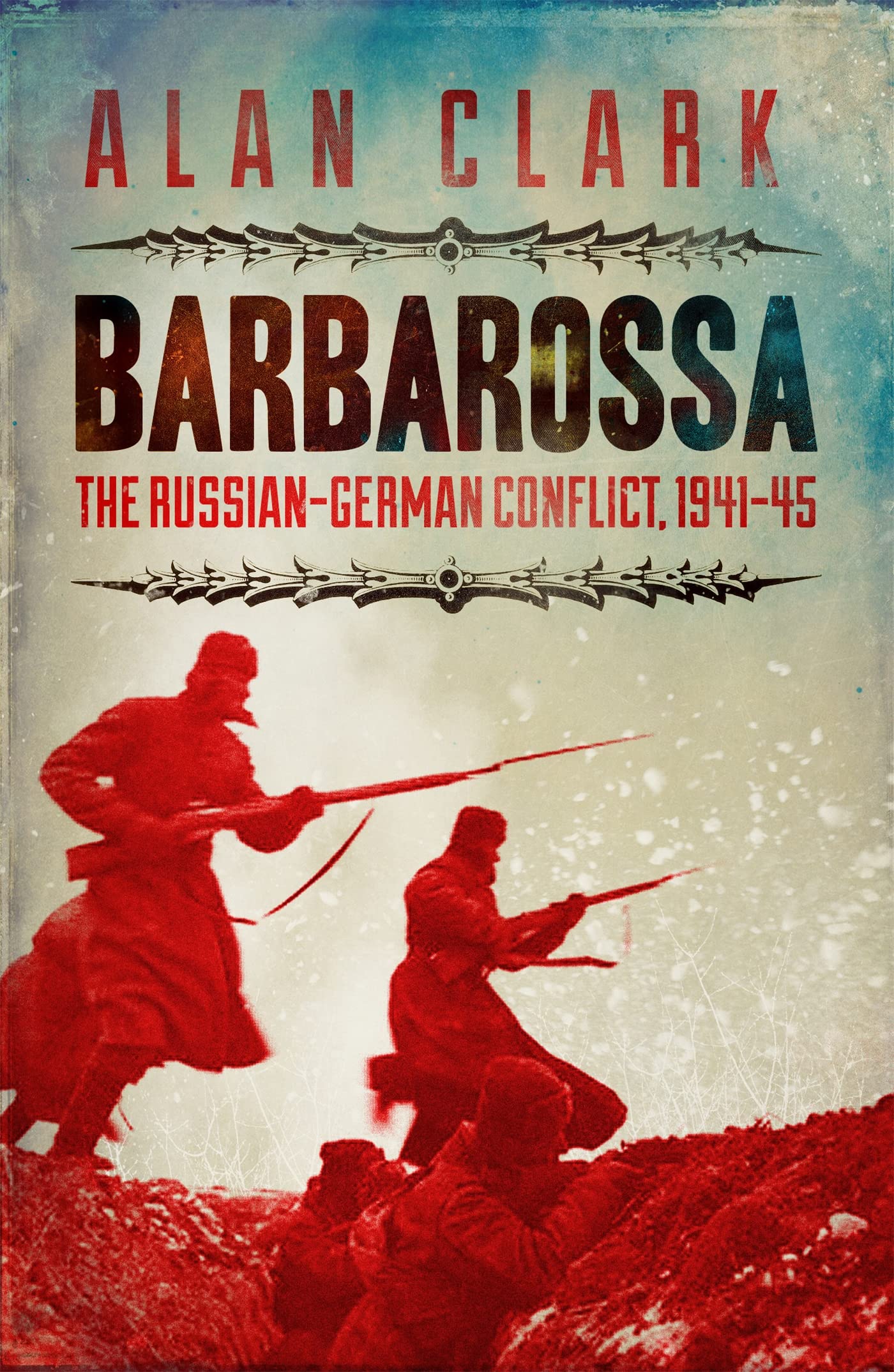
Buy Barbarossa: The Russian German Conflict (W&N Military) New Ed by Clark, Alan (ISBN: 9780304358649) from desertcart's Book Store. Everyday low prices and free delivery on eligible orders. Review: A really good, well researched book - I've been reading "proper" history books about WW2 for sometime now and it's really interesting to read that there were other reasons for the defeat and end to the Nazi regime than the "madness of Hitler". This book is a brilliant example for that. It's well researched and well laid out, but not just facts and figures mixed with names I'd heard of, but wasn't aware of what they did. Those are there of course, but added to with proper background and insight. The authors political knowledge and experience comes to play as he explains the ways in which political ambition, military ambition and plain old jealousy and envy can prove to be just as damaging as lack of equipment and men on the battlefield. Spoiler alert! Hitler was mad at the end, but we knew that anyway! Review: Decent narration but lacking critical parts - Being aware that this book is no 30/40 years old, I decided to read Alan Clark's work on this atrocious conflict that involved two of the most powerful war machines of this century. The book has good reviews and offers a perfect overview to the gigantic subject. The narration is fluid and the chapter division quite helpful. More importantly, the author keeps away from overdescription of unit positions, movements of troops, etc. which can blur the vision sometimes. This is especially true for a campaign like Barbarossa. Its is quite often that military history authors lacking politic and economic knowledge prefers to concentrate on purely militaristic matters. However, I had a really good time reading the book but was quite dissapointed and would say frustrated that the book was very light on: - The Leningrad siege - The battle for Berlin - The role of the luftwaffe and the war in the air Despite the above, there are some really brillant parts such as the Stalingrad chapters, or the addition of recorded dialogues between Hitler and his staff, or personal accounts such as the 2 ou 3 pages long account of the russian sniper. Finally, I recomend the reading of Guderian's book "Panzer Leader" which presents the conflict through the eye of the famous tank theorist and leader.
| Best Sellers Rank | 412,875 in Books ( See Top 100 in Books ) 31,750 in History (Books) 65,118 in Society, Politics & Philosophy |
| Customer reviews | 4.4 4.4 out of 5 stars (315) |
| Dimensions | 13.6 x 4.8 x 21.6 cm |
| Edition | New Ed |
| ISBN-10 | 0304358649 |
| ISBN-13 | 978-0304358649 |
| Item weight | 572 g |
| Language | English |
| Print length | 560 pages |
| Publication date | 12 July 2001 |
| Publisher | W&N |
S**N
A really good, well researched book
I've been reading "proper" history books about WW2 for sometime now and it's really interesting to read that there were other reasons for the defeat and end to the Nazi regime than the "madness of Hitler". This book is a brilliant example for that. It's well researched and well laid out, but not just facts and figures mixed with names I'd heard of, but wasn't aware of what they did. Those are there of course, but added to with proper background and insight. The authors political knowledge and experience comes to play as he explains the ways in which political ambition, military ambition and plain old jealousy and envy can prove to be just as damaging as lack of equipment and men on the battlefield. Spoiler alert! Hitler was mad at the end, but we knew that anyway!
E**E
Decent narration but lacking critical parts
Being aware that this book is no 30/40 years old, I decided to read Alan Clark's work on this atrocious conflict that involved two of the most powerful war machines of this century. The book has good reviews and offers a perfect overview to the gigantic subject. The narration is fluid and the chapter division quite helpful. More importantly, the author keeps away from overdescription of unit positions, movements of troops, etc. which can blur the vision sometimes. This is especially true for a campaign like Barbarossa. Its is quite often that military history authors lacking politic and economic knowledge prefers to concentrate on purely militaristic matters. However, I had a really good time reading the book but was quite dissapointed and would say frustrated that the book was very light on: - The Leningrad siege - The battle for Berlin - The role of the luftwaffe and the war in the air Despite the above, there are some really brillant parts such as the Stalingrad chapters, or the addition of recorded dialogues between Hitler and his staff, or personal accounts such as the 2 ou 3 pages long account of the russian sniper. Finally, I recomend the reading of Guderian's book "Panzer Leader" which presents the conflict through the eye of the famous tank theorist and leader.
P**T
Brilliant
This book has been favourably reviewed many times here so I won't add detailed comments. This is the second time I have read the work and I can hardly fault it (yet I shall). Even though one knows the ending it reads like a novel one cannot put down; Clark engages his reader very well indeed. Clark, sensibly, does not regard Hitler as a mindless monster as of the "Black lagoon": he recognizes Hitler's personal bravery and his brilliance. Indeed, he partially exonerates Hitler of blame for military cock-ups which were attributed to the Fuehrer post hoc in the memoires of German generals. The story is a tradegy for the Russians, ultimately more so for the Germans, and for the many hapless others caught up in a conflict imbued with crazy racial doctrines. Which leading character comes out best from Clark's account: Hitler or Stalin? It's a toss up really. Stalin had no compunction about starving peasants or culling his military leadership in purges. Hitler, for the most part, did not persecute those he regarded as his own countrymen yet he was merciless to those deemed racially inferior (which included some of his own countrymen). The only reservation I have of this work is the quality of the maps. Clark frequently refers to locations that are not on his maps. To get the best out of this book one needs to refer to a war atlas of Russia at that time.
A**A
The bloody and glorious truth!!
This summarizes what was really the WWII: USSR x the germans and their sycophants, Russian people and Red Army x nazism. The war was won by Russians and other soviet nationalities, NOT by the western allies, as is always wrongly taught. Magnificent book, with details, curiosities and the harsh practices and sharp attitudes of the war that shaped what we are today, about the victory that kept us alive and healthy.
L**S
A very understandable look at the invasion of Russia
A memorable account which explains very well the military and wider history of this conflict. The secret of its success is, in my view, the authors narration which gives the impression of having been spent alot of time on. I found the scenes particularly fitting such as the first scene on a dreary Sunday to the choice of letters and photos which tell alot of the awful drama those actually in the battle faced. This book is deserving of big recognition I think.
C**D
biggest war in history.
The struggle of the Soviet Union with the invasion by Nazi germany in 1941. The battles to decided the outcome of the second world war. Well written, lots of details, the changing structure of the german army from its invasion, to its avoidable disaster at stalingrade. The biggest war in history.
N**P
The hardcover edition of this book was published in 1965, with an author's forward for the reprinted version in 1985. Despite the archival resources that the author didn't have access to in 1965, his research efforts and literary skills bring Operation Barbarossa to life. The description that the author provides on the relationships between Hitler and his generals contributes to the doom that befell the Germans during a campaign that was massive in scale and depth. The euphoria that spellbound the German army after their successful invasions of Poland and France would not apply to the war on the Eastern Front. We learn about the resentment and maneuvering that occurred within the German High Command and the inner circle of Adolf Hitler. Even before the invasion of Russia, the mistrust that plagued the command structure of the German army played out in power struggles that contributed to the demise of Barbarossa. The author accesses the map rooms of Adolf Hitler and we witness the slow mental and physical decline of the leader who said that the "world will hold its breath" when the German army invaded Russia. We see the mistakes that German leadership made prior to the invasion: 1) underestimating Red Army forces; 2) difficulties with logistics and supplies; 3) a limited understanding of history on the part of Adolf Hitler; 4) poor intelligence concerning Russia strength; 5) a lack of winter clothing; 5) wider gauged railroad tracks in Russia than in Germany; 6) Hitler's claim that just kicking in the door will cause the" entire rotten structure of Russia to come crashing down." The German Army was confronted by an opponent of a completely different kind from those in the West; it failed to appreciate that the Russian soldier "loves a fight and scorns death." This information sets the stage before German tanks and guns began firing across the Russian border. The early days of the invasion resemble those of Poland and France, but the German Army quickly learns that the resistance of the Russian soldier is so intense that some believe they have killed the same man twice. The summer successes that the German Army experiences with victories at Mink and Smolensk contribute to the false belief that the campaign will end in months. The intoxicating momentum that drives the German Army comes to a grinding halt when Hitler decided to attack Leningrad and Kiev instead of Moscow. His decision to divide the strength of Army Group Center - and postpone a full assault on Moscow before the rains and winter set in - does not bode well for the German Army. If you like World War Two history, please consider having this book on your shelf. The details that it provides on Operation Typhoon (the Batlle of Moscow) as well as the deathtrap of Stalingrad and the Battle of Kursk will not disappoint. You will be introduced to Guderian and Manstein on the German side and to Zhukov, Chuikov, and Timoshenko on the Russian side. The last chapter concerns the final, ill-fated efforts that the German Army made to slow the Russian forces that head to Berlin. This book provides the foundation and inspiration for other authors to write about a very important part of miliaty history.
M**N
eerrer
N**A
came safely with no damage. thanks to amazon. The book covers all aspects of Operation Barbarossa in a quite comprehensively manner. one of the best books for understanding the art of war and war strategy Highly recommended. special for the defence officer
B**R
Fantastic, one of the best book on the German-Soviet War 1941-45, a part of World War II that doesn't get enough attention in Western Europe of the U.S. Americans have not been taught about how truly titanic and brutal that part of WW2 actually was. Stalingrad, Kursk, Ukraine, Sebastopol, the Siege of Leningrad and of course the Battle of Berlin, where Russia took 500,000 casualties.
R**A
All details about the German campaign, well presented and easy to understand. The book came safely with no damage. The book covers all aspects of Operation Barbarossa quite comprehensively. Highly recommended.
Trustpilot
3 days ago
4 days ago