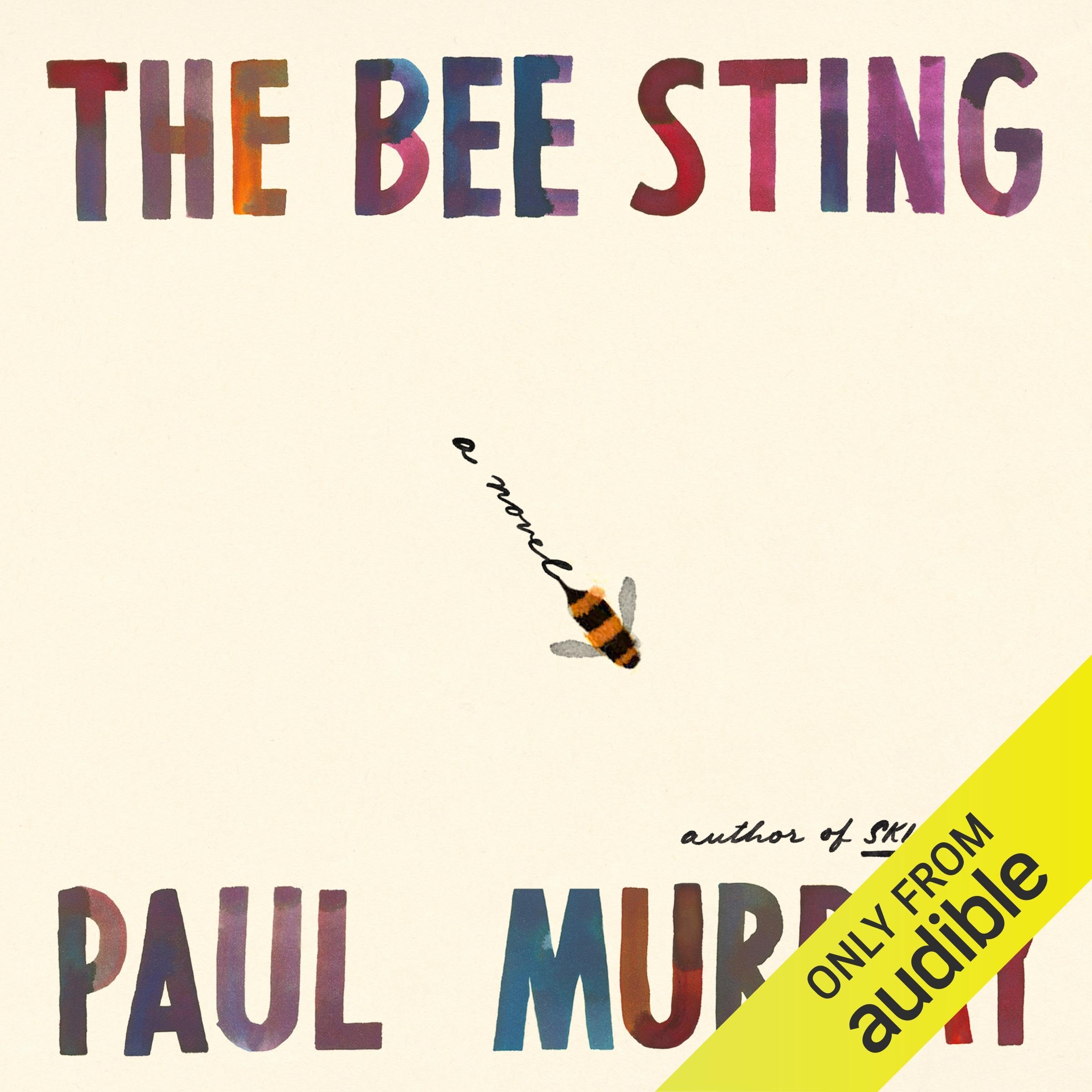
desertcart.com: The Bee Sting: A Novel (Audible Audio Edition): Paul Murray, Heather O’Sullivan, Barry Fitzgerald, Beau Holland, Ciaran O'Brien, Lisa Caruccio Came, Audible Studios: Audible Books & Originals Review: One of the Best This Year - Started Paul Murray's The Bee Sting back at the end of March, then set it down for a month or so while I read other things ... only to pick it up again and finish it in a whirlwind reading session that saw me knock out the entire second half in a day. It's now nearly two am, and I'm slowly beginning to come out of this whole "What?!?" mindspace that this book has thrown me into. 643 pages, over 300 of which I inhaled like a bag of Totino's pizza rolls (with ranch), and it's nearly impossible to discuss because everything hinges on spoilers. And I mean everything. The title, every plot thread, each bit of standout narrative that made my readerly ears perk up like little grey squirrels ... there isn't a bit of it where I can't say, "Oh, that relates to this," or "that reveals that," or "that hints at this and connects to these over here..." Which, to me, is a sign of a truly exceptional novel. Murray has taken what he sees as the virtues and vices of humanity and swirled them into the epic saga of a single Irish family as they individually struggle through their deeply personal issues following the economic crash that has sent them all into crisis. Dickie, the father, and his obsession in building a doomsday shelter in the woods behind their home despite the fact that the family business he's been left to manage is tanking; Imelda, Dickie's wife, stuck in a marriage she doesn't want to be in, selling off the family's assets just to be able to keep them afloat; daughter Cass whose friendship with the narcissistic Elaine has her struggling with alcoholism, her sexuality, and the path her future will take; and precocious little P.J., the frequent target of bullies, whose fears of being sent off to a boarding school has him making plans to disappear. The novel takes turns focusing on each character's narrative, oftentimes overlapping them, allowing us to experience those pivotal moments in each life that have led to its current crisis. I'm not usually a fan of familial dramas, but the characters in The Bee Sting were so completely realized that stepping away from the novel is like saying "goodbye" to a group of people that you've come to know on the most intimate of levels. What really makes this one stand out for me, however, are the control and expertise with which Paul Murray has woven this story. What appears as reality to one character will be shown as something else entirely when relayed through another character, giving the entire narrative intricate layers of reveals that feel almost like a puzzle gradually filling itself in. Add to this a multitude of plot threads that, at first encounter, seem like just one-off anecdotes, but turn out to be pivotal in filling in the gaps, giving the novel a refreshing sense of completeness that I've found lacking in much fiction lately. And even though there's a moment within The Bee Sting's 600-plus pages where Murray, through a side character's oration, spells out the novel's main themes, there is still so much left for the reader to unpack, so much open to interpretation that it begs to be discussed. Which I'd love to do here, but I can't. Because of spoilers. But rest assured, this novel does have something to say -- about love, about sacrifice, about trauma, good and evil, humanity and nature -- and it says it so well. Which is why I told Constance she has to read it immediately. I wanna be in the room with her when she gets to the last page. Review: Beautiful writing - Very Beautiful writing! That’s the good news. The characters are real and the writer gets into each one’s psychology . One begins to care about each of them very much. The writing style varies somewhat for each which I found very interesting And as others have pointed out, for one character, some punctuation is eliminated. Periods are eliminated, but capital letters remain. I don’t think it worked however because it slowed down my reading, and sometimes made my eyes just quickly scan over the page without actually reading it. Some of the sections go on for too long. I am sure the book could’ve been shorter and just as effective. The ending was disappointing, although it was very obvious early on that it was coming. I have never been a fan of an ending that is ambiguous. The ending presented yet another writing style. Pretty interesting experiment I noticed that most people who dislike the book didn’t really finish it so I wouldn’t take those reviews too seriously. I think it’s worth reading, although it is not a book that I would ever consider rereading
S**N
One of the Best This Year
Started Paul Murray's The Bee Sting back at the end of March, then set it down for a month or so while I read other things ... only to pick it up again and finish it in a whirlwind reading session that saw me knock out the entire second half in a day. It's now nearly two am, and I'm slowly beginning to come out of this whole "What?!?" mindspace that this book has thrown me into. 643 pages, over 300 of which I inhaled like a bag of Totino's pizza rolls (with ranch), and it's nearly impossible to discuss because everything hinges on spoilers. And I mean everything. The title, every plot thread, each bit of standout narrative that made my readerly ears perk up like little grey squirrels ... there isn't a bit of it where I can't say, "Oh, that relates to this," or "that reveals that," or "that hints at this and connects to these over here..." Which, to me, is a sign of a truly exceptional novel. Murray has taken what he sees as the virtues and vices of humanity and swirled them into the epic saga of a single Irish family as they individually struggle through their deeply personal issues following the economic crash that has sent them all into crisis. Dickie, the father, and his obsession in building a doomsday shelter in the woods behind their home despite the fact that the family business he's been left to manage is tanking; Imelda, Dickie's wife, stuck in a marriage she doesn't want to be in, selling off the family's assets just to be able to keep them afloat; daughter Cass whose friendship with the narcissistic Elaine has her struggling with alcoholism, her sexuality, and the path her future will take; and precocious little P.J., the frequent target of bullies, whose fears of being sent off to a boarding school has him making plans to disappear. The novel takes turns focusing on each character's narrative, oftentimes overlapping them, allowing us to experience those pivotal moments in each life that have led to its current crisis. I'm not usually a fan of familial dramas, but the characters in The Bee Sting were so completely realized that stepping away from the novel is like saying "goodbye" to a group of people that you've come to know on the most intimate of levels. What really makes this one stand out for me, however, are the control and expertise with which Paul Murray has woven this story. What appears as reality to one character will be shown as something else entirely when relayed through another character, giving the entire narrative intricate layers of reveals that feel almost like a puzzle gradually filling itself in. Add to this a multitude of plot threads that, at first encounter, seem like just one-off anecdotes, but turn out to be pivotal in filling in the gaps, giving the novel a refreshing sense of completeness that I've found lacking in much fiction lately. And even though there's a moment within The Bee Sting's 600-plus pages where Murray, through a side character's oration, spells out the novel's main themes, there is still so much left for the reader to unpack, so much open to interpretation that it begs to be discussed. Which I'd love to do here, but I can't. Because of spoilers. But rest assured, this novel does have something to say -- about love, about sacrifice, about trauma, good and evil, humanity and nature -- and it says it so well. Which is why I told Constance she has to read it immediately. I wanna be in the room with her when she gets to the last page.
C**N
Beautiful writing
Very Beautiful writing! That’s the good news. The characters are real and the writer gets into each one’s psychology . One begins to care about each of them very much. The writing style varies somewhat for each which I found very interesting And as others have pointed out, for one character, some punctuation is eliminated. Periods are eliminated, but capital letters remain. I don’t think it worked however because it slowed down my reading, and sometimes made my eyes just quickly scan over the page without actually reading it. Some of the sections go on for too long. I am sure the book could’ve been shorter and just as effective. The ending was disappointing, although it was very obvious early on that it was coming. I have never been a fan of an ending that is ambiguous. The ending presented yet another writing style. Pretty interesting experiment I noticed that most people who dislike the book didn’t really finish it so I wouldn’t take those reviews too seriously. I think it’s worth reading, although it is not a book that I would ever consider rereading
D**S
Meh.
A lot of words. 641 pages worth. I stopped at 201. I found it repetitive and creatively indulgent. The writer made strange choices, like not using punctuation, for no apparent reason. Characters left me cold.
K**7
Didn't sting like a bee, but a successful novel.
Really appreciated the intelligence behind it. I was transported in an out of each of the characters one by one as the voice changed. I don't think many writers can pull it off, but Murray did! And very good writing, too! The speed really picked up in the last quarter of the book and that's when I started to hold my breath.... and, nothing. Why, just why? Why doesn't he tell you clearly what happened? Is this a French movie or what? Sure, I can see what happened, but I want to hear him tell us the story! If Murray doesn't win the Booker Prize, that will be the reason. Because this novel is like a knitted piece with loose threads not weaved in. You're supposed to clean it up and seal it. Again, if he wins it, it will be for the same reason. It's because more people than not like things to be left to their imagination rather than to know the exact truth. One more comment: For example, in knitting, if you want the pattern to come out perfect, you can't afford to ignore a slipped or wrong stitch and then try to improvise later. It will show. Similarly, you can't rely on too many coincidences or outside interventions to save the day and rescue you, because in real life, nothing like that happens easily. Anyway, thanks for the ride. It was wonderful, I mean it. It's truly a five star book, but given his immense intelligence Murray let the reader glimpse into, I expected much more from this novel!
A**R
Different storyline
Long story (600 pages) of a family in chaos. No one feels happiness in their lives. No one has the courage to express their true feelings. I found this story sad and left me hoping for a positive outcome. The ending is quite twisted. Be prepared should you decide to read this novel.
A**Y
An Interesting Premise, but Ultimately a Disappointing Read for Me
I had heard so much buzz about this book (no pun intended) and was intrigued by the premise so I went in with high hopes. While there are certainly positives to be found — the author is talented and the story has moments of originality — I ultimately didn’t enjoy this book. Here’s why: 1. I never really connected with the characters. Despite spending a lot of time inside their heads, I found it hard to care deeply about any of them. Their choices often felt frustrating or emotionally distant, and I struggled to feel invested in what happened to them. 2. Imelda’s stream-of-consciousness chapters were difficult to read. I appreciate literary experimentation, but the lack of punctuation in her sections made them feel disjointed and, at times, exhausting. Rather than pulling me into her world, it pushed me out. 3. The ending didn’t work for me. I had hoped for a more satisfying or redemptive conclusion. Instead, I was left confused and a bit frustrated, wondering what the message was supposed to be. I know this book has its fans, and I can see how some readers might appreciate the layered storytelling and unconventional structure. But for me, it was a tough and often unenjoyable read that didn’t ultimately pay off. I’m glad I gave it a shot — but I don't recommend it.
J**E
Well-developed characters and plot
So much better than I expected. This book is funny and tragic with well-developed characters and an absorbing plot that leads the reader to a perfect conclusion. It is a book you will continue to think about and will want to discuss.
B**O
Remarkably uninteresting
There are some readers who are drawn toward books simply because they seem edgy and creative. Never mind story, never mind character development. For those readers, this may be a book of interest. For anyone who cares about plot, character, and readability, this is a book to avoid. The plot, such as it is, is derivative and, frankly, dull. Another dysfunctional family, and not dysfunctional in any new or different way. And the uninteresting story drags on and on, with various writing devices that are apparently intended to be ground-breaking. But others (see The Sound and the Fury by William Faulkner) have already used some of those writing devices, and to much better purpose. It's not at all clear why this book has garnered such praise. It's not terrible, but it's hard to make the case it's worth the investment of time.
Trustpilot
3 weeks ago
2 weeks ago