desertcart.com: The Three Pillars of Zen: Teaching, Practice, and Enlightenment: 9780385260930: Philip Kapleau Roshi: Books Review: Zen Buddhist Practice - The editor, an American Zen Buddhist teacher, presents a collection of personal experiences, letters, and lecture transcriptions to show the reality of Zen practice. This is different from many other books on Zen, which instead focus on the philosophical side of Zen rather than its praxis. There are three main features of Zen practice -- zazen (meditation), teisho (formal commentary on Buddhist teachings) and dokusan (personal meeting with the master (roshi)). Zazen is at the heart of Zen practice though, as it is through meditation that one is expected to focus the mind and break through illusions. Zazen is often coupled with koans, in particular koans centering around the concept of "Mu" (nothingness). Through zazen and koan practice, the individual aims to eliminate the primary illusion -- the illusion of duality -- and come to realize the oneness of all beings and time. Interestingly for me, there is not one stage of enlightenment. Rather, enlightenment is a process, such that individuals can be "more" enlightened than others. I found the stories of individuals attaining enlightenment to be simultaneously an interesting and skepticism-inducing section of the book. Several of the stories come from Americans who seem interested, in addition to Zen, in various other forms of "woo": yoga, Jungian psychology, birth trauma, etc. This makes me skeptical of the veracity and depth of their "enlightenment", a skepticism that is only heightened by the backdoor conceit that individuals have different levels of enlightenment. The book is well-written and an interesting introduction to Zen Buddhist practice, especially how it was understood by Americans in the early-1960s. Review: Three pillars - Great view into the eye of the Buddha
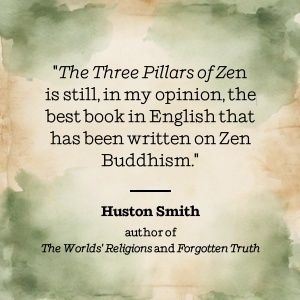
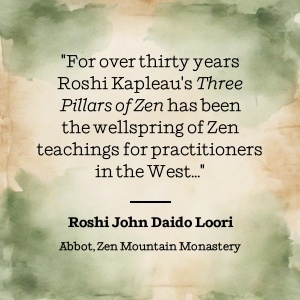

| Best Sellers Rank | #28,797 in Books ( See Top 100 in Books ) #25 in Zen Philosophy (Books) #27 in Zen Spirituality #768 in Personal Transformation Self-Help |
| Customer Reviews | 4.6 4.6 out of 5 stars (894) |
| Dimensions | 5.17 x 1.04 x 7.99 inches |
| Edition | Updated,Anniversary |
| ISBN-10 | 0385260938 |
| ISBN-13 | 978-0385260930 |
| Item Weight | 13.8 ounces |
| Language | English |
| Print length | 480 pages |
| Publication date | February 27, 1989 |
| Publisher | Vintage |
C**S
Zen Buddhist Practice
The editor, an American Zen Buddhist teacher, presents a collection of personal experiences, letters, and lecture transcriptions to show the reality of Zen practice. This is different from many other books on Zen, which instead focus on the philosophical side of Zen rather than its praxis. There are three main features of Zen practice -- zazen (meditation), teisho (formal commentary on Buddhist teachings) and dokusan (personal meeting with the master (roshi)). Zazen is at the heart of Zen practice though, as it is through meditation that one is expected to focus the mind and break through illusions. Zazen is often coupled with koans, in particular koans centering around the concept of "Mu" (nothingness). Through zazen and koan practice, the individual aims to eliminate the primary illusion -- the illusion of duality -- and come to realize the oneness of all beings and time. Interestingly for me, there is not one stage of enlightenment. Rather, enlightenment is a process, such that individuals can be "more" enlightened than others. I found the stories of individuals attaining enlightenment to be simultaneously an interesting and skepticism-inducing section of the book. Several of the stories come from Americans who seem interested, in addition to Zen, in various other forms of "woo": yoga, Jungian psychology, birth trauma, etc. This makes me skeptical of the veracity and depth of their "enlightenment", a skepticism that is only heightened by the backdoor conceit that individuals have different levels of enlightenment. The book is well-written and an interesting introduction to Zen Buddhist practice, especially how it was understood by Americans in the early-1960s.
M**E
Three pillars
Great view into the eye of the Buddha
C**T
One of the best book on Zen for Westerners
This is on of those books that were great for its time and still informs and illumines today. A timeless classic. Not only does it go thorough the Buddhist Mahayana teachings from the Zen school but gives practice methods and tips for the Un-monastaried and Un-sanghaed practitioner. If you truly want a beginners work which is shorter and to the point but in the same vein buy The Rinzai Way by Meidro Moore. Both works are very well written, give great advice and a large helping hand on the Zen path. Note: Soto Zennist's have a tendency to hate both books as they are "critical" of those in the Soto Zen way who misunderstand the phrase by awakened masters who have said "sitting is just it," like Dogen. They account for the lower star ratings. Both books go on to mention the correct understanding from the practice/awaking viewpoint of the true practice of Shikan-taza. So dont let bias form those who do not comprehend fully the depth of the dharma from buying either of these two books.
J**H
Comprehensive and Worthwhile ...
This is the third book I had read in my life on Zen; D.T. Suzuki's "Introduction to Zen Buddhism" was first, and Shunryu Suzuki's "Zen Mind, Beginner's Mind" was second ... followed years later by "Three Pillars". This is really a comprehensive overview of Zen history and practice, with unique and powerful stories of "normal people" achieving enlightenment (which has drawbacks as people new to Zen then have notions regarding what enlightenment "is") . As an "overview book" it's excellent! Ultimately I found Uchiyama Roshi's "Opening the Hand of Thought" (the 4th boon on Zen I read) more intuitively informative and ultimately the best "overview" book on Zen I have read). Over time I personally have come to feel much more aligned with the Soto Zen School, and Japanese Buddhism overall, preferring to sit Shikantaza, without an "object of meditation", and thus the most useful and most meaningful book has been "Opening the Hand of Thought" by Kosho Uchiyama, as well as works by Shohaku Okumura, Kodo Sawaki and Dogen Zenji. Kapleau's work is a Soto/Rinzai/Americanized version of Zen. Some minor issues for me have to do with the fact that Kapleau is credited with being the author, when he's really the editor or, at most, a co-author, and the the fact that, though Kapleau was authorized to teach Zen, he himself never received Dharma transmission or completed Koan study, but instead (in brief) really helped found "Western Zen", creating his own school and carrying on the Harada-Yasutani Lineage. This will likely not be a problem for most people, and Kapleau and his successors have made many contributions to Zen, especially in America. Lastly, all of this complaining about this work not being like Alan Watts is really ill informed; Watts was NOT a transmitted Zen teacher and didn't even practice Zazen. Do I love a lot of Watts' talks and books? Sure. But it has very little to do with actual Zen practice, Watts' work is really primarily philosophy. Also, Zen and drugs don't mix.
S**N
Eines der besten Bücher über Buddhismus die ich je gelesen habe. Faszinierende Einblicke in die Praxis von Zen.
F**O
Come curioso e persona attratta dall'Oriente, questo è un libro che mi ha avvicinato molto al Buddismo Zen. Chiaro, con concetti ben spiegati, è una base per chiunque voglia avvicinarsi a questo modo di vivere e pensare.
S**M
I came to this book because Michael Singer said he read it during his initial spiritual awakening. This book has helped me gain a deep understanding of Zen Buddhism and how to practice Zazen. One major contribution to my spriritual pursuit was and is the need to improve my flexibility. The book provides some exercises to do in order to achieve this so that one can get into the half lotus and then eventually into the fill lotus. Once again, definitely a beneficial read for the spiritual aspirant, at the least will simply add to one’s knowledge of the different ways in which humans of old have achieved enlightenment.
B**Y
Good
C**Z
Very interesting in regards to the philosophy and the practice of step to step how to meditate, interesting records of conversations student master and reports of people who attained enlightenment
Trustpilot
2 weeks ago
2 weeks ago