We remain fully operational. Our teams are working around the clock to ensure your deliveries continue safely.

DOWNLOAD THE APP


Customer Services
Copyright © 2025 Desertcart Holdings Limited
DOWNLOAD THE APP
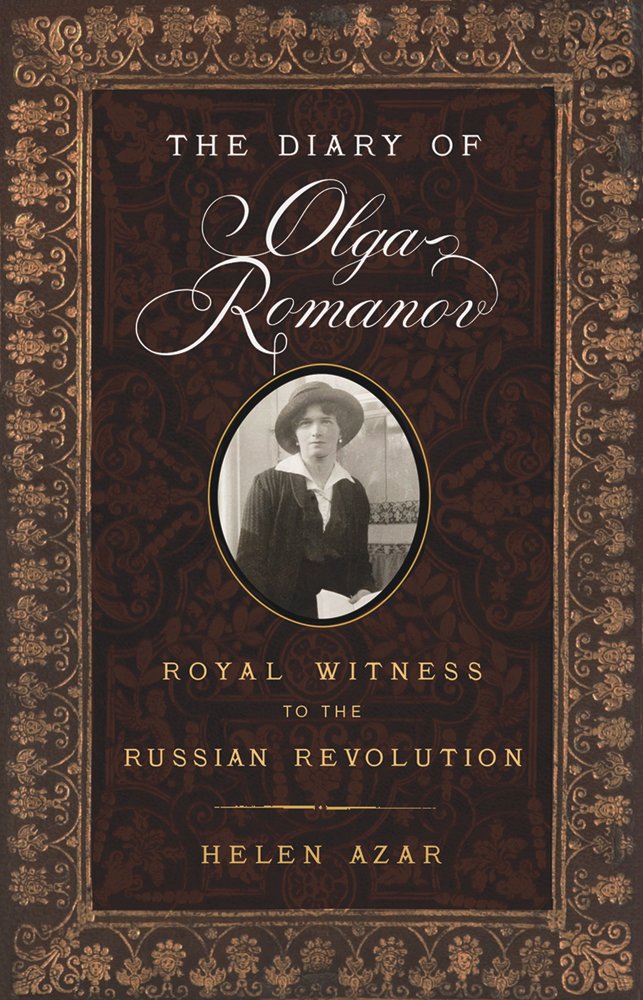
desertcart.com: The Diary of Olga Romanov: Royal Witness to the Russian Revolution: 9781594162299: Azar, Helen: Books Review: The final years of a Grand Duchess - To date, there have been few books that have given voice to the daughters of Nicholas II as they were swept up by events beyond their control. This book offers insight into the life of Nicholas II's eldest daughter, Olga, using excerpts from her diaries in the time period 1914 - 1917. These entries offer glimpses into Olga's life during World War I and the Russian Revolution. Olga's own words are supplemented with entries from her father's diary and others close to the grand duchess which provides further context to the events she describes. Personally, I found Olga's diary entries regarding her role as a nurse and her interactions with medical staff and patients most interesting. As mentioned in another review, I was also surprised by the amount of interaction she had with other Romanov family members, as the common perception is the emperor's daughters were isolated at home. Unfortunately, Olga stopped writing in her diary in 1917, so there are no diary entries for the final months of her imprisonment, but the book does include letters that she wrote while in exile. The period not covered by Olga's diaries is filled in using supplemental material such as Nicholas II's diary entries. My only suggestion for a second edition would be a reworking of some of the foot notes and an expanded list of persons referenced in the diary entries. Those not familiar with the last imperial family may have some difficulty keeping track of members of the Romanov family and the imperial court, as well as others associated with Olga since she frequently uses nicknames. Despite these minor criticisms, I am very happy I added this to my collection of Romanov books. It is a valuable resource since it is primarily Olga's own words being expressed. Overall, I think Helen Azar has done a very nice job with this book. I would like to see the full diary entries published someday in English, perhaps Ms. Azar will publish a complete version someday. Review: O without TMA - Roberto Cortéz González, Ph.D. My background so you can understand HOW I read Azar's book. At 56-years-old, been reading European history, biographies, memoirs, letters, atlases since I was fourteen. B.S. Communication Studies, Northwestern University,1979, with "lesser concentrations" in Spanish Literature and European history---took Lacey Baldwin Smith's three-course sequence on History of England. M.A. Counseling and Educational Psychology, New Mexico State University, 1982. Ph.D. Counseling Psychology, Stanford University, 1990, with a minor in Psychology where I got to take courses from Albert Bandura, Philip Zimbardo, and David Rosenhan. My landlord at Stanford was a Nobel laureate. I'm not bragging on me, I bragging on them! I I used to sneak off to the history sections in the libraries at Northwestern and Stanford and read these eighteenth and nineteenth century histories that should have been in their Rare Book Collections long before I got there. I have been a university "perfesser" for twenty-five years on master's and doctoral level in counselor education, marriage and family therapy, counseling psychology, and educational leadership and administration. Licensed Psychologist, TX. Have practiced clinical work part-time off-and-on for thirty years. As a clinician I have evolved from a cognitive behavioral therapist into a narrative therapist, listening to my client's stories and how they make sense into their past and present worlds, getting into their mindset, not some preconceived notion of what's psychopathology. But, of course, client's personal narratives and experiences---their meaning-making---have to be viable and cohere into the larger social construction of realities. So now in the last third of my career I am getting multi-disciplinary, using my clinical training and setting preconceived notions aside to get into the mindset of historical personages from the past about whom I've read about for years, especially through their letters and memoirs, the latter of which can be self-serving. In short, I know good work when I see it. It's little wonder that I RACED THROUGH AZAR'S BOOK IN THREE DAYS. SOAKED IT UP LIKE A SPONGE. Like many of us who know of Nikolai II and Aleksandra of Russia, their four daughters and their hemophiliac son Aleksei, I knew of the daughters as this undifferentiated monolith. "OTMA" they sometimes signed themselves in notes to their parents and other relatives. OTMA = Olga + Tatiana + Marie + Anastasia. And even then, Olga and Tatiana were dubbed by the parents as "the Big Pair," Marie and Anastasia "the Little Pair." Nuclear families do that. They pigeon-hole their children---the smart one, the troublesome one, the quiet one. Relatives lump together extended family's children. Until Azar's book, we did not see Olga stand alone. Olga Nikolaievna Romanov was the eldest daughter of the last Emperor of Russia. There were times as I read when, in my mind's eye I saw Olga seated on a simple stage without decorations, seated in a comfortable chair speaking to us in her own voice as she reads from her diary, a simple spotlight lighting her from above. She is fashionably dressed. "The Diary of Olga Romanov" individuates her from her parents and siblings. This individuation developmental milestone was denied her in life. She began her Diary at nine-years-old. At ten-years-old, the grand duchess's new French tutor Pierre Gilliard described Olga as "... very blonde, with eyes full of mischief, and a slightly retrouseé little nose; [she] was studying me with an expression that seemed like an attempt to find my weakest point---however from this child emanated such feeling of purity and sincerity that she immediately gained my sympathy" (Gilliard, cited in Azar, p. xxvii). Azar's book covers Olga's Diary from 1914 to 1917. When we meet Olga in the beginning 1914, she is eighteen-years-old. She turns nineteen in November of that year, after the Great War has started. Already Olga had been performing some of the public duties that the Emperor's consort would usually do, due to her mother's dislike of public appearances and frequent illnesses. Until I read Azar's book, I had not comprehended that Olga was a stand-in for her mother. Nor did I realize that, of all the children, Olga was the one closest to her father. Well, she WAS his first-born. She probably learned from the moment of awareness how to read his legendary caressing eyes, his non-verbal expressions, his body language and when his shoulders were slumped or when there was a spring in his step. I had no idea that Olga saw as much of her extended family as she did. Somehow I imagined the Russian Imperial Family as more isolated, withdrawn at Tsarskoye Selo ("Czar's Village") and at the Alexander Palace than they actual were. [Here I must credit the Face Book Group Site "The Alexander Palace" of my friend Shawn Kailian, who has made me much more acquainted with Olga's main home than I ever was before. Being Permanently Disabled Under the Americans with Disabilities Act and unable to travel at all, I combined what I've seen of Mr. Kailian's Face Book Group Site with Olga's words. THAT'S how I read Azar's book, in part.] Azar provides plenty of helpful illustrations and a useful Glossary of terms, especially for Russian Orthodox religious services, as the Imperial Family were deeply religious and observant. Only, I would have subtitled it: "Imperial Witness to the Russian Revolution." On Tuesday, January 7, 1914, Olga writes: "Went on [train] to meet Aunt Ella." (The Empress's sister Grand Duchess Elizaveta Feodorovna, by this point a widow and Mother Abbess of her own convent in Moscow.) "Breakfasted in the library with Papa, Mama, Unc. Boris, and Unc. Georgyi." (p. 4) This being the first of Olga's Diary entries that Azar translates, I said to myself, "Unc. Boris and Unc. Georgyi?" [Uncle] Boris was Nikolai II's paternal first cousin Grand Duke Boris Vladimirovich, son of Grand Duke Vladimir Aleksandrovich and "Miechen," Grand Duchess Maria Pavlovna the Elder, [Uncle] Georgyi was Nikolai II's and Boris's fathers' Romanov paternal first cousin, Grand Duke Konstantine Konstantinovich [KR] and "Mavra," Grand Duchess Elizaveta Marvriekievna (Louda & Maclagan, 1981, p. 278), Georgyi being near enough to Nikolai II and Boris in age, although one generation older. "What are THEY doing there?" I said to myself. Clinicial practice has taught me to pay attention to my internal dialogue as someone's story unfolds. Then I laughed at myself and thought, "I'm sure Empress Aleksandra was thinking the same thing!" But I had to catch myself. "Stay with Olga and her mindset and lived experience, not your own present time frame, Roberto." [This multi-disciplinary hint was provided to me by Ilana Miller, whose Face Book Group Site is "Queen Victoria's Granddaughters."] Then I was GLAD that Olga was seeing extended family and wasn't isolated. I also noticed none of Olga's siblings were present at Breakfast with the other adult Romanovs. Olga writes on that same date that later that night she spoke by telephone with her paternal Romanov aunt Grand Duchess Olga Aleksandrovna. So I counted up two aunts and two uncles that Olga Nikolaievna was in contact with that day. Revelations began for me from that first Diary entry Azar presented above. A stimulating start. I wanted to know more right away... About six weeks later, February 26, 1914, Olga writes: ". . . Had breakfast with Grandma and Aunt Ksenia and Unc. Sandro." Grandma, of course, being the Dowager Empress Marie Feodorovna, Aunt Ksenia being her daughter and Olga's paternal Romanov aunt Grand Duchess Ksenia Aleksandrovna, and Uncle Sandro being Ksenia's husband Grand Duke Aleksander Mikhailovich, another Romanov paternal first cousin of Nikolai's and of the earlier mentioned Boris's fathers (Louda & Maclagan, 1981, p. 278). Again, none of her younger siblings were present at this breakfast. "Oh," I said, to myself, "Olga saw lots of relatives." I was aware that, coming from a large extended family myself of about seventy first cousins from both sides combined, that it was easy for me to keep track of who was who in Olga's world. I was GLAD they WERE in Olga's world. She writes that the breakfast group observed it was the birthday of her late paternal grandfather Aleksander III, Grandma's husband. Later that day, WALKING along the Nevsky Prospect, the main thoroughfare of St, Petersburg, Olga [by herself!] runs into her "crush," Pavel Voronov, one of her father's officers. Ooh, Olga! Who knew? An accomplished pianist, the best of her sisters, Olga had to have had a sensual side to her as a musician. The above was just the second Diary entry published by Azar. I counted three more relatives---seven if I include those from Jan. 7, 1914---with whom Olga was in touch, alone, on her own terms. My entire perception of Olga Nikolaievna was changed by Azar in the first two Diary entries. How could I put this book down? Well, I couldn't. More relatives pass through these pages of 1914. Including the ambitious "Missy," Queen of Romania, with her husband "Nando," King Ferdinand of Romania and their son Crown Prince Karol [sic] in tow. Missy was a first cousin of both of Olga's parents and hoped for a match between Karol and Olga. Olga records their visit indifferently enough, and when they depart refers to them as "The Romanians" (Sunday, March 22, 1914, p. 5). When Germany declares war on Russia, Olga writes, "God help us. So difficult" (Saturday, July 19, p. 6). To me, Olga had come into her own in many ways before her nursing experience during the Great War exposed her to the horrors of armed conflict. Before the War, she had her own relationships with extended family members that did not include her younger siblings. At least among the Romanovs, she individuated. She headed various committees, work she found boring. She had a "crush," whom she later teases in letters to her father about when Pavel Voronov is with the Emperor at military headquarters, a delicious morsel of life about whom she managed to keep from her younger sisters. She attended public events in place of her mother. But I only realized this from Azar. I must admit to jumping ahead to the murder of Rasputin in December 1916. On Saturday, December 17, 1916, Olga writes: ". . . Father Grigori is missing since last night. They are looking for him everywhere---awfully hard." Then, quite tellingly, her entry ends, "Slept all 4 together. Lord help us." (p. 74) "Slept all 4 together." Twenty-one-year-old Olga still had the attachment and bond with her younger sisters intact and relied upon it in times of distress. Many princesses, archduchesses, and grand duchesses were married with children by twenty-one. Here we see how her sheltered life IN SOME RESPECTS kept her younger than her years. "Slept all 4 together." On Monday, December 19, 1916, Olga writes: ". . . Found out for certain that Father Grigori was murdered, most likely by Dmitri and thrown from a bridge [into the River Neva]. They found him in the water. It's too terrible, should not even write" (pp. 74-75). Dmitri was Grand Duke Dmitri Pavlovich, a younger paternal first cousin of Nikolai II whose mother died giving him birth and was raised in Moscow by Olga's previously mentioned maternal Aunt Ella and her late husband Grand Duke Sergei Aleksandrovich, a paternal uncle of Nikolai II, of the earlier mentioned Boris, and of Dmitri. The latter had spent some of his youth living with the Imperial Family and, barely four, five years older than Olga, was considered a potential husband for her. The Empress Aleksandra had included Grand Duke Dmitri into the intimacy of the Imperial Family circle when he came from Moscow to Tsarskoye Selo to begin his military training, and she felt especially betrayed by his involvement in Rasputin's murder. Clearly, Olga felt Rasputin was authentic, sincere, regardless of what propagandists said against him and her mother. While having tea with her mother's two closest friends/ladies-in-waiting that evening of Dec. 19, Olga wrote that ". . . the entire time felt Father Grigori with us" (p. 75). She had a spiritual side of which this entry reveals its depth. Grand Duchess Olga Nikolaievna's reaction to Rasputin's murder leads me to reconsider the role he played in the Imperial Family. That is, WITHIN THE FAMILY, I am more willing to give him the benefit of the doubt because of Olga. This does not mean I endorse his political interference with the Empress during the War. When I jumped back to 1915 I realized how sensible Olga was. On September 5, 1915, in a letter to her father at military headquarters, she writes: ". . . Kostya killed a young elk yesterday and is planning on giving me the head, after stuffing it. I am not too happy about this. First of all, why kill such a young one, without antlers? Then, what am I going to do with it?" (p. 46). This Kostya is Prince Konstantine Konstantinovich Romanov, a son of the earlier mentioned KR and, as a great-grandson of Emperor Nikolai I, a Prince, not a Grand Duke, of Russia. Like the earlier mentioned Dmitri, Kostya was within four, five years older than Olga. At this point I STARTED TO WONDER FOR THE FIRST TIME how many of Olga's Romanov male relatives near in age to her might have had a "crush" on HER? Dmitri? Kostya? Who else among the extended family? When Prince Kostya's father KR had died in June 1915, Olga went to his widow and family to join them in Orthodox prayers for the dead. (p. 34) No younger siblings accompanied her. The book's Introduction gives us further insight into Olga's personality. ". . . [T]he most intelligent and studious of the imperial siblings, but at the same time the most prone to self-analysis, even melancholy" (p. xxvii). By 1916 she was keenly aware of the dangers and menaces that the Russian Empire faced. Grand Duchess Olga Nicolaevna's Diary ends suddenly on March 15, 1917. Nikolai II abdicated for himself and his only son Aleksei on March 2, 1917. News was posted in Petrograd (formerly St. Petersburg) on March 3, and Nikolai's paternal uncle Grand Duke Pavel Aleksandrovich---the earlier mentioned Dmitri's father---came to Tsarkoye Selo to inform Aleksandra on March 4. Olga was ill with the measles since the preceding February 23. No doubt her immune system and resistance were still down when the news came of her father's abdication. Her condition would have made Olga emotionally vulnerable. All her sisters and brothers came down with what was an epidemic of the measles. Azar fills out the end of "The Diary of Olga Romanov: Royal Witness to the Russian Revolution" with diary entries from Nikolai II, and the memoirs of others until the Imperial Family was murdered at Ekaterinburg. Imperial Romanov rule was no longer a viable social construction, a narrative incompatible with the Russian Revolution, despite the personal views of Olga and her immediate family. Azar had to finish the story by others because Olga's voice was silenced by events. Olga's narrative had come to an end. After her father's abdication and her recovery from the measles, Olga's life had no meaning anymore and she had nothing left to say. . .
| Best Sellers Rank | #597,377 in Books ( See Top 100 in Books ) #183 in Historical Russia Biographies #842 in Russian History (Books) #11,933 in Memoirs (Books) |
| Customer Reviews | 4.3 4.3 out of 5 stars (176) |
| Dimensions | 6 x 0.57 x 9 inches |
| Edition | 1st |
| ISBN-10 | 1594162298 |
| ISBN-13 | 978-1594162299 |
| Item Weight | 12.5 ounces |
| Language | English |
| Print length | 212 pages |
| Publication date | March 23, 2015 |
| Publisher | Westholme Publishing |
R**N
The final years of a Grand Duchess
To date, there have been few books that have given voice to the daughters of Nicholas II as they were swept up by events beyond their control. This book offers insight into the life of Nicholas II's eldest daughter, Olga, using excerpts from her diaries in the time period 1914 - 1917. These entries offer glimpses into Olga's life during World War I and the Russian Revolution. Olga's own words are supplemented with entries from her father's diary and others close to the grand duchess which provides further context to the events she describes. Personally, I found Olga's diary entries regarding her role as a nurse and her interactions with medical staff and patients most interesting. As mentioned in another review, I was also surprised by the amount of interaction she had with other Romanov family members, as the common perception is the emperor's daughters were isolated at home. Unfortunately, Olga stopped writing in her diary in 1917, so there are no diary entries for the final months of her imprisonment, but the book does include letters that she wrote while in exile. The period not covered by Olga's diaries is filled in using supplemental material such as Nicholas II's diary entries. My only suggestion for a second edition would be a reworking of some of the foot notes and an expanded list of persons referenced in the diary entries. Those not familiar with the last imperial family may have some difficulty keeping track of members of the Romanov family and the imperial court, as well as others associated with Olga since she frequently uses nicknames. Despite these minor criticisms, I am very happy I added this to my collection of Romanov books. It is a valuable resource since it is primarily Olga's own words being expressed. Overall, I think Helen Azar has done a very nice job with this book. I would like to see the full diary entries published someday in English, perhaps Ms. Azar will publish a complete version someday.
R**.
O without TMA
Roberto Cortéz González, Ph.D. My background so you can understand HOW I read Azar's book. At 56-years-old, been reading European history, biographies, memoirs, letters, atlases since I was fourteen. B.S. Communication Studies, Northwestern University,1979, with "lesser concentrations" in Spanish Literature and European history---took Lacey Baldwin Smith's three-course sequence on History of England. M.A. Counseling and Educational Psychology, New Mexico State University, 1982. Ph.D. Counseling Psychology, Stanford University, 1990, with a minor in Psychology where I got to take courses from Albert Bandura, Philip Zimbardo, and David Rosenhan. My landlord at Stanford was a Nobel laureate. I'm not bragging on me, I bragging on them! I I used to sneak off to the history sections in the libraries at Northwestern and Stanford and read these eighteenth and nineteenth century histories that should have been in their Rare Book Collections long before I got there. I have been a university "perfesser" for twenty-five years on master's and doctoral level in counselor education, marriage and family therapy, counseling psychology, and educational leadership and administration. Licensed Psychologist, TX. Have practiced clinical work part-time off-and-on for thirty years. As a clinician I have evolved from a cognitive behavioral therapist into a narrative therapist, listening to my client's stories and how they make sense into their past and present worlds, getting into their mindset, not some preconceived notion of what's psychopathology. But, of course, client's personal narratives and experiences---their meaning-making---have to be viable and cohere into the larger social construction of realities. So now in the last third of my career I am getting multi-disciplinary, using my clinical training and setting preconceived notions aside to get into the mindset of historical personages from the past about whom I've read about for years, especially through their letters and memoirs, the latter of which can be self-serving. In short, I know good work when I see it. It's little wonder that I RACED THROUGH AZAR'S BOOK IN THREE DAYS. SOAKED IT UP LIKE A SPONGE. Like many of us who know of Nikolai II and Aleksandra of Russia, their four daughters and their hemophiliac son Aleksei, I knew of the daughters as this undifferentiated monolith. "OTMA" they sometimes signed themselves in notes to their parents and other relatives. OTMA = Olga + Tatiana + Marie + Anastasia. And even then, Olga and Tatiana were dubbed by the parents as "the Big Pair," Marie and Anastasia "the Little Pair." Nuclear families do that. They pigeon-hole their children---the smart one, the troublesome one, the quiet one. Relatives lump together extended family's children. Until Azar's book, we did not see Olga stand alone. Olga Nikolaievna Romanov was the eldest daughter of the last Emperor of Russia. There were times as I read when, in my mind's eye I saw Olga seated on a simple stage without decorations, seated in a comfortable chair speaking to us in her own voice as she reads from her diary, a simple spotlight lighting her from above. She is fashionably dressed. "The Diary of Olga Romanov" individuates her from her parents and siblings. This individuation developmental milestone was denied her in life. She began her Diary at nine-years-old. At ten-years-old, the grand duchess's new French tutor Pierre Gilliard described Olga as "... very blonde, with eyes full of mischief, and a slightly retrouseé little nose; [she] was studying me with an expression that seemed like an attempt to find my weakest point---however from this child emanated such feeling of purity and sincerity that she immediately gained my sympathy" (Gilliard, cited in Azar, p. xxvii). Azar's book covers Olga's Diary from 1914 to 1917. When we meet Olga in the beginning 1914, she is eighteen-years-old. She turns nineteen in November of that year, after the Great War has started. Already Olga had been performing some of the public duties that the Emperor's consort would usually do, due to her mother's dislike of public appearances and frequent illnesses. Until I read Azar's book, I had not comprehended that Olga was a stand-in for her mother. Nor did I realize that, of all the children, Olga was the one closest to her father. Well, she WAS his first-born. She probably learned from the moment of awareness how to read his legendary caressing eyes, his non-verbal expressions, his body language and when his shoulders were slumped or when there was a spring in his step. I had no idea that Olga saw as much of her extended family as she did. Somehow I imagined the Russian Imperial Family as more isolated, withdrawn at Tsarskoye Selo ("Czar's Village") and at the Alexander Palace than they actual were. [Here I must credit the Face Book Group Site "The Alexander Palace" of my friend Shawn Kailian, who has made me much more acquainted with Olga's main home than I ever was before. Being Permanently Disabled Under the Americans with Disabilities Act and unable to travel at all, I combined what I've seen of Mr. Kailian's Face Book Group Site with Olga's words. THAT'S how I read Azar's book, in part.] Azar provides plenty of helpful illustrations and a useful Glossary of terms, especially for Russian Orthodox religious services, as the Imperial Family were deeply religious and observant. Only, I would have subtitled it: "Imperial Witness to the Russian Revolution." On Tuesday, January 7, 1914, Olga writes: "Went on [train] to meet Aunt Ella." (The Empress's sister Grand Duchess Elizaveta Feodorovna, by this point a widow and Mother Abbess of her own convent in Moscow.) "Breakfasted in the library with Papa, Mama, Unc. Boris, and Unc. Georgyi." (p. 4) This being the first of Olga's Diary entries that Azar translates, I said to myself, "Unc. Boris and Unc. Georgyi?" [Uncle] Boris was Nikolai II's paternal first cousin Grand Duke Boris Vladimirovich, son of Grand Duke Vladimir Aleksandrovich and "Miechen," Grand Duchess Maria Pavlovna the Elder, [Uncle] Georgyi was Nikolai II's and Boris's fathers' Romanov paternal first cousin, Grand Duke Konstantine Konstantinovich [KR] and "Mavra," Grand Duchess Elizaveta Marvriekievna (Louda & Maclagan, 1981, p. 278), Georgyi being near enough to Nikolai II and Boris in age, although one generation older. "What are THEY doing there?" I said to myself. Clinicial practice has taught me to pay attention to my internal dialogue as someone's story unfolds. Then I laughed at myself and thought, "I'm sure Empress Aleksandra was thinking the same thing!" But I had to catch myself. "Stay with Olga and her mindset and lived experience, not your own present time frame, Roberto." [This multi-disciplinary hint was provided to me by Ilana Miller, whose Face Book Group Site is "Queen Victoria's Granddaughters."] Then I was GLAD that Olga was seeing extended family and wasn't isolated. I also noticed none of Olga's siblings were present at Breakfast with the other adult Romanovs. Olga writes on that same date that later that night she spoke by telephone with her paternal Romanov aunt Grand Duchess Olga Aleksandrovna. So I counted up two aunts and two uncles that Olga Nikolaievna was in contact with that day. Revelations began for me from that first Diary entry Azar presented above. A stimulating start. I wanted to know more right away... About six weeks later, February 26, 1914, Olga writes: ". . . Had breakfast with Grandma and Aunt Ksenia and Unc. Sandro." Grandma, of course, being the Dowager Empress Marie Feodorovna, Aunt Ksenia being her daughter and Olga's paternal Romanov aunt Grand Duchess Ksenia Aleksandrovna, and Uncle Sandro being Ksenia's husband Grand Duke Aleksander Mikhailovich, another Romanov paternal first cousin of Nikolai's and of the earlier mentioned Boris's fathers (Louda & Maclagan, 1981, p. 278). Again, none of her younger siblings were present at this breakfast. "Oh," I said, to myself, "Olga saw lots of relatives." I was aware that, coming from a large extended family myself of about seventy first cousins from both sides combined, that it was easy for me to keep track of who was who in Olga's world. I was GLAD they WERE in Olga's world. She writes that the breakfast group observed it was the birthday of her late paternal grandfather Aleksander III, Grandma's husband. Later that day, WALKING along the Nevsky Prospect, the main thoroughfare of St, Petersburg, Olga [by herself!] runs into her "crush," Pavel Voronov, one of her father's officers. Ooh, Olga! Who knew? An accomplished pianist, the best of her sisters, Olga had to have had a sensual side to her as a musician. The above was just the second Diary entry published by Azar. I counted three more relatives---seven if I include those from Jan. 7, 1914---with whom Olga was in touch, alone, on her own terms. My entire perception of Olga Nikolaievna was changed by Azar in the first two Diary entries. How could I put this book down? Well, I couldn't. More relatives pass through these pages of 1914. Including the ambitious "Missy," Queen of Romania, with her husband "Nando," King Ferdinand of Romania and their son Crown Prince Karol [sic] in tow. Missy was a first cousin of both of Olga's parents and hoped for a match between Karol and Olga. Olga records their visit indifferently enough, and when they depart refers to them as "The Romanians" (Sunday, March 22, 1914, p. 5). When Germany declares war on Russia, Olga writes, "God help us. So difficult" (Saturday, July 19, p. 6). To me, Olga had come into her own in many ways before her nursing experience during the Great War exposed her to the horrors of armed conflict. Before the War, she had her own relationships with extended family members that did not include her younger siblings. At least among the Romanovs, she individuated. She headed various committees, work she found boring. She had a "crush," whom she later teases in letters to her father about when Pavel Voronov is with the Emperor at military headquarters, a delicious morsel of life about whom she managed to keep from her younger sisters. She attended public events in place of her mother. But I only realized this from Azar. I must admit to jumping ahead to the murder of Rasputin in December 1916. On Saturday, December 17, 1916, Olga writes: ". . . Father Grigori is missing since last night. They are looking for him everywhere---awfully hard." Then, quite tellingly, her entry ends, "Slept all 4 together. Lord help us." (p. 74) "Slept all 4 together." Twenty-one-year-old Olga still had the attachment and bond with her younger sisters intact and relied upon it in times of distress. Many princesses, archduchesses, and grand duchesses were married with children by twenty-one. Here we see how her sheltered life IN SOME RESPECTS kept her younger than her years. "Slept all 4 together." On Monday, December 19, 1916, Olga writes: ". . . Found out for certain that Father Grigori was murdered, most likely by Dmitri and thrown from a bridge [into the River Neva]. They found him in the water. It's too terrible, should not even write" (pp. 74-75). Dmitri was Grand Duke Dmitri Pavlovich, a younger paternal first cousin of Nikolai II whose mother died giving him birth and was raised in Moscow by Olga's previously mentioned maternal Aunt Ella and her late husband Grand Duke Sergei Aleksandrovich, a paternal uncle of Nikolai II, of the earlier mentioned Boris, and of Dmitri. The latter had spent some of his youth living with the Imperial Family and, barely four, five years older than Olga, was considered a potential husband for her. The Empress Aleksandra had included Grand Duke Dmitri into the intimacy of the Imperial Family circle when he came from Moscow to Tsarskoye Selo to begin his military training, and she felt especially betrayed by his involvement in Rasputin's murder. Clearly, Olga felt Rasputin was authentic, sincere, regardless of what propagandists said against him and her mother. While having tea with her mother's two closest friends/ladies-in-waiting that evening of Dec. 19, Olga wrote that ". . . the entire time felt Father Grigori with us" (p. 75). She had a spiritual side of which this entry reveals its depth. Grand Duchess Olga Nikolaievna's reaction to Rasputin's murder leads me to reconsider the role he played in the Imperial Family. That is, WITHIN THE FAMILY, I am more willing to give him the benefit of the doubt because of Olga. This does not mean I endorse his political interference with the Empress during the War. When I jumped back to 1915 I realized how sensible Olga was. On September 5, 1915, in a letter to her father at military headquarters, she writes: ". . . Kostya killed a young elk yesterday and is planning on giving me the head, after stuffing it. I am not too happy about this. First of all, why kill such a young one, without antlers? Then, what am I going to do with it?" (p. 46). This Kostya is Prince Konstantine Konstantinovich Romanov, a son of the earlier mentioned KR and, as a great-grandson of Emperor Nikolai I, a Prince, not a Grand Duke, of Russia. Like the earlier mentioned Dmitri, Kostya was within four, five years older than Olga. At this point I STARTED TO WONDER FOR THE FIRST TIME how many of Olga's Romanov male relatives near in age to her might have had a "crush" on HER? Dmitri? Kostya? Who else among the extended family? When Prince Kostya's father KR had died in June 1915, Olga went to his widow and family to join them in Orthodox prayers for the dead. (p. 34) No younger siblings accompanied her. The book's Introduction gives us further insight into Olga's personality. ". . . [T]he most intelligent and studious of the imperial siblings, but at the same time the most prone to self-analysis, even melancholy" (p. xxvii). By 1916 she was keenly aware of the dangers and menaces that the Russian Empire faced. Grand Duchess Olga Nicolaevna's Diary ends suddenly on March 15, 1917. Nikolai II abdicated for himself and his only son Aleksei on March 2, 1917. News was posted in Petrograd (formerly St. Petersburg) on March 3, and Nikolai's paternal uncle Grand Duke Pavel Aleksandrovich---the earlier mentioned Dmitri's father---came to Tsarkoye Selo to inform Aleksandra on March 4. Olga was ill with the measles since the preceding February 23. No doubt her immune system and resistance were still down when the news came of her father's abdication. Her condition would have made Olga emotionally vulnerable. All her sisters and brothers came down with what was an epidemic of the measles. Azar fills out the end of "The Diary of Olga Romanov: Royal Witness to the Russian Revolution" with diary entries from Nikolai II, and the memoirs of others until the Imperial Family was murdered at Ekaterinburg. Imperial Romanov rule was no longer a viable social construction, a narrative incompatible with the Russian Revolution, despite the personal views of Olga and her immediate family. Azar had to finish the story by others because Olga's voice was silenced by events. Olga's narrative had come to an end. After her father's abdication and her recovery from the measles, Olga's life had no meaning anymore and she had nothing left to say. . .
C**N
Refreshing look into the life of a young Russian young lady who happened to be a Grand Duchess
A slice of life of the Russian court told from the perspective of Tzar Nicholas's oldest daughter, Olga. Sometimes giddy, at other times grounded in the stark realities of the first world war, it is a firsthand account in the form of a diary that outlines her day to day life and the impact of her changing world. Sweetly innocent, and charmingly devoted to her family, it's an insider's look into the everyday details, filled with Olga's warmth. Seemingly unaffected by her title, yet understanding her vital role in the royal family, it was a pleasure to read. Too often Alexandra's two youngest children, Alexsie and Anastasia steal the show. This book gave illumination to the personality of a budding, young woman born into a changing world and then destroyed because of it.
R**N
As it says on the tin .... and very well done
J**L
Even less interesting than Russia's Last Romanovs
A**E
Un bel ouvrage, certes en anglais, mais excellent pour découvrir un peu la grande-duchesse Olga. Le livre est un peu court, un peu sélectif, il s'adresse clairement aux néophytes, mais il est élégant et très agréable à lire. Un joli document pour une personne qui le mérite.
A**R
Mitia war nicht ihr Geliebter, es war ihr uneheliches Kind, er wurde außer Palast geschafft, auf dem gleichen Weg, wie das uneheliche Kind von Katharina der Großen. Das letzte Tagebuch fehlt, weil Olga Nikolajewna Oldenburg-Romanow es mit auf die Flucht genommen hat. Sie war die einzige Überlebende der Familie von Zar Nikolaus II. Sie lebte im Untergrund und fiel dem Holocaust fast zum Opfer, da sie um zu überleben vom russisch-orthodoxen Glauben zum jüdischen Glauben konvertierte. Später konvertierte sie zurück zur evangelischen Kirche, das war der Ursprung des Glaubens ihrer deutschen Mutter. Sie starb mit 98 Jahren in Hessen unter einem anderen Nachnamen. Woher ich das weiß? Olga war meine Urgroßmutter. Ich half in den achtziger Jahren den Code ihrer Tagebücher zu entschlüsseln, nachdem ich ihn meinem Hausarzt mitgeteilt habe und er diese Informationen weiter leitete. Die Wege des Herrn sind unergründlich.
L**H
After reading a couple of books on the Romanov daughters I figured that this book would hopefully give a bit more insight into the life of the oldest Romanov daughter. The book started out well with Olga describing everyday life both in her diary and in letters to her father. Some find this boring, I think that's mainly because the concept of keeping a diary is different today than it was back then. I'm guessing back then a diary was more a record of daily events and occurrences, while today a diary is more for pouring out your heart and soul. I found her writing interesting and the add on of memoirs from those close to the family as well as Kerensky added to the story. It was readable and relatable as at times you can forget that she is a Grand Duchess, as she goes about her work as a nurse, or plays games with her sisters and brother. However there were some things I didn't care too much for in this book. The foot notes were confusing and some didn't make sense. She would throw an foot note in to explain who someone was even though that particular name had been mentioned several times before, or she would put the same foot note in twice. Example twice there were foot notes talking about Rasputin's hometown. Other times there would be no foot notes at all and you'd be wondering what was going on. My other complaint about the book is that when Olga's diary ends in March 1917, instead of using the letters she wrote to friends and family, the author mentions that she wrote lots of letters, it turns into more of Nicholas II's diary, and there are just two letters from March 1917 until their execution in July 1918 that were written by Olga herself. All the rest is her father's words with the memoirs of those close to the Romanovs. So in the end it became just another story about the final days of the Romanovs and had very little to do with Olga at all. I wish they had started her diaries sooner so we could really get to know and read about Olga in her own words. This wasn't a bad book, it was a good quick and enjoyable read but beware the title is misleading as it is not solely Olga's diary.
Trustpilot
2 months ago
1 month ago