We remain fully operational. Our teams are working around the clock to ensure your deliveries continue safely.

DOWNLOAD THE APP


Customer Services
Copyright © 2025 Desertcart Holdings Limited
DOWNLOAD THE APP

Full description not available

S**G
weaves it all together in a well-ordered story
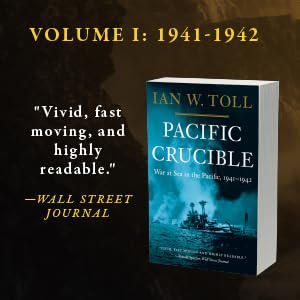
Pacific Crucible: War at Sea in the Pacific, 1941-1942. Ian W. Toll. 2011. Kindle ed.Writing this book was a massive undertaking and it is very well done. Toll used a vast number of sources but weaves it all together in a well-ordered story. He had to make choices, what to include, what to leave out, and he made the choices well.Reading the first pages, I thought it started out slow, with stuff about life at the Naval Academy, the influence of Alfred Thayer Mahan on naval strategic thought in the nineteenth and early twentieth century, and Theodore Roosevelt. Then Toll jumps to Pearl Harbor, December 7, 1941. No mention of Japan’s invasion of China and Korea, the war in Europe, the ban on steel and oil exports to Japan, or Japan’s planning of the attack. Nothing on the failure of radar operators to recognize the attack. Toll focuses on the reactions of people in Honolulu, Pearl Harbor, and the White house. There are grizzly details of the wounded sailors. There are fine details of FDR’s study, how he began the afternoon, how the admirals, generals, and Eleanor were reacting. There are other books that give many more details about the Day of Infamy. Soon after the Pearl Harbor attack, Churchill arrived at the White House for a three-week visit, which Toll describes in great detail. Churchill’s overriding goal was to get Roosevelt committed to the war and victory. They worked out arrangements for how the Pacific war would be run by the Combined Chiefs of Staff, CCOS. Toll tells a lot about Admiral King. He is kinder to King than some historians.After the excitement of the Pearl Harbor attack, Toll backtracks to give many details about Yamamoto, Japan’s relations with the western powers before the war, the rivalry between Japan’s army and navy, and the increase of power of young Japanese officers.FDR ordered Nimitz to go to Oahu and take command, having fired Admiral Kimmel. Nimitz was promoted over many other admirals. He was the chief of the Bureau of Navigation, which was the navy’s personnel department.Toll gives good descriptions of Halsey’s attack on Japanese air bases in the Marshall Islands, the Japanese attacks on the Philippines, Singapore, and Java, mistakes made by MacArthur, and the Doolittle raid on Tokyo.The last half of the book is about the Battle of Coral Sea and the Battle of Midway, including an excellent description of the intelligence work that broke the Japanese codes and identified the Japanese plan to attack Port Moresby, Midway and Alaska.The description of the Battle of Midway is mostly complete and very engaging with many details. I would have liked to have read more about why Stanhope Ring took the wrong heading and failed to find the enemy fleet, and why the torpedo bombers didn’t get protection from the F4F Wildcats. Maybe there just aren’t answers to those questions.There were two great scandals of the Battle of Midway. The American torpedo bomber attacks were failures, but not for lack of courage of the aircrews. The TBD bombers were slow and outdated, the torpedoes had insufficient range and often did not work, and the TBDs did not have fighter support. The bravery of the TBD crews, in spite of these shortcomings, was spectacular. Almost all of them died trying to attack the Japanese carriers. They contributed to the victory by keeping the Zeros and carriers occupied and distracted until the SBD dive bombers came in to kill the carriers.The other scandal is how Commander Joseph Rochefort was treated after the battle. He was in charge of Hypo, the Combat Intelligence Unit for the Pacific Command. Without his work on decoding messages, the battle would have been vastly different. After the battle, Captain John R. Redman and his elder brother, Rear Adm Joseph R. Redman, managed to take credit for the intelligence coup and to punish Rochefort for proving them to be wrong. In the weeks before the Battle of Midway, the Redmans disagreed with Rochefort’s assessments and opposed Nimitz’ plan to ambush the Japanese at Midway. John Redman was chief of OP-20-G, the Washington-based Navy Radio Intelligence Section. Joseph Redman was director of naval communications. Joseph Redman was awarded the Distinguished Service Medal, Rochefort was denied his and was recalled to Washington to waste his talents.I highly recommend this book and I am eager to read the other two volumes by Toll. It is better than Shattered Sword or Miracle at Midway, and about equal to Incredible Victory.
F**R
Pacific WW II History: From Pearl Harbor thru to Midway
This book was a very good history book.Pacific Crucible didn’t just say what happened. The book also explained why things happened as they did. For example, what prompted Japan’s attack on Pearl Harbor? It wasn’t just the need for resources (such as oil) as Japan’s domestic politics and national self-identity were also important factors. Another example: why were the Japanese aircraft carriers apparently more susceptible to battle damage than the American aircraft carriers? Basically, the book has lots of information – and it is covered from both the American and Japanese viewpoints. Yet the book provides all this information in both a clear and a constantly-interesting presentation. This is not a dry history. It is informative, yet it is also sometimes sad and other times exciting. It certainly keeps the reader’s attention throughout.Yet this book may not be for everyone because this book is only the first one in a three-book-set of the history of the WW II Pacific War. And being the first one, it mostly covers the initial successes by the Japanese Naval forces. However, the book’s final chapter covers the Battle of Midway Island, a significant American Naval success. So the book ends on a high note (for American readers). Note too that Guadalcanal came later than Midway and so would be covered by the second book of this series.Bottom line: Well written history. But if you want the full story (and who wouldn’t), you will need to buy two more books.
D**7
First-Rate, Balanced Account of the Opening Months of the Pacific War
"I can run wild for 6 months....after that, I have no expectation of success" was Admiral Yamamoto's oft-cited remark to the war planners in the Japanese government prior to Pearl Harbor, and Ian Toll's book very capably describes the enormous expansion of Imperial Japan along almost all points of the compass in the first 6 months of the war until they were checked at Coral Sea and decisively beaten at Midway. Toll writes in a very readable style and his historical judgements are well-reasoned and sound. If you're an armchair strategist, you'll enjoy this book, and if you like exciting accounts of naval battles, you'll love this book, and happily you get both. Toll gives somewhat balanced attention to both sides with the U.S. understandably receiving the greater weight (I would have preferred more attention to the Japanese side since the U.S. side is more familiar, but of course the publisher undoubtedly envisioned a predominant U.S. readership.) The author indicates that most of the Japanese militarists recognized the superior economic power of the U.S. but believed that their superior "fighting spirit" would overcome such material disadvantages. The precise timing of the Pearl Harbor attack coming an hour before the diplomatic note was delivered to Cordell Hull certainly galvanized America and heightened the U.S.'s own "fighting spirit".I particularly enjoyed Toll's comparison of the Japanese and U.S. Navies with the former emphasizing offense and night actions while the U.S was superior in air reconnaissance, damage control and firefighting (the superiority of which were evident at Midway). The vivid descriptions of carrier warfare with their unique tactical imperatives was fascinating. My understanding is that this kind of naval warfare was unique to WW II, and that we'll never see warfare involving carrier-based fleets searching for other carrier-based fleets on the earth's oceans again. The author shows the influence of massed fleets and the overriding importance of the big-gun battleship in both navies before WW II, and interestingly enough, how battleship proponents had a stronger influence in the Japanese Navy than the U.S. Navy even into the war itself. (There's the usual speculation that perhaps Pearl Harbor dealt a fortunate blow to the U.S. Navy by decimating the Pacific Fleet's battleships but preserving its carriers, who were at sea that day, and thus almost forcing a re-orientation toward naval air warfare.) Toll often seems to compare favorably the sober realism of the Japanese Navy with the fanaticism of the Imperial Army, and that's fair to a point, but we shouldn't forget that the Japanese Navy made the critical decision to force Japan to withdraw from the 2nd London Naval Conference in late-1935 when its "fleet" faction prevailed over the "treaty" faction, whose few remaining members were quickly retired from service, and a naval arms race commenced in earnest. To simplify, the Navy wanted to go south and east against the U.S. and Britain, while the Army wanted to go west and north against China and the Soviet Union, and the Navy's argument for acquiring the resources of the East Indies for resource-poor Japan prevailed.Some reviewers have criticized the omission of Guadalcanal and ending the book with the momentous battle of Midway. I believe that Midway -- and the book covers Midway in fascinating detail -- is the appropriate endpoint; after all, Midway has been described elsewhere as the greatest naval turning point since Trafalgar, and to paraphrase Churchill (when talking about El Alamein) Guadalcanal may have been the "beginning of the end", but Midway was the "end of the beginning". Admiral Yamamoto hoped to lure and destroy the U.S. carriers at Midway and thereby expand Japan's defense perimeter, which might force a negotiated peace; instead, he lost four frontline carriers and Japan was faced with a prolonged war of attrition it could not hope to win.
Trustpilot
3 days ago
3 weeks ago