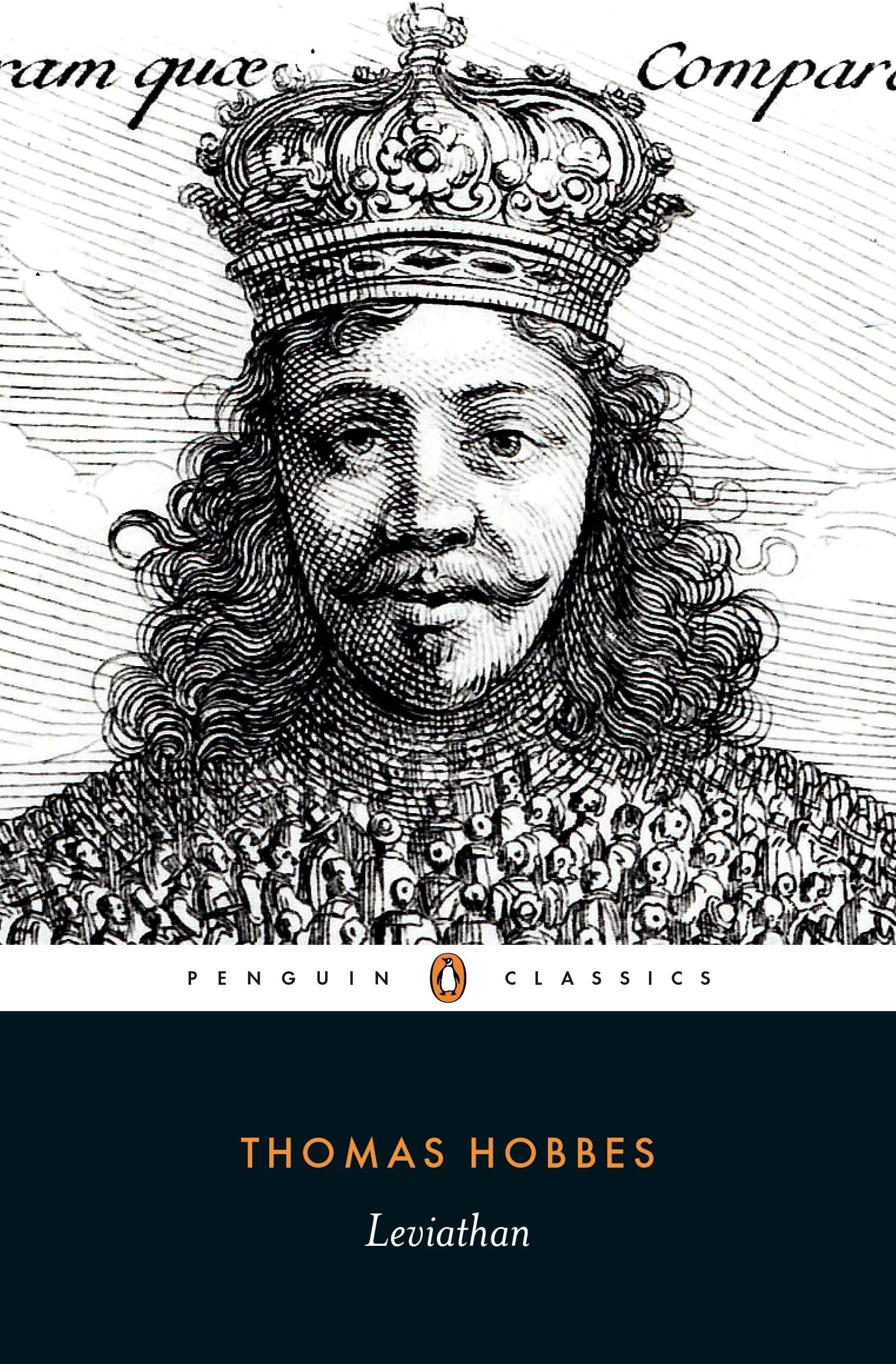
Leviathan (Penguin Classics)
Product ID: 50722013
Buy anything from 5,000+ international stores. One checkout price. No surprise fees. Join 2M+ shoppers on Desertcart.
Desertcart purchases this item on your behalf and handles shipping, customs, and support to Kyrgyzstan.
'The life of man, solitary, poore, nasty, brutish, and short' Written during the chaos of the English Civil War, Thomas Hobbes' Leviathan asks how, in a world of violence and horror, can we stop ourselves from descending into anarchy? Hobbes' case for a 'common-wealth' under a powerful sovereign - or 'Leviathan' - to enforce security and the rule of law, shocked his contemporaries, and his book was publicly burnt for sedition the moment it was published. But his penetrating work of political philosophy opened up questions about the nature of statecraft and society that influenced governments across the world. Edited with an Introduction by Christopher Brooke Review: A monster of a book!! - Hobbes lived and worked at Hardwick, not far from me and is, in fact, buried there. I was given a copy of Leviathan when I went to Grammar School and as I didn't understand it, took it to school and asked my form teacher about it. He reacted as though I'd brought a home-made bomb into school and said it was 'seditious'. I didn't understand that either and thought it was something to do with washing the pots ('the dishes'). That was almost 60 years ago and that copy stayed with me, half unread, for 55 years until a house move saw it lost. I've therefore bought a new copy which I have begun reading and hope to understand and finish. I might find the old one as well. Review: One of the truly great philosophers - A fundamental work of 17th century British/English philosophy, which is as relevant today as it was then. A much misunderstood philosopher, who is as profound as he is misguided, he created one of the undeniably challenging images of the human 'state of nature' as "nasty, poor, solitary, brutish and short". Contrary to some interpretations he did not mean human life as it actually is, but as it would be if all social constraints collapsed and we were left 'in a state of nature'. This image contrasts directly with philosophers like John Locke or Rousseau, for whom the state of nature would be a place of natural harmony and cooperation. It is society that corrupts this innocence, hence the need for the recognition and defence of natural rights in our world. For Hobbes, only a strong leader with unlimited power can bring peace and enable us to rise out of the state of nature. For Locke et al, the right way is to create democratic accountability and a recallable government. Reading Hobbes' Leviathan in the original is indispensable for the study of political theory/philosophy today, whether one agrees with him or not. All young philosophers need to read Hobbes, regardless of their political sympathies.








| Best Sellers Rank | 37,800 in Books ( See Top 100 in Books ) 1,017 in Philosophy (Books) 1,083 in Social & Cultural History 6,421 in Social Sciences (Books) |
| Customer Reviews | 4.5 out of 5 stars 633 Reviews |
B**H
A monster of a book!!
Hobbes lived and worked at Hardwick, not far from me and is, in fact, buried there. I was given a copy of Leviathan when I went to Grammar School and as I didn't understand it, took it to school and asked my form teacher about it. He reacted as though I'd brought a home-made bomb into school and said it was 'seditious'. I didn't understand that either and thought it was something to do with washing the pots ('the dishes'). That was almost 60 years ago and that copy stayed with me, half unread, for 55 years until a house move saw it lost. I've therefore bought a new copy which I have begun reading and hope to understand and finish. I might find the old one as well.
P**T
One of the truly great philosophers
A fundamental work of 17th century British/English philosophy, which is as relevant today as it was then. A much misunderstood philosopher, who is as profound as he is misguided, he created one of the undeniably challenging images of the human 'state of nature' as "nasty, poor, solitary, brutish and short". Contrary to some interpretations he did not mean human life as it actually is, but as it would be if all social constraints collapsed and we were left 'in a state of nature'. This image contrasts directly with philosophers like John Locke or Rousseau, for whom the state of nature would be a place of natural harmony and cooperation. It is society that corrupts this innocence, hence the need for the recognition and defence of natural rights in our world. For Hobbes, only a strong leader with unlimited power can bring peace and enable us to rise out of the state of nature. For Locke et al, the right way is to create democratic accountability and a recallable government. Reading Hobbes' Leviathan in the original is indispensable for the study of political theory/philosophy today, whether one agrees with him or not. All young philosophers need to read Hobbes, regardless of their political sympathies.
I**K
A book
Gave as a gift, recipient very happy
J**J
Everyone knows Leviathan so the review is not based on ...
Everyone knows Leviathan so the review is not based on the book itself - I prefer the older Penguin Leviathan as it has the Chapter numbers at the top of each page, which makes it so much easier to flick back and forth to the right place, when referencing. You can buy the older one here: https://www.amazon.co.uk/Leviathan-Penguin-Classics-Hobbes-Paperback/dp/B00BP0NUW4/ref=sr_1_12?ie=UTF8&qid=1506348408&sr=8-12&keywords=leviathan+hobbes+penguin The updated introduction on this one is very good though
J**T
Important book
It's big and dense and will require re reading but is very interesting and thought provoking.
M**O
Five Stars
as described
J**K
Asking the Right Questions
Thomas Hobbes’s “Leviathan, or The Matter, Forme and Power of a Commonwealth Ecclesiasticall and Civil” was one of the earliest and most influential works of political philosophy written in English, although he might not have been too happy at being described as a philosopher. He had a low opinion of philosophers- Aristotle being a particular bete noire- whom he regarded as playing empty and meaningless word-games wrapped up in dense and impenetrable language. Some have complained about the complexity of Hobbes’s own style, but actually I find his style straightforward and plain speaking compared to some sixteenth and seventeenth century prose writers. The work is divided into four sections, “Of Man”, “Of Commonwealth”, “Of a Christian Commonwealth” and “Of the Kingdom of Darkness”, and it is the first two which will probably hold the most interest for the modern reader. Hobbes was writing during the English Civil War and published “Leviathan” in 1651 shortly after that war had ended. It is therefore unsurprising that much of his analysis is taken up with questions of war and peace, especially civil war and civil peace. (Hobbes does not have much to say about international wars). The English Civil War had involved a struggle between two factions contending for power, but in Hobbes’s view there was another type of civil war even worse than this, the “bellum omnium contra omnes”- a state of anarchy in which every person would be at war with every other. Moreover, their competing needs and desires meant that such a war would be men’s lot if they were still in a state of nature. As Hobbes famously put it “Life in the state of nature is solitary, poor, nasty, brutish and short”. He therefore advocated rule by and obedience to an absolute sovereign as the best defence against anarchy and civil war. Hobbes had in his lifetime the reputation of being an atheist, so it came as a surprise to discover how much time he devotes to discussing religion. As I said, parts three and four of his work, which take up around half the total length of the book, will probably be of less interest to the modern reader, but at the time the religious issues referred to in the would have been highly topical. Hobbes cites extensively from Scripture to argue that the Civil Sovereign is not just head of the executive, supreme lawgiver and supreme judge throughout his domains but also the supreme religious authority. He argues against the Pope’s claim to spiritual authority (and still more against his claim to temporal authority) throughout Christendom. He also, by implication, condemns the many Protestant sects which, claiming a separate revelation from God, broke away from the Church of England during the Civil War. Although Hobbes does not examine specific historical events in any detail, his book can be seen as a vindication of Henry VIII, the English Reformation and the Anglican Church. At the time when Hobbes published “Leviathan” he was living in exile in Paris in exile from the Civil War. He soon discovered that there was something in what he had written to offend everyone. The French authorities did not like his criticisms of Catholicism. (Besides his attack on Papal supremacy, he had also written against other Catholic practices such as the confessional and the veneration of saints). His fellow Royalist émigrés disliked the fact that he grounded the supreme authority of the Civil Sovereign not in Divine Right- the doctrine they had been upholding during the Civil War- but in social contract theory. He was forced to flee from France and return to England where, somewhat surprisingly, he was afforded protection by Cromwell, even though his defence of Royal authority might have been thought offensive to who those had rebelled against what they saw as Charles I’s tyranny. Hobbes does not explicitly discuss the causes of the Civil War, but he implicitly blames the Parliamentarians for its outbreak and makes no secret of his belief that rebellion is a greater evil than even the worst tyranny. Hobbes had a long life, but did not live to see the Glorious Revolution of 1688, which occurred in the hundredth anniversary of his birth. He probably would not have approved of it, but it could at least be explained in terms of his philosophy. He held that the Civil Sovereign need not always be an individual and that an assembly, such as the Senate under the Roman Republic, could fulfil this function. The Glorious Revolution could therefore be explained in Hobbesian terms as a transition from monarchical rule by an absolute King to aristocratic rule by an absolute Parliament; under this analysis William and Mary and all succeeding monarchs, despite their august title, would simply be officers of state who held their office at Parliament’s pleasure. More recent political events would seem in some parts of the world to support Hobbes’s theories but in others to call them into question. His theory of the need for an all-powerful Sovereign could, for example, to explain why Marxist revolutions, far from leading to the withering away of the State which Marx predicted, have actually led to a strengthening of State power and to the rise of autocratic leaders like Stalin, Mao or Kim. The British Parliament may still, in theory, fulfil the role of a Civil Sovereign, but other Western democracies have other ideas. The American Revolution, based upon a claimed right of the people to revolt against a government which they consider unjust, and which led to a permanent separation of Church and State, was a most un-Hobbesian event. And as for the doctrine of separation of executive, legislative and judicial powers, you might as well (according to Hobbes) believe in the Kingdom of the Fairies as believe in that. And yet this doctrine has remained a vital part of American constitutional theory for over two hundred years and has been adopted into the constitutions of many other democracies. Hobbes, perhaps, is not to be blamed for failing to foresee political developments which occurred a century and more after his time. The task of producing a universal system which will hold good in all places and for all time is one which would defeat even the wisest of political thinkers, and one of the great curses of the twentieth century was the belief that such a system was either possible or desirable. The reason why Hobbes remains relevant today is not that he always came up with the right answers. It is that he was asking the right questions.
C**Y
Poorly packed and now I have a damaged book.
It just arrived and it was somehow damaged. I love my books and like to keep them in good condition. So, when this arrived I wasn't best pleased.
S**E
The Most Significant in History
One of the most significant treatises of the Enlightenment, and therefore, of modernity and the world we live in today. I see a lot of negative reviews of the text, mainly people are articulately their opinions as 'disagreeing' with his social contract, with his view of natural man and absolute monarchy. This, may be the case from a 21st Century, 'Western' perspective. But you need to, you HAVE to consider this work in greater context and detail before you submit your final verdict. If you consider the context in which Hobbes wrote, it immediately justifies the excruciating detail and length he delves to in order to supplant his message in the reader's mind. He was a pacifist. He had just beared witness to one of the most bloody periods in human existence. This shaped the opinion of man to strive for peace and prosperity. He, most definitely against his better desire, saw brutality in man - it was all he was ever exposed to... More than anything, Hobbes was inveighing against the prevailing Christian values that dominated at the time. Hobbes took to great measure as to cover his back from the Church and the State. In this period - if there is even the slightest hint of subversion to Christianity, I think we all know what comes next for the author. An Exoteric, who outwardly veils a secret teaching of some sort, identifies in this message a plea to the end of violence. A hope, however unfounded this is. Hobbes exposed his radical beliefs to the world with the intention of making change, and that is EXACTLY what he did. He inspired a lot of change, and frankly shaped the enlightenment period on par with thinkers like Machiavelli, Rousseau and Locke. We need to think of Hobbes as providing as with a model of authority, dominance and legitimacy to further refine our beliefs of political theory as a whole. Hobbes walked so we could run. Without Leviathan, we could not have had all that came after it. He gave us the roots of modern society and government to enable us to live with the peacefulness he had envisioned. It's upsetting to see a contemporary audience strip away the contextualism of a great work, to instead superimpose their own beliefs against a completely different period and set of ideas. Give this book the time to weigh itself against other works around the time. Look at it in context. Look at its importance on modern society. This is a truly special work and one of the most consequential in history.
D**O
Not only Politics: All-encompassing. And surprising
A good and useful edition, with a very interesting introduction. It may be worth noting that, even if Hobbes is studied for his political doctrine that can be found summarized everywhere, the main part of the book examines the Bible (OT and NT) and the history of Christianity. It does so from a plain, blunt, laic, bold historic perspective that surely was not common in the 17th century, as he himself stressed in fact; and, even twenty years before Spinoza's "Tractatus Theologico-Politicus." An all-encompassing treatise, General Anthropology to History to Doomsday. Hobbes' political ideas were much advanced if compared to his own epoch. Still today, they would not surely justify neoliberalism -- while however justifying religious tolerance. Quite suprisingly, anyway, Hobbes' view of a final universal Commonwealth has more than a hint of science fiction to it. Not to speak of his multi-generational hell, possibly a display of sarcasm. Still more suprisingly, the word "Leviathan" indicates a frightening beast as the symbol of a would-be perfect State. Really a lot of food for the mind.
C**R
Ótimo livro
Ótimo livro.
C**N
Bien reçu
Livre acheté à la demande du lycée
J**S
DESARROLLO DE LA SOCIEDAD
Lo estoy leyendo. Muy ilustrativo de la mentalidad y los conceptos sociales de la época. Importante como preámbulo de la sociedad inglesa que más adelante promoviera el inicio de la industrialización. También, el inglés de la época es muy interesante.
Trustpilot
5 days ago
3 weeks ago