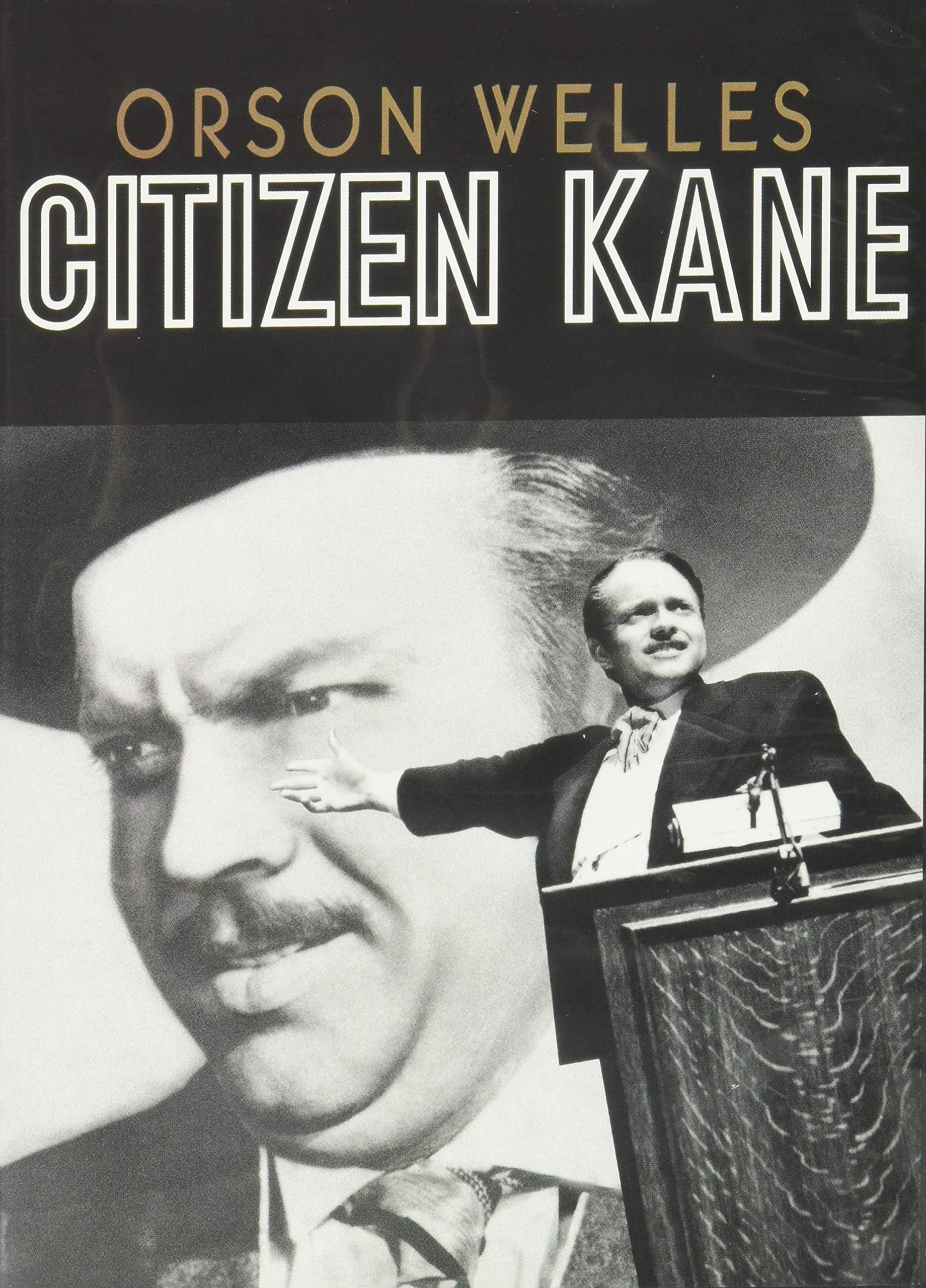

1940. Alone at his fantastic estate known as Xanadu, 70-year-old Charles Foster Kane dies, uttering only the single word Rosebud. So ends the odyssey of a life ... and begins a fabulous tale of the rise to wealth and power--and ultimate fall--of a complex man: A boy abandoned by his parents inherits a fortune, builds a global newspaper empire and aspires to become President of the United States, but he loses everything over an affair with an untalented nightclub singer. This fascinating story unfolds through the eyes of the people important to the tycoon--each showing a different aspect of Citizen Kane. Frequently regarded as the best American film ever made; winner of an Academy Award for Best Writing, Original Screenplay; and nominated for an additional eight Academy Awards including Best Picture, Best Director and Best Actor. Review: Xanadu -- Fact or Fiction? Orson Welles' Magnum Opus!! - I got the two disc DVD set of Citizen Kane. The film was quite controversial of the time and RKO Pictures originally was not going to play it because of the pressure put to bear by William Randolph Hearst, famous newspaper magnate and philanthropist. Even to this day, the Hearst Corporation has its fingers in every pie: radio, television, cable, satellite broadcasting, etc. Hearst did not like that Orson was making what amounted to an unauthorized criticism on Hearst himself. Similarities? Oh yes! Although the names were changed, the film follows Hearst's life to a Tee, with a lot of creative license being taken. Orson Welles, only 24 years old, who, flushed from his success on the Mercury Theater and his famous (or infamous) broadcast, War of the Worlds, he created what many consider the best film of all time and many consider the beginning of the end of Orson's career as a radio, stage and film master of entertainment. [For those who do not know, on Halloween night back in the 1930s, with America concerned about Hitler's advances in Europe, Welles adapted H.G. Wells War of the Worlds with realistic-sounding newscasts and had the Martians invading Grover's Mill, New Jersey. Many people actually believed these broadcasts to be REAL and panicked! Radio was like TV is today, with soaps, westerns, news, and so on as main entertainment and so having your shows interrupted by newscasts and bulletins was common. This created major controversy and put Orson on the map!] But back to the review: Charles Foster Kane, as a child, is being taken away as the family can no longer have him. His mother is played stoically by Agnes Moorhead, a strong character actress in her own right (well before "Bewitched!" the cheesy sitcom of the Sixties.). Kane gets a newspaper, expands his empire, builds a castle (in Florida rather than San Simeon (current location of Hearst Castle), collects art as well as pretty girls, runs for office, confronts scandal and finally dies, dropping a snow globe and whispers "Rosebud." Why Rosebud? Well, the newspaper guys who are creating the news reel (News On The March!) want to know more about Kane and what Rosebud is. The film then goes through a lot of flashbacks and personal interviews with fictional (and thinly disguised) friends of Kane to find out more about the man, his mission and what was Rosebud. Was Kane a self-seeking vampire who sucked the spirit out of everyone he came in contact with? Or did his childhood memories still haunt him decades after the fact? Melodramatic to the extreme, some scenes were slow-paced. The black & white photography was simply gorgeous. And getting a peak at life as it might have been like in the early 20th Century was enjoyable and fascinating. Disc Two: Wow, this was great. Actual filmed interviews with Orson Welles done in the 1980s before his death. You can see his eyes light up as he recalled the creative energy he possessed as a very young man, creating plays in Harlem with an all Black cast in creating Shakespeare for the masses. Touched on are the Mercury Theater broadcasts for CBS and the War of the Worlds broadcast. The narrator said it best: Orson accomplished it all at a young age and then was burned and never came back after Citizen Kane. Extensive biographical data on Welles and Hearst, both driven men, both creative geniuses in their own ways, proud and gifted and heading on a collision course with each other. "A film is never really good unless the camera is an eye in the head of a poet." -Orson Welles "Even if the good old days never existed, the fact that we can conceive such a world is, in fact, an affirmation of the human spirit." Orson Welles "I started at the top and worked down." Orson Welles More on Orson Welles: Orson Welles: Volume 1: The Road to Xanadu Orson Welles: Volume 2: Hello Americans More on War of the Worlds Broadcast: War of the Worlds: Featuring Orson Welles The Orson Welles' War of the Worlds Scandal More on Willam Randolph Hearst: Citizen Hearst: A Biography of William Randolph Hearst The Chief: The Life of William Randolph Hearst Review: Beautiful Classic - Beautiful classic that discusses everything from childhood trauma to living in a self made prison. Great movie!
| Contributor | Agnes Moorehead, Buddy Swan, Dorothy Comingore, Erskine Sanford, Everett Sloane, Fortunio Bonanova, George Coulouris, Georgia Backus, Gus Schilling, Harry Shannon, Joseph Cotten, Orson Welles, Paul Stewart, Philip Van Zandt, Ray Collins, Ruth Warrick, Sonny Bupp, William Alland Contributor Agnes Moorehead, Buddy Swan, Dorothy Comingore, Erskine Sanford, Everett Sloane, Fortunio Bonanova, George Coulouris, Georgia Backus, Gus Schilling, Harry Shannon, Joseph Cotten, Orson Welles, Paul Stewart, Philip Van Zandt, Ray Collins, Ruth Warrick, Sonny Bupp, William Alland See more |
| Customer Reviews | 4.6 out of 5 stars 5,187 Reviews |
| Format | DVD, NTSC |
| Genre | Drama, Drama/Love & Romance, Drama/Political Drama, Mystery & Suspense |
| Language | English |
| Number Of Discs | 1 |
C**R
Xanadu -- Fact or Fiction? Orson Welles' Magnum Opus!!
I got the two disc DVD set of Citizen Kane. The film was quite controversial of the time and RKO Pictures originally was not going to play it because of the pressure put to bear by William Randolph Hearst, famous newspaper magnate and philanthropist. Even to this day, the Hearst Corporation has its fingers in every pie: radio, television, cable, satellite broadcasting, etc. Hearst did not like that Orson was making what amounted to an unauthorized criticism on Hearst himself. Similarities? Oh yes! Although the names were changed, the film follows Hearst's life to a Tee, with a lot of creative license being taken. Orson Welles, only 24 years old, who, flushed from his success on the Mercury Theater and his famous (or infamous) broadcast, War of the Worlds, he created what many consider the best film of all time and many consider the beginning of the end of Orson's career as a radio, stage and film master of entertainment. [For those who do not know, on Halloween night back in the 1930s, with America concerned about Hitler's advances in Europe, Welles adapted H.G. Wells War of the Worlds with realistic-sounding newscasts and had the Martians invading Grover's Mill, New Jersey. Many people actually believed these broadcasts to be REAL and panicked! Radio was like TV is today, with soaps, westerns, news, and so on as main entertainment and so having your shows interrupted by newscasts and bulletins was common. This created major controversy and put Orson on the map!] But back to the review: Charles Foster Kane, as a child, is being taken away as the family can no longer have him. His mother is played stoically by Agnes Moorhead, a strong character actress in her own right (well before "Bewitched!" the cheesy sitcom of the Sixties.). Kane gets a newspaper, expands his empire, builds a castle (in Florida rather than San Simeon (current location of Hearst Castle), collects art as well as pretty girls, runs for office, confronts scandal and finally dies, dropping a snow globe and whispers "Rosebud." Why Rosebud? Well, the newspaper guys who are creating the news reel (News On The March!) want to know more about Kane and what Rosebud is. The film then goes through a lot of flashbacks and personal interviews with fictional (and thinly disguised) friends of Kane to find out more about the man, his mission and what was Rosebud. Was Kane a self-seeking vampire who sucked the spirit out of everyone he came in contact with? Or did his childhood memories still haunt him decades after the fact? Melodramatic to the extreme, some scenes were slow-paced. The black & white photography was simply gorgeous. And getting a peak at life as it might have been like in the early 20th Century was enjoyable and fascinating. Disc Two: Wow, this was great. Actual filmed interviews with Orson Welles done in the 1980s before his death. You can see his eyes light up as he recalled the creative energy he possessed as a very young man, creating plays in Harlem with an all Black cast in creating Shakespeare for the masses. Touched on are the Mercury Theater broadcasts for CBS and the War of the Worlds broadcast. The narrator said it best: Orson accomplished it all at a young age and then was burned and never came back after Citizen Kane. Extensive biographical data on Welles and Hearst, both driven men, both creative geniuses in their own ways, proud and gifted and heading on a collision course with each other. "A film is never really good unless the camera is an eye in the head of a poet." -Orson Welles "Even if the good old days never existed, the fact that we can conceive such a world is, in fact, an affirmation of the human spirit." Orson Welles "I started at the top and worked down." Orson Welles More on Orson Welles: Orson Welles: Volume 1: The Road to Xanadu Orson Welles: Volume 2: Hello Americans More on War of the Worlds Broadcast: War of the Worlds: Featuring Orson Welles The Orson Welles' War of the Worlds Scandal More on Willam Randolph Hearst: Citizen Hearst: A Biography of William Randolph Hearst The Chief: The Life of William Randolph Hearst
S**L
Beautiful Classic
Beautiful classic that discusses everything from childhood trauma to living in a self made prison. Great movie!
R**I
KANE is great...but Thompson is a moron!!!
Yes, great film...perhaps the greatest for myriad reasons many of us know and those who do not should excitedly discover on their own. But has anyone ever commented until now that in addition to being an examination of the title character, CITIZEN KANE contains a devastating, damning commentary on the basic idiocy of most "investigative" reporters - in this case the "truth"-seeking Thompson. But was it intentional - or a script oversight - that when Raymond the Butler is giving his two cents worth (in his case actually a thousand bucks worth!) to the meaning of Rosebud.....Thompson - a basic idiot-in-the-shadows (is this then why he is always in shadows? To show he is the man-in-the-dark...the man who cannot see what is before him? Who can't even do his job well!) - when Thompson is told by Raymond that Kane utters the word "Rosebud" both when Susan left him and he pocketed "something" and "that other time" when he dropped the glass ball - yet Thompson does NOT even ask what the hell the glass ball was! If he had known it was of a snow scene he might have had the wits to trace it back to young Kane's winter of discontent when the bank seized hold of him and stole him from his beloved sleigh. How dumb could one get? (Perhaps as dumb as many investigative reporters are who fail to deliver the goods or come up with erroneous nonsense that they pass off as truth - or WMDs?) Anyway - I will forever wonder if Thompson's not picking up the "ball"(in this case albeit a glass, smashed one) was intentional by the makers of KANE or was Thompson just tired at the end of the day or was this a script glitch? Also not mentioned - to my knowledge - is the preponderance of fireplaces in the film...leading up to the end one which consumes the secret for all time. (Notice the fireplace directly behind the young Kane when he is given a new sleigh by Thatcher - portent of things to come.) One other thing that I have never seen mentioned in commentaries of the film is this: the great Kane-as-a-boy snow scene....the snowman....it is a forecast of the endless statues that the elder Kane will collect; plus...it somewhat looks like the bald-domed, fatter Kane when we last see him: in the Colorado scene we thereby have child and future man, together. The fact that a snowman is frozen- as Kane is emotionally frozen (especially at the end of the film after Susan leaves) is another point to be considered. So when we first see the dying Kane he God-like holds his past world in his hand, yet being a limited human being afterall (despite Kane's seeming unlimitness of power and money, etc) he cannot enter the scene in the ball...just like he cannot return to that moment in Time. Conversely, when we first see Kane as a boy, he is in the world of the glass ball - but that world is also about to be shattered by the adults who plot his future within the confines of the warm boarding house. It is then - from this interior - that we see child Kane framed...as he is also about to be "framed" for a crime he did not commit and sentenced to a life of wealth and riches he never asked for - or may have ever even wanted. In both cases, however, the dying Kane at the film's opening and the first time we see K as a child - in both instances, he is....alone. Existentially alone in a frozen world that only the human heart and hearthside can warm. One last thing to anyone familiar with the music of Rachmaninoff: listen to his magnificent tone poem "Isle of the Dead" and you will hear what is essentially the Kane motif throughout it. I absolutely love the music of Bernard Herrmann but cannot help thinking he was influenced - however subconsciously - by Rachmaninoff's piece. Even the painting that Rachmaninoff based his tone poem on is reminiscent of Xanadu, somewhat. Anyway - CITIZEN KANE is the ultimate film about ALL of us....not just powerful, multimillionaire publishers....but ALL of us...because we ALL have a "Rosebud" in our souls and minds that will be on our lips when the curtain closes. "Rosebud" is, in its most basic form, the desire we all share to....start again, conquer Time, turn back the clock and NOT have die and end our dreams or our bodies. This is what ultimately makes KANE....a CITIZEN.
D**S
Best Film Ever? Yes, I Think So.
Yes. Count me in as one of "Them." A Kanenite. Orson Welles's initial motion picture effort, CITIZEN KANE, not only is Welles's best film--it's the best film ever made. Because of the story? Well, that's certainly interesting enough in its own right, but it's not the reason this powerful film is the best ever captured on celluloid. Look, any film that spawns books, documentaries, commentaries, and makes countless "Best Films of All Time" lists has got something unique and magical going for it. So what is it? To explore this topic, I highly recommend you get this TWO-DISC SPECIAL EDITION of CITIZEN KANE. Made in 1941, when Welles was a mere twenty-five, CITIZEN KANE was light years ahead of its time in production, imagery, lighting, sets--unparalleled cinematography. Easily one of the most creative and innovative of all films, CITIZEN KANE is a haunting presentation of moving camera shots (often through what are supposed to be inanimate objects), of rooms with low ceilings made of cloth (for lighting purposes, plus the cloth easily hid the boom mikes), of scene lighting contrasts where one character is in light, the other in total silhouette, of scenes shot entirely by a below-ground-level camera, of surreal close-ups, of a despondent Kane walking across the screen, his reflection captured in hundreds of mirrors. All of the visual tricks and optical illusions serve to enhance and symbolize the story of Charles Foster Kane, a newspaper tycoon so extravagant and outrageous in his efforts to attract acceptance and love he ultimately garners neither--and loses everything, especially a connection to his childhood. ("Rosebud.") That Welles was making a thinly-disguised biography of mogul William Randolph Hearst was lost on no one, especially Hearst, who made so much trouble with RKO Studios the film was quickly shelved, and didn't find an appreciative audience until years later. While this special edition contains several extras, you must view movie critic Roger Ebert's commentary. Ebert, an unabashed and enthusiastic student and fan of CITIZEN KANE, is a wealth of information about all the scenes and their background history, about all the tricks and gimmicks and optical illusions Welles and cinematographer Gregg Toland (the real star of this movie) dreamed up to make watching this film so mesmerizing. For supporting actors, Welles brought over his Mercury Theater radio performers, who all made their screen debuts here, including Joseph Cotten, Dorothy Comingore (playing a very shrill and petulant second wife), Agnes Moorehead, Ruth Warrick, Everett Sloane, and William Alland (a longtime Welles assistant). On disc two you'll find the documentary "The Battle Over Citizen Kane," a 1996 PBS production; it explores the lives of Hearst, Welles, and the controversy surrounding the production of CITIZEN KANE in meticulous and fascinating detail. The delicious irony here, in the film and in all of the extra features, is that not only is CITIZEN KANE the portrayal of William Randolph Hearst--it is also a thorough examination of the personality of Orson Welles himself. Best movie ever? A resounding yes. --D. Mikels, Author, The Reckoning
T**N
Classic
Some say this is the best movie of all time. Although I enjoyed it, I wouldn't say that. Definitely a good classic movie.
S**W
This is it...the summit....the mountaintop......the ultimate.....and still greatest of all time......CITIZEN KANE.
This review is for the two disc set of Orson Welles 1941 masterpiece Citizen Kane, which has endlessly (and rightfully) been called the greatest film ever made. Of course, I'm not going to go over the whole plot, which to film lovers is already gospel. This review is to concentrate on the technical and scholastic aspects of Kane, namely this two dvd set. And there are three very good reasons to get this particular copy of Kane. 1. The film itself, which has rarely looked better. It's a very crisp print, in which details obscured in earlier versions are now wonderfully clear. The soundtrack by Bernard Herrmann has never sounded better. Maybe the most overlooked great film soundtrack ever. All the technical wizardry at play in this film, from the lighting to the camera angles to the special effects (which, when pointed out, are absolutely astounding) seem to be just so much more breathtaking in this version. It's certainly as good as the movie can possibly look. 2. The audio commentary by the late, great Roger Ebert. (I'm guessing it was recorded in the late 90's/early 00's, before he lost the ability to speak.) Mr. Ebert stated on more than a few occasions that this was his favorite movie of all time. The commentary shows that at absolutely every turn. He's the perfect person to take you on a guided tour of the dark alleys, brightly-lit paths, strange regions and brilliant hidden corners that make this film so magnificent. I could never get tired of hearing him talk about how the deep focus camera work in Kane is so carefully and subtly handled. Or how the special effects are just as revolutionary as, say, Star Wars, without being noticed much, if at all. Or fascinating tidbits, such as how the actor who portrays the reporter, Thompson, is also the stentorian voice of the announcer in the opening News on the March segment. Most important of all, Mr. Ebert shows you how to appreciate this film, for all it's worth, like no one else can. Whether you end up loving the film and making it your cinematic lifeblood, or decide that it's too inflated, dark, slow paced, and maybe even overrated, is up to you. But you will understand why this film is considered perhaps the greatest film of all time. 3. The bonus documentary on the 2nd dvd, The Battle Over Citizen Kane, which was originally aired on PBS back in 1996 as part of the series American Experience. This nearly two hour doc is about how Welles clashed with newspaper tycoon William Randolph Hearst, the purported inspiration for Charles Foster Kane. How the film took Hearst's life, loves, and powerful ego and transformed them into the ultimate parable of business: you were happiest when you had nothing except what you loved most. How Hearst tried to suppress, and even destroy the film. How the career of Welles took off like Comet, and then burned out into wine commercials. How the film vanished from the public view for many years, only to reappear with the position in history it still holds today. This is one of the best documentaries ever made on movies, business, power, politics, Hollywood and celebrity. I'd say it's worth the price of admission, but when you get the greatest film ever to boot, well you can't go wrong. Also there are some other features of note, such as a second commentary by director Peter Bogdonovich. This one is interesting, but not as good as Mr. Ebert's. Since PB knew Welles and hung out with him a lot in later years, it's more of a bit chummy and anecdotal in nature. Plus there are also other extras such as the original trailer for the film, (don't pass it up, it's priceless) a photo gallery and a tiny bit of film of the world premiere. In all, it's the Kane 101 you will need in your film theory class (If you're into that sort of thing.) But with a movie as classic, timeless, groundbreaking, endlessly watchable and almost symphonic as this, you may never have to go to film school. -----------------PEACE BTW- Just for the record, my favorite bit of dialogue in Kane is: "You know Mr. Thatcher, at the rate of a million dollars a year, I'll have to close this place in..............sixty years!"
L**A
Try to Watch It with Fresh Eyes
Citizen Kane was created when Orson Welles was only 26 years old, and came out in 1941, just before the attack on Pearl Harbor. The film is based on the life of William Randolph Hearst and there were many legal battles between Welles and Hearst. It's always hard to read or watch a "classic" without having huge expectations - and perhaps not just enjoying the film. That's true for books you're required to read in high school as well as for movies. You might really have enjoyed reading "Pride and Prejudice" - but if you're forced to read it and told "this is a great book!" you might not enjoy it at all. Let me say first why this is a classic. There are a TON of visual puns, lighting effects, production effects, that had never been used before. The in-focus effects were spectacular when this movie came out. It was an incredible groundbreaker - one that inspired thousands of other filmmakers. If you weren't around in 1941, then in essence everything you watch is "based" on this. It's like praising Edgar Allen Poe for writing mysteries, if you love mysteries that exist now. They draw their origin from that spectacular start. If you were born after 1941, you might say "well that's interesting, but I don't have to like the pyramids of Egypt to like modern architecture. I like Van Halen even though some of their songs were really written by classic blues artists 40+ years earlier; I don't like the blues original songs. I like current stuff and don't care about what it was based on." That is of course true, and a human trait. So if you're not a fan of "tracing the roots" of movies you love, let's just take the movie itself as a standalone entity - as the story of a man. Orson Wells made this as his very first movie - and he not only acted in it but also directed it. He was a newbie. He did some amazing things in his very first attempt every to make a movie. To start with, you as the viewer are really "drawn in" to the movie in a way that most movies don't do. The interviewer is usually in the lower right, i.e. sort of where you, the audience, are sitting. You and the interviewer are both directly talking to and interacting with the people on the screen. Kane was "stolen" from his family at a very young age - raised by strangers, sent off to schools and training. He grew up alone, with only some friends to keep him company. He decides when just out of college to run a newspaper, sort of a lark. He has great ideals - to help the little man. Once he gets a taste of power and public affection, he gets addicted to it. He begins to create stories that don't really exist, to "make world events happen". He starts to manipulate the people around him to get him more and more attention. When he gets abandoned, you feel sorry for him - but you also know it's completely his own fault. These aren't just random vague events that are happening in outer space. They are very personal events happening to a "real person" - this was of course based on real life events of that era. Not only that, but they could happen to any of us. We all have tasks that we do, that bring us joy. We all have the potential to have growth with our dreams - but if we got that growth, would we do "good" with that power, or would we start to be tainted? If we had power over those we love, would we use it 100% for their own good, or would we do subtle things that made US happy and not necessarily them? How many parents, for example, pushed kids to go to a particular college because it appealed to the parent, even if it wasn't the perfect match for the child's personality? This obviously isn't a hack and slash movie with a lot of combat and violence. It's a movie about the trade-offs we all make as we go for our dreams, find success, find failure, try to make love work. This isn't the story of a 23 year old having a fun college life. It's the story of the full life of a man - from sad, lonely young child, to idealistic young man, to a sad, lonely old man. The way life affects us - and the way in which our choices affect our life - are universal concepts that are really important to pretty much every human being. It might be that some particular humans might not care yet. Certainly I remember for example when I was a teenager that I didn't give a lot of thought to the nebulous "long off future". Now that I'm a bit older, though, the thoughts of choices made, opportunities missed and long term goals are very important to me. Citizen Kane is a very touching portrayal of one man's journey through the years.
G**.
If I hadn't been rich, I might have been a truly Great Man!
There is a reason Citizen Kane appears somewhere on just about everyone's Top 10 List of all-time great movies, and it isn't that movie reviewers and movie lovers have gone sappy & sentimental or "politically correct" in their estimation of this film. It is simply because it is still, over half a century later, an astonishing piece of work. Absolutely stunning, using every trick & device ever invented in movie making, and coming at them with such freshness and originality, decontructing and reconstructing them into something new & unique, that the word "genius" was invented to describe such efforts. I dislike how that word genius is bandied about so much today describing everything from gifted natural athletes to clever comedians and politicians. I rarely use it myself. But, if this wasn't a work of genius, I don't know what would qualify. This is such a grown-up movie, telling an archetypal American story, but with brilliance in every frame and every line of dialogue. Is is so mature a work, made under the strictures of the Hayes code, that it makes most of what we see today, without virtually any limits, look like the work of children. AND it was made with such economy! Really a low-budget project, through sheer brilliance a Big Story is told modestly, without a wasted shot or line of dialogue, by terrific editing and intelligent construction. Intelligence is what you see everywhere in Citizen Kane, especially in its humor...and funny it is as well. I could go on, but why bother? If you don't "get it" if you find it "boring" nothing I say will change your mind. I will say this, if that is your reaction, you know nothing about film-making. Citizen Kane is an exhaustive primer in brilliant film-making. Welles threw in the kitchen sink! That it was a 25 year old's first movie , while not important to your enjoyment or appreciation of the film, is finally just awsome. The continual inventiveness in scene after scene is dizzying. The DVD has lots of goodies. An excellent documentary on the background of the struggle to make and release the film and William Randolph Hearst's (somewhat understandable) effort to destroy it. There are comments and even regrets by Welles...he was a young man tearing down an old man and there is cruelty in it. There are 2 very different and excellent commentary tracks by Peter Bogdanovich and Roger Ebert. The former more a friend's recollections, the latter an intense analysis of the art of the film-making. All in all, a very nice package. The restored film is beautiful. One of my oldest memories is sitting in front of a B&W television mesmerized by the opening of Citizen Kane. I must have been 10, and I don't recall if I watched it all, and certainly wouldn't have understood it all, but I was completely entranced by the sheer look of the film. I had never seen anything like it. It was pure Magic! And "magic" it remains to film lovers the world over. Nuff said.
Trustpilot
1 month ago
2 weeks ago