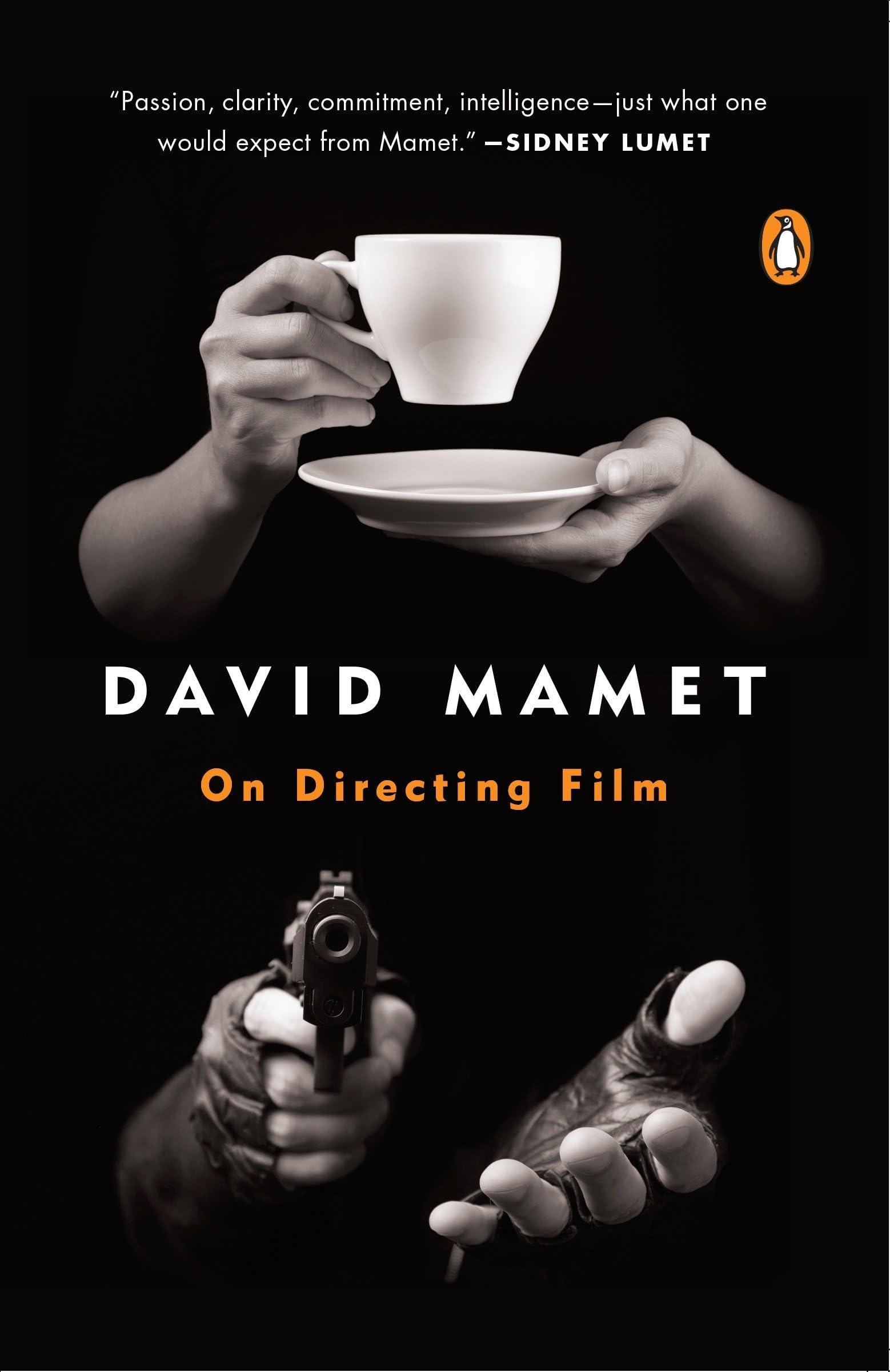

On Directing Film [Mamet, David] on desertcart.com. *FREE* shipping on qualifying offers. On Directing Film Review: Undid Every Falsehood I Had Been Taught - A few years ago I married a scoundrel--a delusional little man who had taken two whole classes one year at a presigious film school before announcing to the world that he was the next Steven Spielberg, who then spent the next twenty years refusing to get a job because filmmaking was his alleged "destiny." As it turned out, I really was his muse; obsessed with real-life cable crime dramas about psycho brides who kill their unsuspecting, purely innocent husbands, his family would later tell me, he had hoped that he could get me to snap and become the "write what you know" foil in the horror movie of the century, to gain the wealth, adulation and admiration he so richly deserved. In the years since our not-so-amicable divorce, I've been in real film school, taking classes and seminars wherever I can, and working every peon job on every set that will have me because, in a weird twist of life's true horror, I actually do want to make films, and I want to make them well. David Mamet is one of the great filmmakers that my Peter Pan wanted to pose as, but in reading this book I have learned that everything I had been told about the science of Mamet's method was completely false. Either Dopey had a far poorer grasp on reading (and watching) comprehension than I ever realised, or he just made it up as he went along. In truth, I learned in reading this book that Film Directing is much more creative and far less pretentious than I'd been led to believe, and this lecture series made me wish that I had chosen Columbia instead of Boise State way back when these classes were first taught. David Mamet's positive view that the film director is a "Dionysian extention of the screenwriter" makes the prospect much less dull. His philosophy about "letting the story evolve," how that happens, and allowing the subconcious mind to lead shot sequences and angles is brilliant. But his final advice to "stick to the channel, it's marked," is what makes this series of lessons timeless. All of the classes I have taken have left me feeling daunted, worried about the future direction of my path, losing focus in the minutiae of technicality, camera choices, light angles...resisting the urge to pummel bad actors. But then there is the clearheaded, short-and-sweet teaching of Mamet to follow first principles, plotting a sure course, summed up with: "The more time you have invested, and the more of yourself you have invested in the plan, the more secure you will feel in the face of terror, loneliness, or the unfeeling or ignorant comments of those from whom you are asking a whole bunch of money or indulgence." This book is truly a series of peptalks from a great and humble mentor, and is going into my war chest to be referred back to whenever I need to find the center again. It's so much more sensible than the ramblings of the idiot I married. Review: If Not the Best Book on Film Directing, then Damn Close! - ON DIRECTING FILM, by David Mamet, is one of the best books ever written on the topic. Mamet, a writer/director himself, doesn't fill up the book's 107 pages with talk of the technical know-how required by a film director but instead writes about what makes a story compelling; how to communicate to a cast and crew with short and simple directions; how to not pander to an audience but still effectively communicate your film's intent; in short, how to make a better film. Part of the book consists of transcripts between film students and Mamet when he lectured on directing at Columbia Film School. Mamet and the student's talk through an imaginary scene, beat by beat, with Mamet never letting them choose the easy route at any time in the process, but instructing them to think like screenwriters, imagining the scene shot by shot. Mamet's extremely wide vocabulary and commitment to making this book as accessible as possible make it well worth your time to read and, like me, re-read.
| Best Sellers Rank | #53,030 in Books ( See Top 100 in Books ) #19 in Video Direction & Production (Books) #29 in Movie Direction & Production #35 in Screenwriting (Books) |
| Customer Reviews | 4.6 out of 5 stars 961 Reviews |
M**W
Undid Every Falsehood I Had Been Taught
A few years ago I married a scoundrel--a delusional little man who had taken two whole classes one year at a presigious film school before announcing to the world that he was the next Steven Spielberg, who then spent the next twenty years refusing to get a job because filmmaking was his alleged "destiny." As it turned out, I really was his muse; obsessed with real-life cable crime dramas about psycho brides who kill their unsuspecting, purely innocent husbands, his family would later tell me, he had hoped that he could get me to snap and become the "write what you know" foil in the horror movie of the century, to gain the wealth, adulation and admiration he so richly deserved. In the years since our not-so-amicable divorce, I've been in real film school, taking classes and seminars wherever I can, and working every peon job on every set that will have me because, in a weird twist of life's true horror, I actually do want to make films, and I want to make them well. David Mamet is one of the great filmmakers that my Peter Pan wanted to pose as, but in reading this book I have learned that everything I had been told about the science of Mamet's method was completely false. Either Dopey had a far poorer grasp on reading (and watching) comprehension than I ever realised, or he just made it up as he went along. In truth, I learned in reading this book that Film Directing is much more creative and far less pretentious than I'd been led to believe, and this lecture series made me wish that I had chosen Columbia instead of Boise State way back when these classes were first taught. David Mamet's positive view that the film director is a "Dionysian extention of the screenwriter" makes the prospect much less dull. His philosophy about "letting the story evolve," how that happens, and allowing the subconcious mind to lead shot sequences and angles is brilliant. But his final advice to "stick to the channel, it's marked," is what makes this series of lessons timeless. All of the classes I have taken have left me feeling daunted, worried about the future direction of my path, losing focus in the minutiae of technicality, camera choices, light angles...resisting the urge to pummel bad actors. But then there is the clearheaded, short-and-sweet teaching of Mamet to follow first principles, plotting a sure course, summed up with: "The more time you have invested, and the more of yourself you have invested in the plan, the more secure you will feel in the face of terror, loneliness, or the unfeeling or ignorant comments of those from whom you are asking a whole bunch of money or indulgence." This book is truly a series of peptalks from a great and humble mentor, and is going into my war chest to be referred back to whenever I need to find the center again. It's so much more sensible than the ramblings of the idiot I married.
S**7
If Not the Best Book on Film Directing, then Damn Close!
ON DIRECTING FILM, by David Mamet, is one of the best books ever written on the topic. Mamet, a writer/director himself, doesn't fill up the book's 107 pages with talk of the technical know-how required by a film director but instead writes about what makes a story compelling; how to communicate to a cast and crew with short and simple directions; how to not pander to an audience but still effectively communicate your film's intent; in short, how to make a better film. Part of the book consists of transcripts between film students and Mamet when he lectured on directing at Columbia Film School. Mamet and the student's talk through an imaginary scene, beat by beat, with Mamet never letting them choose the easy route at any time in the process, but instructing them to think like screenwriters, imagining the scene shot by shot. Mamet's extremely wide vocabulary and commitment to making this book as accessible as possible make it well worth your time to read and, like me, re-read.
S**R
Mamet takes us to school
On Directing film is a good introduction to directing film by one of my favorite screenwriters, David Mamet. Just like his films, the writing is direct and straight to the point. As someone who has always been interested in how movies are made, I loved the parts of the book where Mamet and the students he taught break down how they would approach filming a scene. You may not agree with Mamet's approach 100%, but it's worthy reading for anyone who enjoys movies, enjoys how they are made and—who knows—may want to make a movie themselves.
M**C
Changed the way I think
"If a person's objective is truly - and you don't have to do it humbly, because you'll get humble soon enough - to understand the nature of the medium, that objective will be communicated to the audience." This book is a brilliant study in taking the role of the director and bringing an idea to life through communicating a series of images - the shot list. It's a book on Directing, but I would just as much recommend it to any screenwriter as well. Mamet works hard to stay away from discussing angles & visual style as he thinks you should (at least in your initial planning) as these are not his strong suits (to which he admits) but instead demands that shots should communicate through staging, action and juxtaposition. Information should not be read or told but questioned, answered and experienced. His points are further stressed through demonstration in workshop format between students and himself in two of the longest chapters near the beginning and end of the book that I quite enjoyed. A strong theme running throughout the book is putting in the hard work will help you to know the job as it focuses heavily on workshopping down to communicating the information in the shot to it's core which in turn cuts away the fluff making it easier to communicate (in theory) what's happening in said shot with the sets, props, actors, etc. The book's back cover purports that this book looks at every aspect of directing - "from script to cutting room floor" - that's simply not true if you simply learning about film and are just getting into the art form. However if this is a chapter slightly further along on your journey I would HIGLY RECOMMEND this as an advanced masterclass. Not too advanced to understand for anyone by any means - but maybe too advanced to fully absorb... But what do I know. Read it anyways :)
R**W
Good for Mamet fans.
If you like Mamet, you will get this.
G**W
It's that good
This book lays out a clear concise way to navigate through the telling of a story on film that is primarily based on theories of Eisenstein and his ideas on storytelling. If you want a book to help you through this process and free your subconscious to be creative on set, then get this book. Keep in mind, this is his approach, and I have found it to be the best explanation of how to tell a narrative on film than many other books that take many more pages to get to the point. Just 107 pages and I refer to it constantly. Key points: tell the story in uninflected images. The story is advanced in the 'cut' (editing). Keep focused on the objective of the scene, and the overall objective of the story. Where you put the camera is based on the characters goal in the scene, etc. This is essential storytelling that is often forgotten. Highly recommended.
M**K
A master storyteller reveals quite a lot
Mamet was behind some of the best films ever. If you have not seen House of Games (not be confused with House of Cards), you are missing out on a genuinely twisted story that takes you unexpected places. Same with Glengarry Glen Ross. He is a master storyteller and a very decent director.. especially on low to mid budget films such as these ones. He goes into the practical aspects of visual storytelling with a range of examples and anecdotes. He is very much into naturalism and has an understated approach both photographically and also with acting. I can imagine that any cinematographer or actor would not have had a good time with him as his style is all about the story with all else being simply delivered! As a director myself I was engrossed and read it in one sitting. Definitely a must read for film professionals.
A**G
The Arrogance and the Ignorance
Suppose someone wrote a book on the mating patterns of the sperm whale and then, after he wrote it, realized he knew nothing about mating patterns of the sperm whale and wrote an endearing line of apology in the preface confessing his ignorance. Should the publisher go ahead and publish the book anyway? Should we still buy and read the book? Should we still respect the author? This is precisely what happens with Mamet's "On Directing Film." Somehow, in this book, Mamet thinks that his skill as a dramatic writer makes him a de facto authority on film, directing, and acting--three disciplines of which he is, to varying degrees, shamefully ignorant. The book is not only unaware of its own ignorance, it is pompous and often cursorily written, as if Mamet had just vomited and was half-passed out in the toilet stall of some dingy New York club as he was scribbling down the words. "Perhaps your task as a designer of shots is, after a point, that of a decorator, quite frankly," says our sage of cinema (74). "In the old cartoons, the artists realized the essence of the theory of montage, which is that they could do whatever the heck they wanted," says our esteemed lecturer (80). This book not only makes Mamet look bad, it makes the Columbia Film School look foolish for propping Mamet up as an expert and allowing him to teach classes in something he knows next to nothing about. I felt sorry for the poor students in the book's dialogues. They had paid tens of thousands in tuition to attend a prestigious university and gain pearls of wisdom into the cinematic art only to have this novice hack trot around and infect their naive minds with wildly distorted half-truths. I was fully ready to give this book a one star and leave it at that, but, as foul as parts of the book are, Mamet is still a skilled dramatist and there are parts that do shine. Mamet's always trying to simplify and get to the essence of things and, in spite of his pomposity and ignorance, he does manage to say some really important things about directing film that help put things into perspective and make the practical work of directing clear and manageable. In fact, if all the tripe were gutted from the book, I might say this is one of the most helpful manuals on directing I've ever read.
Trustpilot
3 weeks ago
2 days ago