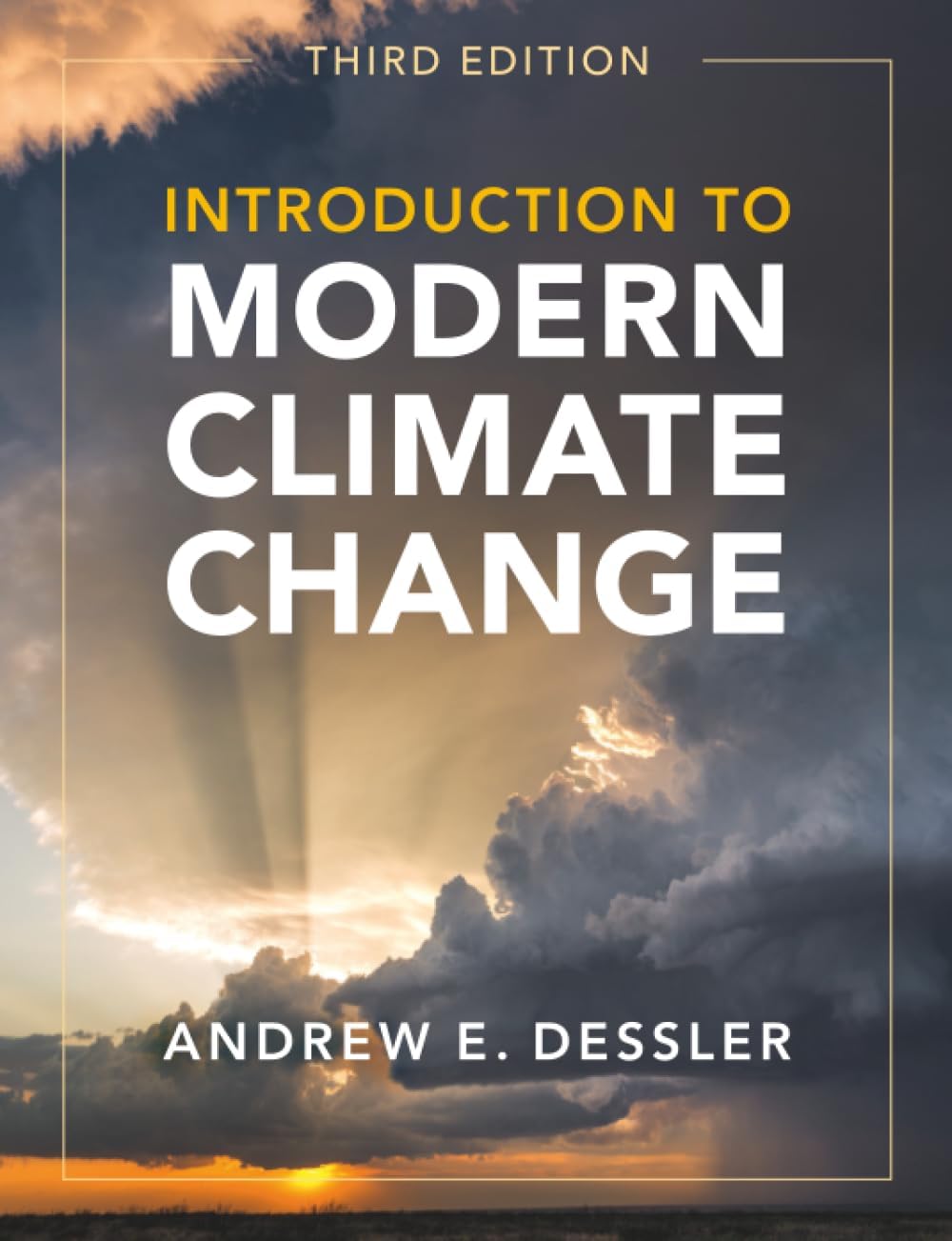

Introduction to Modern Climate Change [Dessler, Andrew E.] on desertcart.com. *FREE* shipping on qualifying offers. Introduction to Modern Climate Change Review: comprehensive, clear presentation, good examples - While I am not a climate scientist, I did teach college chemistry for over 40 years from freshman to graduate chemistry. I've spent about 10 years trying to educate myself about climate change. I have read about 150 CC books (pro and con, at many levels), read countless articles and Wikipedia pages, watched endless videos and lectures (pro and con) on most aspects of CC. Anyone willing to put the work to understand the science will come away with a solid foundation of how climate change works after reading this book. The figures are helpful in understanding the discussions and there are problems at the end of every chapter, with some answers at the end. (picture of my book, read twice) The first 7 chapters explain the science of climate change. If it's been awhile since you took science and math courses, this could be a bit challenging, but well worth it. The writing is clear and the author has many helpful examples. I had previously seen the atmospheric "layers" model, but the author took it one step beyond what I had studied (to "n" layers), and it greatly improved my understanding (though I had to read it 3 times to get there). He used our neighboring planets (Mercury, Venus and Mars) to show how it works in comparison to earth. Dessler covers most CC aspects in a more quantitative way than many of the generic (and sometimes alarmist) books that are out there. He discusses temperature (recent and historical), electromagnetic radiation (wavelength and region of the electromagnetic spectrum), blackbody radiation, the Stephen-Boltzmann law, energy balance, what the greenhouse gases are, the carbon cycle (atmosphere, land and oceans), how CO2 gets in the atmosphere (volcanoes, warming oceans and humans) and how it gets out of the atmosphere (weathering by land, oceans and photosynthesis), time lags between those two directions, radiative forcing, climate sensitivity, fast and slow feedbacks, plate tectonics, the solar constant and how it varies with earth's orbit (Milankovitch cycles). other greenhouse gases and more. Using this foundation, Dessler looks considers Predictions of Future Climate Change, using different emission scenarios (Chapter 8) and Impacts of Climate Change, impacts on our world (Chapter 9), depending on what we do. Chapter 10 looks at our poor understanding of the power of exponential functions, discounting, the discount rate and the social cost of carbon. Some of this was new to me and it's quantitative so I had to read it over about a few times. It considers whether we should invest our money up front (cough up the money to make the necessary changes) or wait and invest later as the emergencies arise (transfer the costs to the next generations). The next two chapters (11 and 12) consider policies we can implement to try and save ourselves (adaptation, mitigation, various geoengineering strategies and economic strategies to wean ourselves off of fossil fuels = fees versus cap and trade, conventional regulations versus market regulations versus voluntary strategies, etc). Chapter 13 was historical background on science and politics. I was familiar with much of this information, but it was helpful to see it all summarized in a few pages. The last chapter (14) looks at the uncertainties involved in CC, deciding a long term goal, costs versus benefits, the IPCC goals of 1.5oC and 2oC (and their carbon budgets), what we need to do to achieve those targets, how much it could cost, elements of a coherent policy and some final thoughts. This is really a comprehensive book for anyone who is not an expert on CC. If you have some background, this book can bring it all together, provide a really good overview and deepen your understanding of CC. If you are just beginning your quest to understand CC, you'll have to work harder, but this is still a shortcut to deep understanding (rather than reading the information scattered over 20 different books on different aspects of CC). My 10 year quest has convinced me there is no other topic more important to the future of life on earth than how our climate is changing and what our options are. This is not a novel about climate change, it is a textbook written at a level that you can teach yourself how climate change works, IF you have a basic understanding of algebra level math and high school level science. It's worth the effort. Our future and our children's, grandchildren's and great grandchildren's future depends on what we do right now! Review: Clear explanation of the principles of climate change from a climate scientist - I was looking for a book from an actual climate scientist to explain the physics of climate change, what the data says, and what can be done about it. This book does as excellent job and was what I was looking for. The author clearly explains the physics behind climate change and how the data supports the causes. He explains the natural carbon cycle of the earth and how the extraction and burning of fossil fuels on a massive scale has greatly altered that carbon cycle and why the CO2 we are currently emitting will take thousands of years to be completely removed from the atmosphere.
| Best Sellers Rank | #447,985 in Books ( See Top 100 in Books ) #56 in Weather (Books) #86 in Climatology #332 in Environmental Economics (Books) |
| Customer Reviews | 4.4 4.4 out of 5 stars (114) |
| Dimensions | 7.44 x 0.65 x 9.69 inches |
| Edition | 3rd |
| ISBN-10 | 1108793878 |
| ISBN-13 | 978-1108793872 |
| Item Weight | 1.4 pounds |
| Language | English |
| Print length | 288 pages |
| Publication date | November 18, 2021 |
| Publisher | Cambridge University Press |
P**L
comprehensive, clear presentation, good examples
While I am not a climate scientist, I did teach college chemistry for over 40 years from freshman to graduate chemistry. I've spent about 10 years trying to educate myself about climate change. I have read about 150 CC books (pro and con, at many levels), read countless articles and Wikipedia pages, watched endless videos and lectures (pro and con) on most aspects of CC. Anyone willing to put the work to understand the science will come away with a solid foundation of how climate change works after reading this book. The figures are helpful in understanding the discussions and there are problems at the end of every chapter, with some answers at the end. (picture of my book, read twice) The first 7 chapters explain the science of climate change. If it's been awhile since you took science and math courses, this could be a bit challenging, but well worth it. The writing is clear and the author has many helpful examples. I had previously seen the atmospheric "layers" model, but the author took it one step beyond what I had studied (to "n" layers), and it greatly improved my understanding (though I had to read it 3 times to get there). He used our neighboring planets (Mercury, Venus and Mars) to show how it works in comparison to earth. Dessler covers most CC aspects in a more quantitative way than many of the generic (and sometimes alarmist) books that are out there. He discusses temperature (recent and historical), electromagnetic radiation (wavelength and region of the electromagnetic spectrum), blackbody radiation, the Stephen-Boltzmann law, energy balance, what the greenhouse gases are, the carbon cycle (atmosphere, land and oceans), how CO2 gets in the atmosphere (volcanoes, warming oceans and humans) and how it gets out of the atmosphere (weathering by land, oceans and photosynthesis), time lags between those two directions, radiative forcing, climate sensitivity, fast and slow feedbacks, plate tectonics, the solar constant and how it varies with earth's orbit (Milankovitch cycles). other greenhouse gases and more. Using this foundation, Dessler looks considers Predictions of Future Climate Change, using different emission scenarios (Chapter 8) and Impacts of Climate Change, impacts on our world (Chapter 9), depending on what we do. Chapter 10 looks at our poor understanding of the power of exponential functions, discounting, the discount rate and the social cost of carbon. Some of this was new to me and it's quantitative so I had to read it over about a few times. It considers whether we should invest our money up front (cough up the money to make the necessary changes) or wait and invest later as the emergencies arise (transfer the costs to the next generations). The next two chapters (11 and 12) consider policies we can implement to try and save ourselves (adaptation, mitigation, various geoengineering strategies and economic strategies to wean ourselves off of fossil fuels = fees versus cap and trade, conventional regulations versus market regulations versus voluntary strategies, etc). Chapter 13 was historical background on science and politics. I was familiar with much of this information, but it was helpful to see it all summarized in a few pages. The last chapter (14) looks at the uncertainties involved in CC, deciding a long term goal, costs versus benefits, the IPCC goals of 1.5oC and 2oC (and their carbon budgets), what we need to do to achieve those targets, how much it could cost, elements of a coherent policy and some final thoughts. This is really a comprehensive book for anyone who is not an expert on CC. If you have some background, this book can bring it all together, provide a really good overview and deepen your understanding of CC. If you are just beginning your quest to understand CC, you'll have to work harder, but this is still a shortcut to deep understanding (rather than reading the information scattered over 20 different books on different aspects of CC). My 10 year quest has convinced me there is no other topic more important to the future of life on earth than how our climate is changing and what our options are. This is not a novel about climate change, it is a textbook written at a level that you can teach yourself how climate change works, IF you have a basic understanding of algebra level math and high school level science. It's worth the effort. Our future and our children's, grandchildren's and great grandchildren's future depends on what we do right now!
D**D
Clear explanation of the principles of climate change from a climate scientist
I was looking for a book from an actual climate scientist to explain the physics of climate change, what the data says, and what can be done about it. This book does as excellent job and was what I was looking for. The author clearly explains the physics behind climate change and how the data supports the causes. He explains the natural carbon cycle of the earth and how the extraction and burning of fossil fuels on a massive scale has greatly altered that carbon cycle and why the CO2 we are currently emitting will take thousands of years to be completely removed from the atmosphere.
N**C
Excellent book on the topic.
I'm not a climate scientist, nor did I acquire this book as a requirement for a class, but if I were teaching a class on this topic, Modern Climate Change 3e would be on the short list of books I would want to teach from. As the author says, this is a quantitative topic, so the book does make its points using numbers and math, but at the same time the book is very accessible to those without a strong science background. A knowledge of high-school algebra is sufficient, and although a passing knowledge of chemistry and/or physics would be beneficial, it is by no means necessary. I really like the author's no-nonsense approach to spelling out what's going on, and the time he takes refuting popular bad faith arguments. The book is concise and accessible while still being thorough, a difficult combination to pull off. I think this is an excellent choice for a one-semester class on climate change accessible for non-science majors. I also think this is an excellent choice for someone seeking self-education on the foundations of this topic. The book works really well for self-instruction outside the classroom environment. Strong recommendation.
T**A
Recommended
Very good quality paper. Had to buy it for one of my classes and it is a good book.
L**N
Super informative for anyone
I took Dr. Dessler’s class in 2020. The book matches his class exactly. Reading this with the class or just by itself is super informative and accessible to anyone, no matter how much or little they already understand climate change.
M**.
Bought it for class
Got it for a class, wasn't as expensive as other textbooks, and was easy to read.
R**N
Does not properly define the tropics, I quit reading
I got a Kindle sample because the author has a PhD in a relevant area. I was looking for science since I am an engineer PhD. I got to page 626 and I found the tropics, which he claims are conveniently defined as the region between 30 deg N and 30 deg S, and this region covers half the surface area of the planet. Now given all the bad information being dissent recently, I wanted to check this claim out. So I did a search on DuckDuckGo and never found anything about what percentage of the earth’s surface was in the tropics. But what I did find was a scientific definition which was approximately +/- 24 degrees. Now I am an Astronautical Engineer, and I am trying to learn if climate change has scientific backing, but making so egregious error seems inexcusable. I am glad that I did not buy this book! I would not recommended it to anyone.
R**Y
Jury is still out....
Watched interviews with Steve Koonin and then Desseler back to back on Rogan. Desseler came across to me as a salesman for solar and wind and lost me when he declared humans 100% responsible for warming. He kept painting Dr. Koonin as a defense attorney for carbon when all he does is ask questions that they have no reasonable answers to, yet we're supposed be alarmed and rush to change everything at a cost which we do not know. I'll keep my $40 and wait 10 years and see.
D**R
On the back it says that all illustrations are in color whereas in the book all illustrations are monochrome which makes them next to uninterpretable.
M**N
This does exactly what it says on the cover: it is a clear and up to date introduction to our changing climate, and at undergraduate geography level. It is well written and supported up by good scientific plots. Dessler constructs a simple energy balance model, discusses carbon cycling and shows why the only sensible answer to the question “why is the climate changing” is that it is a result of human impacts. He then summarizes with some useful graphics some of the key impacts so far. Particularly striking for me was a plot of property values against time for a house in Houston TX, that was flooded twice – one massive flooding event didn’t alter the value too much, but the second massive flood caused the value to crash (Figure 9.5 if you’re interested). The last 1/3 of the book is a very useful introduction to climate change policy through adaptation and mitigation including economic regulation and geoengineering. There is also a good chapter on the history of climate science and politics which explains how we have arrived where we are. I am a climate scientist and I like how Dessler finishes the book, “I do not know what the future holds. But I do know that, if we are going to navigate the coupled problems of energy and climate, we are going to need people like you to get involved in all parts of the problem: The political, the economic and the scientific. Given the enormous creativity and inventiveness of humans, there is no question that we can solve the problem. I encourage you to get involved and ensure that we do.”
S**.
Bon livre! Très bonne revue de l'effet des changements climatiques et de l'argumentaires des climats-sceptiques.
C**N
Il libro è molto interessante. Peccato che sia stampato in bianco e nero. Dalle foto delle altre recensioni noto invece che dovrebbe essere a colori. Le didascalie dei grafici fanno infatti riferimento a colori ma essendo in bianco e nero non è possibile distinguere.
Trustpilot
3 weeks ago
1 month ago