We remain fully operational. Our teams are working around the clock to ensure your deliveries continue safely.

DOWNLOAD THE APP


Customer Services
Copyright © 2025 Desertcart Holdings Limited
DOWNLOAD THE APP

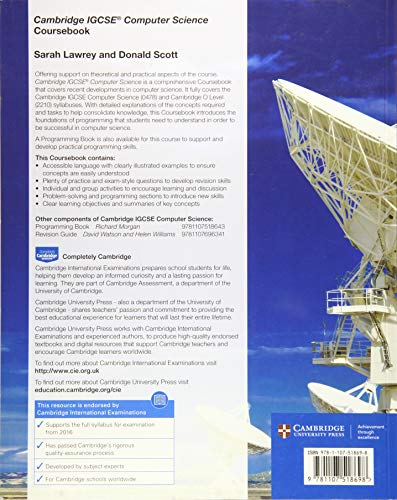
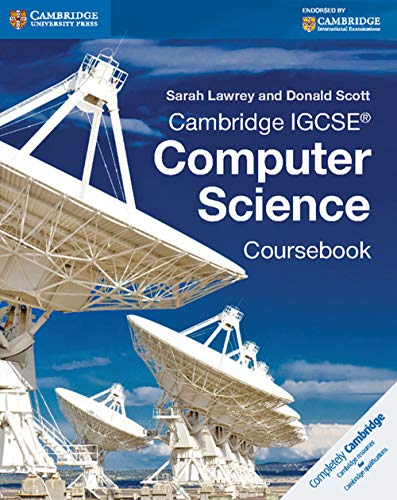


Cambridge IGCSE® Computer Science Coursebook (Cambridge International IGCSE) [Lawrey, Sarah, Scott, Donald] on desertcart.com. *FREE* shipping on qualifying offers. Cambridge IGCSE® Computer Science Coursebook (Cambridge International IGCSE) Review: Detailed and useful to students enrolled on this course - In line with most recent specification. Detailed and useful to students enrolled on this course. Prompt delivery. Thank you. Review: Better Textbook - This is far from being the perfect book for IGCSE CS, but its much better than the only alternative ... the white book by Watson and Williams (hodder education). Unlike that book, the material here is properly divided into digestible chunks, illustrated with adequate pictures and diagrams and sufficiently explained. On the downside, unlike other Cambridge Science titles, there is no accompanying disc with activities and multimedia (rather strange since this is COMPUTER SCIENCE).
| Best Sellers Rank | #860,837 in Books ( See Top 100 in Books ) #147 in Computer Science for Teens & Young Adults #48,714 in Textbooks (Special Features Stores) |
| Customer Reviews | 4.4 4.4 out of 5 stars (62) |
| Dimensions | 8.5 x 0.5 x 11 inches |
| Edition | New |
| Grade level | 10 - 12 |
| ISBN-10 | 1107518695 |
| ISBN-13 | 978-1107518698 |
| Item Weight | 1.28 pounds |
| Language | English |
| Print length | 232 pages |
| Publication date | May 31, 2016 |
| Publisher | Cambridge University Press |
| Reading age | 14 - 16 years |
D**N
Detailed and useful to students enrolled on this course
In line with most recent specification. Detailed and useful to students enrolled on this course. Prompt delivery. Thank you.
C**R
Better Textbook
This is far from being the perfect book for IGCSE CS, but its much better than the only alternative ... the white book by Watson and Williams (hodder education). Unlike that book, the material here is properly divided into digestible chunks, illustrated with adequate pictures and diagrams and sufficiently explained. On the downside, unlike other Cambridge Science titles, there is no accompanying disc with activities and multimedia (rather strange since this is COMPUTER SCIENCE).
S**K
Good rationale, but some things are just unprofessionally done.
There are mistakes on almost every page, and that's just the first chapter. Here are some examples of what I mean from Chapter 1 so far: - Wrong references to tables/figures. A case in point is that the book refers a paragraph to "Table 1.08" but really actually means "Table 1.09." There are many more places where tables are referred to incorrectly. It feels as if a table was added one point during editing, but nobody bothered to edit their references in the paragraphs surrounding the tables. Speaking of Computer Science, why don't you find a way to get the computer to do the job of collecting references and put them correctly in the paragraphs instead of manually doing it yourself? This way, all changes are reflected nicely. You know, just like LaTeX would do. - Confusing wordings on most paragraphs, especially when explaining the algorithm to convert between binary and denary, that take too many passes to read and re-read. For example, "If we calculate the denary number by adding together all the binary units that <del>are</del> used, ..." <ins>can possibly be used</ins>. As with references, this part of the book I've seen is ridden with incorrectly used word choices, confusing structures, misleading texts, and even incorrect figures. - Speaking of incorrect figures, have a look on page 4 in step 4 of the algorithm to convert decimal to binary. It says, "22 is not larger than 32 so we do not need 64 and a 0 can go beneath it." Instead of 64, did you actually mean to say 32? - The entire section about measuring memory size is misleading. First of all, if you are going to use the IEC standard of measuring data (each order of magnitude increases by some power of 2), you should refer to the unit symbols as KiB, MiB, GiB, TiB and call it kibibyte, mebibyte, gibibyte, tebibyte respectively. You don't just use the SI standard when that's not what you want to use. This will confuse students for a very, very, very long time. Please, just make it clear that there are two standards: IEC (1 KiB = 1024 B) and SI (1 kB = 1000 B). At least, there was decency in using the lowercase "k" in "kB". :p - In the paragraph right above Figure 1.05, HTTP status codes are NOT in hexadecimal notation. Otherwise, we would be seeing status codes like "40E" being possible. If you look at a list of them on Wikipedia, they are not represented or even based on the hexadecimal number system. So, just remove that paragraph. - Microsoft Access Database files' extension is ".mdb," not ".mbd." Is this an erratum again? Also, "PNG" stands for "Portable Network Graphics," with an "s." Another thing I want to mention is that the publishers should consider using a serif typeface instead, because sans serif typefaces are only ever good for viewing on a pixelated screen, and please justify your paragraphs. I feel that I cannot resist the urge of mentioning the use of LaTeX or even Troff for the publishing of this book. There are better books written using those typesetting and publishing software, but sadly none of them covering IGCSE Computer Science. Isn't that what Computer Science courses should promote anyway? Using a publishing software that puts the hard work on computers, but not on the person? Using all the technology you can in order to deliver the best in class, just like what Cambridge promises at the back of the book -- that they want to bring high-quality textbooks to the world? On the positive side, what I do like about this book is the fact it was written by a woman, and I am a girl too. There are so many books out there written by men and to see equality, it just makes the world feel like a more graceful place. I also like the friendly way it presents things from the start to the end of the book. But that is all, really. I'm sorry, it's a 1 star for me. I've written better essays than this book and I used Troff and LaTeX for it. As someone who bought this book, I expect the publishing and factual quality to be better; perhaps as high as the highest academic standards. This means that it should be better than the UNIX manual pages printed at AT&T, which I think is already the best in class for what it is. Thank you.
M**M
Great book if you are studying IGCSE and need a Computer Science book Imho better than the Hodder Education book, OUP is the best
E**N
Si haces IGCSE Computer Science, este es el mejor libro que puedes comprar para revisar y aprender. Todo está muy bien explicado, con ejercicios sencillos y también complicados que te prepararán para tus exámenes.
K**S
got this book, self taught myself whilst doing my A levels. What a book, I already love Computer Science and Software Engineering. So this book was a pleasure to read, literally. Did my exams, and got an A thankfully. and know for sure that you can get an A* if you read it earlier than me. And make sure to do pass papers, so that you know what topics you need to go back on and improve... just re-read and do more pass papers. Loved the book, no flaws, and love this course and Cambridge IGCSE system for being my backup cuz I couldn't take a normal Computer Science GCSE in my college (they don't teach it)
S**E
It's a vey good book to study for Olevel and IGCSE computer science.
M**K
The biggest problem is the exam-style questions, which have no answers or marking scheme included, leaving you wondering what you're supposed to even think when reading some of the more poorly written questions. Reading this just leaves you angry and distraught, how has our education system produced something of such poor quality? It beggars belief.
Trustpilot
1 day ago
1 month ago