We remain fully operational. Our teams are working around the clock to ensure your deliveries continue safely.

DOWNLOAD THE APP


Customer Services
Copyright © 2025 Desertcart Holdings Limited
DOWNLOAD THE APP


🔌 Power up your precision — never miss a charge detail again!
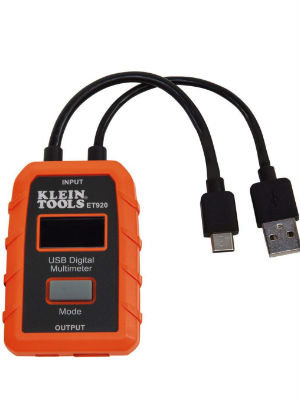
The Klein Tools ET920 USB Power Meter is a compact, professional-grade tester designed for USB-A and USB-C ports. It measures voltage (3-20V), current (up to 5A), capacity, energy, and resistance with continuous monitoring for up to 1000 hours. Featuring data storage for 10 readings and overload detection, it’s built for accuracy and device safety. Ideal for tech-savvy professionals needing reliable USB power diagnostics.






| ASIN | B07GXZHPVR |
| ASIN | B07GXZHPVR |
| Best Sellers Rank | #39,891 in Tools & Home Improvement ( See Top 100 in Tools & Home Improvement ) #74 in Voltage Testers |
| Brand Name | KLEIN TOOLS |
| Color | Orange |
| Customer Reviews | 4.4 4.4 out of 5 stars (1,588) |
| Customer reviews | 4.4 4.4 out of 5 stars (1,588) |
| Date First Available | 30 August 2018 |
| Department | Unisex-Adult |
| Global Trade Identification Number | 00092644691669 |
| Included Components | USB Digital Meter, USB-A and USB-C |
| Is Discontinued By Manufacturer | No |
| Item Dimensions | 23 x 5 x 1.3 centimeters |
| Item Length | 2.96 Inches |
| Item Type Name | USB Tester |
| Item Weight | 1.7 Ounces |
| Item Width | 1.96 Inches |
| Item model number | ET920 |
| Manufacturer | Klein Tools |
| Manufacturer | Klein Tools |
| Maximum Operating Voltage | 20 Volts |
| Measurement Type | USB Power Meter |
| Minimum Operating Voltage | 3 Volts (DC) |
| Model | ET920 |
| Power Source | [USB Powered] |
| Product Dimensions | 22.96 x 4.95 x 1.35 cm; 48.19 g |
| Specification Met | EN 61010-1 |
| Style Name | Compact |
| UPC | 092644691669 |
| Unit Count | 1 Count |
F**O
Amazon perfetta come sempre: comprato un oggetto, risultato non funzionate, me lo hanno sostituito e visto che nemmeno il secondo funzionava, me lo hanno rimborsato. Prima di rendere il secondo oggetto, però, ho contattato la casa produttrice sperando in un loro supporto e sono qui a raccontarvi la mia esperienza. I due dispositivi che ho provato, visualizzavano la tensione ma non la CORRENTE, parametro fondamentale per un simile tester. Ho scritto alla Klein Tools spiegando le prove fatte ed il problema riscontato, ma loro hanno ignorato la mia mail dandomi una risposta preconfezionata. La loro risposta: “corrente troppo bassa perché il tester la misuri”, ma se avessero letto che ho testato l’oggetto con un carica batterie Apple da 30W con un MacBook, avrebbero potuto risparmiare una risposta così sterile. Ho quindi inviato la foto che pubblico anche quì. Vi spiego cosa mostra, così come l’ho spiegato all'azienda: Ad un carica batteria Fast Charge ho collegato un tester analogo ma per Micro USB che mostra un passaggio 0,71 Aampere, all’uscita di questo entro nel tester KLEIN ET920 che però mostra 0 Ampere, da li entro in un power bank che carica tranquillamente. Si deduce che il tester ha dei problemi nella visualizzazione della corrente ma …. Per la KLEIN, l'immagine non dimostrava nulla e mi suggerivano di rendere l'oggetto perchè non ero in grado di adoperarlo. Visto che ho la reale necessità di un oggetto simile, ho cercato di far comprendere bene alla Klein Tools la problematica, così ho realizzato un video in un laboratorio elettronica. Ora vi descrivo il test, così come ho fatto con la azienda. Fornisco energia da un alimentatore digitale che imposto con corrente massima di output a 5 Ampere; ad un carico fittizio imposto per avere un assorbimento di 1,5 Ampere, tra i due dispositivi è inserito il tester ET920. Una volta dato l’output all’alimentatore, il carico fittizio mostra un assorbimento di 6,4 Watt con una corrente di 1,5 Ampere; l’alimentatore mostra una erogazione di 1,518 Ampere ma il tester continua inesorabilmente a segnare ZERO. Pur avendo inviato questo video due volte all’azienda, non mi hanno mai risposto. Peccato, sembrava un bel prodotto, magari sono stato io sfortunato due volte, ma una azienda che risponde ad un cliente in difficoltà che ha argomentato il problema con dovizia di esempi con: "Since this is the second one and it still does not work, I feel it is something other than this device. Please take or send it back and purchase another manufactures similar item." Non mi vedrà più come cliente.
S**B
This Simple and Logical to use, brilliant bit of kit, allows you to check and confirm the output values (Voltage, Current, Capacity, Energy and Resistance) of USB A and USB C charging ports, whether that be USB Wall Sockets, USB Chargers or Battery Power Banks. The ET920 unit is a little smaller than I expected, being slightly smaller than a Credit Card and if it were just a cm or two longer and wider, it would be ideal but it's not the end of the world. The unit is robustly made, the screen is well lit and all data is clearly legible and accurate, albeit some a tad small. The attached input cables are a little stiff and if the USB Socket is 'the wrong way up' (if that makes sense), you have to twist the cable to be able to view the screen but I'd rather that, than suffer flimsy cables and the pluses outweigh the negatives. It does have its limitations, in that firstly, you cannot cross the cables i.e. USB A Input must be used with USB A Output (not USB C). Secondly and this could be a Major Issue for some users, if the Input Charge stops, due to, for example, a low input voltage value, which would happen if the device attached to the output port has become fully charged, the displayed values are NOT stored on the device and are therefore lost. Conclusion: To date, I'm impresses and Well Pleased with my purchase. It could be better but..... I'll update this review if necessary but to date, Highly Recommended!
M**L
Das Messgerät zur Messung der Ladestrom, Ladespannung und übertragene Energie wirkt mechanisch und elektrisch stabil. Messwerte werden gut lesbar dargestellt.
L**S
Bueno y útil, idénticas medidas de voltaje que la Power Z, recomendado.
T**E
Bastante bien acabado, de lo mejor que he visto en este tipo de medidores USB para voltaje, corriente y capacidad. A destacar que no funciona de forma cruzada ni ambos conectores simultáneamente, claro. Es decir, que USB-C entrada con USB-C salida o bien USB-A entrada con USB-A en salida (y no ambas a la vez) La solución obvia en ciertos momentos es usar cables USB-C a USB-A, obviamente y según la calidad del cable ello afectará a la resistencia medida en carga/alimentación. Me está siendo útil para comprobar la salida real de fuentes de alimentación o powerbanks (así como su capacidad real). La pega es que no retiene los datos, de forma que si se interrumpe, pierde los valores de capacidad, por ejemplo. Estaría bien que tuviera memoria para guardar un cierto número de mediciones o el proceso en curso.
Trustpilot
2 weeks ago
4 days ago