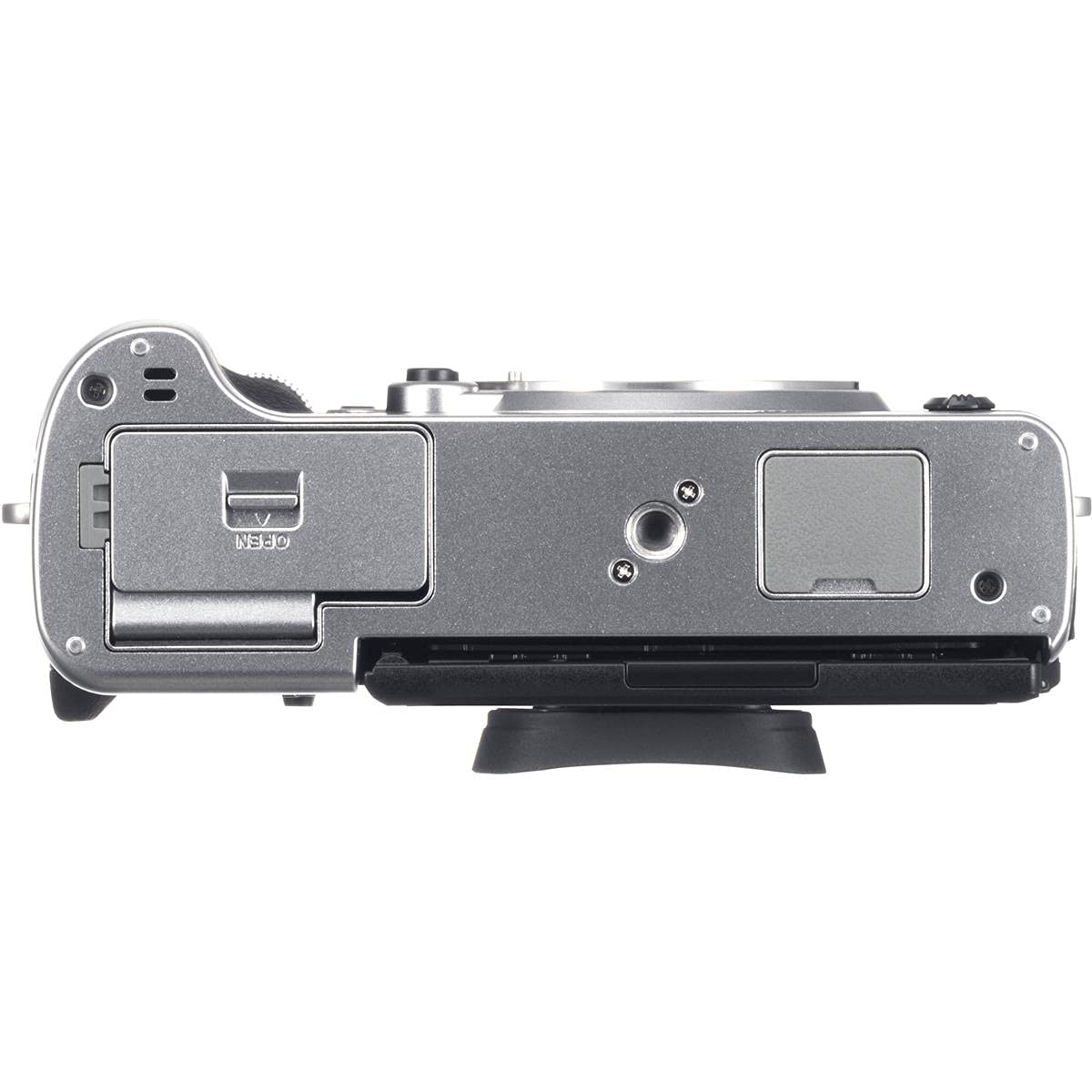
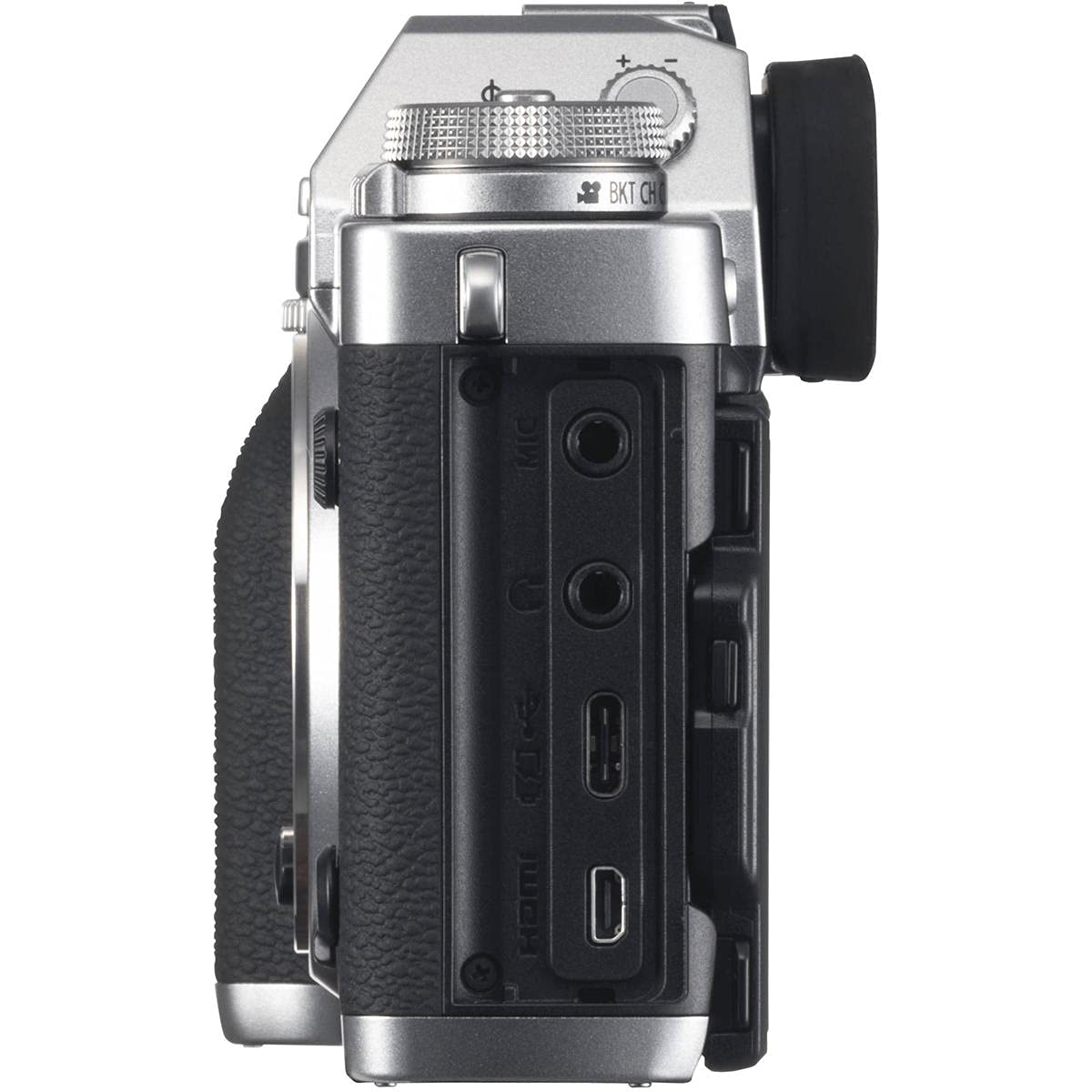


🚀 Elevate your creative game with the Fujifilm X-T3 — where vintage charm meets cutting-edge power!
The Fujifilm X-T3 Mirrorless Digital Camera with XF16-80mm lens combines a 26.1MP APS-C X-Trans CMOS 4 sensor and X-Processor 4 for exceptional image quality and speed. It supports internal 4K/60P 10-bit video recording and boasts a 2.16 million-point phase-detection autofocus system for precise tracking. Designed with retro-inspired tactile dials and extensive customization, it offers a professional shooting experience. Dual SD card slots ensure data security, while the high-resolution OLED EVF and touchscreen enhance usability. This silver kit is a versatile powerhouse for both photographers and videographers seeking premium performance in a stylish package.


| ASIN | B08164R1G8 |
| Item model number | X-T3 Camera w/XF16-80mm Lens Kit -Silver |
| Manufacturer | FUJIFILM |
| Product Dimensions | 32.39 x 28.19 x 3.18 cm; 952.54 g |
A**L
DISCLAIMER - I am writing this review after spending a vacation with this camera. I'll divide my review into parts or I'll never be able to make it cohesive enough. Build Quality: ----------------------------------- The first thing you notice when you take it out of the box is the build quality of the body. It 'feels' solid. The top and bottom plate is all metal. The middle of camera is metal wrapped over by a rubbery texture that makes it great to hold. Then you notice the lens. As someone who's been using Nikkor DX 35mm 1.8 prime (which is a great lens, tbh), the all metal lens body was a revelation. Yeah, it makes things heavier. But the weight gives it some welcome heft when you handle it. No, Fuji is not the only company that makes metal lenses. But yes, fuji lenses are extremely well made and can go toe to toe with any lens's build quality out there. Design ----------------------------------- This is one of the better looking cameras on market. Obviously, the looks are subjective. But I've yet to come across a reviewer who had bad things to say about the looks of this camera. The dials are 'retro-looking', but actually make things way easier than the mode dials. Again, I am writing from experience. Aperture priority and Shutter priority are easy enough to understand on most cameras. But when you want to control both Aperture and Shutter, while leaving ISO on auto, and when you want to customise ISO too for that one shot, having dedicated dials saves time. The dials make the entire experience extremely tactile. It 'makes you wanna shoot'. Kit Lens ----------------------------------- This is hands down the best kit zoom lens you can get with any camera of any brand. I mean, look it up. Firstly, the lens goes to f2.8 with 18mm. Second, it's all metal with classy optics. While most kit lenses cost around 10k - 25k standalone, this kit lens costs upwards of 45k most of the times. And the quality of the pictures matches the build. Many photographers have praised this lens, and it's easy to see why. There's little distortion and I didn't find any color fringing. This lens takes you places. Literally. That said, I plan to purchase a prime soon. Not because I don't like my kit lens (I love it) but prime fits my shooting style better. When I'm not lazily trying to zoom at things while sitting in chair, I find that I make better shots. Also, this lens isn't weather resistant, which is a bit of a downer. But hey, it's still the best kit lens there is. Functionality ----------------------------------- X-T3 gives you a lot of customisability. The 'Q' button gives you a bunch of quick settings. And you can customise the placement of each of these settings and even swap them out for other things you might find more useful. For even quicker changes, there are dedicated function buttons as well as touch screen gestures, all of which are customisable. I feel customisation is one of those things that differentiate a workhorse from a beginner camera. You can adjust things to make your workflow easier. Having two memory card slots is awesome. I use one for raws and other for jpegs. That way, I have my raws to process, but if something goes south with my primary card, I still have my backups for jpegs. Thankfully, when I delete a raw, the camera also lets me delete its corresponding jpeg from card 2 automatically (you can turn this off) so both my cards are consistent with each other. One of the not-so-good things here is placement of playback and delete buttons. Everything is on right side, but these two buttons are all the way on top left corner, making it extremely hard to access. Plus I end up triggering the EVF sensor every time I do that. Thankfully, I was able to assign one of the function buttons to playback, so I don't have to live with Fuji's questionable choices. Screens ----------------------------------- Yep, this camera has two. If this is your first mirrorless (as it was for me), know that there is no optical view finder (that little lens on top of camera you use to see things). Instead, it's a small, extremely high resolution OLED screen. That means everything you can do from main touch screen, you can do in EVF. Changing settings, jumping through menus etc. It also means camera shows you how your photos are gonna look. So if you apply a film simulation (like B/W Acros), the live view in EVF reflects that. The touch screen in this camera is usable, although I find myself never using the touch screen features. I sometimes use joystick to select focus, but mostly keep the focus in center and just lock and recompose. Battery ----------------------------------- There's no two ways about this. The battery is not very good on this camera. I mean, it's not abysmal. It got me two days of outdoors with on and off shooting in performance mode, with me turning off my camera when there were long pauses between shots. So if you're thinking of shooting your next vacation with it, no, it won't fail you in middle of day. That said, the battery is no where near my old Nikon D5300. This is mostly because of that high res EVF that I primarily use. Expect to charge the battery overnight or every two nights when you're shooting and you should be fine. They supply a wall charger too, although the camera lets you charge battery in-body using a USB-C cable. Accessories ----------------------------------- I got a 16 gb SD card. Put it in slot two as my JPEG backup. Had to purchase a 64 gb high speed card for slot 1 for raws. The raw files of this camera are consistently over 50 mb, so the space fills quickly. They also gave me a camera bag. It has room enough for everything in box, plus one extra lens when/if you buy one. That said, the bag is not good at all. The top flap doesn't have a chain and is closed only through a hook. The belt on this hook loosens every time you life the bag using top handle. The strap is also not long enough, making me wear this camera pretty awkwardly around my body. I plan to switch this bag out soon too. Final thoughts ----------------------------------- Do you need a 1 lac+ camera to make good photos? No. Great photographers can take better photos on an instax than I can take on my X-T3. However, I'd argue that if you have the money to spend, and find a camera (doesn't have to be this) that ignites your passion and makes you wanna go out and experiment, shoot and enjoy photography, then by all means, get one. You certainly won't regret the purchase. As always, before buying this camera, do some research. I love this, but it may not be the right one for your needs. Look at Sony's alpha series, Canon's R series and Nikon's Z series. Most importantly, look at the lens selections. When you buy a camera, you're buying into a system. You are not gonna use canon lenses on fuji, so make sure which ever system you wanna get into, has the lenses you need. That said, Fuji has a very good lens selection. The best part is that they don't have any full frame cameras (at all). So they focus pretty hard on their APS-C lens lineup, which has already made it one of the best out there. Go shoot!
A**.
The Fujifilm X-T3 is a fantastic camera, I’m so glad I upgraded. First a little background. I’m a hobbyist photographer who has been doing hobbyist photography for about 25 years since I was in my teens. My first interaction with cameras was my father’s Asahi Pentax 35mm film camera which he bought in England back in the 60s. By the time I started to use that camera, it was older than I was! In my early 20s, I decided to step up the game and bought a Panasonic fixed lens “SLR look” camera. That was 1” sensor if I’m not mistaken. I took some pretty decent photos with that digital handheld camera. Back in 2013, I told myself that I’d upgrade once more and take a stab at the DSLRs. So I invested in a Canon Rebel T3i which came with the kit lens, 18-55mm. I also added a 70-300mm telephoto zoom lens to my arsenal and used this setup for 5 years. I’d shoot anything from my kids at home, to dance concerts to archery events and really maximized the Canon in many ways. I started to shoot in P-mode for about one year and then mostly shoot in Aperture Priority Mode, with some shoots done in Manual Mode. The T3i was a great starter camera. In 2017, I decided that I wanted to upgrade my camera and this is where things got confused. I looked at full frame cameras in Canon, full frame mirrorless in Sony, Micro 4/3, and APS-C cameras in almost every manufacturer, except Nikon (reason being, if I was upgrading in to a APS-C DSLR, I told myself I’d stick with the Canon). Believe me when I say that I had researched cameras for more than 18 months before deciding to invest in the X-T3. I then narrowed down my search to mirrorless systems. A friend of mines let me use his Olympus OMD-M5 for a few hours. Two things that struck me… How light the mirrorless was compared to my Canon and the ability to see what the photo looks like in the EVF or on the LCD with different ISO, Shutter Speeds and Aperture settings. Looking for the mirrorless, the search then spread to Sony (both full frame and APS-C), micro 4/3 in Panasonic and Olympus and of course Fujifilm. I eventually ruled out Sony. I felt that the “starter” Full Frames from Sony lacked some of the better features that the other, similarly priced APS-C cameras possessed. Plus, I thought the Sony lenses were too expensive. Micro 4/3 systems were inveigling me but that small sensor capabilities in low light, even with fast lenses was a bit iffy (for me). Eventually, in early 2018, I settled on either the X-T20 or the X-T2. The first feature that I was drawn to was the retro styling… the full manual adjustments on shutter speed, ISO and exposure. And the manual aperture ring adjustments on equipped lenses. Drool!!!! I was taken back to my teens when I was shooting on my dad’s Pentax and how excited I was to see how my photos would come out when I played around with different settings, not to mention the disappointment I would feel when I saw many over exposed or under exposed photos. For me, shooting on the Canon did not give that experience and while I learnt to navigate the buttons quite well for shooting in Aperture Priority or even Manual, the Pentax experience was always top notch. The Fujinon lenses also appealed to me. All reviews I read alluded to how sharp images were. And the prices of the lenses, while quite steep, were still cheaper than some of its counterparts in other manufacturers. I think in early 2018, I eventually settled on the X-T20 as it had many of the features of the X-T2 with the touchscreen. Then came July 2018 and I saw that the price on the X-T2 dropped to $1,099 a mere $200 more than the X-T20. The X-T2 then became the camera of choice. In early September, my decisions were stymied by the launch of the X-H1 as I began to wonder whether Fujifilm were heading in a different direction for IBIS. But I told myself that the lenses would be around for a while and that the X-T2 would be the way to go. Mid-September I was about to buy the X-T2 and while looking at a review of a Fujinon lens on dpreview, I saw a post on the new X-T3. I read all I could about the X-T3 and saw that there were introductory offers available on the X-T3 and many of the Fujinon lenses. Eventually I bought the X-T3 along with the Fujinon XF16-55mmF2.8 R LM WR Lens. I got the new setup over two days ago. Configured the camera to the way I want it, including back button focus and some customization on the Fn buttons. This camera is a dream to use. The build quality of the camera is first class and solid. My setup with the 16-55mm lens and the camera is a bit heavy, but that’s a price to pay for quality glass. The camera does indeed feel like the old Pentax and after shooting about 50 pictures, it is so effortless to simply turn a dial or a ring to adjust some aspect of the exposure. No more fiddling with this dial and that button and looking at a LCD screen to see the exposure settings before taking a picture, or half pressing the shutter button to see the same information in the view finder (that’s what I had to do with the Canon). The X-T3 is heavily customizable. Every setting is easily changed from the intuitive menu. One small complaint is that some of the menu settings are not that self-explanatory or clear so you would need the manual to decipher what a change in that setting does. Maybe in a firmware update Fujifilm could add a little on screen explanation on menu settings so the user can understand the change being made without having to revert to the manual. Which brings me to firmware. My camera was shipped with revision 1.0 of the firmware. I downloaded the latest firmware from Fuji’s website and followed the instructions to upgrade on the camera. The actual upgrade takes less than 90 seconds. So I would suggest that once you get your camera, perform the firmware update before doing anything else. The EVF is crystal clear, and to be honest, there’s no difference to me in using this EVF as compared to the pentaprism on the Canon. I found that the transition was seamless. The LCD is fun to use although I have found that sometimes my nose would cause a change of setting, especially a change in AF. So I just disable touchscreen AF. I tried a 120fps slow motion video capture of my daughter jumping. This is an awesome feature that I know I’ll love at those archery shoots. While the camera touts some impressive video features, only with time will I be able to unlock that potential. And speaking of archery, the 20 fps and 30 fps burst shooting would be great once I put it to the test. I did a few frames at these speeds and the camera was quite fast so this is another feature that I’m excited to use on the archery range. The AF is spot on fast. What I love about how I have the camera configured is that with back button autofocus I can leave the AF in Manual mode but still have AF-S or AF-C by either touching or holding the AF-L button (which I have configured as “AF-ON”). I have attached some photos to the review. All but the two photos of the X-T3 alongside the Asahi Pentax were out of camera JPEGs. The X-T3 alongside the Asahi Pentax were taken with my phone to give you an idea of the retro styling and the retro look with the silver and black. The photos show you the background blur you can get – that’s the lens mind you. But Image Quality looks great for out of camera JPEGs. The amount of detail is amazing with this camera and lens. Look at the photo of the lemon and all the imperfections you see on the skin! The picture of the willow was intentionally underexposed as I tried to show just how bad the weather was. And that chicken was on the grill while I was taking the photos. It was about 75% done but still looks delicious. You will see that there is a picture of some ants on an orchid leaf. Well for that picture, I was using AF-C mode. It was a challenge to get a fast moving ant in the focus point but once I did and locked on, the camera kept focus on the ant to the top for a few frames, until it disappeared or I moved. I’ve only had this camera for a few days but already love the combination of the lens and the camera. I can tell that this would be a great investment. After 18+ months of research and dawdling, I am glad that I took the time to research my options and bite the bullet with this X-T3.
@**H
No hay mucho que agregar a lo que ya se sabe sobre esta cámara. Es extraordinaria. Muy recomendable, sobre todo si la encuentras en oferta.
J**A
Ya ha pasado un buen rato de que la compré y estoy muy satisfecho, es una cámara híbrida que toma muy buenas fotos y excelente video; la resolución de las fotografías me ha funcionado bien tanto para fotografía de paisajes como para productos en set, y los códecs/posibilidades de video sobrepasan mis necesidades. Al principio pensé que las Fuji tenían un proceso de revelado digital raro, porque las fotos al momento de editarlas se veían... Peludas. Pero resultó que la forma en la que Adobe interpreta el formato Fuji no es el indicado para un buen flujo de trabajo, entonces si estás leyendo esto busca un programa que se llama Capture One que interpreta las fotos Fuji sin ningún problema.
A**R
Item was delivered in good time, and working well so far without issues. When I enquired about warranty, I was told by the seller (BecexTech) that if it cannot be claimed locally, then you can claim it with them. Not an ideal situation as it's unknown how that would turn out, but hopefully it won't come to that. My X-T2 is 5 years old and still going strong with zero issues, so I'm hoping this does the same.
Trustpilot
2 weeks ago
3 days ago