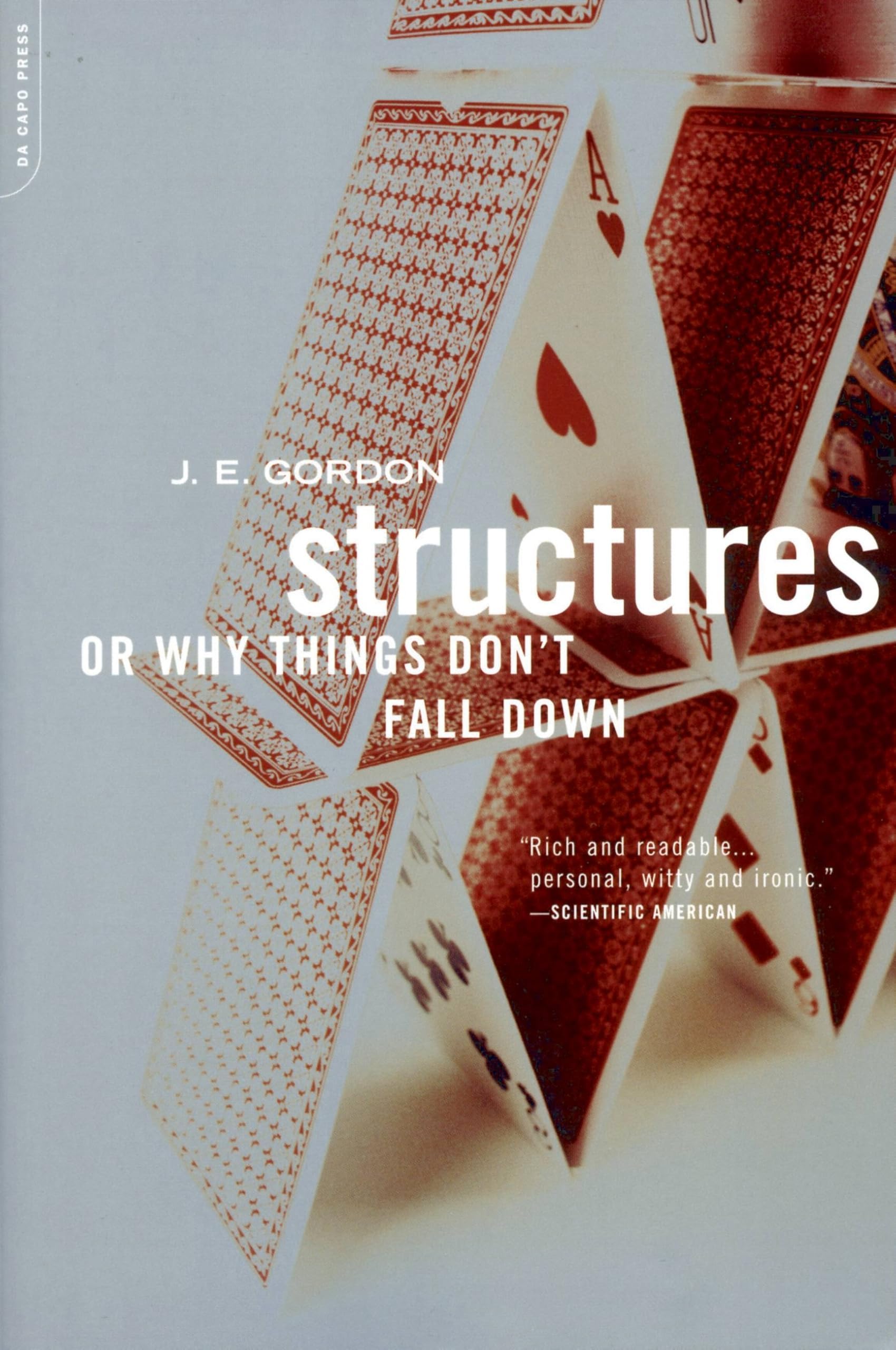
Structures: Or Why Things Don't Fall Down
Product ID: 2715669
📚Comprehensive Guide
🔍In-depth Analysis
🧠Critical Thinking
Buy anything from 5,000+ international stores. One checkout price. No surprise fees. Join 2M+ shoppers on Desertcart.
Desertcart purchases this item on your behalf and handles shipping, customs, and support to Kyrgyzstan.
📖 Build Your Knowledge, Build Your Future!
Structures: Or Why Things Don't Fall Down is an essential read for anyone interested in the principles of engineering and architecture. This book offers a thorough exploration of the mechanics behind stability, providing readers with a solid foundation in structural design and critical thinking.
| Best Sellers Rank | #4,848 in Books ( See Top 100 in Books ) #1 in Structural Engineering #2 in Architectural Materials #8 in Architecture (Books) |
| Customer Reviews | 4.6 out of 5 stars 2,119 Reviews |
T**E
A 'for the educated layperson' introduction to materials science. by a founder of the field.
If you are the kind of person who enjoys Scientific American articles, or the summary articles and news at SCIENCE/AAAS or "Nature", you will almost certainly enjoy and find this book quite accessible. This book introduced me to the concept of energy and "the work of fracture" in the propagation of cracks. It is one of my favorite 'for the educated layperson' books on materials science. I am not an engineer or technician, but have taken college (non calculus) physics, and used simple algebra at work (medical). Gordon was one of the founders of materials science as a field, and he was quite important in the development of plywood body airplanes in WWII, so he had plenty of experience in mission critical engineering in the real world, contrary to the implication of remarks expressed here by others about a 'bitter academic' . British scientific discourse is more 'robustly' opinionated than US, so some may find his more acerbic comments annoying, but i found the book extremely readable, witty, and the small bits of simple algebra are fine for anyone with junior high or high school math exposure. If you want a bit more technical discussions, look for the books by Steven Vogel, who writes for the college educated non specialist or introductory undergraduate courses. The popular science level Vogel books do contain some math, but no calculus IIRCl. I own and enjoyed a bunch of them, and I am certainly no mathematical athlete. As far as this book goes, I can't imagine discussing the concepts in it any more simply and accessibly. I own a used copy that was sufficiently beat up that I bought a second new copy of the paperback out of nostalgic respect. I keep considering buying a hardback copy and reading it for a third time. If you want a graphically more exciting discussing of the same area, by the same author, look for the Scientific American Library book Structures and Materials, which covers many of the same topics, and is equally enjoyable and accessible for those with genuine interest and a decent high school education. For folks who find either of these Gordon books "too technical", I wonder what they were expecting in a book about structures and materials. Gordon's other book "The New Science of Strong Materials" is equally excellent for those with a real interest in the area, and similarly simple in the level of math employed.
D**O
Good book
Good product
S**G
Entertaining, educational, but could be deeper for experts.
Bought this to learn more about the engineering behind buildings and structures. What I like • The book breaks down complex engineering concepts in a simple and entertaining way. • Engaging examples and clear illustrations help visualize how structures work. • Provides a deeper understanding of the science behind everyday buildings and objects. What could be better • Some sections may feel a bit too simplified for readers with a technical background. • Could benefit from more in-depth case studies of real-world structures. • The pacing may slow down in certain areas for readers seeking a quicker overview. Bottom line: A great read for anyone curious about how structures stand the test of time, but may not offer enough depth for those with engineering expertise. Perfect for beginners and general readers, but look for more technical resources if you’re seeking advanced knowledge.
M**.
Book Review Number One: year 2017
Structures: Or why things don’t fall down A very interesting book, covering a wide field of topics, from the ground up you might say. Basic concepts of forces are addressed. Compression, tension, shear and torsion forces, and their occurrence in everything from bridges, ancient coliseums, trees, boats and human biology. This, the author does very well; constantly interweaving the effects of various types of strains and stresses and fractures as they occur in wood construction and metal beams, as well as human skeletons and arteries. Reasons for, and types of failure are described for wood, concrete, boat sails, steel, femurs and aortas. Advantageous shapes of design for handling wind and accepting impacts are given, and reasons for spoke wheels. Critical and safe limits of fatigue and fracture are described…historical cases are offered, describing why early aero planes crashed and bridges fell down, and why boats capsize. Cautions are pointed out. Over design of repair: The repair must work in harmony with the repaired material, and not be so unyielding that it works against it. So many invisible forces of tension and compression are at play, and violation of acceptable limits must be watched for when they manifest in fractures. Different approaches to bridge trusses are explained, not so much mathematically, but in concepts of load bearing and the transference of force throughout the truss. By way of example, Bowstring bridges seem quite clever in design, where the internal force of the arch pulls the roadway below it taught so that the whole thing is held in equilibrium like a bow and arrow on a giant scale. The all important “thrust line” is a constant theme from chapter to chapter. Now I know why those old cathedrals have so many spires and spooky statues way up there, and it’s not for warding off evil spirits, it’s because they’re heavy. There are photographs, all clumped together in the middle of the book. Black and white, kind of blurry, but still a helpful aid. Very nice drawings, not blurry, and graphs are abundant in all chapters to help visualize the topics being discussed. These and many more topics and application fill this book, none of it came across as boring or dry. Beyond the final chapter, a few concepts are given a light mathematical treatment. Moments in I-beams, deflections in cantilevers and so forth. The pages are made of sturdy heavy paper, the printing is nice size and clear for those who require reading glasses, with ample space around the print for making marginal notes.
K**9
Fascinating multi-level insight into everything around you
Structures are everywhere, from houses to chairs, from animal bones to aircraft hulls. The author clearly explains with words, pictures, a few key equations, and some amusing examples, the common relationships in all of them. The book is full of architectural examples over the last few thousand years, contrasts between different animals, and a bit of engineering humor. It works on multiple levels. You could read it as a casual history of ideas, an interesting set of disconnected examples, or as a serious mathematical exposition. I liked best that it shows how the different perspectives all connect to each other.
G**R
A fascinating and informative book
Good book, fast service and reasonably priced
A**R
Great content--bad Kindle formatting
I believe I'd love this book in hard copy. It's a classic. The problem is that Kindle's formatting for this work is very poor. The plates are not in the text, and even if that's normal for the hard copy, the print is out of line and just wrong. The formatting is not acceptable--it reminds me of some of the free versions of classics. In fact, even the cheap but non-free versions of public domain books are formatted in a more readable format.
R**Y
Think Like an Engineer
Highly recommended for anyone who wants to understand how things work. The same is true for the companion volume, The New Science of Strong Materials: Or Why You Don't Fall through the Floor. When I think about the understanding I got from these books the phrase I come up with is "informed intuition". I first read these books decades ago, and loved them. I bought copies of both here on Amazon as a gift to someone who was considering studying engineering. I really think that if you don't enjoy these, you probably want to go into some other field. (The recipient is not going to study engineering.)
M**4
Amazing Book
I love this book! As a mechanical engineer student i hate structural analysis. This book explains the structural analysis in a very easy way, and it even goes far beyond. You will learn about the history of structural analysis, dynamik etc. and their inventor. I read it in one weekend. Structures: Or Why Things Don't Fall Down is on the must read list of Elon Musk...what more should i tell. For all non native english speaker: The english is level B2-C1
D**D
très interessant, pedagogique, agreable a lire
un livre qui fait le lien entre le comportement mecanique des materiaux et le comportement des structures. Les exemples et anecdotes sont piochés dans des domaines variés : genie civil, construction naval, aeronautique, tissus, matière vivante ... et illustre très bien les propos de l'auteur. Les exemples sont placés dans une perspective historique que j'ai trouvé très interessante. L'auteur fait genereusement part de ces idées et experiences. Très pedagogique et agreable a lire. Un excellent livre d'introduction à la science des matériaux et à la macanique des strucures.
J**E
Muy bien libro.. una visión práctica
Recomendable
M**K
Worth reading
A good book to read and then walk around with a new perspective looking at construction.
E**.
Sorunsuz
Kitapta herhangi bir hasar yok, kargolama gayet iyi. Rahatsız olduğum iki nokta var: yazı fontu uzun okumada gözü yorabilir ve baskı kalıcılığı sanıyorum biraz zayıf. Hafif bir silgi kullanımında yazı hasar gördü. Konuya gelince, yazar "yapı" kavramına çok ilginç bir noktadan yaklaşmış. Her mühendisin okuması gereken bir kitap kesinlikle. Henüz giriş bölümünde "iyi ki karşıma çıkmış" dedim bu kitap için. Tek kelime ile harika.
Trustpilot
1 month ago
3 weeks ago