We remain fully operational. Our teams are working around the clock to ensure your deliveries continue safely.

DOWNLOAD THE APP


Customer Services
Copyright © 2025 Desertcart Holdings Limited
DOWNLOAD THE APP
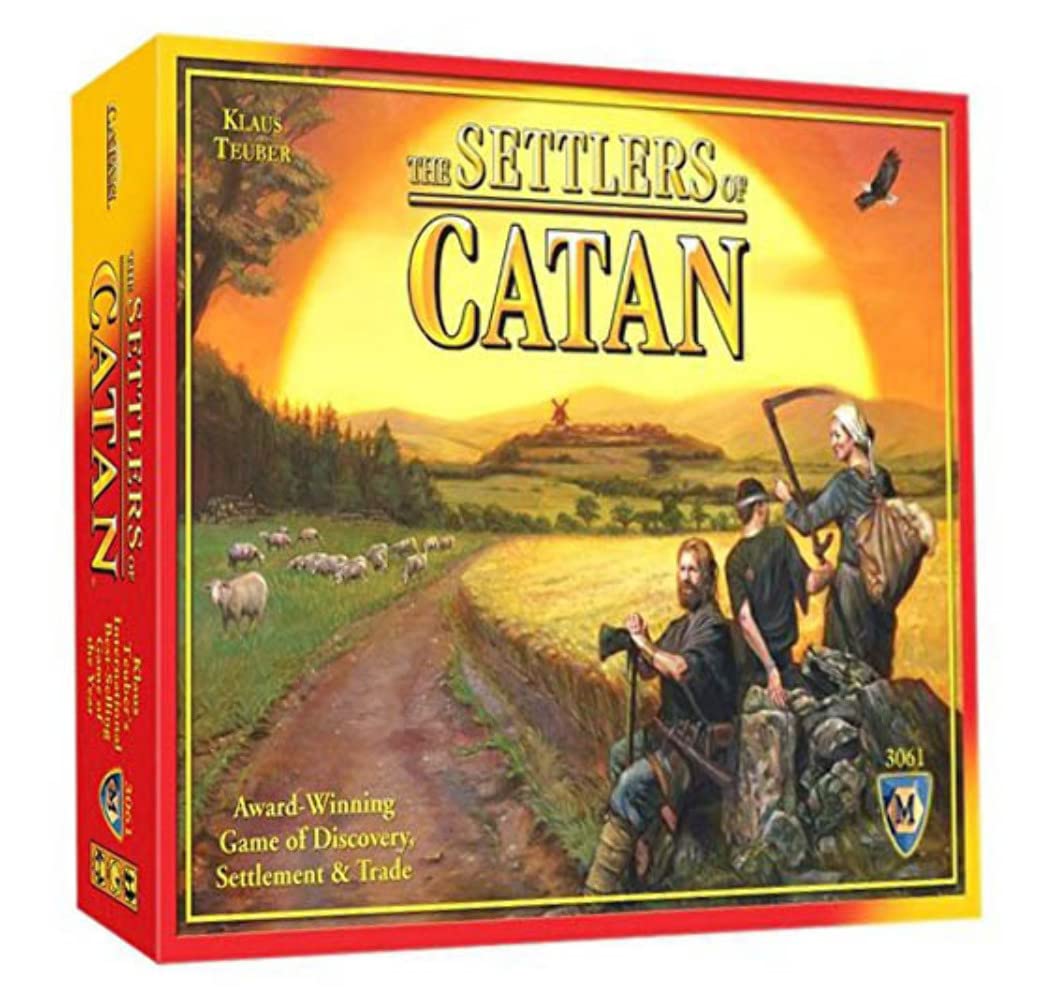
🌍 Conquer Catan: Where strategy meets endless adventure!
The Settlers of Catan is a legendary strategy board game by Mayfair Games featuring a modular island board of 19 hex tiles that changes every game. Designed for 3-4 players aged 10 and up, it challenges players to collect and trade resources to build roads, settlements, and cities while competing for 10 victory points. With a full-color rules book, engaging player interaction, and award-winning gameplay, Catan offers hours of strategic fun and social bonding.
| ASIN | B000W7JWUA |
| Age Range Description | Kid |
| Best Sellers Rank | #129,870 in Toys & Games ( See Top 100 in Toys & Games ) #3,636 in Board Games (Toys & Games) |
| Brand Name | Mayfair Games |
| Color | Design 1 |
| Customer Reviews | 4.5 out of 5 stars 2,468 Reviews |
| Educational Objective | Develop strategic thinking and resource management skills through gameplay |
| Global Trade Identification Number | 00029877030613 |
| Included Components | Cards |
| Item Dimensions | 3.12 x 11.62 x 9.38 inches |
| Item Height | 9.38 inches |
| Item Weight | 3 Pounds |
| Manufacturer | Mayfair Games |
| Manufacturer Maximum Age (MONTHS) | 168.0 |
| Manufacturer Minimum Age (MONTHS) | 120.0 |
| Manufacturer Warranty Description | No Warranty |
| Material Type | Cardboard |
| Number of Batteries | 1 AAA batteries required. |
| Number of Players | 3-4 |
| Operation Mode | Manual |
| Power Source | Manual |
| Size | One Size |
| Subject Character | Catan |
| Supported Battery Types | Rechargeable lithium-ion battery included. |
| Theme | Strategy |
| UPC | 885357572406 029877030613 |
| Unit Count | 1.0 Count |
S**S
One of the best board games ever
When I was first introduced to this game by friends of my sister, I loved the challenge and intricacies that the game offered. There are a lot of aspects of the game that gives it many different ways to develop strategy and gameplay varies with different opponents. I played it a few times when I did visit home and was invited by my sister to play with her friends. Her friend got it for her for Christmas and I bought her the 5-6 player extension. She actually got busy and didn't play it again. She got married and moved out and so I inherited the game. I kept it around but didn't get around to playing it until a year later. Once I taught my roommate, I re-kindled the love for the game and to a new level! My roommate and I got so addicted for about a year of playing multiple times per week and attempting to lure in all new guests to our apartment if they were willing to learn. We had a regular Settlers crew and I originally had the 3rd edition, but decided to sell it and the extension to invest into the whole set of the 4th edition bundle (Settlers + 5-6 player extension, Seafarers + 5-6 player extension, Cities & Knights + 5-6 player extension, Traders & Barbarians + 5-6 player extension). There was never a dull moment with this game because once we got weary of the regular settlers, we busted open the expansions and enjoyed going into the water on other islands with Seafarers, duking it out with angry faces at each other in Cities & Knights, and we also tried a couple scenarios with Traders. It was a different game when any of the expansions were thrown into the 5-6 player modes, where the maps are extended, but strategy changes too. We even ventured into other strategy board games that were similar to Settlers, such as Dominion, Puerto Rico, Pandemic, and Carcassonne for a new spice to our board games lives. However, despite enjoying the new games, there was nothing as strongly addicting as the drug we called "Settlers." We played it over and over and would crave playing when we haven't gotten together in a week to play. Eventually the good times had to end though and half of our crew moved off to other ends of the nation and we still talk about the good ol' Settlers days. In memory of the good old days, I bought the game again as a gift for one of the friends that moved away, just to remind her of the glory days and hopefully she'll infect some more people in her new neighborhood. I now only play when the old Settlers crew gets together and also with coworkers who have occasional board game parties here and there. I highly recommend this game! It's one of the best things that have happened to me in my life :)
N**O
A fantastic introduction to Eurogames
One-Line Review: I know people who sing Black Eyed Peas songs with Settlers-inspired lyrics when they get the resource cards they want. The Settlers of Catan is the game that jump-started my interest in board games, and it completely changed my idea of what a board game could be. With many expansions, an iPhone game bearing its name, and being carried in Barnes & Noble, Settlers may be the best known German board game. When The Settlers of Catan burst onto the scene in 1995, it turned heads, garnered critical praise, and won the Spiel des Jahres (Game of the Year); German board gaming's highest honor. Rightly so, I might add. In Settlers, 3-4 good friends each assume the role of a colonist who has come upon an uncharted island. Beginning the game with two settlements each, players explore the island and lay claim to the resources it has to offer, gaining victory points along the way. The rules of Settlers are simple. Each island tile provides a resource: ore, clay, grain, sheep, or wood, and each tile has a number. On your turn, you roll a pair of dice and the tile(s) whose number matches your roll produces resources. Everyone who has a settlement or city bordering that tile gets a resource card. Next, you can trade resources with other players or with the bank to get the resources you need (or deny other the resources they need). Finally, you can use your resources to build. You can build roads to explore the island and block in other players, settlements to collect more resources, cities to increase the production of your settlements, or you can buy development cards which serve to give you resources or victory points. You gain victory points through building settlements and cities, but bonus points are also awarded to the player who has the longest continuous road and to the player who has the most Knight cards acquired from the development card deck. The first player to reach 10 victory points wins. I think that The Settlers of Catan is a very well-designed game. The first thing that stands out to me is that each player is always busy. Even when it isn't your turn, you're collecting resources, bargaining with other players, and plotting your next move. Having little player downtime is great for keeping everyone interested and keeping the game moving. Next is the Robber. The Robber is a mechanic in Settlers to ensure that no one can run away with the lead. Players may place the Robber on an island tile to prevent that tile from generating resources. In this way, players have the power to burden the guy in the lead a little bit while they catch up. The Robber tends to even out the playing field in a game of Settlers, and because the Robber is moved every time someone rolls 7 (or plays a Knight card), no one is ever penalized for too long. Another shining quality of this game is its variable setup. No game of Settlers is ever really the same because the island tiles are places randomly so your strategy has to be a little bit different each time. At the start of the game when players choose where to place their starting settlements, you have to look to see where the most important resources are, and plan how you're going to get there Wood and clay are in dire need at first, but as the game progresses, everyone will need ore and grain. Choices! The set up phase is where my games are at their most stressful; Everyone carefully eyes everyone else and hopes that the spot they want isn't taken. Long story short, The Settlers of Catan is a great game for new and seasoned gamers alike. While the veterans may dislike Settlers for the amount of luck present in the game, I think that this game is perfect for showing people just how fun a board game can be.
W**E
Settlers of Catan, a great game for friends and family.
Settlers of Catan is a very dynamic board game which offers tons of fun, and is also a good way to teach basic economics. The board game is made up of 19 hexes arranged roughly in a circle. There are 6 different types of hexes. 5 of them produce resources while the 6th (desert hex) does not. Each hex has a number token placed on it. Using 2 dice, when the number of a hex is rolled, settlements located on the vertices of that hex will produce resources. Using the 5 types of resources, players aim to build roads to expand and build more settlements, which in turn can be used to acquire more resources, and later upgrade their settlements to cities. Cities will produce 2 resources for the hex they are situated on. Each settlement is worth 1 point, and each city is worth 2. The goal is to emerge victorious with 10 Victory Points. There is another way to acquire resources, and that is through trading. Players can: trade with each other, trade via a port, trade through maritime trade. Trading with other players benefits those involved but sometimes, they may not have what you need, or simply don't want to trade to you. In this situation, using a port, where a settlement of city is located enables players to trade 2 or 3 of the same resource for the resource desired. Trading through maritime trade is the most costly, because the ratio is 4:1. In addition to building, players can spend resources to purchase Development Cards. The cards have different effects, which range from earning an additional Victory Point, building 2 roads at no cost, taking all of a specific resource players hold (Monopoly), to using the Knight Card to move the Robber to a different hex and steal a resource from a player whose settlement or city is built upon. There are two other ways to acquire points. The first is via The Longest Road. The player with The Longest Road earns 2 extra Victory Points. The second is via The Largest Army. This involves purchasing Development Cards, and using the Knight Card more than any other player (minimum of 3 Knights must be played). While there is no limit to the number of resources players can hold, there is a safe maximum amount to hold on to. The magic number is 7. When a 7 is rolled, (the most frequently rolled number) all players who hold 8 or more cards must discard half, rounded down. The turn player then moves the robber to a hex and take a resource card from a player whose settlement is built on. The robber also prevents that hex from producing any resources. This game mechanic enables lagging players a chance to stifle the lead of others and catch up. The arrangement of the hexes, number tokens and ports can be changed each time (shuffle face down for randomness) to offer a different board layout so the game is never quite the same. The learning curve isn't that steep, but it takes a keen trader and strategist to come out on top. In my experience, this game is most enjoyable with 4 players (there is an extension set to allow 2 more players to play). Play time is generally about 1-1.5 hours. It is a great way to interact with friends and family members, alongside snacks, drinks and with a sports event or movie playing in the background. If you're leaning on the fence, on whether to purchase, check out the tons of images online for Settlers of Catan. Thanks for reading. I hope you found this review helpful.
L**Y
Great fun! Ok quality
Settlers is one of my favorite all time games. It's not so simple that in that it relies completely on luck, but it's not too complicated that the average person couldn't understand game play and basic strategy. I also really like that there's not one single ultimate strategy to win and that variations are easily implemented. The length of a game really depends on the number of players, but it's varies between ~45min (2 player) to ~2hr (4 player). However those numbers came about using the 10 victory point rule. Game play can get quite intense (the frequency of profanity appearing in my speech increased a lot). I gave a 4 star rating overall because I have known the quality of the game board itself to be a bit dissatisfying. The outline (sea/port) pieces are a bit warped, so the hexagons don't fit perfectly inside (this is rather annoying, but bearable). I have also known (in other people's versions) for some of the road pieces to be chipped or deformed in also annoying, but bearable ways. It's still probably your money's worth - it's a blast for me :)
W**Z
Wonderful board game that I would recommend to practically everyone.
When you first open Catan, you may be a little underwhelmed by the prevalence of cardboard pieces (I wish there was a more durable wood version of the board tiles) and the seemingly complicated rule book. I admit, there were a few minor questions it didn't answer that I had to go to the website to figure out from the Q&A section. With that being said: Never fear! The positives far outweigh those criticisms. The rule book covers all of the basics you'll need to know to start playing, and, after giving it a good read through, you should be ready to play, even if only one person has the time to read it. Everyone I've played with learns quickly from my basic description of the rules and picks up the rest naturally and intuitively throughout the game. For some reason, the new person to play the game always seems to win in the games I play. Perhaps that speaks poorly of my Catan skills, but, on a positive note, it has contributed greatly to the game's popularity with my friends. You can use a suggested set-up for new players and then after a game or two you can try more advanced set ups... that is a random set up of the board. The coolest thing about Catan is simply that unlike Monopoly the board changes every time you play if you set up the tiles randomly (see the above illustration provided by Amazon). It makes each game challenging and unique and fun to play. Warning, the game can be a little cutthroat as you vie with other players to occupy the best areas of the board and as you use the "robber" piece to steal cards from other players. Still, everyone's had fun with it and there are ways to adjust the game to make it suitable for kids to play too without hurt feelings. This is the first "Euro" style strategy game I have ever played and I already think it is much better than Risk, though I'd still give "Diplomacy" the edge in terms of my favorite strategy board game. This game is hands down better than your typical American game, from Monopoly to Life, and a nice change of pace from the games that seem to be most popular with the 20s crowd these days: Cranium, Scene-It, and Banagrams. Also, you can play this game with two players as there is an official variant designed by Klaus Teber himself available online with some searching. Still, I'd recommend playing with 3-4 if at all possible because the two player version is not as interactive in that the voluntary trading phase of each player's turn doesn't exist and is replaced by a forced trading mechanism using tokens.
G**R
Wow...what a great little game...
I'd read a little bit about this game on the Penny Arcade blog. They seemed to like it so I figured I'd try it out one day. I finally bought it (along with the Cities and Knights and Seafarer's expansions) and played it with a friend of mine. It seems a bit simple at first (a 20 or so grid board with wooden play pieces) and the rules seem complicated but once you get the hang of it, the game becomes a lot of fun. It's essentially a board/table-top version of a small part of a Civ game. You have a grid of plots that each have different terrain. That terrain translates to a resource (i.e. a Forest gives you Wood, a Field gives you Grain, etc.). You place numbered disks on each plot which correspond to numbers on a 2d6 roll (2-12, except for 7). When that number comes up, any player with a settlement on the edge of the plot that has the number rolled gets a resource (in the form of cards in a deck). You can then take resources to build more settlements, cities and roads. You can also buy a card from the Development deck which is slanted towards one type of card unfortunately (the Knight) but some of the cards let you do stuff like buy something for less, steal resources from other players and the like. There is this robber concept where a robber sits on a desert plot and, when 7 is rolled, is moved by the player who rolled that 7. The robber cleans out anyone with more than 7 resource cards (you ditch half back to the deck) and then the player who rolled the 7 gets to take a card from a player adjacent to the plot where the robber is now located. Also, resources cannot be drawn from the plot the robber is on. It creates an interesting dynamic in the game and throws a nice curve into gameplay. The ultimate goal is to get 10 victory points which you get by having settlements (1 VP), cities (2 VP), and any bonuses from the Development deck or by having the largest army (most knight cards above 3) or the longest contiguous road on the map. You can make the game a bit better (in my opinion) by getting the Catan: Cities & Knights Expansion - New 4th Edition!!!!! expansion which evolves the game play a bit more. In terms of the contents of the box, the wooden pieces are a bit retro but they're nicely made. The cards are solid (not flimsy) and the game board is made of solid cardboard. I've seen some pretty cheap implementations of games and game components and this one looks solid if a bit retro.
J**G
one of the most well-balanced game of strategy, luck, and player vs. player gameplay. very addicting
a fantastic game. it blends strategy, luck, and player vs. player gameplay really well. it's very well-designed. you may have perfect strategy, but the factor of luck the dice provides may slow your plans. or you may have a poor strategy, but the dice can be on your side. the randomization makes the game different everytime. you win by getting 10 points from building different structures and/or getting bonus victory points. building requires resources which are gained by the lucky roll of the 2 dice. for any of your buildings that are touching the number that was rolled, you get those resource cards to add to your hand. 6s and 8s are statistically the most common numbers rolled, besides 7s. 2s and 12s, on the other hand, are the hardest to roll, so setting up around good numbers at the beginning is important. when a 7 is rolled, the roller can move the robber onto a number on the board which will make that part of the board not produce resources until the robber is moved elsewhere. it also means the roller can steal a resource card from 1 of the other players that has buildings touching that part of the board. and if anybody has 8 or more cards must lose half of their resource cards too. and of course 7 is statistically the most common # rolled, so the game can be a rollercoaster. and finally, during your turn, you can trade your resource cards 4 to 1 of the same type, or 3 to 1 or 2 to 1 depending on what trading port you have access too. better yet, you can trade with other players on your turn too. what's cool about that is the players get to name the terms. for example, you can say "i'll give you 1 card for 2 of your cards." the strategy is simple but greatly variable. when you get used to the game, try the Catan: Cities & Knights Expansion , which adds many more dimensions that make it even more fun. the way the game is designed leaves it open to virtually unlimited expansion, even your own.
D**N
The Settlers of Catan Review by Dad's Gaming Addiction
The Settlers of Catan (Core Game), 2-4 Players, Ages 10+, Average Play Time: 30-45 Mins I still haven't decided if I like it or not. There is a luck element to it that I find hard to ignore yet there is some strategy in the placement of your cities and roads, as well as the thief should you roll a seven or draw a knight development card. I suppose I should stop there and explain the game before you begin scratching your heads. The board is broken up into hex pieces; each piece is separate from each other so that the board can be randomized in any way you'd like before the game starts. Each hex piece has a picture on it, representing a resource. There are five resources that you'll be collecting from these hexes: wool, lumber, grain, brick, and ore. After the board is assembled (via the recommended configuration in the manual or your own custom design) you'll place number chits on each hex. Whenever dice are rolled, players will look at the board to see which hex(es) that number represents. Players will earn resources for every settlement or city bordering that numbered hex. Resources are used to build settlements, upgrade settlements to cities, build roads, and buy development cards. Surrounding the outside of the hexes are harbor pieces that you also have to manually assemble, again, to allow for the possibility of customization. If a player has a settlement or city bordering a harbor, they gain a bonus to resource trading with the bank. A player would normally have to give up four resources to gain one resource of his or her choice, but the harbor cuts that harsh price down to say 2:1 or 3:1. Players are thus encouraged to trade with each other, if they agree to do so. The object of the game is to earn a set number of victory points before the other players do. Players earn victory points in a number of different ways. Building settlements or cities, having the longest road, and purchasing development cards (which have various effects) are the main ways to earn victory points. One thing I like about Settlers of Catan is that players can earn resources on anyone's turn. No matter who is currently rolling the dice for resources, all players earn resources depending on which number comes up and who has settlements or cities near that number. The thief element is interesting and is pretty crippling if placed on a hex you are actively earning resources from. When a player rolls a seven, they can place the thief token on any hex they want. Anyone who rolls that number will not earn resources should they have a settlement or city bordering that hex. Moving the thief onto a hex that borders an enemy settlement or city allows that player to steal a resource card from an enemy. I won't go into the rules in detail, but that pretty much sums up the game...start with and place two free settlements and roads, roll for resources, build more stuff, roll for resources, build more stuff, roll for resources, occasionally move a thief, roll for resources, build more stuff, roll for resources, build more stuff, occasionally (or regularly) purchase development cards...etc etc etc. Did I like it? I'm still on the fence as I've mentioned earlier. Having separate hexes and harbor pieces make the game very customizable, but the quality of the dock pieces are poor. The cardboard for the harbor pieces are warped and don't lay flat. Unless you're playing on a felt surface (or one which exhibits friction), bumping one hex will cause a chain reaction and cause the rest to slide under the harbor pieces on the outside. In theory, the harbor pieces are supposed to support the hexes and thus keep the playing board stable...mine do not. As I've mentioned, the pieces are separated and must be assembled prior to play...because of this, it took about five to ten minutes for me to get the hexes and the numbers that go on them all set up. The harbor pieces refused to smooth out so I let them fold slightly and was just careful in not bumping a hex by accident. My son and I played the game in about half and hour...turns were quick and easy, most of the time we were waiting for the dice to roll a number for a hex that bordered one of our towns...this is where the luck factor kicks in. Even though you have a greater chance of rolling a seven than you do a ten, the dice determines when you get resources. You could do the math and put your settlements near all the numbers with the best odds of being rolled but random chance can still factor into play. I'm personally not someone who likes random chance. Overall the game is good and I'd recommend it for those that want a relatively quick to moderate resource game which has a mix of both strategy and luck. My son expressed his desire to play it again in the future, I just haven't figured out yet if he is only saying that because he won. There are numerous expansions out there that adds more features and players to the standard two to four player game.
Trustpilot
2 months ago
4 days ago