We remain fully operational. Our teams are working around the clock to ensure your deliveries continue safely.

DOWNLOAD THE APP


Customer Services
Copyright © 2025 Desertcart Holdings Limited
DOWNLOAD THE APP

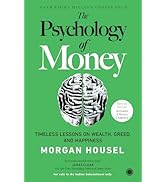
🧠 Unlock the money mindset that Wall Street won’t tell you!
The Psychology of Money by Morgan Housel is a bestselling finance book ranked #10 overall and #1 in Analysis & Strategy, offering 19 short, engaging stories that reveal how human behavior, emotions, and mindset shape financial decisions more than formulas or income. With a 4.5-star rating from nearly 80,000 readers, it emphasizes patience, risk awareness, and long-term thinking to build sustainable wealth, making it essential reading for anyone seeking to transform their financial perspective.









| Best Sellers Rank | #10 in Books ( See Top 100 in Books ) #1 in Analysis & Strategy #2 in Personal Transformation |
| Customer Reviews | 4.5 out of 5 stars 79,652 Reviews |
B**Y
Not a typical finance book
The Psychology of Money is not a typical finance book about formulas or stock tips; it is about how human behavior shapes financial decisions. Morgan Housel explains money through simple stories, showing how emotions, habits, and mindset matter more than intelligence or income. The book highlights that wealth is built through patience, discipline, and long-term thinking rather than quick profits. It teaches that risk, luck, and timing play a bigger role in success than most people admit. Each chapter is short, clear, and practical, making it easy for beginners and experienced readers alike. What makes this book powerful is its focus on real-life thinking patterns—fear, greed, and confidence—and how they affect saving and investing. Instead of telling you what to buy, it teaches you how to think. Overall Verdict: A thoughtful, easy-to-read book that changes how you see money. Perfect for anyone who wants financial wisdom, not just financial advice.
M**L
A Paradigm Shift! "The Psychology of Money" is Essential Reading for Everyone!
I've always believed that managing money was about math and formulas – how much to save, where to invest, and optimizing returns. But "The Psychology of Money" by Morgan Housel completely shattered that notion and opened my eyes to a much more profound truth: financial success isn't primarily about what you know, but about how you behave. This book is an absolute revelation. Housel doesn't just present dry financial advice; he masterfully weaves together captivating stories and timeless principles to explain why our emotions, biases, and unique personal experiences play such a crucial role in our financial decisions. Each short chapter is a powerful lesson, making complex concepts incredibly accessible and engaging. You'll find yourself nodding in agreement, reflecting on your own past choices, and realizing how much of financial advice overlooks the messy, human element. What truly stands out is the book's emphasis on simplicity and common sense. It's not about getting rich quick, but about building sustainable wealth through patience, understanding risk, and defining "enough." Housel distills decades of financial wisdom into actionable insights that are relevant whether you're just starting your financial journey or are a seasoned investor. I particularly appreciated the focus on humility and the acknowledgment that luck and risk often play larger roles than we admit. This book has changed my perspective on money, investing, and even my own relationship with wealth. It's a powerful reminder that controlling your emotions and adopting a rational, long-term mindset are far more valuable than chasing the latest stock tip. If you're looking for a book that will not only improve your financial understanding but also profoundly impact your financial behavior for the better, then "The Psychology of Money" is an absolute must-read. It’s clean, insightful, and delivers on its promises. This is undoubtedly a 5-star product that has earned its permanent spot on my bookshelf and in my mind. Highly, highly recommended!
J**I
A mindset book for money, not a finance manual
Focuses more on money behavior than technical finance. Many ideas around saving, risk, and long-term thinking. A practical and approachable read for building better money habits. Though examples are dated and location based.
N**T
Only if I could advocate this more!
This book is my favourite book of all time now. It has short stories that author brings up of public figures to share their lessons - I believe narratives are quite good for teaching you lessons like these. Plain self help books with no stories lose their meaning after you finish the book and your subconscious mind stores them in the back of the head. I personally found this book to be very helpful. The book is not necessarily about money or finances but as the title says, the psychology of human nature and how it responds to varying degrees of money in life.
A**R
A good read on how to manage money
4.5 Stars. A curveball by Morgan Housel. With a twist in the middle, this book opened certain viewpoints that changed my financial conceptions. Being from a third world country, My views regarding money were very much different. Still,money is a subject which every person in this world sees as an object of wealth, greed & happiness. Hard work & dedication is one of the main principles to it. What you get is how you think of it. Here are some aspects I searched out to be useful and actionable : > It’s never as good or bad as it seems in finance. Going out of your way to find Humility when things seem right and Forgiveness/Compassion when things go wrong is the way to find peace with money. Respecting the power of money mixed with luck and risk will help you focus on the things that you can control. To be honest -> I am still to find it, I take calculated steps to find peace with my money. I am a bit whimsical when it comes to money. Need to control my urges > Saving money is the gap b/w your ego and your income. Wealth is something created by suppressing the urge to buy now; so as to have more stuff in future. ‘No matter how much you earn today, it won’t create wealth unless you discard the thought of how much fun you can have with your money today.’ Save, just save. You don’t need to a specific reason. > Manage your money in a way that helps you sleep at night. It is different for different people. Some won’t sleep until they see higher returns on their money; for others it may be investing conservatively. To each their own. > For every investor, the single most powerful thing is to increase the time horizon. It pushes results closer to what people deserve. We can be wrong half the time, and yet make a fortune. It’s OK to be have lots of things wrong, you’re human. Chillax. > Using money to gain control over your time & the ability to do that gives you independence. What you want, when you want, how you want, with who you want, for as long as you want to, pays the highest dividend in money matters. > Being nicer & less flashy with money helps infinitely. No one else’s as much impressed of your possessions as you are. What you most Want is Respect & Admiration, which can ONLY be achieved by Kindness & Humility, not horsepower and chrome. > Defining the cost of success & paying it is obvious coz nothing worthwhile comes free. Uncertainty, doubt & regret are common costs of money world. We must view costs as fees, not fines. Getting one thing for another is a way of life in finance. > Worship room for error is a conservative hedge that gives us endurance. It happens by the gap b/w what could happen in future versus what you think that should happen in future. Incentives are huge motivators in life. So, try to get more out of life. > Avoid extreme ends of financial decisions at all costs helps us get over a feeling of regret as we evolve. All our goals & desires change over time. In our childhood & youth, we crave to consume. In our adulthood, we crave to consume and provide. In our retirement zone, we try to consume again. Consumption and Creation are parts of life. Minimize the wastage of money. > Conservative risks taking help us, it pays off in time. Being reasonable, not overly rational, helps the most in our financial decisions. They are mostly taken, not in boardrooms or on spreadsheets, but at the dining table, with family. > Define the game you are playing & make sure your actions are not being influenced by others who’re playing a different game. Keeping the ball in your court is crucial. Respect the mess coz smart & reasonable people can disagree on your decisions, as they vary in their thought process.
M**B
An Eye Opening Book About Wealth
The Psychology of Money is an easy and eye-opening book that helps you understand how people think and act about money. It’s not about numbers or formulas but about behavior and emotions. The stories are simple and real, showing why being smart with money is more about patience and mindset than just knowledge. I liked how it teaches that wealth is not how much you earn but how you handle it. The book makes you see money in a calmer and wiser way. It’s a must-read for anyone who wants to manage money better and think long term.
A**K
Must read but Repeated ideas sometimes
✅ Easy to read & full of real-life money lessons 💡 ✅ Makes you think differently about wealth & happiness 💭 ✅ Short chapters — perfect for quick reading sessions ⏳ ✅ Great examples & storytelling style 📖 ❌ Gets a bit repetitive in a few parts 🔁 💬 Overall: A must-read for anyone who wants to understand the mindset behind money — simple, smart, and eye-opening! 💰✨
H**U
Super read - should be part of school curriculum
The best book that I’ve read in my life and I would suggest anyone and everyone to read. It is thought provoking and provides insights in how the other way may be equally right as well (but may not be for you). Super read and should be part of school curriculum.
Trustpilot
3 weeks ago
1 month ago