We remain fully operational. Our teams are working around the clock to ensure your deliveries continue safely.

DOWNLOAD THE APP


Customer Services
Copyright © 2025 Desertcart Holdings Limited
DOWNLOAD THE APP




🚀 Elevate your embedded vision game with Arducam’s plug-and-play 2MP powerhouse!
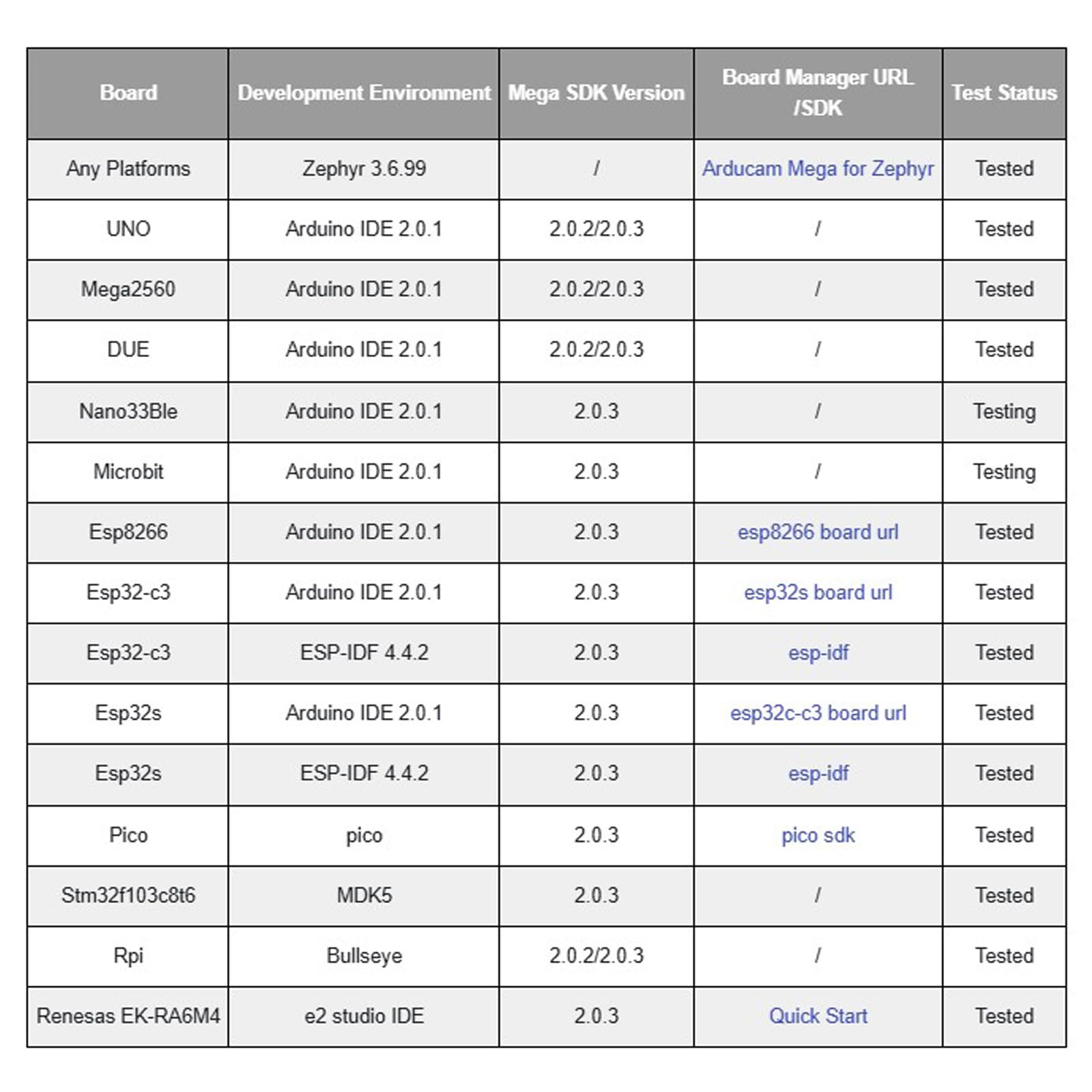
The Arducam Mini Module Camera Shield features a high-definition 2MP OV2640 sensor with IR block filter, compatible with Arduino, Raspberry Pi Pico, and various MCU platforms. It supports SPI and I2C interfaces for streamlined control and data transfer, offers interchangeable M12/CS lens mounts, and comes with open-source code libraries. Designed for compact, low-power applications, it enables professional-grade imaging in IoT, robotics, and embedded systems.
| ASIN | B012UXNDOY |
| Best Sellers Rank | #461 in Single Board Computers (Computers & Accessories) #8,505 in Home Theater Accessories |
| Customer Reviews | 4.2 4.2 out of 5 stars (198) |
| Date First Available | July 29, 2015 |
| Is Discontinued By Manufacturer | No |
| Item Weight | 0.81 ounces |
| Item model number | B0067 |
| Manufacturer | Arducam |
| Package Dimensions | 2 x 1.7 x 1.6 inches |
A**R
Stunning Still Photography for 8 and 32 Bit Microcontrollers
We have integrated the Arducam into our product the ImOkBox and have obtained fantastic results. The ArduCAM Mini lives in two worlds and excels in each. In the Arduino world, it is simply a matter a plugging the device into the header and loading the very well written and commented Sketch.(Sketch is the term for an Arduino programming project.) With one of the provided Sketches you can step through the different camera sensor resolutions and capture images to the SD card. The Sketch sends status information through the UART console. The image quality is amazing. This is a high quality image sensor with a great lens. The other world in which the ArduCAM Mini hits the mark is in commercial products. The genius in the ArduCAM design is that they have abstracted away all the complexity of the image sensor data transfer using their FPGA while keeping direct I2C register access to the sensor. Once the I2C registers have been loaded with the suggested settings, a two character command through the SPI port allows you to capture an image then transfer it at your leisure through the SPI. Using the example Sketches and the excellent documentation .PDFs we were able to start "talking" to the sensor from a non-Arduino platform during the first development session. ArduCAM supplies all the suggested I2C register settings for the sensor for various resolutions. So far I have not needed to tweak a single one but if I needed to, it would just be a simple I2C write. Though a previous reviewer is correct that the ArduCAM mini is a little complex for the Raspberry Pi (Note: ArduCAM makes a superb camera just for the Raspberry Pi) the tradeoff for the "complexity" is that if you are comfortable with working with SPI and I2C on a microcontroller, your 8 bit or 32 bit device can now implement crystal clear still photography with just a few SPI and I2C commands. If we'd tried to implement a direct camera sensor interface on 32 bit ARM silicon, we would be months away from a prototype. Instead, today, using the ArduCAM Mini and less than a hundred lines of C we're uploading 1024 x 768 images to our Twitter API application (@imokbox_dovey) every minute of every day using a $2.50 Freescale microcontroller. If you are comfortable with I2C and SPI communication, or you are willing to put in the effort to learn, this camera delivers everything you could ask for in a still camera. The support team is very responsive, the documentation is clear and provides examples and the working code in their Git Hub repository is professional and well commented.
M**N
Turns digital cameras into a standardized peripheral instead of a custom engineering nightmare
I purchased 16 Arducams from Amazon and 30 more from Arducam directly for a machine vision project of mine. The Arducam is an insightful product that fully standardizes the interface to digital cameras on the I2C and SPI busses such that its users can concentrate on what to do with the images they get instead of how to get those images. Manufacturing quality is high, all of the cameras I received were fully operational. The organization backing the Arducam is active on GitHub, providing both reference software implementations and support for their users. The Arducam is straightforward enough that it can be easily used with an Arduino, however this simple interface means that the Arducam is equally easily integrated with other single board computers such as the Raspberry Pi and the Beaglebone black. It isn’t just a camera for the Arduino, it’s a camera that because it can be easily interfaced to an Arduino, can be easily interfaced to any single board computer, either directly, or through an Arduino if needed for a larger system without exposed SPI/I2C busses. In short, the Arducam brings a plug and play solution to digital cameras at the hardware level. If you want to be able to construct software application that can easily talk to a wide range of cameras without modification, if you need image acquisition to be a straightforward process and not a custom engineering nightmare, this is the solution you want. I believe that as this ‘platform’ evolves, we’ll see an increasing rich set of cameras fronted by the Arducam chip and a steady evolution in the features and capabilities of the Arducam chip itself. In my own application the Arducam has let me integrate a large number of cameras without being buried underneath the details of the implementation, which leaves me free to concentrate on the hard problems, such as building and training the TensorFlow models that consume these images. For that reason alone, I strongly recommend these devices for anyone looking to incorporate digital cameras into their work. The Arducam itself is a unique product, however its greatest value is that it turns the cameras themselves into a commodity, just another part of the project instead of the axle you get wrapped around.
E**P
Wonderful
Honestly, great job! I got this delivered about an hour ago and set it up with low expectations because of how things like this can go. Following the instructions, I was able to get everything up and running within an hour. Excited and see what else is capable with this tiny camera, and for the price you really can’t beat the amount of work that I actually went into making this library and everything else function. People want plug-and-play I guess and as far as Arduino goes this is the easiest thing ever. Super happy !!
D**D
Great
A**R
I am impressed by the quality of this camera (2MP version) purchased for just under £25. Admittedly there was no setup information supplied with the product but an email address quickly resulted in some links to appropriate instructions and software. The camera worked first time and, using the manual focus, produced sharp, colourful images. I had a bit of difficulty getting it to save images to my hard drive but an email exchange quickly sorted that out. Highly recommend both product and service.
明**く
取り付けてみました。web上に落ちているソフトで簡単に動きました。
K**N
Received in good quality and it works!
ひ**9
pico2wで無事使えました
Trustpilot
2 days ago
4 days ago