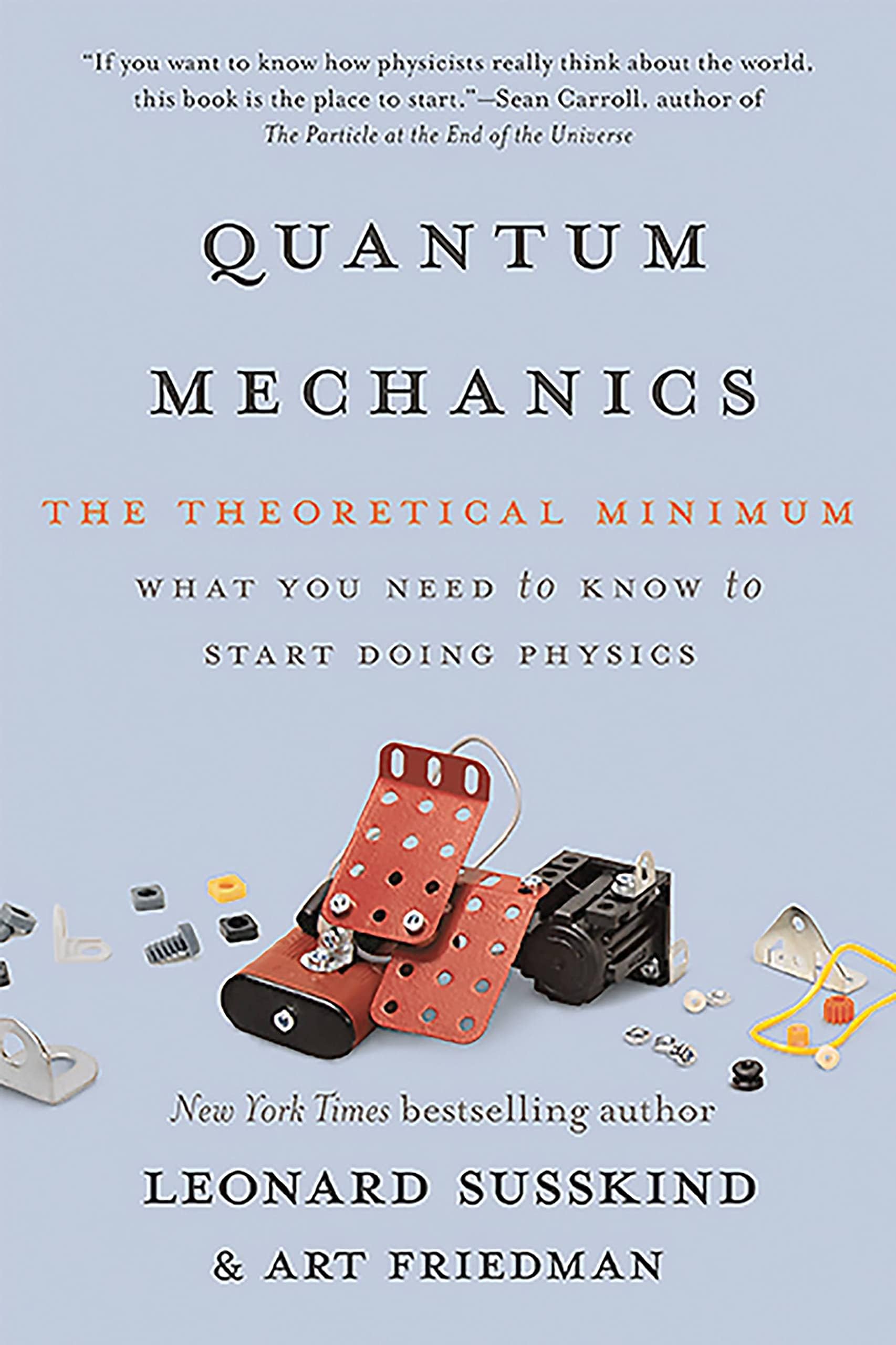
Quantum Mechanics: The Theoretical Minimum
Product ID: 203183603
Buy anything from 5,000+ international stores. One checkout price. No surprise fees. Join 2M+ shoppers on Desertcart.
Desertcart purchases this item on your behalf and handles shipping, customs, and support to Kyrgyzstan.
Buy Quantum Mechanics: The Theoretical Minimum Illustrated by Friedman, Art, Friedman, Art, Susskind, Leonard, Susskind, Leonard (ISBN: 9780465062904) from desertcart's Book Store. Everyday low prices and free delivery on eligible orders. Review: The best introduction to the math, without blather about quantum weirdness - This book will appeal to people who, like me, have dabbled in many ways with quantum theory over the years and read many books on it but perhaps never before found anything so clear, authoritative, mathematically sound, and free of blather about how quantum theory defies what seems to pass for common sense along lay readers. The mathematical level will challenge readers lacking prior acquaintance with algebra, calculus, vectors and matrices, complex numbers, and classical mechanics, but this is after all the basic toolkit for anyone seeking to get a serious grip on what makes quantum mechanics tick. Apart from that, the humility that comes with advancing age and a wry sense of humor will suffice to carry you through this engaging little book. Leonard Susskind obviously knows the theory as well as anyone, intimately, and has evidently taught it often enough to know exactly know to optimize his approach. He prepares the ground carefully and uses the qubits representing spin as his main running example, which lets him avoid murky issues around particles and waves for most of the discussion. He also works in Dirac algebra from the start, which is far and away the clearest approach for my money and provides a solid base to discuss the respective approaches and main results of Heisenberg and Schrödinger, when he gets that far. I found his treatment far more enlightening than that in volume 3 of the Feynman lectures, where Feynman made a mess of presenting Dirac algebra and failed to motivate either matrix mechanics or wave mechanics with sufficient mathematical or philosophical care. Susskind has properly taken on board the depth of the foundation work needed to present quantum theory intelligibly, so as not to be shipwrecked on the rocks of the paradoxes that lead weaker heads to despair about ever making sense of their challenge to what used to pass for common sense about physical reality. His discussion of states and state vectors, basic principles, entanglement, uncertainty, nonlocality, dynamics and so on is always spot on, with a confident mathematical grip on the issues and a calm refusal to be ruffled by the difficulties they present to intuitive comprehension. His approach is ideally suited to showing how and where quantum logic defies classical logic, how far you can go before deep issues about spacetime need to be confronted, for example by going from discrete sums to continuous integrals, and how little you need to fuss about particle and waves before the new foundations are in place. A modern introduction to quantum mechanics needs to go beyond Dirac's elegant but dated and difficult textbook, both in terms of approach to set things up for new work in quantum computation and high energy physics and in terms of content to touch on such topics as the Bell inequalities, the trials of Alice and Bob, and the creation and annihilation operators of quantum field theory. Susskind does all this with masterly cool, as well as a warm appreciation of the excitement in wait for people who go on to tackle those further topics. Art Friedman has made sure the text remains accessible to plodders like me, though perhaps some of his humorous additions might be trimmed or deleted in future editions of what seems to me to be a core text with a long and glorious potential afterlife. Review: Info dense - Taught me a lot. Huge inspiration for my own work.


| Best Sellers Rank | 1,807,688 in Books ( See Top 100 in Books ) 16 in Popular Maths 55 in Popular Science Physics 451 in Scientific, Technical & Medical |
| Customer reviews | 4.6 4.6 out of 5 stars (2,505) |
| Dimensions | 13.84 x 3.05 x 20.83 cm |
| Edition | Illustrated |
| ISBN-10 | 0465062903 |
| ISBN-13 | 978-0465062904 |
| Item weight | 381 g |
| Language | English |
| Part of series | The Theoretical Minimum |
| Print length | 384 pages |
| Publication date | 12 May 2015 |
| Publisher | Basic Books |
A**S
The best introduction to the math, without blather about quantum weirdness
This book will appeal to people who, like me, have dabbled in many ways with quantum theory over the years and read many books on it but perhaps never before found anything so clear, authoritative, mathematically sound, and free of blather about how quantum theory defies what seems to pass for common sense along lay readers. The mathematical level will challenge readers lacking prior acquaintance with algebra, calculus, vectors and matrices, complex numbers, and classical mechanics, but this is after all the basic toolkit for anyone seeking to get a serious grip on what makes quantum mechanics tick. Apart from that, the humility that comes with advancing age and a wry sense of humor will suffice to carry you through this engaging little book. Leonard Susskind obviously knows the theory as well as anyone, intimately, and has evidently taught it often enough to know exactly know to optimize his approach. He prepares the ground carefully and uses the qubits representing spin as his main running example, which lets him avoid murky issues around particles and waves for most of the discussion. He also works in Dirac algebra from the start, which is far and away the clearest approach for my money and provides a solid base to discuss the respective approaches and main results of Heisenberg and Schrödinger, when he gets that far. I found his treatment far more enlightening than that in volume 3 of the Feynman lectures, where Feynman made a mess of presenting Dirac algebra and failed to motivate either matrix mechanics or wave mechanics with sufficient mathematical or philosophical care. Susskind has properly taken on board the depth of the foundation work needed to present quantum theory intelligibly, so as not to be shipwrecked on the rocks of the paradoxes that lead weaker heads to despair about ever making sense of their challenge to what used to pass for common sense about physical reality. His discussion of states and state vectors, basic principles, entanglement, uncertainty, nonlocality, dynamics and so on is always spot on, with a confident mathematical grip on the issues and a calm refusal to be ruffled by the difficulties they present to intuitive comprehension. His approach is ideally suited to showing how and where quantum logic defies classical logic, how far you can go before deep issues about spacetime need to be confronted, for example by going from discrete sums to continuous integrals, and how little you need to fuss about particle and waves before the new foundations are in place. A modern introduction to quantum mechanics needs to go beyond Dirac's elegant but dated and difficult textbook, both in terms of approach to set things up for new work in quantum computation and high energy physics and in terms of content to touch on such topics as the Bell inequalities, the trials of Alice and Bob, and the creation and annihilation operators of quantum field theory. Susskind does all this with masterly cool, as well as a warm appreciation of the excitement in wait for people who go on to tackle those further topics. Art Friedman has made sure the text remains accessible to plodders like me, though perhaps some of his humorous additions might be trimmed or deleted in future editions of what seems to me to be a core text with a long and glorious potential afterlife.
F**O
Info dense
Taught me a lot. Huge inspiration for my own work.
M**S
A good beginner's introduction to quantum mechanics
If you work through this book carefully, you will learn some of quantum mechanics -- a similar subset to what the Feynman lectures would give you, but without the atomic physics. You will learn a lot about spin 1/2 and entanglement of two particles. You will learn about one dimensional Schrödinger and how to solve it in free space and also the harmonic oscillator. You won't learn anything about bosons versus fermions, or anything at all about three dimensional solutions or anything about the Hydrogen atom or nucleus. You will not be able to follow the book unless you understand basic calculus and some of classical physics, such as the formulae for kinetic energy, momentum and the energy of a spring -- basic A level stuff. Though integration by parts is spelled out for you. The book is aimed at quite a low level, it works very slowly and step by step, and it is reasonably rigorous. I particularly like the presentation of entanglement and the non nonsense approach to the interpretation of quantum mechanics. It would be hard to read this book and end up thinking that consciousness, mysticism or wave-function-collapse have anything to do with quantum mechanics. This book leads you to Many Worlds by the back door, without ever making that explicit, but I don't see that as a bad thing. At the moment, it is the only consistent theory out there. There are a very few typos in the text, but rather more in the exercises. The exercises are mainly very easy, but a few are difficult and a few do not make sense at all, because of mistakes in them. A little more proof reading would help here. I read the Kindle version as it is cheaper. It's OK, but a bit of a pain to leaf back to find formulae that are referred to. I much prefer the way this is done in the online Feynman lectures, where formulae pop up in a box when you click on them. Overall, I recommend this book. If you've not done any quantum mechanics before you'll find it pretty hard going, but probably no harder than any of the other books out there and easier than many of them.
A**R
Great book, very informative.
M**X
It has the best explanation of quantum entanglement that I have encountered so far.
L**M
The book begins with simple and accessible language and increases in difficulty according to the theme, without ever losing clarity. In it, many scholars find new themes of mathematics and physics to be studied. The book together with the course that Professor Leonard Susskind and Stanford University make available for free on YouTube (in English) is enough to begin to understand the immensity of this theme that is applied to everything we use in our day to day, both in electronics as in medicine. Anyone who thinks that Quantum Mechanics is only theoretical is wrong. So, don't think twice, buy the book and watch the 10 classes of 2 hours each on YouTube for free and start understanding more advanced books on the subject.
C**N
Una excelente y peculiar introducción a la mecánica cuántica, con la participación de Leonard Susskind, uno de los padres de la teoría de cuerdas. El texto es relativamente sencillo, pero riguroso. Hay que tener en cuenta de que libro va dirigido a personas que tengan una cierta formación científica-matemática. Yo diría como mínimo un estudiante de ciencias (física, química, matemáticas) de 2º curso. Se necesita también cierto nivel de inglés. Aunque este libro está traducido, yo la que tengo es la versión en el idioma original. Desconozco si la versión traducida al castellano es buena o no. Las lecciones vienen con bastantes ejercicios, que no vienen resueltos en el libro, aunque hay un página web con las soluciones donde se pueden comprobar los resultados. No recuerdo la dirección de la página ahora, pero no es difícil encontrar.
I**N
Mycket bra bok som kräver eftertanke. Ingen snabbläsning
Trustpilot
1 month ago
3 weeks ago