We remain fully operational. Our teams are working around the clock to ensure your deliveries continue safely.

DOWNLOAD THE APP


Customer Services
Copyright © 2025 Desertcart Holdings Limited
DOWNLOAD THE APP


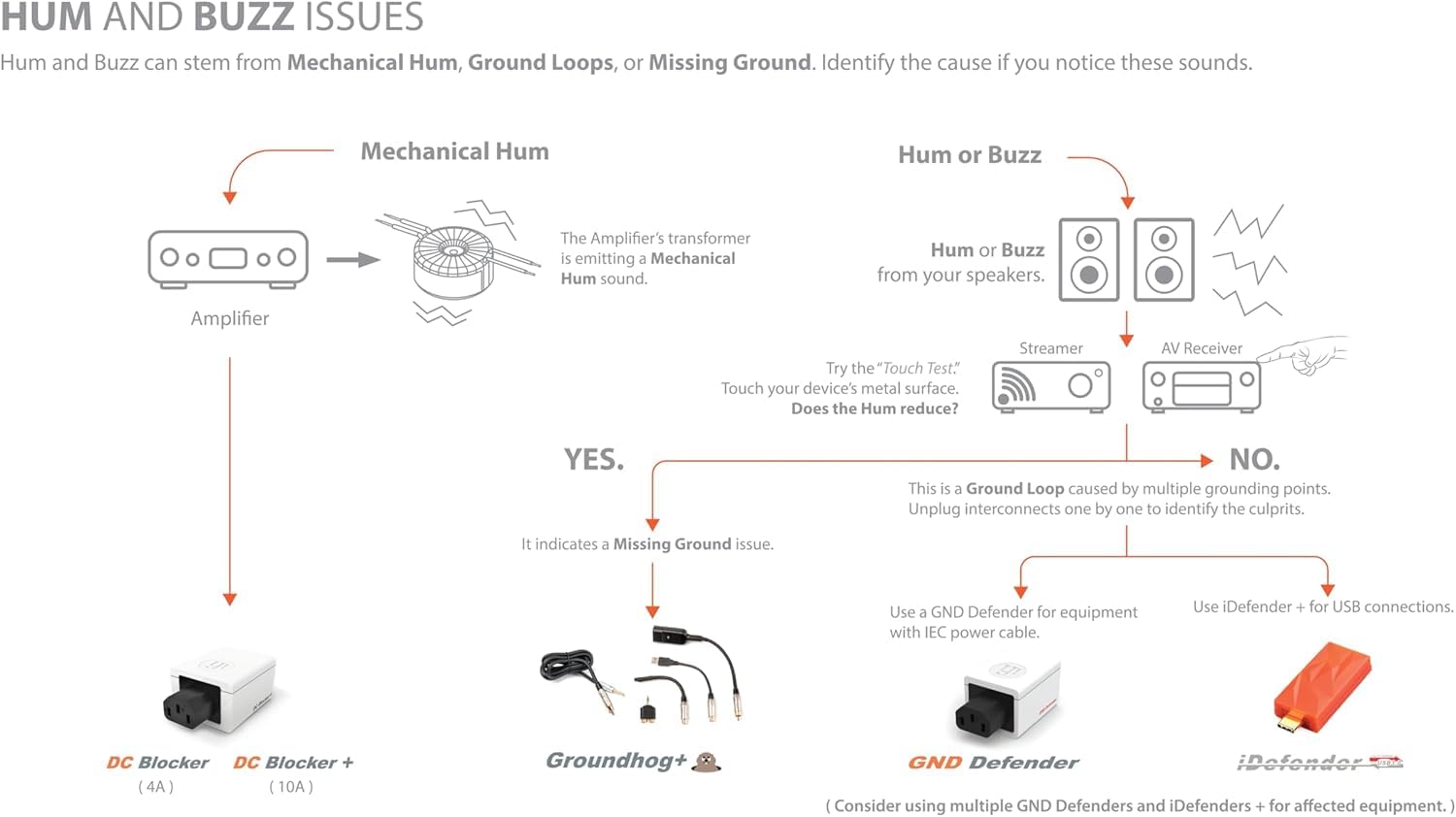
🔊 Cut the noise, keep the vibe — your audio’s new best friend.
The iFi iDefender+ is a compact USB audio ground loop eliminator designed to silence humming and buzzing caused by multiple grounded devices in your audio chain. Compatible with USB Type A connections, it preserves USB 3.0 high-speed data transfer while offering an optional USB-C port for clean 5V power input. Ideal for professionals and audiophiles seeking clearer, warmer sound by reducing system noise floor and interference.


| ASIN | B0849J33T9 |
| Best Sellers Rank | 9,702 in Electronics & Photo ( See Top 100 in Electronics & Photo ) 200 in Audio & Video Adapters |
| Brand Name | iFi |
| Colour | orange |
| Compatible Devices | Laptop, Personal computer |
| Connector Type | USB Type A |
| Country of Origin | China |
| Current Rating | 1 Amps |
| Customer Reviews | 3.8 3.8 out of 5 stars (661) |
| Input Voltage | 5 Volts |
| Item Dimensions | 12.7 x 9.1 x 1.5 centimetres |
| Item Weight | 6.6 Grams |
| Manufacturer | Abbingdon Music Research |
| Model Number | iDef+ |
| Nominal Power | 5 Watts |
| Number of Items | 1 |
| Number of Ports | 4 |
| Package Quantity | 1 |
| Power Plug Type | No Plug |
| Product Finish Type | Metallic |
| Specific Uses For Product | PC, Laptop |
| Unit Count | 1.0 count |
| Warranty Type | Limited |
A**R
It does the job but check you really need it ...
When I moved house and setup up my guitar and synth bits in the new place, I was treated to the most horrendous ground hum, staticy, zuzzing noise through the monitor speakers from the USB audio interface attached to my desktop DAW system. I never had this problem at the old place aside from a very small hum which a small Behringer Hum Destroyer/Suppressor fixed. This little iDefender fella removed most of the noise, leaving only a very faint electrical connection sound in the distance if you put your ear to the speaker and which you'd easily forget about when audio was coming through. So, it did the job it was supposed to do but it is quite expensive at £60. The reason I say "check you really need it" is because I did little more investigation and found a better and cheaper solution for my setup. As I had never had a real problem before, my Steinberg audio interface had always been connected to the Mackie monitors via mono 1/4" cables. Apparently, these are called Unbalanced. The Steinberg and the Mackies both support TRS (stereo) cables otherwise known as Balanced. No idea what all that means but professional stuff all generally supports Balanced. I bought a pair of TRS audio cables from Amazon (RUXELY 6.35mm TRS Instrument Cable) for a grand total of £12 and voilà. ALL the noise vanished. Nothing evident even with your ear up against the speaker. Didn't even need the Behringer. Problem solved. iDefender not required. iDefender returned. Balanced is clearly the way to go and I probably should have known this but I'd never had this problem before in the previous 15 years with all sorts of kit and different interfaces. Balanced TRS cables on everything from now on. That said, if that doesn't do it in your situation then the iDefender will likely get the job done.
S**S
Did not help my audio hum issue
It was quiet pricey for such a simple solution (ground loop noise elimination) but it did not work sadly for me. Will not recommend for someone who has an audio interface like Focusrite Scarlett 2i2 taking power via USB.
D**R
Expensive but works for a specific problem
Lots of different opinions in the reviews but the basic fact is that this little device is made to fix one specific problem, and it fixes it very well. If you have a ground loop issue that is causing your audio interface to hum and crackle - this will fix it. Yes, it's very expensive for what you get. Yes, you need to supply your own external USB power supply. But that pales into insignificance, because it just works. I was getting horrendous interference, humming, call it whatever you like, when I had my Scarlett 8i6 plugged into my PC's USB port. With this, it's absolutely silent. I can turn my amp up to max volume and there isn't a hint of noise. So much so that I keep having to check that it's still powered on. Playing my synths through the audio interface is now crystal clear, the best they've ever sounded. I still can't quite believe it's as good as it is. So like I say. For this one, very specific problem, this little device is fabulous. But if your problem isn't a ground loop, then it ain't gonna do a thing.
F**D
Works brilliantly, but needs external power and is very fussy about the power supply.
At first I thought the stick was defective as I had terrible interference when used with an AudioQuest Dragonfly Cobalt. Adding external power helps, but I was still getting some noise . Powering the unit from my PC didn't work (again, I got some noise), nor did powering it from the wall using a USB 3.1 C cable. I think the problem was that quick charge or fast charge was introducing noise in this case. You want the oldest, dumbest 5V power supply you can find that still works with USB C. The solution for me was to use an old USB 2.0 A to C cable along with an iPhone wall charger With the iPhone charger powering the unit, I can turn my external amp up to 100% (way too loud to listen comfortably or safely) with no signal playing and I get no noise whatsoever - no buzz or hiss. At sensible listening volumes music is crystal clear. The eliminator comes with a USB C to barrel adapter, but I didn't have a suitable power supply on hand for that. If you do what I did and use a phone charger with a USB C cable, be prepared to try a few different cables until you find one that plays nicely with this unit.
G**S
Cheaper Than Power Conditioning and It Worked For Me!
I was having a nasty ground loop buzz through my RME Babyface Pro and Yamaha HS5 monitors since I moved into my flat. Despite my skepticism, the iFI Defender actually worked as things are whisper quiet now. Be aware, THIS IS NOT A MIRACLE CURE FOR GROUND LOOPS. I still had to do a lot of trouble-shooting in regards to my setup, as the culprit was due to my multi-effects (Line 6 Helix) creating a lot of noise via its USB connection in the same chain as the RME Babyface ; even with the iFI Defender connected. It still depends on how you chain your audio equipment together. While it may be pricey in comparison to the cheaper ground loop isolation modules on the market, it may be the only product you need to keep you from a large headache with ground loops!
J**N
Después de fabricar cables, buscar soluciones por internet sin éxito encontré este el dispositivo. La única solución después de años de búsqueda para el dichoso ruido ha salido la solución. Eso sí, debes comprar también el adaptador de corriente que vende la misma empresa, si no lo compras y lo pones no sirve de nada, pero ambos son la solución perfecta. En mi caso lo he puesto en el hub donde tengo todos los sintetizadores conectados por USB para la transferencia de datos midi entre los sintetizadores y mi Daw. Mano de santo estos Dos dispositivos en su conjunto siempre. Dejaros de cortar cables de corriente en los cables midi, las tomas de tierra, ni cables en Y fabricados ni por uno mismo ni comprados, ya lo he probado "todo" y por fin encontré la solución al problema que tenía y por supuesto no es una broma el problema, es un gran problema porque al componer y grabar tener el maldito ruido no es poca cosa.
D**.
Ich nutze Yamaha HS7 als PC Lautsprecher. Fürs Zocken, Filme schauen und so weiter. Also keine studiotechnischen Anwendungen. Angeschlossen sind diese an einem Audio Interface, dem Steinberg UR22C. Das Ergebnis ist wirklich gut, kein Rauschen, Summen etc. WICHTIG! - Unbedingt ein passendes Netzteil [5V/2,5A] verwenden. - WICHTIG! Hatte den iFi iDefender+ per USB-C auf USB-A Kabel direkt an der Stromleiste angeschlossen oder wahlweise mit einem anderen Netzteil (Amazon Alexa-Echo-Dot Netzteil, Samsung Charger). Es muss nach meiner Erfahrung nicht das iFi iPower2 sein. Habe ein Netzteil [5V/2,5A] für 15€ inkl. Kabel beim Elektrofachhandel gekauft und das Ergebnis ist nochmal besser als zuvor. Das Behringer MicroHD HD400 wird nun NICHT mehr mit genutzt. ///Alte Bewertung: Allerdings gab es je nach Anwendung - Knistern / Rauschen bei Mausbewegungen - Knistern / Summen bei Downloads - Knistern / Summen / Rauschen bei Arbeit in grafikintensiver Software / oder Videogames Einmal den kompletten Raum auf den Kopf gestellt und versucht die "Störquelle" zu finden. Neue Kabel, alles. Bis ich den iFi iDefender+ (Typ A bis A) bestellt und angeschlossen habe. Knistern und Rauschen sind deutlich besser geworden, jedoch nicht zu 100% verschwunden. Daher hatte ich lange überlegt die dazugehörigen Netzteile zum iFi iDefender+ dazu zu bestellen. Bei der Recherche bin ich jedoch auf das Behringer MicroHD HD400 aufmerksam geworden. Die Störgeräusche sind nun völlig auf 0. Meine Empfehlung liegt daher ganz klar erst das Behringer MicroHD HD400 zu testen da es deutlich preiswerter ist und passiv eine deutliche Verbesserung bewirkt. Sollte das nicht ausreichen, kann immer noch mit einem iFi iDefender+ nachgeholfen werden. Erdungsschleife hin oder her, das Rauschen auf den Lautsprechern/USB Interface ist nun Geschichte!///
S**E
Ayant récemment remplacé tout mon materiel de MAO (Tour PC, carte son...) par du tout frais, je me suis heurté aux problèmes que beaucoup rencontrent: buzz, interférences... une horreur quoi. J'ai tout tenté (utilisation de jacks symétriques, placements des cables audio par rapport aux alimentations.....) sans succès... J'ai identifié une boucle de masse générée par mon préampli guitare externe connecté sur ma carte son, et dont l'alim est sur le même réseau électrique que le reste de mon materiel, mais buzz et interférences étaient toujours bien présents. Je n'avais jamais rencontré ces soucis avec ma config précédente, que j'utilisais depuis plus de quinze ans. Après pas mal de recherches, je me suis décidé à tenter cet isolateur USB car tout me menait vers cette option... Et bien gagné !!!!!! Plus le moindre souffle, pas de buzz, pas une interférence, le silence absolu !!! Certes, ce petit isolateur est assez couteux, mais franchement impossible de s'en passer lorsque on rencontre ces problèmes. Ma config est la suivante: - tour PC type "Gamer" bien puissante, mais naturellement source d'interférences pour de la MAO (ventilateurs, carte graphique, wifi...) - Interface audio Steinberg UR242 (du coup pluggée sur l'isolateur en entrée usb du PC) - Processeur externe guitare Avid Eleven Rack - Plug-in guitare Bias FX2 de chez Positive Grid sur PC - routage de la carte son et du processeur guitare via une petite mixette analogique Behringer (de manière à pouvoir utiliser l'eleven rack pour jouer sans avoir à allumer le PC) - Enceintes de monitoring Samson Resolv 40A en sortie de la console - Cubase 11 pour l'enregistrement - Clavier Nektar Panorama T4 pour le pilotage de Cubase et le jeu sur des instruments virtuels Tout ce petit monde cohabite maintenant dans la paix et l'harmonie :-) Précision importante: l'isolateur doit être impérativement alimenté (même si la carte son à elle aussi sa propre alimentation électrique) via son connecteur USB C (perso j'utilise mon chargeur de téléphone, peut être en achèterais-je un dédié...) Je souhaite que ce petit isolateur fonctionne bien dans la durée parce qu'il reste quand même assez cher... J'ajusterais mon commentaire si je constate quoi que ce soit qui cloche. J'espère que mon avis pourra aider ! et... mort aux buzz !!!!!
V**D
Its do nothing
S**T
I have a couple of Line6 guitar processors (Helix Floor and HX Effects) that both inject ground loop noise into my amps and recording interface when plugged into my PC to use their editing software. This device succeeds in breaking the ground loop that causes the noise and does not disrupt the software communication with the device. Just be sure to power it using a phone charger rather than a port on the PC. I was hoping I could use it passively like a transformer-based solution, but it does require power.
Trustpilot
3 weeks ago
4 days ago