Some deliveries may take a little longer than usual due to regional shipping conditions.

DOWNLOAD THE APP


Customer Services
Copyright © 2025 Desertcart Holdings Limited
DOWNLOAD THE APP
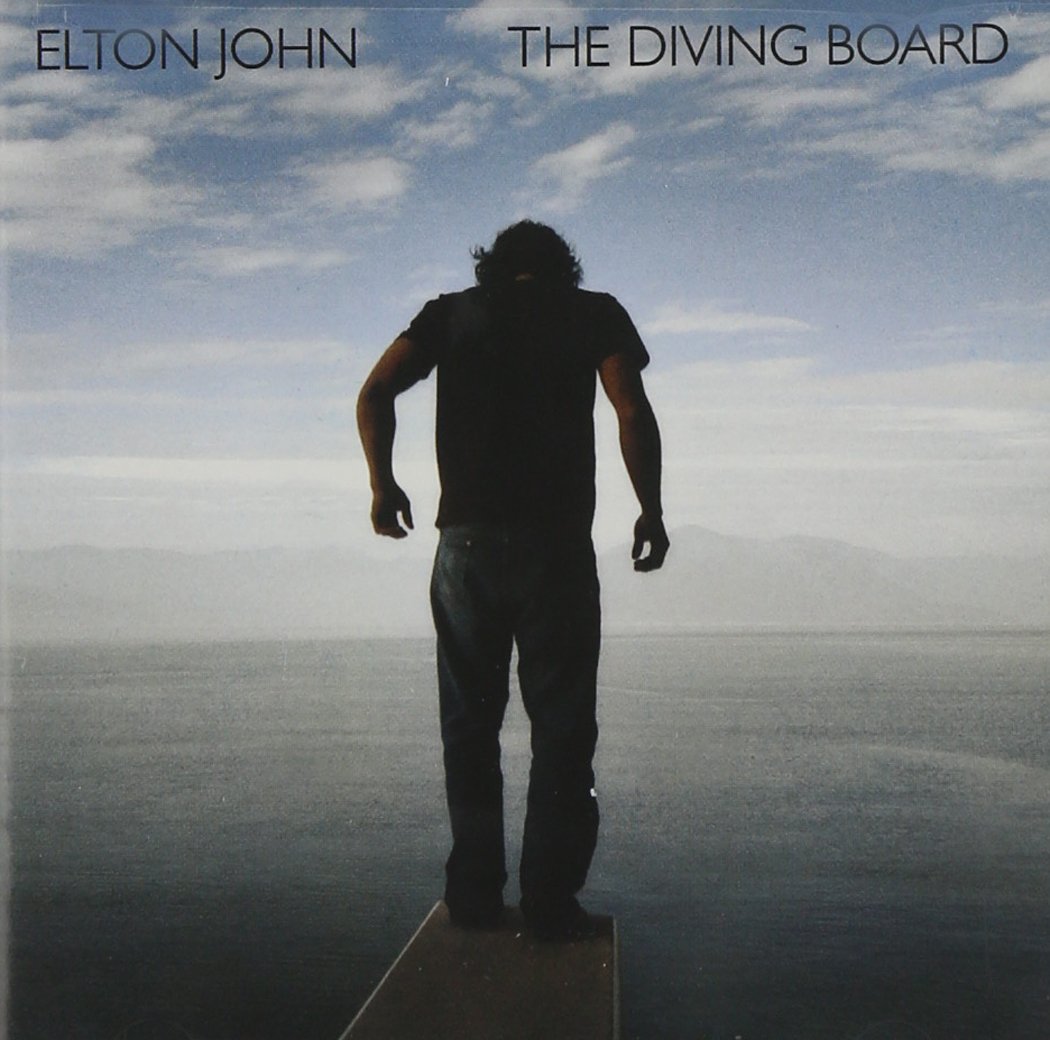
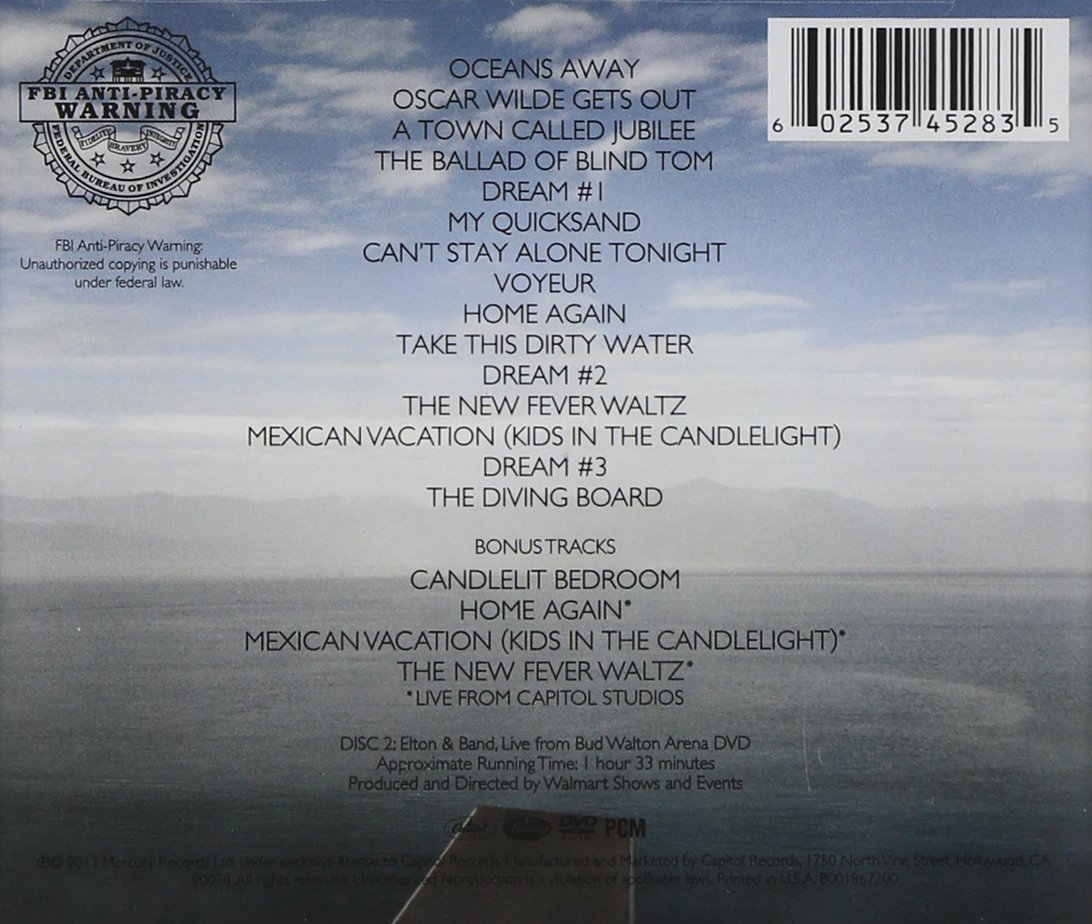
ELTON JOHN DIVING BOARD DELUXE 19 TRACK CD COMES WITH 1hr 33min DVD LIVE CONCERT CONCERT RECORDED AT THE BUD WALTON ARENA
E**L
This is the Elton John We've Been Waiting For!
The Diving Board is not Elton John's "first record" since The Captain and the Kid in 2006. He released a CD called The Union with Leon Russell - produced by T Bone Burnett - just three years ago. Although it was not a "solo" Elton John effort, it was as much an Elton John album as anything else he's released in his career, even if he shared top billing with his hero and mentor of 40-plus years ago. EJ co-wrote and played piano on almost all of the songs, and sang lead or backing vocals on all but one track.As for The Diving Board, it was controversial before anyone had heard a note. Some fans were apoplectic that Elton's excellent and versatile touring band, headed by longtime EJ guitarist Davey Johnstone, was left off the new work. Fans furiously pointed fingers at T Bone Burnett, the producer on this, his second project with the Rocket Man. "Burnett is a musical tyrant!" protested some Elton John devotees on social media sites. "He is a bad, bad man who doesn't understand Elton's music!" I'm paraphrasing, but you get the idea.The truth is that T Bone Burnett deserves a medal for drawing out the real Elton John on this recording. Burnett told Elton before they started that he'd like to see the Pinner native go back to basics. Not just back to basic rock, or back to organic music without synths and click-tracks, but a piano-bass-drums set-up, like Elton's touring band of 1970-71, which featured Nigel Olsson on drums and Dee Murray on bass. Burnett attended one of Elton's historic Troubadour concerts in Los Angeles the week of August 25, 1970, the series of shows which made EJ a star, as they say, overnight. As Elton enthusiasts know, his trio floored jaded, music industry heavies. Elton, with his voice and piano in the forefront, amazed his audience without special effects or gimmicks. He didn't even dress up (much) for this gig. With Nigel and Dee, he simply brought his songs to life through ingenious musicianship, and the sort of breast-beating vigor he still summons today, at age 66.So T Bone Burnett now gives us the real Elton, the unadorned Elton, the barely accompanied Elton, the Elton who has not an unmusical cell in his body. His lyricist of 46 years, Bernie Taupin (who now prefers to be known as a "storyteller"), once remarked, "Elton is the most musical person I've ever met. It vibrates from him." And those vibrations sent tremors that shook the recording studio; T Bone welcomed them, nurtured them, captured them - in analog - and now it is our privilege to let them settle into our generally unmusical lives, bringing us joy, tears and plenty of tingly moments.Elton has played piano on all of his albums, with the exception of the Complete Thom Bell Sessions (released in 1989 but dating from 1977) and the unfortunate 1979 disco release, Victim of Love. He has titillated us, made us laugh, got us dancing, or made us mourn with that piano. But compared to The Diving Board, Elton's other albums seem almost devoid of piano, seem like aural adaptations of the "Where's Waldo" game:"Where's Elton?"Past producers, including, occasionally, Elton himself, have more often than not treated his piano as just part of the band. An electric guitar or saxophone solo was perhaps likelier than a piano interlude in the middle of any given recording. Sometimes, even when you knew the piano was there, it was barely audible.Elton chose noted bass guitarist Raphael Saadiq for the Diving Board sessions. Jay Bellerose on drums, who played on The Union, completes the trio. Other instruments enter the recording unobtrusively, like a garnish or brush of color. Luka Sulic and Stjepan Hauser, the two members of 2Cellos, who have toured with Elton as well as on their own, make their strings purr in spots. For a couple of songs, the twang of a pedal steel hovers shyly in the air. Horns slide in warmly a few times. Backing vocalists join here and there. Otherwise, it's just Elton and the keys.It's evident on The Diving Board that T Bone pushed or encouraged Elton to be, in the recording studio, what he is onstage - a master of keyboard improvisation, a vocal powerhouse. Burnett gives us the Elton of the deep, lower register, that sexy lower register heard only sparingly on latter-day recordings. On The Diving Board, it dominates, especially on "Oscar Wilde Gets Out," "My Quicksand," "Home Again" and the title track, "The Diving Board."Taupin has come through with possibly the most exciting set of lyrics - or stories - he's handed Elton in many years, if not ever. There is a knowingness in Taupin's words, from having actually lived life, that is missing from much of his most famous word-paintings, since, as a young man, he was largely writing not from life, but from books and his mind's eye. With his increased insight come lines and imagery of special elegance.Peeling away the layers that have hidden Elton's genius in varying degrees for far too long, T Bone gives us the complete music man, as close to unvarnished as possible, as Captain Fantastic animates Taupin's words in an Elton John album like no other, the least commercial of his career, and the most daring.Now we turn to the songs.Oceans Away: This track, a gorgeously elegiac album-opener, featuring just piano and voice, is a vastly superior update of Tumbleweed Connection's "Talking Old Soldiers" (1971). In "Oceans Away," Taupin seems to have spent real time with nonagenarian World War Two vets reminiscing about "those that flew, those that fell, the ones that had to stay, beneath a little wooden cross, oceans away."Oscar Wilde Gets Out: The noted 19th century Irish writer - his most familiar work being The Picture of Dorian Grey - who was imprisoned in England for being gay and, just a few years after his release, died in Paris, young (only 46), miserable and destitute, comes alive in this dramatic track. Elton's music takes several gut-wrenching turns, leaving the listener emotionally spent by the end. On this and several other tracks, Funk Brother Jack Ashford's percussion block, most famously heard in Marvin Gaye's "What's Going On," comes through, as lonely and haunting as the echoing clank of a prisoner's ball and chain.A Town Called Jubilee: What is this song about? A farm family made homeless by foreclosure, moving to a better place, a new town serving as their "jubilee"? Or have they passed to the Great Beyond? It's hard to say. But the rustic setting, a junk-filled yard, auctioneers playing cards, and an old black dog are gently swept along in Elton's pleasing tide of jazzy, gospel chord progressions, with a bit of bluegrass guitar politely asserting itself in the background.The Ballad of Blind Tom: This tells the true story of Blind Tom Wiggins, a sightless, autistic African-American, first a slave and then barely free, who brought fame to himself and fortune to his one-time owner as a piano-playing wizard, entertaining VIPs across America and Europe. "I may be an idiot/I may be a savant/I didn't choose this life for me/But it's somethin' that I want." Elton's driving, classically-tinged playing suggests a performance by Blind Tom himself.Dream # 1: The first of three brief, piano instrumentals, which Elton improvised in one take, this serves, wittingly or not, as the perfect outro to "Blind Tom," with its clever integration of antebellum melodicism and Jim Crow-era ragtime.My Quicksand: An unlucky person laments getting sucked into a life-draining relationship. "My quicksand/Welcome to my final stand/I went to Paris once/I thought I had a plan/I woke up with an accent/I wound up in quicksand." Elton sings theatrically, but in a 1950s torch song sort of way. He is wry, regretful, a nearly-willing victim. A smoky, jazz piano break, caressed by Jay Bellerose's intimate drum brush, is the romantic slow dance. But descending chords emulate the fatal scene in which the protagonist is swallowed whole.Can't Stay Alone Tonight: This is the best country song the John/Taupin songwriting team has ever composed. In its witty sophistication and friendly, down-home imagery, it outdoes `em all: "Country Comfort," "Texan Love Song," "Dixie Lily," "Turn the Lights Out When You Leave." They are all plebeian efforts next to this one. Toby Keith, George Strait, take note. You could learn a thing or two. "Can't Stay Alone Tonight" makes you want to get out your cowboy boots and ten-gallon hat, even if you don't have any, and find the nearest country dance hall, even if you don't live near one. "Things have to change/And they might," Elton sings brightly over his rollicking country piano licks. And you believe it.Voyeur: This is the cream of a very abundant crop, the song worth the CD purchase price all by itself. You wouldn't think that a mid-tempo ballad about voyeurism would literally grab you by the collar, shake you up and leave you sprawling in a strangely seductive back alley, but that's what this song does. Is it about a pervert who gets his jollies sneaking glimpses of embracing lovers through a keyhole or from behind a curtain? Is it about government spying? Either way, you'll love every minute of it, every titillating melodic turn. Have a warm compress handy if you need calming afterward.Home Again: The moving first radio single from the album, it is a mini-epic, a five-minute cinematic, anguished longing for home, for the past, for whatever it is that makes one feel that need to return to one's roots. It's sad - thus, bluesy - and Elton's sweeping piano chords wash the song in symphonic tones. "We all dream of leaving/But wind up in the end/Spending all our time trying to get back home again."Take This Dirty Water: The simplest song of the bunch, it's an infectious, straight-up African-American gospel ditty with cheerful, staccato expressions on the blacks-and-whites, a churchy, muscle-flexing lead vocal and a mischievous back-up chorus of oo-hoos, all of which put a broad smile on your face well before the end.Dream # 2: Elton's second instrumental, slightly longer than the first, full of classical introspection, forms the perfect introduction to the next song.The New Fever Waltz: Some may notice a faint resemblance here to "Grandma's Song" in Elton's West End theatrical smash, Billy Elliot: The Musical, but it's really a gripping update of "Where To Now, St. Peter?" the fan favorite from Tumbleweed Connection. Instead of taking a "blue canoe" to the world beyond this mortal coil, as do the U.S. Civil War dead in "St. Peter," we join a World War One cavalry soldier, dying from the flu or some other untreatable infection in that pre-penicillin age ("I was shaking with a fever/When the last good horse went down"). He glides from this life in graceful waltz steps ("Shaking with a fever/Before the white flag flew/And the ballroom opened up to us and the dancers danced on through"). It's impossible not to tear up.Mexican Vacation (Kids in the Candlelight): After the consummated tragedy of "The New Fever Waltz," one gladly joins Elton on a fierce, blues-inflected boogie-woogie kick through a pending societal shift. Whether referring to young, would-be beneficiaries of the DREAM Act (the U.S. immigration bill languishing in Congress), or Occupy Wall Street activists, or a procession of Wide-Awakes during the 1860 presidential campaign, "Mexican Vacation" gives EJ a chance to showcase some of the rockingest chops and bluesiest growling ever to reverberate off the walls of a recording studio.Dream # 3: This is the longest of the three instrumentals, and the most illuminating, as EJ veers into Keith Jarrett territory. Elton isn't known for playing abstract jazz, but listen to this and you'll think that's what he's been doing all of his life. Drummer Jay Bellerose taps a clever counterpoint to EJ's spontaneous musings.The Diving Board: This is some song, this title track, bursting with feeling, a misty mix-up of jazz, blues and country, and somewhat of a "prequel" to the 1976 John/Taupin jazz ballad, "Idol," from Blue Moves. In interviews, Elton has said that "The Diving Board" is about young stars - like Justin Bieber and Lindsay Lohan - who struggle with newfound, mind-boggling fame. "Sink or swim/I can't recall who said that to me/When I was 16 and full of the world and its noise." Elton's powerful vocal, a bit Tony Bennett, a bit Frank Sinatra, tops anything else he's ever recorded in his very long, very accomplished career.So there you have it. I would give this album more than five stars if I could!
K**I
A Unique Elton Album
I have been a fan of melodic music for all of my life, but I have only gotten around to listen to Elton John music a bit more than a year ago (28 years old, so didn't grow up in his peak era). Up till that point, I have known very basic and general info on Elton, but not much about his music. Boy, wish I did earlier in my life, because listening to this man's compositions has made me rediscover why I fell in love with melodic music all over again. I am now familiar with all of his works, and a hardcore fan for who I consider my all-time favorite musician. I consider myself not completely biased to his 70s material like some of the long-time fans, as I don't hold any specific attachment to it, all of his music is new to me (though a lot of my favorite albums from him are from the 70s, but I also love his work since Songs from the West Coast in 2001, and portions of his 80s and 90s).I had the pleasure to anticipate an Elton album release for the first time of my life, and it was very exciting. The Diving Board deserved every bit of anticipation I had, and did not disappoint. It is definitely up there with his best work, and the surprising element in it that really got me off guard is that it is unique, and has an identity of its own unlike some of his similar sounding albums. For a man at this age, I have to be really impressed with the effort and craftsmanship that is displayed in the Diving Board, an album that may very well be among my top 10 Elton albums; not an easy feat considering the amount of great albums Elton has made over the decades.I would briefly talk about how I felt about each song:1. Oceans Away (8/10): Really soothing introduction to the album, and reminds me of Elton's talent in creating such moving ballads. It also works in dictating the general vibe of the album (moody and weighty)2. Oscar Wilde Gets Out (9/10): Up there with the best of Elton's up tempo songs. The beat and melody are very recognizable, and this one I fell immediately in love with unlike some of the other tracks that require repeated listens. This is the track I would use to get people interested in this album, as it is quite easy to listen to and appreciate3. A Town Called Jubilee (7/10): Probably my least favorite track on the album, yet it still gets a 7 as it's a pleasant listen, though not very memorable or unique. In some of Elton's weaker albums, this would be one of the best tracks, which indicates the overall quality of this album4. The Ballad of Blind Tom (8/10): This one is a grower, didn't impress me much on the first listen but now I really enjoy its haunting melody. I always loved Elton's more dramatic melodies, the cellos in the song definitely add to its eerie mood and flow into the lyrics very smoothly5. Dream 1 -> My Quicksand (9/10): I would treat each dream piece as a part or intro of the song that follows it, because I believe their placement makes more sense that way. I have seriously debated to give this song a 10, as it is an absolute standout for me, and could potentially be my favorite track over the long run. This is unlike any of Elton's work, has a killer piano solo part that is THE best part of the album. Piano has always been my favorite instrument, and this track drives home the point of Elton's mastership of this instrument. It could very well be a 10 after a few days; the only reason for a 9 is that I find the song hard to get into without some headphones. In the right mood, this is simply unforgettable.6. Can't Stay Alone Tonight (9/10): This is classic Elton material, probably the catchiest melody in the album. It's very memorable, has a very nice hook, and just plain fun to listen to and sing along with. This is the song for those who enjoy Elton's pop and radio hits.7. Voyeur (8/10): Started out as a very mediocre track in the beginning, this song has grown on me the most, every time I listen to it I find more to like and gets more interesting. It seems like a mix of Elton's classic tunes, along with some of his recent work, combined with Elton's deep voice that really gives it a character of its own8. Home Again (8/10): Lyrics are the main attraction to me in this one in particular (great job Bernie). The words are so honest, direct, and carry such strong emotions and make me remember my life and my past, and almost get me to tear up. Elton's delivery is top notch, with some really great piano work. The melody is great, but it lacks the unique aspect that I got from many of the other songs in this album9. Take This Dirty Water (7/10): Pleasant song and surprisingly memorable. Elton needs to do more in this style in general as it adds diversity to his catalogue and demonstrates his versatility as an artist. Makes me groove!10. Dream 2 -> The New Fever Waltz (9/10): What a song. Almost teared up from the very first listen, and almost wanted to rewind it before going to the next song. Such an emotional and beautiful song that reminds me a lot of tracks from his self-titled album (i.e. I Need you to Turn to, Greatest Discovery, First Episode to Hienton), but Elton's deep voice takes it to another level, and the lyrics are beautiful. This and My Quicksand are my contenders of favorite track in the album.11. Mexican Vacation (8/10): Another grower with more interesting facets appearing after each listen. It appears very simplistic at first, but that's what makes it so different, and Elton's spreads his signature style on it in small bits that makes it a unique mix of Elton and bar blues music.12. Dream 3 -> The Diving Board (9/10): A standout title and embodies the unique aspect of this album. Never knew Elton was capable of composing such a song as he only showed some hints of such compositions in Blue Moves, and here he achieves greater success as it feels much more complete with a stronger structure than his Blue Moves experiments. Dream 3 works so well as an introduction to it, and puts the spotlight on Elton's unparalleled skill on the piano, taking your mind adrift just like a true dream.Overall, this is by far one of the most consistent Elton albums; there isn't any song that I would skip. It merges and integrates a lot of what Elton has done in the past, with traces from Blue Moves, Songs from the West Coast, Tumbleweed Connection, and even Too Low For Zero. The icing on that delicious mixture is songs like the title track, Dream 3, and My Quicksand, which represent the live performer side, as well as an almost new side of Elton that I haven't seen. As a result, The Diving Board forges an identity of its own that is refreshing, intriguing, and yet remains at its core that melodic beautiful sound of Elton.
A**Y
Superb 31st studio album from Watford's finest
With Elton's piano and voice at the fore throughout the majority of this album, "The Diving Board" continues Elton's creative purple patch and delivers an album reminiscent of some of his best work from the early seventies. It's not a particularly instant piece of work and like "Tumbleweed Connection" requires a little bit of time and focus to appreciate everything Elton and Bernie are trying to get across on this project. The first time I listened to it, I concluded that it was a rather nice album, but a little unremarkable. Half a dozen playbacks later and I think that it's really a rather wonderful album indeed. It is a relatively gentle affair, very little that gets out of second gear here, but the music and lyrics really are largely fantastic and it proves to be a very good piece of work to simply relax to and enjoy. It also feels like a truly accomplished album, rather that just a collection of songs, with some lovely short pieces of incidental, instrumental music to tie everything together. In other words, it's a classy affair.There aren't many compositions here which are less than excellent. The highlights are plentiful, with my favourites including the magnificent "Oscar Wilde Gets Out", imagining the scene when Wilde was released from his couple of years hard labour, "A Town Called Jubilee", one of Bernie's many richly descriptive pieces of prose based on small town old America and "The Ballad Of Blind Tom", which tells the story of a blind pianist over a deft riff and an uplifting, catchy chorus. The mournful "My Quicksand" is also rather excellent, "Voyeur", even with its piano line a little reminiscent of Cat Stevens' "Matthew and Son" is one of the best songs on the album and "Home Again" is a beautiful, wistful piece with a longing chorus. Other stand-outs on the album are "The New Fever Waltz", "Mexican Vacation (Kids In The Candlelight)" and the excellent title track. There are, simply, too many top-quality songs here to list them all in any great detail. The only song that sounds a little contrived and pedestrian here is "Can't Stay Alone Tonight", which doesn't have the level of intricacy and thought to either the music or lyrics that make the other songs so appealing. It's pleasant enough, of course, but the rest of the material on offer here puts it to shame. The bonus live tracks really aren't worth the extra money on the deluxe edition either, as the tinny, distorted piano sound is quite awful and compares badly with such a beautifully recorded studio album. To be frank, I find them quite difficult to listen to, especially right after the main album, so they're a bit of a disappointment.To surmise, I don't think it's quite as good as his best album from the last twenty years, "Songs From The West Coast", but it's probably better than anything else from these last two decades which, considering the other excellent efforts such as "Peachtree Road" and "The Captain and The Kid" (I wasn't over-awed by "The Union"), isn't exactly faint praise. His piano playing is creative, painting beauteous, intricate pictures within the songs, and, although his voice perhaps lacks the range it once had, he delivers these songs with real belief in the material and makes the most of what he still has. Lyrically, "The Diving Board" is nothing short of excellent and the long-standing partnership between Elton and Bernie sounds as fresh today as it did forty years ago. This album may be a little too slow-paced and gentle for some palates, but if you appreciate beautifully crafted songs and some of the less-commercial efforts that Elton has released over the years, especially in his early days, then "The Diving Board" will probably be something you will enjoy greatly.
R**N
Outstanding
The Jimmies As can be seen from other reviews, some love this album while others (including self-declared EJ fans) either hate it or are at best lukewarm. Well, this reviewer just loves it - and it gets better and better the more times I listen to it.EJ has emerged from what I would consider a kind of comfort zone to deliver this album. This comfort zone included use of his longstanding backing band and crafting and arranging tunes to take account of his band's strengths (particularly evident on the fine Songs from the West Coast album, the less good Peachtree Road album and his most recent solo effort, The Captain and the Kid. On this album, he's crafted songs primarily for himself and piano - and the excellent session musicians and TBone production provide sensitive back-up to this approach. It has resulted in a cohesive suite of relatively sparse, excellent, but piano-rich tracks, far removed from the heavily arranged norm. What some people would consider the "EJ sound" is markedly absent here, and the album is all the better for it. The songs (based on a set of Taupin lyrics that among his best) are honest, rootsy and non-commercial. They are a breath of fresh air and befit an artist of EJ's age and rich musical heritage.Among the real highlights for me are Oceans Away, Oscar Wilde Gets Out, The Ballad of Blind Tom, Voyeur, The Diving Board, the outstanding instrumental Dream #3, and Can't Stay Alone Tonight (a vastly superior country song that shows what Turn the Lights Out from the Peachtree album could have been with more rigorous quality control and musical de-cluttering).This album is so surprising ... it harks back to the days when the Elton John, Tumbleweed Connection, Madman Across the Water, Honky Chateau, Don't Shoot Me, Goodbye Yellow Brick Road, Caribou, Captain Fantastic, Rock of the Westies and Blue Moves albums all sounded completely different to each other showed progression and versatility. I suspect that this album will one that I will go back to again and again in years to come, just like Madman Across the Water and in contrast with most of EJ's recent output.Five stars and well deserved! The Jimmies
N**8
IT'S A CLASSIC 5 STAR ALBUM
If you listen to this album 1 to 3 times you will dislike it and put it away in a drawer. Like the majority of ELTON JOHN albums you need to listen properly. Switch off the television, tell the wife to be nice and quiet, read the lyrics and listen like you used to when you were a teenager. After 5 listens you will love it, and after 10 or more you will realise that ELTON has written yet another classic album. Its atmospheric, beautiful, and the best thing your ears will hear this year. Nick.
T**D
Back to uncommercial form.
Elton and Bernie in great mood.Elton John gets back to his roots with melancholic piano music at its best. These songs are strong with inner meaning and thoughtful attitudes to life.Is our Elton looking back with these songs, well maybe, but with this result keep going in reverse.There is an added passion on this album that flows throughout.If you one of the old fans that had given up on him, buy this give it a couple of listens without pre judging.
M**D
Elton is back at his best on the Diving Board brilliant!
I love this album because I feel that Elton has broken out of the mould of using too much instrumentation.He has focussed instead on playing the piano with a variety of different backings.Highlights of the album our , for me" Oceans Away" and "Going Home" and the very haunting "Oscar Wilde Steps out"There is a hint of Jazz in this album which gives it something very new.I feel that Elton Has really benefitted from working with TBone burnett the producer and I love the wide variety of different lyrical themes that Bernie taupin explores on this album.Its the most listened on my repertoire at the moment and compares well with Goodbye yellow Brick Road for being very special. Agreat album which shows Elton is back to his best.
Trustpilot
1 month ago
1 month ago