Some deliveries may take a little longer than usual due to regional shipping conditions.

DOWNLOAD THE APP


Customer Services
Copyright © 2025 Desertcart Holdings Limited
DOWNLOAD THE APP
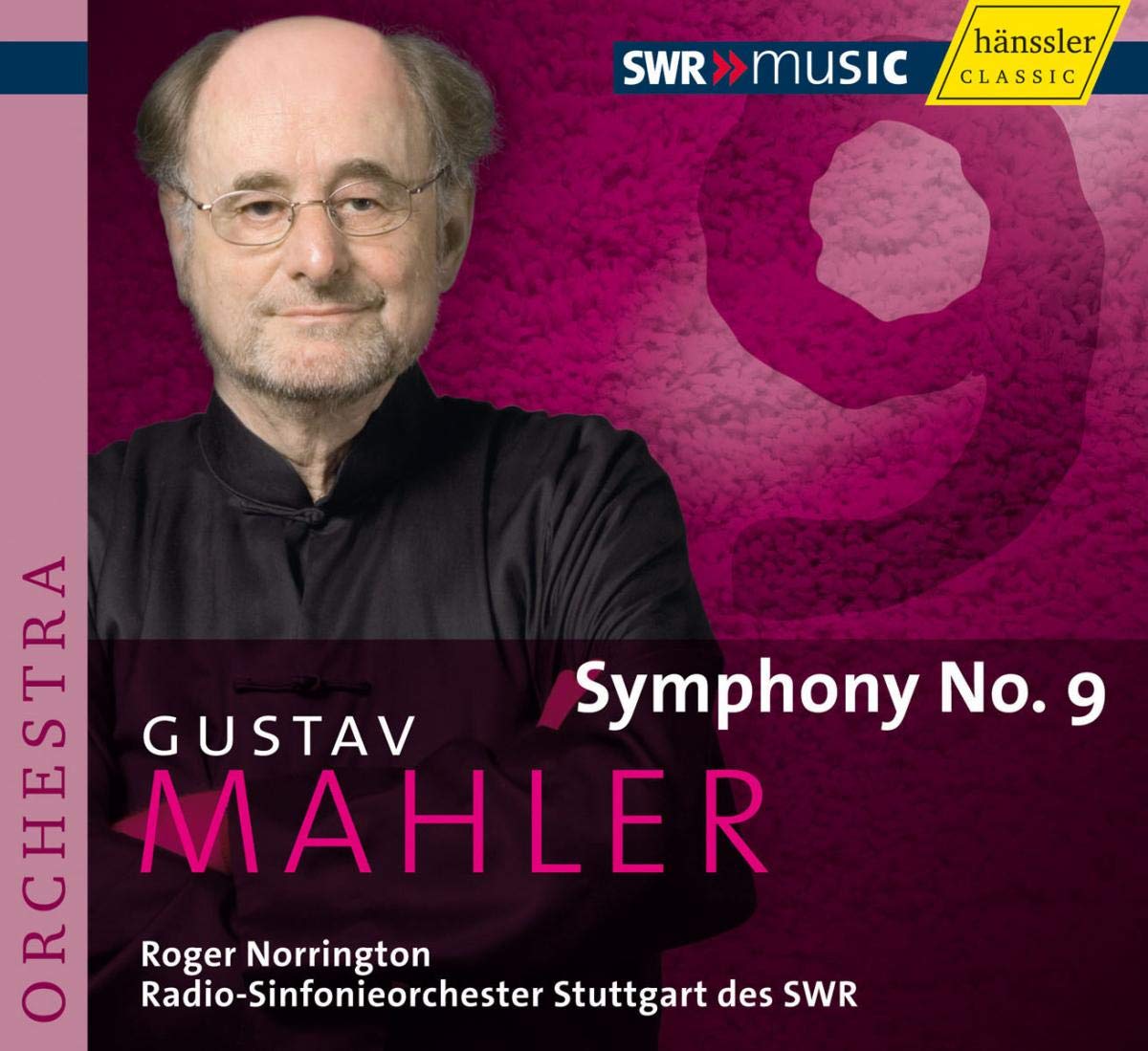
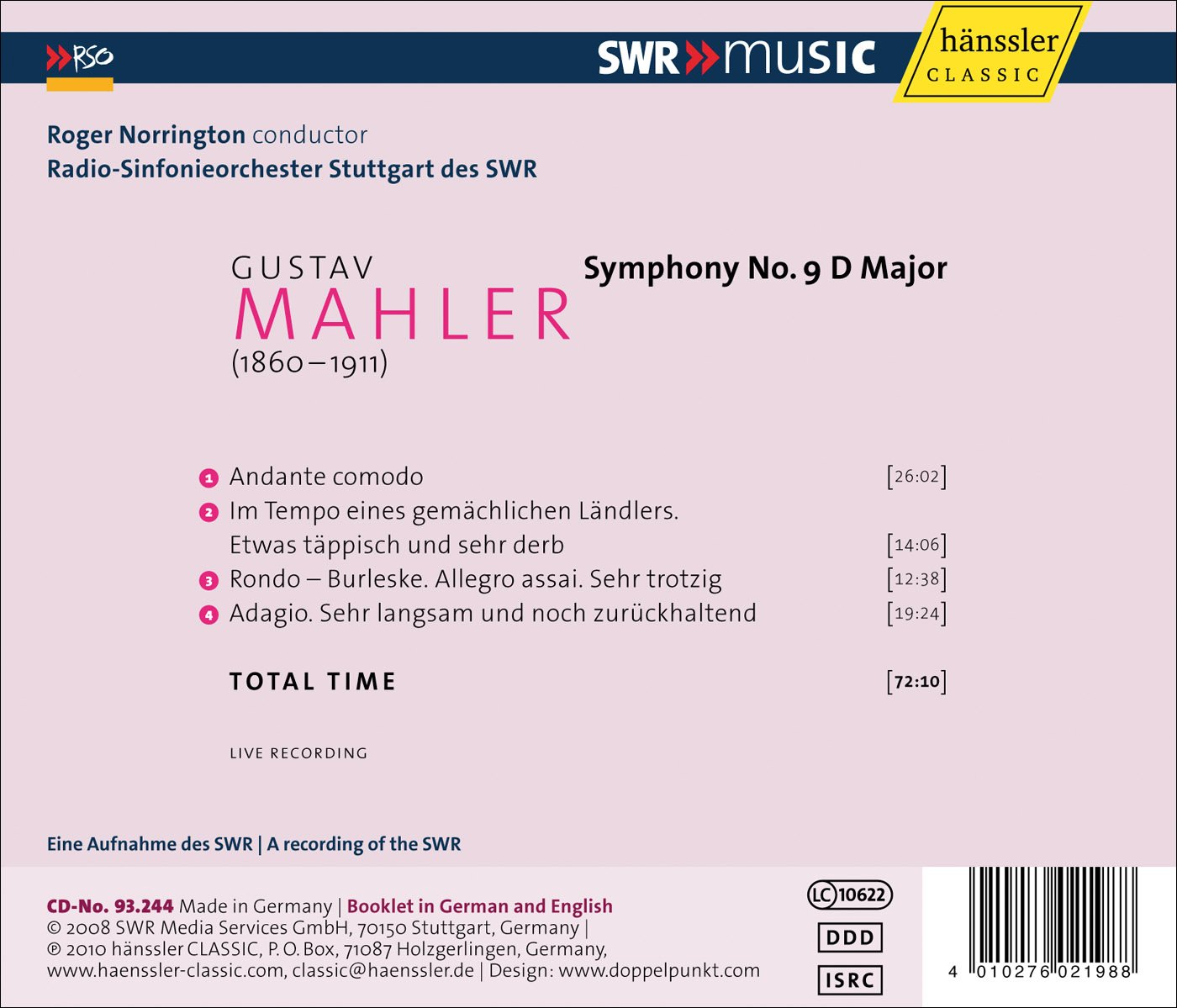
Review "I don't think the Ninth was the first Mahler I ever heard, but it was the first Mahler that clobbered me - in that way Henry Miller used to like to boast, "When I fuck 'em, they stay fucked." I've been happily perma-fucked by Mahler since the legendary Four Days of Television in the wake of the JFK assassination. For me, even more mind-blowing than watching the live murder of Lee Harvey Oswald by Jack Ruby was Leonard Bernstein's leading the New York Philharmonic in a seemingly impromptu Mahler Ninth in memory of his dead friend, Mr. President. (If you can prove me wrong that that was the program, I'll gladly endorse my check for this review to you. I've sought confirmation of this for decades.)I'll lay my cards on the table. I think that the period between right now and when Claudio Abbado conducts the Ninth with the Lucerne Festival Orchestra on Aug. 20 (watch the Internet for TV or radio broadcasts) is a chasm of wasted time. That's how I like my Mahler. But I also think here are worse things we could do in these Mahler years (next year is the death centennial, so this could really go on, just like Mahler does) than consider what the Ninth might have sounded like in his day (not to him; he didn't live to hear it). That's what Sir Roger Norrington aims to do in his live performance of Sept. 5, 2009 with the Radio-Sinfonieorchester Stuttgart (Haenssler Classic), and largely succeeds. As Bay Area historical performaniacs doubtless already know, Sir Roger's bugbear is the constant vibrato present-day string-players deploy, which historical recordings plainly prove is a mid-20th-century innovation. The first time I heard him rail against it - in Davies, in fact - I instantly realized that it was something I too thought weird from the very first time I "saw" an orchestra play. The problem, of course, is that decrying it is like deploring global warming - however good your point and sincere your belief, you're not going to stop it. But Sir Roger does arrest it - more to the point, does what he says his ancestors would have done: used it as an expressive device for specific moments, rather than applying it like varnish - and the result is, I assure you, arresting. In his notes, Sir Roger gratefully avoids the term "straight" tone, but does regularly call it "pure" tone, which in this reading it is, and beautiful, too. But he focuses on matters well beyond vibrato, and the effects of portamento, particularly of the downward variety, properly applied, are illuminating. As always, when you assemble the right instruments, kitted out appropriately, and then have them play in a fitting style, the usual problem of finding proper balances almost disappears.None of which would matter a hoot if the results weren't sensual, but this turns out to be a more pungent Ninth than usual that also attains unsuspected degrees of nobility. Those long string phrases in the opening movements achieve real liftoff. You can almost smell original Lederhosen on the players in the Laendler, and the Rondo Burlesque ventures into the remote harmonic regions Mahler took it but that better-behaved maestros have covered with thicker pancake. You hear sounds from the winds I couldn't describe in a family newspaper like the B.A.R., and the Adagio is a little piece of heaven..." -- Bay Area Reporter, Tim Pfaff"Roger Norrington's Mahler both harks back to the original Mahler tradition and breaks from it in important ways. Norrington is a noted proponent of original playing styles, even when using modern instruments and a modern orchestral complement. For the live recording of Mahler's Ninth that Hänssler Classic has just released, Norrington had the orchestra's strings return to the playing style of Mahler's own time, in which vibrato was minimal or absent except when called for as a special effect. This puts a heavy burden on players trained in modern performance style, in which vibrato is integral to all playing and (not incidentally) can be helpful when one does not hit a note with perfect precision. The Radio-Sinfonieorchester Stuttgart des SWR - which, after all, is one of Europe's top ensembles - rises to the challenge and produces clear, clean, transparent sound that is quite unlike the massed (and unfortunately sometimes muddy) sonority often associated with modern-times Mahler. The effect in Mahler's last completed symphony is quite wonderful: far from being dense and doom-laden, it emerges as a work of surprising optimism despite a sense of Abschied throughout (not just in the last movement). The first movement - which, as Norrington points out in his booklet notes, repeatedly makes references to a Johann Strauss Jr. waltz whose title, in English, is "Enjoy Life" - becomes a tone poem in which death may be inevitable but is scarcely demonic. The middle movements, which do often sound demonic, here come across as elements of the wild whirligig of life, with even the Rondo Burleske emerging as hectic but not frantic or depraved. And the finale - well, here Norrington decidedly breaks with Mahler performance tradition, as a cursory glance at the timing of the movement will show. This is one of the fastest Adagio conclusions ever recorded for this symphony - and yet, and this is the surprising and wonderful thing, it does not feel fast except in a very few places. Somehow Norrington, while keeping the underlying pace quicker than usual, brings out all the emotion that Mahler put into this finale and that listeners have come to expect in it. And the very ending is truly sublime: impeccably played and almost unbearably beautiful in the mode of "I hope this never ends." In all, Norrington's Ninth is an extraordinary performance that remakes the Mahler landscape in important ways." -- infodad.com: May 20, 2010 - http://transcentury.blogspot.com/2010/05/mahler-mastery-and-mystery.htmlYet another Mahler cycle from Roger Norrington who finds himself delighting in a happily controversial golden fall of his career. With the ideology and methods of the original instrument and historical performance practice movement, he's been inching his repertory ever further up, suggesting that the modern tradition of performing romantic music is in fact much more modern than the music itself and that in just a few decades the newfound habits--especially that of permanent orchestral vibrato--have clogged out memory of how the composers themselves still had (and expected) their music (to be) played. When he forces this theory down an unwilling or unable orchestra's collective throat--regardless of the merits of his theories--the results have been frankly awful. I shudder to remember the Bruckner Fourth he made the NSO perform a few years back. But he has his own modern orchestra lab now--the excellent SWR Stuttgart Radio Symphony Orchestra, and they have wisely learned to go along with Norrington's shtick. Not just hesitatingly, by the sound of it, but with considerable enthusiasm and even more dexterity. The results are performances of staple repertoire played in ways you haven't likely heard before (Norrington goes further, with more teeth, than Herreweghe) which has in turn put the Stuttgarters squarely on the map of record collectors and concert-goers--both as object of derision, but more and more so of admiration. Norrington calls the vibrato-free playing of his strings the `pure tone' and suggests that the last time we've heard an orchestra play with such a pure tone was the pre-World War II Vienna Philharmonic, still led by concertmaster Arnold Rosé (Mahler's friend and brother in law), and conducted in such a `pure' Mahler 9th by Bruno Walter's famous EMI recording (which I happen to think is woefully overrated). So Norrington gives the great diffuser and comfort-smudger that permanent vibrato admittedly is, the boot, and has his modern instrument violinists, violists, cellists, and double basses hit the notes and play them clean without--literally--the wiggle room that vibrato provides, intonation-wise. Since his orchestra knows how to do that, now, the sound isn't off; instead it's more direct, perhaps seeming a little more strident at first, a little sharper, but it's certainly also more detailed and clearer or, I suppose, `purer'. I've only now heard the Ninth Symphony of Mahler with Norrington (the First, Second, Fourth, and Fifth are also available), and while I wouldn't say that loving this performance means being sold on his theory to the exclusion of the various other current ways of performing Mahler, I, well... I love it. There is a zany bite and yet a plain simplicity to the music that is very refreshing, gripping, and exciting. Although Norrington certainly doesn't stretch the heavenly closing Adagio to its limits at 19'24'' (that's two minutes faster than Boulez), he draws out the ethereal quality just right. He also manages to keep the tension in those last minutes when the energy of the symphony drops to what sometimes ends up a hesitant whimper rather than carefully stringed repose evaporating into a confident, gentle goodbye. -- WETA 90.9, Jens F. Laurson
B**N
Insane or ingenious? Or both?
Roger Norrington's Mahler cycle for Hänssler Classics (their second cycle, following Michael Gielen's generally excellent cycle: Gielen Conducts Mahler Symphonies 1-9 ) is probably the most hated and rejected project on record in many years. Norrington is famous for his revisionist or "historically informed" view on playing techniques, insisting, basically, that string vibrato is a recent development (post WW 2) that distorts older works (i.e., all works pre WW 2). Norrington is the principal conductor for Radio-Sinfonieorchesters Stuttgart since 1998, and he has made the orchestra famous for this non-vibrating "Stuttgart sound".I must confess that I hated Norrington's period Beethoven interpretations, which he recorded for EMI some decades ago (see Symphonies 1-9 - I have not heard his second cycle for Hänssler). In those EMI performances he interpreted Beethoven's metronome markings literally, which resulted in extreme tempi in crucial passages, not always convincing. His literal readings were also quite boring and uninspiring in general.Thus I had serious doubts concerning Norrington's evolution from a quite boring British classic authenticist to an historically informed "Kapellmeister" in Stuttgart. With too many bad Mahler interpretations in my collection already, I hesitated investing in this new cycle.But this is not one of those bad interpretations! On the contrary I find it convincing, stimulating, well played and well recorded (it's a "live" recording, but the Stuttgart audience is not audible). It is an exaggerated interpretation, of course, but Mahler's works calls for exaggerations, as Bernstein once claimed. One could, for instance, compare Kubelik and Bernstein! So much for the insanity issue.The most demanding exaggeration in this interpretation is not the almost complete absense of string vibrato, which is some sort of hype as far as I can tell, but the swift take of the final movement. It is comparable to Walter's famous 1938 recording, Symphony No 9 , the obvious reference which Norrington himself also indicates. Walter has 18:10, Norrington 19:23. Is it too fast? Not in my view. Some conductors have favoured extremely slow tempi for this movement in particular, but also for the "Adagietto" in the fifth (e.g., von Karajan, Bernstein, Sinopoli). That kind of exaggeration distorts the music, killing the flow. By contrast, Norrington's swift approach is refreshing and quite ingenious.Radio-Sinfonieorchesters Stuttgart is not one of the great German orchestras but nonetheless excellent, playing with confidence and brio, apparently appreciating Norrington's regime. The playing does not "fall apart" anywhere, as it actually did in Günther Herbig's recording of the same work some years ago: Symphony 9 .In sum, yes, five stars for a very interesting, insane and ingenious interpretation in fine sound. So this is not a "stupid" interpretation that should be avoided. On the contrary, Norrington's Mahler ninth is an emotionally raw and compelling performance that divides critics and music lovers stuck in different camps. It will offend those who assume that the "definitive" Mahler interpretations came with Bernstein and von Karajan. In addition to its artistic merits, I take that as one of its significant qualities.I will return to this recording many times.
M**N
Wonderful performance, but not "gospel."
I really have grown to love this performance. It reminds me a great deal of the classic Vienna performance by Walter, which in its original EMI version is a desert island disk for me. This Norrington performance is compelling, although I can understand why it is controversial. The finale takes some getting use to because of its pacing, but it really has grown on me. The straight tone of the strings sounds wonderful. Vibrato-free strings strings are a terrific option to performance of this repertoire. There is always room for one more Mahler 9 in my collection, and I'm really glad I finally discovered this one.
M**P
Lucid and challenging
The moment I saw David Hurwitz's diatribe against this recording, entitled "Norrington's stupid Mahler Ninth", I knew I just had to hear it. It is quite interesting how Norrington's approach illicits such agressive reactions. Yes, his single-minded insistence on abolishing just about all vibrato may be annoying at times, but it isn't half as annoying as Hurwitz's interminable, verbose yet strangely unconvincing counter-essays. And in any case, there is no reason at all why a Mahler 9 without any vibrato should be any more stupid than the kind we're used to, which has vibrato all the time. After all, if, as Hurwitz argues, vibrato is a means of expression, it can only be meaningful if applied occasionally, not constantly. One may also wonder what is so particularly expressive about an oscillation in pitch, but that is another discussion...In the end it all boils down to the simple question whether or not you like the very particular sound of an orchestra that avoids vibrato. I for one do, very much so. I found Norrington's Brahms revelatory, and in a way so is this Mahler. The only comparable recording is the magnificent Cleveland Boulez. It has the same crystal clarity. The intricate polyphony stands out in all its glory; in most recordings a lot of it is reduced to mere padding. This recording lets you hear that that is wrong. Harmonic processes, too, stand out far more clearly in an ensemble where the pitch is exact all the way through. Just listen to that f natural grinding against f flat in the basses at the start of the final movement - fantastic! There's only a handful of recordings where you'll notice this extraordinary progression at all.What makes this recording sound different, too, is the very precise attention to accents, sforzato's and such. Vibrato is not the only way to create an 'espressivo' sound - dynamics and accents are quite as important (interestingly, Hurwitz in his essay shows an example from the finale that seems to illustrate this point. The first violins play 'molto espressivo', and the other 'ohne Ausdruck', i.e., without expression. How can you do that without using vibrato, Hurwitz asks. But he overlooks the fact that in the espressivo part Mahler writes sforzando accents, which are not in the other parts. There's more to espressivo playing than just vibrating).Apart from the vibrato debate Hurwitz in his essay piles a lot of criticisms on this recording that are disingenuous at the least, if not simply untrue. I listened to this recording several times, score in hand. In found balances generally excellently judged, and the strings not lacking in power. The initial tempo for the second movement did strike me as rather too fast, but internal tempo relations in the piece are excellently judged. The waltz theme after all is only 'poco piu mosso', slightly more lively, than the Ländler, so the problem isn't that Norrington underplays the contrast, but that most other overplay it.It's only at the end of the third movement that things get out of hand a bit. Here, Norrington's insane tempo is too much for his players and temporary chaos ensues. Well, it's nothing compared to the chaos throughout Bernstein's Berlin recording, and that has been praised to the heavens... The final movement is spellbinding in its cool majesty. No soppy 'farewell to life' this, a preconception about this movement that may well be completely misguided as La Grange argues in his Mahler biography. This is clear, lucid, peaceful music. Norrington's tempo will shock many, but Boulez did it like this, and so did Bruno Walter. We know, too, that Mahler himself tended to conduct his slow movements a lot faster than we are used to, so this may well be spot-on.And the vibrato? Well, there is an occasional exposed solo-violin note that could have done with a little shake. But Norrington's visions stands; it is coherent and valid, and it makes the music shine. This may not be the Mahler 9 to buy if you want only one recording of it (go to Boulez, Zander, Pesek, or the live Karajan for that); - but all dedicated Mahlerians ought to hear it.
R**O
Surprisingly effective.
As others have queried, who would have expected Norrington to be a Mahlerite? But a Mahlerite he is in this very touching performance.Maybe not as effective sonically or musically as his M 4, but beautiful nonetheless. The quickly paced last movement does take some getting used to, but it’s preferable to the interminably slow versions of many others. Anyway, I understand Bruno Walter, Mahler’s close compatriot was even brisker in this finale.
P**P
like a lot of Norrington's Mahler
This, like a lot of Norrington's Mahler, gets a bad response from many. It is not deserved. It is true that one needs to listen with different ears in some ways - and there is nothing wrong with that. Forget talk of authenticity beforehand, though, for it is not an issue one way or the other. There is real depth to this reading and the playing is radiant. It develops patiently and this pays off for anyone with the patience to listen. The final movement works very well indeed. I have a lot of time for Barbirolli's famous recording (some criticize the playing on it as scrappy, but hard to know why). I also think Abbado's VPO rendering is special and likewise Michael Gielen's. This performance deserves a place alongside them.
Trustpilot
1 month ago
2 weeks ago