
DOWNLOAD THE APP


Customer Services
Copyright © 2025 Desertcart Holdings Limited
DOWNLOAD THE APP
📈 Position Your Brand for Success!
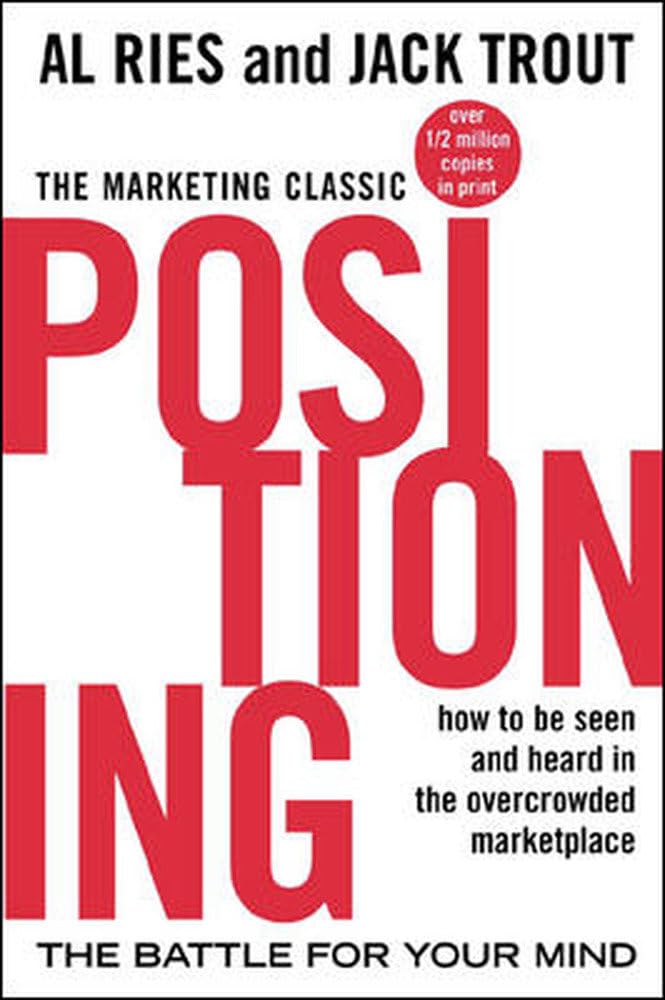
Positioning: The Battle for Your Mind is a groundbreaking book that delves into the art and science of brand positioning. It provides readers with actionable strategies and real-world examples to help them understand how to effectively position their products and services in the minds of consumers, ensuring they stand out in a competitive landscape.


| Best Sellers Rank | #37,166 in Books ( See Top 100 in Books ) #19 in Leadership Training #36 in Advertising (Books) #121 in Marketing (Books) |
| Customer Reviews | 4.4 out of 5 stars 1,692 Reviews |
T**L
A true marketing classic and a must-read masterpiece!
This book is excellent—it shows that success comes from winning the battle in the customer’s mind, not just the marketplace. The authors explain the concept of positioning with clarity and back it up with inspiring examples like Avis’s “We’re No. 2” and Volkswagen’s “Think Small.” The stories are thought-provoking, timeless, and make you rethink how products and brands succeed or fail. A true marketing classic and a must-read masterpiece. Now, as we enter the new era of social media, I can’t help but wonder: does this change the rules of positioning? Can the method alone tackle today’s marketing challenges? To explore these questions, I’ve picked up another book to read.
O**H
Finding a window in the mind!
This is a classic in the marketing field. The authors define positioning as "a new approach to communication...But positioning is not what you do to a product. Positioning is what you do to the mind of the prospect. That is, you position the product in the mind of the prospect." The book then goes on to present the concept of positioning, and the associated challenges and opportunities. What sets this book apart is the plethora of examples that are provided from a variety of industries (both services and products) that illustrate both how position can and should be used, and how it shouldn't be. Finally the authors extend the concept of positioning and show how it can be applied to one's self and career. In addition how one can start a positioning program for a business. A very insightful and educational book - a must read in the business arena and particularly the marketing field. Below are some key excerpts from this book: 1) "Positioning is an organized system for finding a window in the mind. It is based on the concept that communication can only take place at the right time and under the right circumstance." 2) "Leaders should use their short-term flexibility to assure themselves of a stable long-term future. As a matter of fact, the marketing leader is usually the one who moves the ladder into the mind with his or her brand nailed to the one and only rung." 3) "This is the classic mistake made by the leader. The illusion that the power of the product is derived from the power of the organization. It's just the reverse. The power of the organization is derived from the power of the product, the position that the product owns in the prospect's mind." 4) "But today in the product arena and in the political arena, you have to have a position. There are too many competitors out there. You can't win by not making enemies, by being everything to everybody. To win in today's competitive environment, you have to go out and make friends, carve out a specific niche in the market. Even if you lose a few doing so." 5) "With a good name your positioning job is going to be a lot easier." 6) "A name is a rubber band. It will stretch, but not beyond a certain point. Furthermore, the more you stretch a name, the weaker it becomes." 7) "The lesson here is that a succesfull positioning program requires a major long-term commitment by the people in charge." 8) "The solution to a positioning problem is usually found in the prospect's mind, not in the product." 9) "Positioning yourself and your career...Define yourself...Make mistakes...Make sure your name is right...Avoid the no-name trap...Avoid the line-extension trap...Find a horse to ride...The first horse to ride is your company...The second horse to ride is your boss...The third horse to ride is a friend...The fourth horse to ride is an idea...The fifth horse to ride is faith...The sixth horse to ride is yourself." 10) "Positioning your business...What position do you own?...What position do you want to own?...Whom must you outgun?...Do you have enough money?...Can you stick it out?...Do you match your position?...The role of the outsider...What the outsider doesn't supply." 11) "Playing the positioning game...You must understand the roles of words...You must know how words affect people...You must be careful of change...You need vision...You need courage...You need objectivity...You need simplicity...You need subtlety...You must be willing to sacrifice...You need a global outlook...What you don't need."
V**.
Relevant, Practical and Valuable
This is an outstanding book of high value to anyone trying to stand out from the crowd. The theme is that we are all marketers trying to communicate our message in the most effective manner and that there is a better way. The authors coined the term "positioning" and first wrote about it in a 1972 article in Advertising Age. "Positioning is the first body of thought that comes to grips with the problem of getting heard in an overcommunicated society," they say. It is perhaps even more relevant today given the orders-of-magnitude increase in messaging of all types where only the tiniest fraction is relevant to any one person. Developed largely around big-company advertising, positioning is broadly applicable to entrepreneurs, small business, job seekers, career professionals and lonely people as well as corporations and institutions. How can this be? Don't we live in a society of rapid obsolescence where yesterday's news is virtually irrelevant? The reason is psychology. Positioning is based on how people think, how they evaluate, how they compare, how they prioritize and how they select. These are nearly timeless processes deeply embedded in the human mind. Ries and Trout show you how to hook your message into the subconscious mind of your prospects. In another book Ries defines a brand as "a singular idea you own inside the mind of your prospect." The methods described in this book help you craft that brand message for maximum effectiveness. This book is very well organized. The Table of Contents includes one-sentence chapter summaries so you can quickly jump to material that is relevant to your situation. They cover "Positioning of a Leader," "Positioning of a Follower," and "The Power of a Name." Example positioning exercises include "Positioning of a Company," "Positioning of a Country," "Positioning of a Product," "Positioning of a Service," and "Positioning of a Ski Resort" among several others. For the individual seeking a job or trying to advance a career there is "Positioning Yourself and Your Career." For the small business person and entrepreneur there is "Positioning Your Business" and "Playing the Positioning Game." This is not only for marketing professionals. Some reviewers find the examples outdated. I challenge them to use those examples as a starting point to find companies today whose success is based on excellent positioning (e.g. LinkedIn: Business Networking; Tesla Motors: High-Performance Electric Cars; Starbucks: Social Coffee). The process and the beneficial results have not changed over time. I rate this a 5 star book for thought-provoking content, broad appeal, and excellent organization.
J**R
Great insights
The book is a real classic, giving great insights into what works in marketing and more importantly what does not work and why it doesn't work. The book is an updated version so most of the examples are very dated. It is a little amusing to read about companies that are no longer in existance (Pan Am) and products and ads that ran 10 years ago. However the specific examples are not the important part of this book. The principles are what matters and the authors do a great job of identifying those. It is a very interesting to read about the mistakes of large multi-national companies that should know better. There is also an interesting chapter on the Catholic church and their reluctance to properly position the church. Unfortunately, like with most big organizations, they refuse to see the obvious. And in positioning the obvious is what is so important but so difficult to see. The book is well written, easy to read and has a lot of very useful information. You would do well to read it every six months to keep the ideas fresh in your mind. One of the best chapters is positioning yourself. Some very solid advice that will help anyone in their career or life. Well worth reading even though the examples are very dated.
J**L
Great for business albeit a bit light on substance
I work in communications and a lot of the lessons outlined in “Positioning: The Battle for Your Mind” will carry over well in my work life. The strategies to separate your message from the myriad of other messages consumers are inundated with are discussed well enough here - and you will definitely take away a lot of lessons learned from this book if that’s what you’re looking for. Though I have to take two stars off because of the following reasons. First, it’s very outdated. For instance, it goes into detail about how television is still the most dominant place for advertising. I get that it was published in 1980, but I was left with questions about today’s actual market and what impact the internet is having on advertising and communications. I know this isn’t the fault of the authors per se, but just keep that in mind if you’re looking for ideas about modern day marketing. Second, the ideas set forth in the book are not really detailed enough and don’t have any scientific evidence or in-depth analysis. For instance, an idea will be like, “Doing A is better than B, because company C did this and company D did that, ergo, it’s better.” A lot of the information backing up their claims are based only on results of American businesses and honestly a lot of it was just glazed over because the section on the topic will end or the chapter itself will end. Finally, the writing to me sounds like a quick-talking 1920s movie. Ideas go from one to the other at a breakneck speed, and a lot of the time ideas are underlined by some sort of cliche or play on words. All in all, it’s still a good book that I learned a lot from when it comes to how I approach communications in my career. However, I will be turning to other authors who can offer more scientific evidence of positioning in a consumer’s mind as I think there’s still loads more to discuss in this realm and I didn’t get all that I wanted from this read.
G**I
Undoubtedly classic, today is also a business guide
This book is the "father of positioning" Trout's famous work, the first in the history of the United States, the best business classics, the US CEO is most afraid of being read by competitors in the business book, talking about positioning theory and operation methods And with a wealth of practical case analysis, to guide entrepreneurs to successful corporate positioning, to achieve commercial success. Positioning, not only to find a keyword for the product, to compose a slogan, but also to occupy a unique position in the mind of the prospective customer. This book uses a number of corporate cases, illustrating a company name at the beginning, a simple slogan, may be able to lay the foundation for the success of the product and the company. In short, positioning is not simply advertised, and the depth of the doorway is difficult to distinguish and is crucial. Why do you need to locate? First of all, we are in the era of information explosion: the media channels are rich but the information is asymmetrical, the information is inflated, and the information of products and enterprises is easily submerged in the vast amount of information. Secondly, the first cause effect makes the brain more likely to pay attention to the first. The information of contact, the information defense mechanism makes the brain establish an insurmountable barrier in the first information and the non-first information, and the brain with limited information processing capability is trapped in the chaos of mass information manufacturing. Information is cumbersome and human brain limits make positioning so important. How to position it? Industry leaders have an inherent advantage in positioning. The first cause effect allows consumers to see only the leader of the first place. The position that leaders want to occupy the brains of consumers is simple: analyze market and consumer vacancies, fight for time to fill vacancies, and use value advantages and brand advantages to intercept opponents. However, the leader should be wary of: Do not blindly expand, do not casually expand the product. Once the position of goods and brands is formed in the minds of consumers, it is difficult to be changed. If the trade rushes, it is easy to shake the original positioning, so that consumers can confuse the original positioning and new positioning, the original positioning is broken, and the new positioning is not clear. Consumers are likely to switch to other brands. The author suggests that if you want to expand your product, you must establish a new position with a new name, separate from the original product, and attract new customers. Share the classic arguments in the book with you: 1. The best way to deal with an over-extended society is to simplify the information as much as possible. 2. The main factor in establishing leadership is to get ahead of people's minds. 3. The biggest mistake the company makes is trying to satisfy everyone's needs, that is, everyone's satisfaction trap. 4. If someone forces you to drink a cup of H2O, your reaction may not be good, but if someone invites you to drink a glass of water, you may feel good. That's right, the difference between the two is not in the mouth, but in the mind. 5. If you want to make a new product successful, you should set a new ladder for it. New ladder, new name. It's that simple. 6. Complexity is the enemy of positioning, simple is the true meaning of positioning
E**A
Nice book
Nice book
E**A
A timeless marketing classic that completely changes how you think
Positioning: The Battle for Your Mind is one of those rare books that feels just as relevant today as when it was first written. Al Ries and Jack Trout don’t overwhelm you with theory or complicated jargon—instead, they explain marketing in a simple, memorable way that actually sticks. The core idea is powerful: marketing isn’t about what you do to a product, it’s about what you do to the mind of the customer. Once you understand that, everything from branding to advertising suddenly makes sense. The examples are clear, practical, and often surprisingly modern, even decades later. I especially liked how short and focused the chapters are. You can pick it up, read a few pages, and immediately start seeing brands, ads, and companies differently. Whether you’re into business, marketing, startups, or just want to understand why some brands dominate while others disappear, this book is a must-read. Highly recommended for beginners and experienced marketers—it’s a foundational book that deserves its reputation.
Trustpilot
1 month ago
2 weeks ago