Some deliveries may take a little longer than usual due to regional shipping conditions.
DOWNLOAD THE APP


Customer Services
Copyright © 2025 Desertcart Holdings Limited
DOWNLOAD THE APP
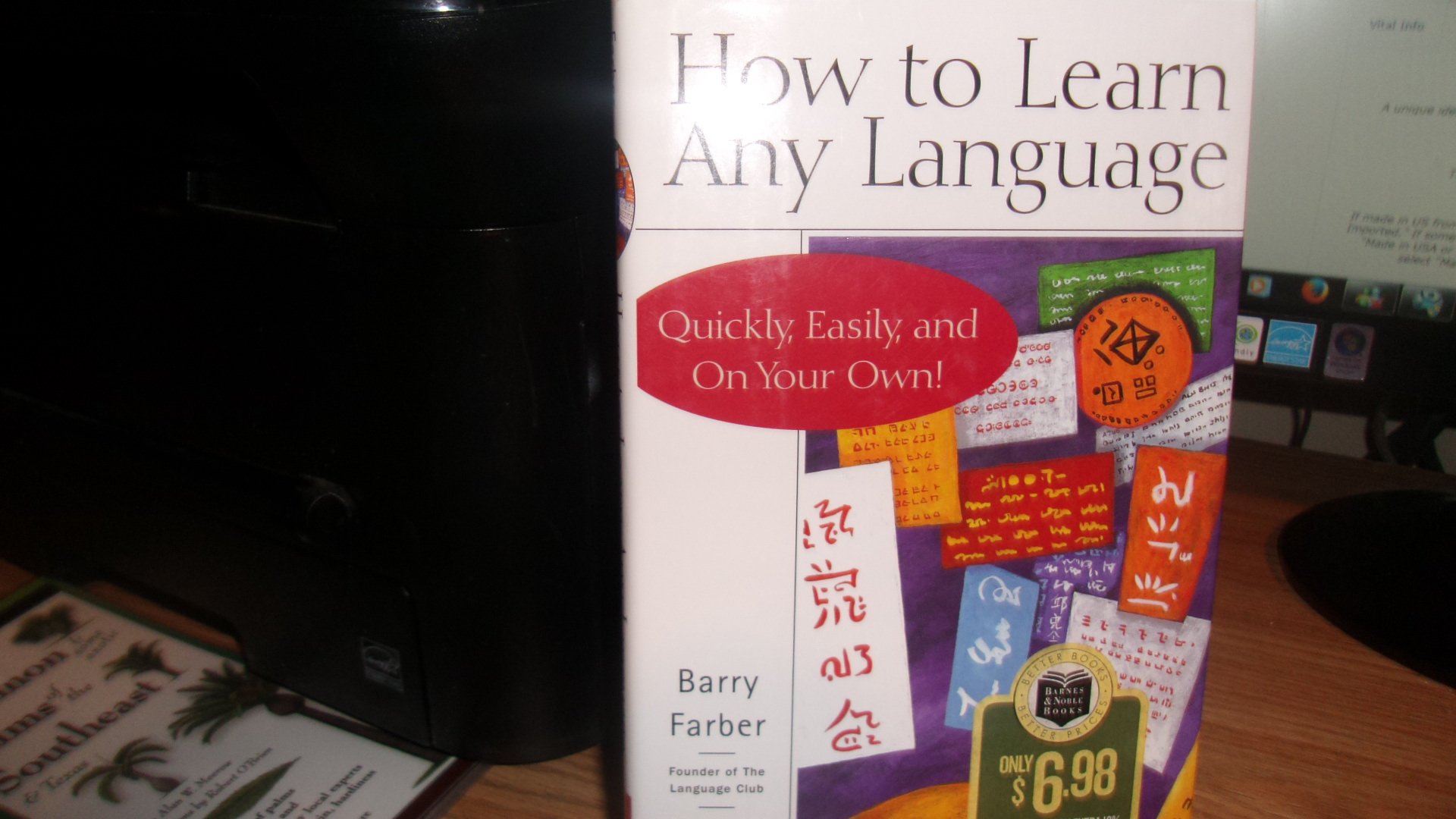
How to Learn Any Language [Farber, Barry J.] on desertcart.com. *FREE* shipping on qualifying offers. How to Learn Any Language Review: How to get from here to there without being bored to death. - Many of us learned a first foreign language by learning grammar first. My first foreign language was Latin and we used a book written by Robert Henle S.J. I later took courses in Latin from Robert Henle S.J. in college. Those courses were fun and very instructive. My high school taught Latin as did most at the time. Grammar first. Barry Barber proposes that is not the way we learn our first foreign language. In the USA that is usually English. Conversation first and when a basic fluency is reached then grammar. He proposes that once you reach basic fluency you will want to learn grammar. I have found him to be right. I am now teaching (mentoring might be a better word) 6-8th graders in Latin. The kids spend 15->30 minutes a day You-Tube watch/listening to conversational Latin one video an evening. They watch grammar videos as they need them. They are using The Cambridge Latin Series as their text book. No homework just suggestions for next class. No tests except the final which is a pass/fail. They are allowed to use medieval Latin or Roman Latin pronunciation. No correction in class except a reciting on the correct way. So far they are doing very well. The kids are all volunteers for a new program and can drop the class whenever. So far they all want in. If they pass the test I will write a letter indicating their fluency in Latin and asking they allowed to skip 1st year Latin. They will be urged to go through Henle 1st Year Latin in the summer before high school. Grammar and vocabulary are important but fluency is more important. Read this book before purchasing any expensive language course. Obtain basic fluency and then perfect your language skill with that DVD/CD/Academic course. If taking academic courses become fluent first and then ask to test out of the boring part. Once I got pass 1st year Latin and began reading Caesar's Gallic Wars that was fun. And so it is with any language. Learning to conjugate Spanish verbs by pure memorization is boring. But reading Los Cipreses Creon en Dios is not. Read I adapted much of what I am doing from this book. I suggest that you read this book before buying any language course. Review: So good that I read it twice! - Great read! Easy. Fun. Entertaining. Insightful. Helpful. Inspiring. The book not only helped me in my language studies, it helped me in all my studies because the lessons taught apply to any learning endevour. (Such lesson as... have fun. Use multiple methods. Keep at it. Be enthusiastic. Don't be afraid to make mistakes.) The other reviewers have done a better job than I have explaining the book. I just wanted to echo their praise. This book is a winner!
| Best Sellers Rank | #1,647,796 in Books ( See Top 100 in Books ) #32,416 in Personal Transformation Self-Help |
| Customer Reviews | 4.2 out of 5 stars 53 Reviews |
F**E
How to get from here to there without being bored to death.
Many of us learned a first foreign language by learning grammar first. My first foreign language was Latin and we used a book written by Robert Henle S.J. I later took courses in Latin from Robert Henle S.J. in college. Those courses were fun and very instructive. My high school taught Latin as did most at the time. Grammar first. Barry Barber proposes that is not the way we learn our first foreign language. In the USA that is usually English. Conversation first and when a basic fluency is reached then grammar. He proposes that once you reach basic fluency you will want to learn grammar. I have found him to be right. I am now teaching (mentoring might be a better word) 6-8th graders in Latin. The kids spend 15->30 minutes a day You-Tube watch/listening to conversational Latin one video an evening. They watch grammar videos as they need them. They are using The Cambridge Latin Series as their text book. No homework just suggestions for next class. No tests except the final which is a pass/fail. They are allowed to use medieval Latin or Roman Latin pronunciation. No correction in class except a reciting on the correct way. So far they are doing very well. The kids are all volunteers for a new program and can drop the class whenever. So far they all want in. If they pass the test I will write a letter indicating their fluency in Latin and asking they allowed to skip 1st year Latin. They will be urged to go through Henle 1st Year Latin in the summer before high school. Grammar and vocabulary are important but fluency is more important. Read this book before purchasing any expensive language course. Obtain basic fluency and then perfect your language skill with that DVD/CD/Academic course. If taking academic courses become fluent first and then ask to test out of the boring part. Once I got pass 1st year Latin and began reading Caesar's Gallic Wars that was fun. And so it is with any language. Learning to conjugate Spanish verbs by pure memorization is boring. But reading Los Cipreses Creon en Dios is not. Read I adapted much of what I am doing from this book. I suggest that you read this book before buying any language course.
C**R
So good that I read it twice!
Great read! Easy. Fun. Entertaining. Insightful. Helpful. Inspiring. The book not only helped me in my language studies, it helped me in all my studies because the lessons taught apply to any learning endevour. (Such lesson as... have fun. Use multiple methods. Keep at it. Be enthusiastic. Don't be afraid to make mistakes.) The other reviewers have done a better job than I have explaining the book. I just wanted to echo their praise. This book is a winner!
N**N
Methods are good, rest of book is overblown
To sum up Barry's methods, his multi track approach has merits, especially if you have no idea or game plan to follow in an orderly fashion. I give his methods a five, but the overall book gets a three, at best. A two wouldn't be off the mark. The first sixty pages are complete with Barry gushing about the number of languages he says he knows. My only question - does Barry know just enough of each language to introduce himself, ask simple directions, and attempt to order a meal in an authentic restaurant, or is Barry fluent enough in over twenty languages to sit as First Chair Translator in the United Nations? At one point, Barry states his Chinese was so good, he flabbergasted a Chinese waitress so badly she screwed up the order for the entire table. I believe a more approximate assessment would be Barry's choice of vocabulary, diction and accent was so bad, she couldn't help but make major errors in their meal orders. The language examples he provides in a language he speaks about sounds like something that can be found in any basic starter language book or audio course. The Appendix material starting at page 140 to the end are useless. Between page 60 to the Appendix are Barry's methods. While I didn't really learn anything new that I am not already doing (learning Japanese) I applaud Barry's methods. A solid grammar course booklet, a good dictionary containing the target language and your own native language, the use of audio (tapes, CD's, MP3 players in today's lifestyle) flashcards, and other various printed materials and sources. Yes, the book needs to be updated, but anyone serious about their target language can fill in the updated blanks. Barry makes a few good points. Set a game plan and stick with it. Don't give up. Be consistent in your studies. Use different sources. His use of memory aids. While some of Barry's ideas of using wasted time to study are a little off the mark (while brushing your teeth, or the one that made me laugh - while you are grunting inaudible 'yes, no, uh-uh, really?' responses to your friend blathering on the phone, pretending you are hanging on their every word) there are better down times that can be used, and will retain what you are learning. Commmuting to and from work. Lunch time. Mindless TV viewing. (How many times can you watch the same hour of ESPN reruns before you decide you had enough?) If you have no clue as how to self teach yourself a language, then purchase the book. Otherwise, if it can be found in a bookstore, read pages 60 to 140, take notes and save your money. Or read the other posted reviews that pretty much explain his methods in a few sentences and save yourself the time and expense.
J**E
Excellent book and gets it right
I learned English and French about the same time. Living in France made that very easy as a child. Now I am taking Spanish and it is a struggle. It is a struggle because, like many, I do not follow the advice in this great book. This book gives a good review of how, even if you are not in the native country, to surround your self with a book, newspaper, (videos, television, internet today) to learn a language quickly. It helps to shake someone out of the nonsense that learning a foreign language takes some special skill. It is a learned skill and this book is a common sense way to do it. I am going back to my Spanish lesson now......
A**N
Good ideas, encouraging
This book gives some good tips on remembering things and helps encourage the reader to learn languages. It suggests not picking a random language to learn as your second language, but rather something highly useful so that it will be helpful even if you don't carry your studies very far. I don't think it is a magic formula, but more of a language guy's story and what he did to help become successful. If he really speaks as many languages as he says he does then he's a genius and probably doesn't understand what we mere mortals go through to learn, for example, Korean.
D**D
Inspiring read for anyone considering learning another language
I have always been intrigued with foreign languages. I started studying Spanish on my own the summer before I was enrolled to take it in high school, and I loved it. My first Spanish teacher was wonderful, but mid-year they put a student teacher in charge of the class, and she was terrible. The class was no longer any fun. I wish I had Farber's book then to keep me inspired and motivated. In college, I took Latin and German, but if I had used the ideas in Farber's book, I could have kept up my speaking and reading of the languages naturally instead of letting those language skills get rusty. With the availability of the internet, Farber's book, which was published in 1991, is somewhat out-dated. He mentions Audio-Forum as a resource for language courses, but they went out of business last year. He also talks about using flashcards, but now there are plenty of apps that allow you to create flashcards for your phone, tablet or e-reader. However, I really enjoyed reading about his experiences learning the various languages and his reviews of languages. I identified with some of his comments and laughed out loud as I read it. He discusses the reasons for learning a foreign language and the benefits. It's an entertaining read and a relatively short book that can be read in a few hours. If you are thinking about learning a new language or brushing up on one you studied in the past, I highly recommend this book.
A**M
Great for language enthusiasts
I had almost no interest in language before I read this book. After reading this book, I'm planning on -- attempting -- to learn Spanish, French, and then German. Perhaps more. This is both a guide and a story, both of which are very inspiring and helpful. The guide portion is a great method, and has worked for many language learners. The stories are enough to keep you fascinated with language and push you to start learning. Farber does a great job.
T**.
Don't waste your time--start Duolingo right now.
You'll get better results from doing Duolingo than wasting two hours reading this book. There are a few morsels of good advice here, but they're buried in military analogies and endless humble-bragging. Despite the bragging, the reader isn't left with a positive impression of the author's mastery of various languages. Thankfully his method can be summarized in these steps: flashcards, audio tapes, newspaper scraping and practicing with foreigners. There are some pleas to "man up" along with a little bit of misogyny to motivate you (e.g. "If you like Brunettes, learn Italian--Blondes, swedish") . Since this book was written last century, modern tools Like Duolingo can help you do nearly all of these things instead (except for the misogyny--sorry). Long story short, skip the book and start using Duolingo.
Trustpilot
4 days ago
1 month ago