
DOWNLOAD THE APP


Customer Services
Copyright © 2025 Desertcart Holdings Limited
DOWNLOAD THE APP
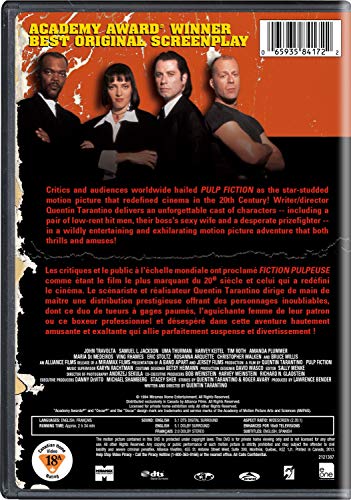
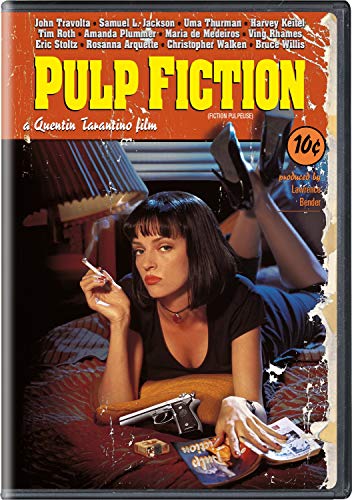


Writer - director Quentin Tarantino revisits the seedier side of Los Angeles - following 1992's RESERVOIR DOGS - with this funny, violent, tongue-in-cheek tribute to the less "classic" side of film making - the potboilers and capers, the Blaxploitation flicks and gangster movies. The film interweaves three tales, told in a circular, fractured manner, which only fully connect by the time the final credits roll. The first story focuses on Vincent Vega (John Travolta) and Jules Winnfield (Samuel L. Jackson), two hit men on duty for "the big boss," Marsellus Wallace (Ving Rhames), whose gorgeous wife, Mia (Uma Thurman), takes a liking to Vincent. In the second, a down-and-out pugilist (Bruce Willis), who is ordered to take a fall, decides that there's more money in doing the opposite. The final chapter follows a pair of lovers (Amanda Plummer and Tim Roth) as they prepare to hold up a diner. Tarantino wears his cinematic influences proudly, bringing them to life in the ironically hip, self-referential 1990s. The result is a work that changed the face of independent cinema forever, making it a legitimate player in the Hollywood mainstream. The all-star cast steps into their roles with obvious glee, and Tarantino once again uses his soundtrack to up the "cool" ante yet another notch, making for a motion picture event that has worked its way into our national vernacular. Review: Breath of Fresh Air, and Nourishment for the Soul. - John Waters recently produced a countercultural personal manifesto, "Cecille B. Demented," in which he specifically targets two of the most depressiingly bad, yet representative, films of the 90's--"Patch Adams" and "Forrest Gump." But Waters' strained, juvenile ranting, for whatever therapeutic value it contains, is ultimately as lame and ineffectual as the films occasioning his rage. The only effective response to the mind-deadening, sedating Pavlonian formulas that pass for movies these days is a truly fresh, well crafted, yet perpetually playful, cinematic statement like Tarantino's dazzling "Pulp Fiction." Whatever you've heard, it's no "Citizen Kane," but in the context of the films of the day, its style and methods are certainly analagous to Welles' breakthrough film. If any proof of "Pulp Fiction's" singular artistry is needed, just compare it to "Natural Born Killers," Oliver Stone's subsequent, over-the-top attempt to beat Tarantino at his own game. Whereas Tarantino knows how to amuse and delight by using familiar patterns (the variation on the buddy theme, for example) which engage our human interest despite the unexpected contexts, Stone merely distances us from all the mayhem on screen, which generates about as much interest as watching someone else play a video game. But now I'm going to suggest something shocking, especially to all those hip critics and postmodern types who insist "Pulp Fiction" is a statement against meaning and interpretation, that the whole point of the cinematic experience is the experience, that "Pulp Fiction" is a 90's cinematic fun house, a celluloid carnival ride on which you go with the flow and miss the trip if you attempt to question any of the moments comprising its visual rush: The film has a potent message. As retro as Jules looks with his Afro-do, he's also a questioning Samuel, a wayward Old Testament prophet trying to sort out the meaning of justice, righteousness, and grace. When I ask young people about the film, they see Jules' "transition" as proof of a character who changes for the better, who for one moment at the end of the film stops being a self-appointed executor and takes on the role of the protective, forgiving Good Shepherd. Truthfully, I find the foregoing interpretation reductive. What's significant, however, is that many young viewers make an intepretation at all. In a culture that has for all appearances rejected the unexamined life in favor of measuring identity by MacDonald's vs. Burger King consumer tastes, Jules' act of interpretation is all the more noteworthy. And he offers not one, but no less than 4 interpretations of Ezekiel 25:17 before reaching the one that forces him to acknowledge both the thoughtlessness and arrogance of his previous interpretations. It's a moment, perhaps, that does not convince us of its lasting impact. But then again, Jules, like most of us, makes no claim to being "saved": he's in a state of "transition," doing the best he can to be a "good Shepherd" as much of the time as he's able. What more could any of us ask of Jules--or, for that matter, of ourselves? Review: In a word, Amazing! - When people ask what my favorite movie is, I almost hate to say it's Pulp Fiction. The reason I hate to say it is because people think "whatever" as if I'm just jumping on the Pulp Fiction bandwagon and following all the people that say it's such a great movie. I don't think that's as much of a problem any more since there's probably more Tarantino/Pulp Fiction backlash than anything else now days. But, in all honesty, I thought this was an amazing film long before I knew what people would be saying about it (I saw it the day it opened and knew nothing about it... see below as to why I saw the movie in the first place) I'm sure there isn't much that needs to be said about this movie that hasn't already been said. I'm sure most people have seen it and most people know what its about. But I can say that this is the first movie that made me realize movies aren't just some people standing in front of a camera talking. I had always watched movies as pop entertainment. I never really thought about them as far as artistic matters are concerned. But, after I saw this move (again and again and again) I realized that there was more to movies than just some people standing in front of a camera and talking. I started to realize that things were done for a reason. The camera movement, camera angles, the editing, everything was done with a purpose. After seeing Pulp Fiction I became fascinated with movies. Now after all the years since its release I've learned a lot about movies and can appreciate them on another level. I see things that, until Pulp Fiction got me interested in movies, I would have missed. So, thanks to Pulp Fiction I have a great appreciation for movies... as entertainment and now as art as well. Now, when I re-watch movies that I had seen before, I can watch them with a new appreciation and understanding. Just to illustrate how little I knew about movies and how I only viewed them as pop entertainment and nothing more... the only reason I went to see Pulp Fiction movie when it first opened was because Bruce Willis was in it. Not that there is anything wrong with Bruce Willis, but I'm sure you know the type of movie he is known for (heck, it was even mocked by Robert Altman and Bruce himself in "The Player."). Those were the movies I liked because they had a lot of explosions and excitement. I didn't know what a truly great movies was before Pulp Fiction. So that is why Pulp Fiction is my favorite movie and one of the best movies I've ever seen. If you haven't seen it... which I doubt since I think everybody has seen it by now, then you need to see this movie.
| ASIN | B00412MU1A |
| Actors | Amanda Plummer, John Travolta, Phil LaMarr, Samuel L. Jackson, Tim Roth |
| Aspect Ratio | 2.35:1 |
| Best Sellers Rank | #84,963 in Movies & TV ( See Top 100 in Movies & TV ) #58,050 in DVD |
| Customer Reviews | 4.8 4.8 out of 5 stars (7,480) |
| Director | Quentin Tarantino |
| Is Discontinued By Manufacturer | Yes |
| Language | English (DTS 5.1), English (Dolby Digital 5.1), French (Dolby Digital 2.0), Unqualified (DTS 5.1 Surround) |
| Media Format | DVD |
| Product Dimensions | 7.48 x 5.39 x 0.59 inches; 0.01 ounces |
| Run time | 2 hours and 34 minutes |
| Studio | Alliance |
S**L
Breath of Fresh Air, and Nourishment for the Soul.
John Waters recently produced a countercultural personal manifesto, "Cecille B. Demented," in which he specifically targets two of the most depressiingly bad, yet representative, films of the 90's--"Patch Adams" and "Forrest Gump." But Waters' strained, juvenile ranting, for whatever therapeutic value it contains, is ultimately as lame and ineffectual as the films occasioning his rage. The only effective response to the mind-deadening, sedating Pavlonian formulas that pass for movies these days is a truly fresh, well crafted, yet perpetually playful, cinematic statement like Tarantino's dazzling "Pulp Fiction." Whatever you've heard, it's no "Citizen Kane," but in the context of the films of the day, its style and methods are certainly analagous to Welles' breakthrough film. If any proof of "Pulp Fiction's" singular artistry is needed, just compare it to "Natural Born Killers," Oliver Stone's subsequent, over-the-top attempt to beat Tarantino at his own game. Whereas Tarantino knows how to amuse and delight by using familiar patterns (the variation on the buddy theme, for example) which engage our human interest despite the unexpected contexts, Stone merely distances us from all the mayhem on screen, which generates about as much interest as watching someone else play a video game. But now I'm going to suggest something shocking, especially to all those hip critics and postmodern types who insist "Pulp Fiction" is a statement against meaning and interpretation, that the whole point of the cinematic experience is the experience, that "Pulp Fiction" is a 90's cinematic fun house, a celluloid carnival ride on which you go with the flow and miss the trip if you attempt to question any of the moments comprising its visual rush: The film has a potent message. As retro as Jules looks with his Afro-do, he's also a questioning Samuel, a wayward Old Testament prophet trying to sort out the meaning of justice, righteousness, and grace. When I ask young people about the film, they see Jules' "transition" as proof of a character who changes for the better, who for one moment at the end of the film stops being a self-appointed executor and takes on the role of the protective, forgiving Good Shepherd. Truthfully, I find the foregoing interpretation reductive. What's significant, however, is that many young viewers make an intepretation at all. In a culture that has for all appearances rejected the unexamined life in favor of measuring identity by MacDonald's vs. Burger King consumer tastes, Jules' act of interpretation is all the more noteworthy. And he offers not one, but no less than 4 interpretations of Ezekiel 25:17 before reaching the one that forces him to acknowledge both the thoughtlessness and arrogance of his previous interpretations. It's a moment, perhaps, that does not convince us of its lasting impact. But then again, Jules, like most of us, makes no claim to being "saved": he's in a state of "transition," doing the best he can to be a "good Shepherd" as much of the time as he's able. What more could any of us ask of Jules--or, for that matter, of ourselves?
1**P
In a word, Amazing!
When people ask what my favorite movie is, I almost hate to say it's Pulp Fiction. The reason I hate to say it is because people think "whatever" as if I'm just jumping on the Pulp Fiction bandwagon and following all the people that say it's such a great movie. I don't think that's as much of a problem any more since there's probably more Tarantino/Pulp Fiction backlash than anything else now days. But, in all honesty, I thought this was an amazing film long before I knew what people would be saying about it (I saw it the day it opened and knew nothing about it... see below as to why I saw the movie in the first place) I'm sure there isn't much that needs to be said about this movie that hasn't already been said. I'm sure most people have seen it and most people know what its about. But I can say that this is the first movie that made me realize movies aren't just some people standing in front of a camera talking. I had always watched movies as pop entertainment. I never really thought about them as far as artistic matters are concerned. But, after I saw this move (again and again and again) I realized that there was more to movies than just some people standing in front of a camera and talking. I started to realize that things were done for a reason. The camera movement, camera angles, the editing, everything was done with a purpose. After seeing Pulp Fiction I became fascinated with movies. Now after all the years since its release I've learned a lot about movies and can appreciate them on another level. I see things that, until Pulp Fiction got me interested in movies, I would have missed. So, thanks to Pulp Fiction I have a great appreciation for movies... as entertainment and now as art as well. Now, when I re-watch movies that I had seen before, I can watch them with a new appreciation and understanding. Just to illustrate how little I knew about movies and how I only viewed them as pop entertainment and nothing more... the only reason I went to see Pulp Fiction movie when it first opened was because Bruce Willis was in it. Not that there is anything wrong with Bruce Willis, but I'm sure you know the type of movie he is known for (heck, it was even mocked by Robert Altman and Bruce himself in "The Player."). Those were the movies I liked because they had a lot of explosions and excitement. I didn't know what a truly great movies was before Pulp Fiction. So that is why Pulp Fiction is my favorite movie and one of the best movies I've ever seen. If you haven't seen it... which I doubt since I think everybody has seen it by now, then you need to see this movie.
W**R
Super classic!
5 star classic!
K**E
Impresionante película e impresionante edición. Tras llamar la atención de público y crítica con su anterior película, Reservoir Dogs, Pulp Fiction supuso el espaldarazo definitivo para Tarantino. Si la primera la hizo sin apenas medios, con unos escenarios casi teatrales, aquí el incremento de presupuesto para nada significó una disminución en la calidad como les ha ocurrido a otros muchos, contando con un platel de actores de renombre que apenas caben en la carátula de la peli sin tapar el cartel. Esta película es buena muestra de casi todas las virtudes de Tarantino. Para empezar el hecho de convertir en puro arte e incluso en cine de autor lo que en teoría sería simple Serie B. Ya el título da una pista de por donde van los tiros, argumentos en teoría de novela barata pero que en las manos de Tarantino se convierten en historias que te enganchan desde el primer momento, con unos giros de guión sorpresivos pero para nada artificiosos y que hacen que te mantengas casi sin pestañear durante todo el metraje esperando cuál va a ser la siguiente sorpresa. Y todo contando la historia, o las historias más bien, saltándose a la torera los corsés de Introducción-Nudo-Desenlace pero dotando de cierta lógica a lo que se nos cuenta a pesar de estar todo el rato dando saltos en el tiempo. Parte de esa culpa la tienen los personajes y los diálogos que Tarantino les asigna. Junto al plantel, que Tarantino va convirtiendo en troupe a medida que va sumando títulos a su filmografía, el director va rescatando viejas glorias del cine comercial o de la Serie B (otra vez esa bonita letra) y dándoles en muchos casos el papel de su carrera, rescatándoles del ostracismo de la industria. De los diálogos hay que destacar, aparte del ingenio de las conversaciones, el saber meterlos en el sitio justo. Poca gente antes de Tarantino, o al menos fue éste el que consiguió convertir esto en algo habitual, había mezclado el costumbrismo con tanta naturalidad en películas de gansters. ¿De qué hablan los gansters cuando están trabajando? Pues de lo mismo que habla cualquiera con otro tipo de trabajo, el hecho de ser gansters no limita sus problemas al número de balas que va a necesitar para cargarse a un tío o cuál va a ser luego su plan de huida, sino que también hablan de qué hacen para relajarse, qué comen, a donde viajan... Algo que siempre se podía ver en los personajes policíacos pero pocas veces se trataba con profundidad al otro lado de la ley. Y ese contraste entre situación y conversación se convierte en una de las señas de identidad más características de Tarantino, dando lugar a situaciones de humor negro y surrealista. Como digo, Tarantino popularizó este tipo de costumbrismo gansteril hasta hacerlo algo normal y en cierta medida incluso series como Los Sopranos se convierten en deudoras de su cine. (Nota prescindible:) Serie que encumbró a otro de los actores Tarantinianos aunque sólo de rebote, James Gandolfini, que bordó uno de los mejores papeles de su carrera haciendo también de ganster en una peli de Tony Scott pero con guión de Tarantino (con casi todas las filias y fobias de éste): Amor A Quemarropa/True Romance. Hasta tal punto llega la maestría de Tarantino en la creación de personajes y diálogos que es habitual encontrar toda esa imaginería impregnando la cultura popular en camisetas o incluso escuchar coletillas de sus personajes en conversaciones entre amigos. Otra de las virtudes de Tarantino es elaborar bandas sonoras. Si hay directores cuyas películas serían irreconocibles sin unas partituras creadas a tal efecto, Tarantino recopila canciones que sobre el papel no pegan ni con cola, y las convierte en parte de su película de tal forma que luego ya resulta difícil no oír esa canción y recordar tal o cual escena. Con algunas de esas canciones consiguió lo mismo que con algunos actores, sacarlos del olvido y volverlos a convertir en superventas. Una película sin duda alguna para disfrutar como niños, aunque como niños grandes dado el grado de violencia gamberra. En el aspecto técnico, prácticamente todo impecable. Como algún comentario habrá hecho ya, lo mejor para conocer estos aspectos es remitir a la reseña de Javier Alonso aquí en Amazon. Aunque es un detalle el hecho de que hayan incluído en audio de alta calidad en español en vez de limitarse al Dolby o DTS ordinarios, aun así el audio original en inglés le da mil vueltas al del doblaje en español. Pero a mí me ha llamado poderosamente la atención el hecho de que desde el submenú de audio sólo se puede acceder al audio en inglés con subtítulos, siendo necesario acudir a las funciones propias del reproducto de Bluray para eliminar esos subtítulos y poder ver la peli sin el texto en pantalla, al menos en la copia de la que yo dispongo. Nota: Si te gusta esta peli y este tipo de cine, es altamente recomendable una película de ese mismo año y con características parecidas, Amateur de Hal Hartley.
B**H
This sits at the top of my 4k collection 👌
I**N
Everything came in good condition, the only downside being that it was region 1 only, witch is kind of unfortunate for ppl living in the eu.
F**A
The delivery was smooth , product is good .
F**N
A cinematic masterpiece that redefined modern storytelling. Quentin Tarantino’s signature dialogue, dark humor, and nonlinear narrative keep you fully engaged from start to finish. The performances are phenomenal—Travolta, Jackson, and Thurman are unforgettable—and every scene is packed with style and tension. A must-watch that rewards multiple viewings and remains endlessly entertaining.
Trustpilot
2 days ago
1 month ago