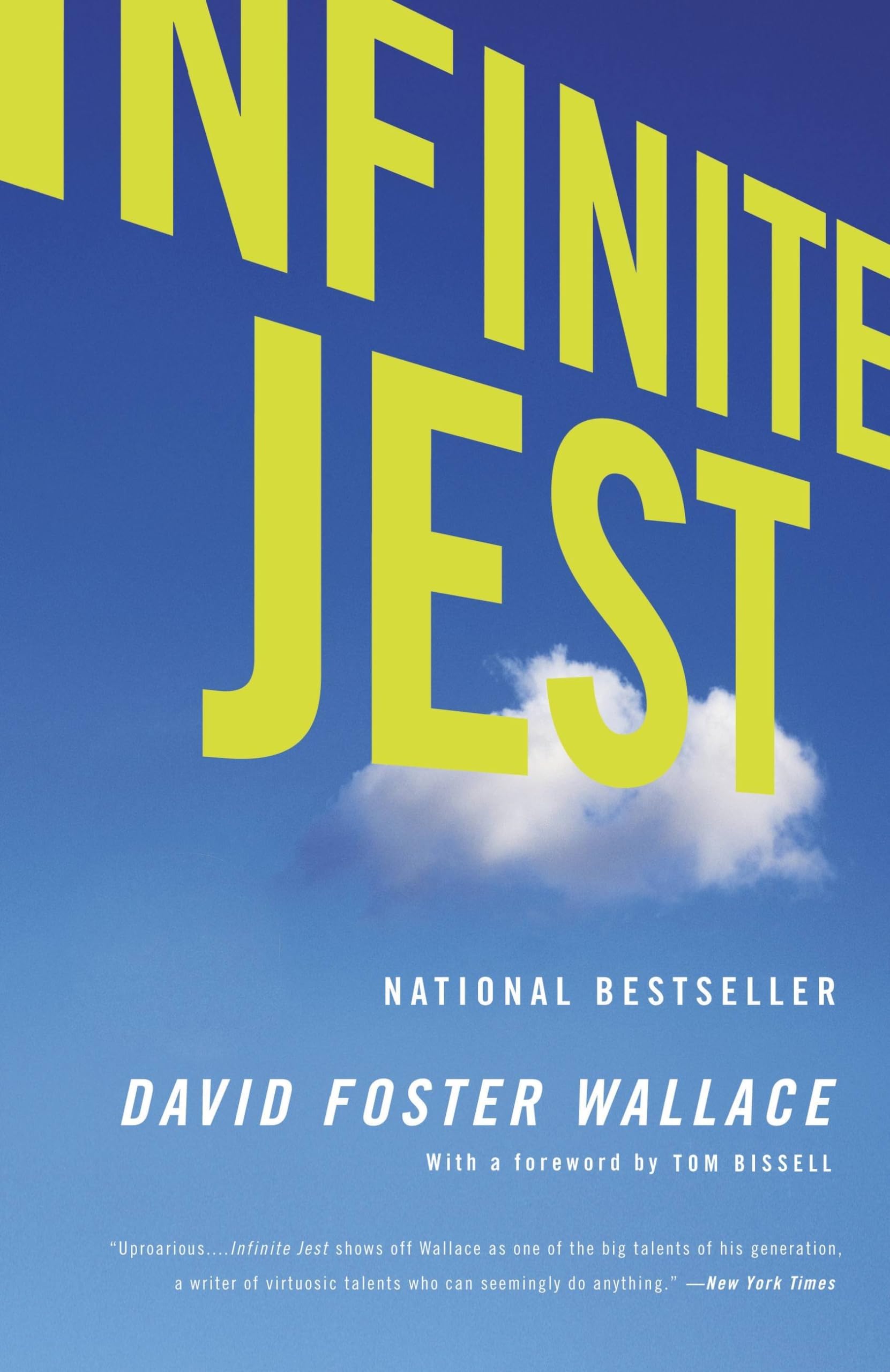


Infinite Jest [Wallace, David Foster] on desertcart.com. *FREE* shipping on qualifying offers. Infinite Jest Review: A working vacation - INFINTE JEST. (1996) David Foster Wallace. Everything you have heard, read, and that has been said about Infinite Jest is true. Should YOU read it? Is the only relevant question. This book is work--it's going into the gym and the classroom. (It is 1079 pages and holding it requires strength and strategy. And Kindle, iPod, or cd isn't a remedy because of the classroom aspect--you will want to highlight, and write in the margins; and it requires two bookmarks--one for the body and one for the endnotes.) This book, though a novel, is a journey into the mind of David Foster Wallace and is one long suicide (Wallace hung himself 12 years after publication at age 46) note. But it is not grim and dour. It is, at times, gruesome and frightening, yes, and also funny, and always insightful into the human condition and especially the American pursuit of happiness and pleasure along with the concurrent escape from discomfort and pain. And mostly about the inherent and ironic conflict between pleasure and pain--how the relief of pain into pleasure ultimately creates more pain, which causes one to seek more relief/pleasure, i.e. a psychological and physiological trap--a cage with no way out ... except maybe through a Twelve-step program which is SO boring so as to be not worth the effort. And then, there is reincarnation--which DFW never calls by name (something he does with the Psychoanalytic Reaction Formation, also) but which plays a huge part in the story. Both. Should YOU read it? I rank it as one of the four best books of all time. I lived with it for three weeks pretty much not doing anything else but reading and thinking about what Wallace was saying. I stopped drinking (One theme is addiction) and didn't bother to go out or watch any entertainment or do any work of my own (writing). It, the book, moved into my mind--took up residence in my apartment, became my roommate. Of course that is ironic also because the book's first name was "A FAILED ENTERTAINMENT," and the book is the most entertaining thing I've ever experienced - passively; but then it is work so it's not completely passive, as say watching something - "spectation" Wallace calls it. What the book is is inside the brain of a particular personality who happens to be a genius with a photographic memory (which again he doesn't name but describes: "Hal [a central character] can summon a kind of mental Xerox of anything he'd ever read and basically read it all over again, at will, ... ." (Pg. 797) I think parts of Wallace surface in all of the characters (there are scores of them) and what he does is to debate through interior and exterior dialogue, btw & w/in characters. Ideas/thoughts/philosophy (and of course this is discussed. He also critiques his own writing style via this, his technique,) Wallace's personality is, if categorized by the trait theory of The Big Five (OCEAN) [I think]: Extremely high O (open) slightly less but still very high C (conscientiousness), somewhat low E (extraversion, i.e Introverted), somewhat low A (agreeableness) and somewhat above average N (neuroticism). Add to that an extremely high I.Q. with that memory thing, a large physical presence (6'2, 200lbs.) and a cute and interesting face and you've got the man. If you think you can relate to those characteristics--you'll probably be taken by, and drawn into the novel as I was. [About being high O. Highly Open persons tend to be bored by people below them on the continuum, which looks like arrogance, elitism, snobbery, creative showoffishness, etc. Openness is the trait most associated with creativity. They also tend to be low in A (a `pussified' trait) for obvious reasons.] That by way of introduction. Briefly now, a look at Infinite Jest by way of the six elements of a story. Title: Perfect, either one. Defines the book. Plot: There is only a very almost inconsequential one. It is sometimes a distraction. It is about the relationship btwn the USA and Canada and the use and disposal/reuse of energy and territory. In an interesting way - it is woven into the pleasure/pain conundrum and so therefore worth some consideration. The personal and political intersect with, I think, some very bizarre drug enhanced imaginative thoughts and ideas. Free association. Characterization: There are three main protagonists. Hal Incandenza, a 17 yr.old, privileged white boy, at an elite youth tennis academy in Massachusetts; founded by his father (alcoholic) and run by his mother (OCD). Hal is addicted to marijuana and nicotine and a gifted and highly rated tennis prospect. He has younger residents/students/players he mentors, as well as two brothers who play prominent roles. Don Gately, a 29 yr. old, staff resident of a halfway house for recovering substance abusers, located adjacent to the tennis academy. Don is 9 months sober and oversees other recovering addicts. He is recovering from addiction to downers and a life of crime. Remy Marathe, (of unknown age) a legless Canadian, and member of a group of wheel chair assassins involved with the USA v. Canada's political/environmental/territorial mess. There are numerous sub-characters within these three facets of the story - the tennis academy, the halfway house, and the governments of the two countries. There is a prominent female character, Joelle van Dyne. She is involved with Orin Incandenza (Hal's older brother); James Incandenza (Hal's father); Mario Incandenza (Hal's younger, deformed, brother); and Don. She is also a person of interest i/r/t Remy's work. She is addicted to crack cocaine and a girl of exceptional beauty--the P.G.O.A.T.--the Prettiest Girl On The Planet. To me, none of the characters were all that likable. Setting: The story takes place mostly in and around Boston, Mass. USA in the near future [The book being written in the mid 90's.] year of 2007. It is spring through fall and there is rain, humid heat, and snow. The "action" is mostly in and around the tennis academy, the halfway house and the seedy underbelly of Boston. There is also the desert SW around Tucson. Wallace is the best I've ever read of painting landscape and cityscape with words. He is also the best at the littlest details of people behavior. [Reading him is in some ways like opening your eyes to the world for the first time.] The zeitgeist is a future that revolves around telecommunications and entertainment, both voice and video. It is eerily accurate i/r/t where we are today. [It was written pre Internet & wireless explosion.] Style: This is maybe where most people simply go batty and throw the book against the wall. There is no consistent POV or voice save for Wallace's. He breaks every rule (for writing) there is ... and yet he pulls it off. All the characters pretty much talk the same, with the same idiosyncrasies, i.e. Wallace's. He uses conjoined conjunctions up the wazoo: "And so but... That thus this is why... So and but that night's next ..." etc. He repeats words: "Then he considered that this was the only dream he could recall where even in the dream he knew that it was a dream, much less lay there considering the fact that he was considering the up-front dream quality of the dream he was dreaming." [then he adds, mocking himself] "It quickly got so multileveled and confusing that his eyes rolled back in his head." (pg. 830) Events are not lineal. Sometimes events and persons don't become clear for 100s of pages. He makes up words. He uses obscure words. He uses acronyms up the wazoo. He uses endnotes that are stories in and of themselves. The endnotes sometimes explain the main story. There can be page upon page w/o a paragraph break. His segues sometimes are just barely, and then ... the sidebar has next to nothing to do with anything except - the central theme(s). This is the where the personality factor of Openness factors in--if you're not of a like mind/brain--it'll drive you nuts. The story has no ending, the book ends. Theme: The strongest case for reading this book. DFW says the book is about: Tennis; Addiction; & Entertainment. It is that, and more. Some readers struggle with the minutiae of tennis. But the game of tennis and the discipline required is a metaphor for life, in Wallace's mind. This is what is taught at the academy, and also all the AA stuff, characters and references. Delay of gratification and effort and struggle are their own rewards ... blah,blah, blah and yada, yada. Life is a GAME and it is not about you or who wins that matters. Ironically--nothing matters. Addiction is covered from head to toe, from its genesis to its usually horrific conclusion. You think you're not, addicted, maybe you should read this book for that reason. Entertainment and the individual and that relationship- ship's- ships' (Wallace's style is infectious) exploitation by design and by fate (Never named.). Then there is the issue of control, choice, and self-determination, which is the underpinning of The Game, Addictions, & Entertainment. Is it (control) really just a delusion? So why not - seek pleasure and submit to ecstasy? And running beneath the underpinning is all the unnamed Freudian stuff (Also, never named.)--that childhood decides. That even the best of intentions can have disastrous consequences, and not even here to get into all the horror of the ubiquitous neglectful, abusive, and incestuous parenting stuff that Wallace explores. And finally [not really possible] Wallace's take on reincarnation--that YOU will be killed by a woman, and that that woman will be your mother in your next life. Got time? Time to explore who you are and why you do what you do--to step outside your cage and study yourself as subject? Take a vacation ... haha. Review: Absurd, long, hilarious, confusing, non-linear, heartbreaking, wonderful - I’m not sure what I can say about this book beyond what I put in the title of this review. It’s heartbreaking and hilarious at the same time, on the same page, in the same paragraph, in the same sentence, with the same words. A book full of very, very flawed characters I came to care about deeply. It’s science fiction, political satire, coming-of-age story, character study, comedy. Long and often frustrating. Wonderful, beautiful, moving, did I already say heartbreaking. A couple of recommendations if you’re going to read this. Read it in the electronic version if you can. There are many long indispensable footnotes. If you don’t read them, you’ll be even more lost than you will probably be otherwise. Turning to the back of the book frequently can be maddening. I found myself looking up vocabulary (real, and made up) over and over. Also, I read it in a book group with my children, 100 pages a month. I never would have finished it otherwise. Did I mention it’s heartbreaking, hilarious, wonderful?
| Best Sellers Rank | #4,701 in Books ( See Top 100 in Books ) #50 in Contemporary Literature & Fiction #56 in Classic Literature & Fiction #216 in Literary Fiction (Books) |
| Customer Reviews | 4.4 4.4 out of 5 stars (6,156) |
| Dimensions | 6 x 1.88 x 9.25 inches |
| Edition | Anniversary |
| ISBN-10 | 0316066524 |
| ISBN-13 | 978-0316066525 |
| Item Weight | 2.55 pounds |
| Language | English |
| Print length | 1079 pages |
| Publication date | November 13, 2006 |
| Publisher | Back Bay Books |
| Reading age | 1 year and up |
M**R
A working vacation
INFINTE JEST. (1996) David Foster Wallace. Everything you have heard, read, and that has been said about Infinite Jest is true. Should YOU read it? Is the only relevant question. This book is work--it's going into the gym and the classroom. (It is 1079 pages and holding it requires strength and strategy. And Kindle, iPod, or cd isn't a remedy because of the classroom aspect--you will want to highlight, and write in the margins; and it requires two bookmarks--one for the body and one for the endnotes.) This book, though a novel, is a journey into the mind of David Foster Wallace and is one long suicide (Wallace hung himself 12 years after publication at age 46) note. But it is not grim and dour. It is, at times, gruesome and frightening, yes, and also funny, and always insightful into the human condition and especially the American pursuit of happiness and pleasure along with the concurrent escape from discomfort and pain. And mostly about the inherent and ironic conflict between pleasure and pain--how the relief of pain into pleasure ultimately creates more pain, which causes one to seek more relief/pleasure, i.e. a psychological and physiological trap--a cage with no way out ... except maybe through a Twelve-step program which is SO boring so as to be not worth the effort. And then, there is reincarnation--which DFW never calls by name (something he does with the Psychoanalytic Reaction Formation, also) but which plays a huge part in the story. Both. Should YOU read it? I rank it as one of the four best books of all time. I lived with it for three weeks pretty much not doing anything else but reading and thinking about what Wallace was saying. I stopped drinking (One theme is addiction) and didn't bother to go out or watch any entertainment or do any work of my own (writing). It, the book, moved into my mind--took up residence in my apartment, became my roommate. Of course that is ironic also because the book's first name was "A FAILED ENTERTAINMENT," and the book is the most entertaining thing I've ever experienced - passively; but then it is work so it's not completely passive, as say watching something - "spectation" Wallace calls it. What the book is is inside the brain of a particular personality who happens to be a genius with a photographic memory (which again he doesn't name but describes: "Hal [a central character] can summon a kind of mental Xerox of anything he'd ever read and basically read it all over again, at will, ... ." (Pg. 797) I think parts of Wallace surface in all of the characters (there are scores of them) and what he does is to debate through interior and exterior dialogue, btw & w/in characters. Ideas/thoughts/philosophy (and of course this is discussed. He also critiques his own writing style via this, his technique,) Wallace's personality is, if categorized by the trait theory of The Big Five (OCEAN) [I think]: Extremely high O (open) slightly less but still very high C (conscientiousness), somewhat low E (extraversion, i.e Introverted), somewhat low A (agreeableness) and somewhat above average N (neuroticism). Add to that an extremely high I.Q. with that memory thing, a large physical presence (6'2, 200lbs.) and a cute and interesting face and you've got the man. If you think you can relate to those characteristics--you'll probably be taken by, and drawn into the novel as I was. [About being high O. Highly Open persons tend to be bored by people below them on the continuum, which looks like arrogance, elitism, snobbery, creative showoffishness, etc. Openness is the trait most associated with creativity. They also tend to be low in A (a `pussified' trait) for obvious reasons.] That by way of introduction. Briefly now, a look at Infinite Jest by way of the six elements of a story. Title: Perfect, either one. Defines the book. Plot: There is only a very almost inconsequential one. It is sometimes a distraction. It is about the relationship btwn the USA and Canada and the use and disposal/reuse of energy and territory. In an interesting way - it is woven into the pleasure/pain conundrum and so therefore worth some consideration. The personal and political intersect with, I think, some very bizarre drug enhanced imaginative thoughts and ideas. Free association. Characterization: There are three main protagonists. Hal Incandenza, a 17 yr.old, privileged white boy, at an elite youth tennis academy in Massachusetts; founded by his father (alcoholic) and run by his mother (OCD). Hal is addicted to marijuana and nicotine and a gifted and highly rated tennis prospect. He has younger residents/students/players he mentors, as well as two brothers who play prominent roles. Don Gately, a 29 yr. old, staff resident of a halfway house for recovering substance abusers, located adjacent to the tennis academy. Don is 9 months sober and oversees other recovering addicts. He is recovering from addiction to downers and a life of crime. Remy Marathe, (of unknown age) a legless Canadian, and member of a group of wheel chair assassins involved with the USA v. Canada's political/environmental/territorial mess. There are numerous sub-characters within these three facets of the story - the tennis academy, the halfway house, and the governments of the two countries. There is a prominent female character, Joelle van Dyne. She is involved with Orin Incandenza (Hal's older brother); James Incandenza (Hal's father); Mario Incandenza (Hal's younger, deformed, brother); and Don. She is also a person of interest i/r/t Remy's work. She is addicted to crack cocaine and a girl of exceptional beauty--the P.G.O.A.T.--the Prettiest Girl On The Planet. To me, none of the characters were all that likable. Setting: The story takes place mostly in and around Boston, Mass. USA in the near future [The book being written in the mid 90's.] year of 2007. It is spring through fall and there is rain, humid heat, and snow. The "action" is mostly in and around the tennis academy, the halfway house and the seedy underbelly of Boston. There is also the desert SW around Tucson. Wallace is the best I've ever read of painting landscape and cityscape with words. He is also the best at the littlest details of people behavior. [Reading him is in some ways like opening your eyes to the world for the first time.] The zeitgeist is a future that revolves around telecommunications and entertainment, both voice and video. It is eerily accurate i/r/t where we are today. [It was written pre Internet & wireless explosion.] Style: This is maybe where most people simply go batty and throw the book against the wall. There is no consistent POV or voice save for Wallace's. He breaks every rule (for writing) there is ... and yet he pulls it off. All the characters pretty much talk the same, with the same idiosyncrasies, i.e. Wallace's. He uses conjoined conjunctions up the wazoo: "And so but... That thus this is why... So and but that night's next ..." etc. He repeats words: "Then he considered that this was the only dream he could recall where even in the dream he knew that it was a dream, much less lay there considering the fact that he was considering the up-front dream quality of the dream he was dreaming." [then he adds, mocking himself] "It quickly got so multileveled and confusing that his eyes rolled back in his head." (pg. 830) Events are not lineal. Sometimes events and persons don't become clear for 100s of pages. He makes up words. He uses obscure words. He uses acronyms up the wazoo. He uses endnotes that are stories in and of themselves. The endnotes sometimes explain the main story. There can be page upon page w/o a paragraph break. His segues sometimes are just barely, and then ... the sidebar has next to nothing to do with anything except - the central theme(s). This is the where the personality factor of Openness factors in--if you're not of a like mind/brain--it'll drive you nuts. The story has no ending, the book ends. Theme: The strongest case for reading this book. DFW says the book is about: Tennis; Addiction; & Entertainment. It is that, and more. Some readers struggle with the minutiae of tennis. But the game of tennis and the discipline required is a metaphor for life, in Wallace's mind. This is what is taught at the academy, and also all the AA stuff, characters and references. Delay of gratification and effort and struggle are their own rewards ... blah,blah, blah and yada, yada. Life is a GAME and it is not about you or who wins that matters. Ironically--nothing matters. Addiction is covered from head to toe, from its genesis to its usually horrific conclusion. You think you're not, addicted, maybe you should read this book for that reason. Entertainment and the individual and that relationship- ship's- ships' (Wallace's style is infectious) exploitation by design and by fate (Never named.). Then there is the issue of control, choice, and self-determination, which is the underpinning of The Game, Addictions, & Entertainment. Is it (control) really just a delusion? So why not - seek pleasure and submit to ecstasy? And running beneath the underpinning is all the unnamed Freudian stuff (Also, never named.)--that childhood decides. That even the best of intentions can have disastrous consequences, and not even here to get into all the horror of the ubiquitous neglectful, abusive, and incestuous parenting stuff that Wallace explores. And finally [not really possible] Wallace's take on reincarnation--that YOU will be killed by a woman, and that that woman will be your mother in your next life. Got time? Time to explore who you are and why you do what you do--to step outside your cage and study yourself as subject? Take a vacation ... haha.
B**K
Absurd, long, hilarious, confusing, non-linear, heartbreaking, wonderful
I’m not sure what I can say about this book beyond what I put in the title of this review. It’s heartbreaking and hilarious at the same time, on the same page, in the same paragraph, in the same sentence, with the same words. A book full of very, very flawed characters I came to care about deeply. It’s science fiction, political satire, coming-of-age story, character study, comedy. Long and often frustrating. Wonderful, beautiful, moving, did I already say heartbreaking. A couple of recommendations if you’re going to read this. Read it in the electronic version if you can. There are many long indispensable footnotes. If you don’t read them, you’ll be even more lost than you will probably be otherwise. Turning to the back of the book frequently can be maddening. I found myself looking up vocabulary (real, and made up) over and over. Also, I read it in a book group with my children, 100 pages a month. I never would have finished it otherwise. Did I mention it’s heartbreaking, hilarious, wonderful?
S**Y
Great Read!
I've heard a lot about this book, with many people calling it a challenging read due to its complex structure, the large number of characters and story lines, use of unnecessary and sometimes irrelevant footnotes, and non-linear narrative. I think these people are missing the point! JFW wrote in a style that literally and figuratively expresses the experience of information overload and getting lost down rabbit holes, as well as themes of addiction, entertainment, politics, capitalism, and mental health. It's sad and funny all at once. But is this book for you? If you like things to make sense right out of the gate, if you're Type A, results-oriented, goal-driven, or lack a sense of subtlety or patience, this is NOT the book for you. But if you're willing to read with an open mind and let the stories open themselves to you, without needing to understand it all (which you won't, as in life) then this book will reward you with pathos and insight and some laugh-out-loud funny moments, as well as soul-sucking tragedy. It's a story about the world we all live in. It's actually quite an easy, conversational read so far. I'd give it 5 stars except I haven't finished yet, so I can't speak to the book as a whole. I know I will finish it, though. I just couldn't wait to share my thoughts!
G**U
Couldnt hold my interest.
S**E
The physical state of the book is quite good.The binding is good given this book has 1000+ pages The font is also decent and is NOT as small as other reviews have stated. It is quite readable.
G**O
Having spent the last 6 years reading every single thing that DFW had written in a prolific and varied career, this remains, by far my favourite book of all time. I have read a number of books of a similar length, so upwards of 500k words or 1300 pages, namely, Gravitys Rainbow by Pynchon (laugh out loud funny!), Ulysses by Joyce (awful and felt like a torture, took almost a year to read I hated it so much!), War and Peace (deep and profound and philosophical, I feel I was too young, at 16, to truly understand its real themes), Atlas Shrugged by Rand (read most recently in just 6 weeks and my god was it preachy and needed an editor, desperately!) and it was Infinite Jest (a direct quote from Hamlet, 'a fellow of infinite jest') which I read in 5 months which I enjoyed the most. This is a thoroughly post-modern novel and books being a form of entertainment, is going full meta by being about the nature of entertainment itself. It present a world of a tennis academy, the nature of addiction, a dystopian future in which Mexico and the States and Canada united together into what DFW calls ONAN (Organisation of North American Nations). Canada, in this vision of the future, is a nuclear wasteland, where there prowl giant feral mutant rats, while Quebecois separatists are assassinating their enemies via a very unique style - by giving them a copy of a film on a VHS tape called, appropriately, 'The Entertainment' which the person puts into their VCR player and watches on loop until they die of malnutrition/exhaustion imposed on them by their inability to stop watching such a compellingly, addictively, entertaining film. DFW riffs on this theme in an earlier essay called 'De Unibus Pluram' (which you can find online for free) which was written on the back of the statistics, at the back-end of the 1980s, that the average American household spends 6 hours a day watching TV (it's probably considerably longer, 3 decades on!) So if you like the essay, I'd suggest you get the book. It is incredibly fresh and laugh out loud funny in an enormous amount of places. Once thing that will probably annoy people who buy the physical books are the endless footnotes and endnotes (some running for 10 pages and often having footnotes to the footnotes!) which are integral to the plot and for which you will probably require a separate bookmark at the back of the book to refer to. I read this book digitally and it very helpfully has hyperlinks allowing you to jump to the footnotes/endnotes and back to the main text at will. I suspect this book is a lot harder to read in physical form and there are some reviews that say they had to break the spice of the book to separate the final 150 pages - which is the footnotes, as otherwise, it is very difficult to read this novel. This novel is broadly about the nature of modern entertainment, addiction, tennis, drugs and a whole lot else. It is hilariously funny and self-aware. DFW is possibly the greatest fiction writer (and definitely THE greatest non-fiction writer) of his generation and he was a person who was both exceptionally smart and talented (at Amherst he was doing 2 dissertations simultaneously, one on philosophy and one on creative writing, the latter being published as The Broom of The System, his first novel, when most of his peers were struggling with just 1). He has written extensively on all sorts of topics, from AVN awards to lobsters in Maine, to tennis, Terminator 2, philosophy and mathematics (see his book Everything and More) and I am sure I am not doing justice to the sheer breadth of the things that he writes about with refreshing candour and incredible humour. He was also a tragic figure, hanging himself when changing anti-depressants in 2008. He did though, leave behind a hugely impressive body of work and Infinite Jest, in my opinion, having read everything he has written over the years, is his crowning glory. It is the most fun book of this length that I have ever read. As somebody who had to give up alcohol through recovery, the sections of the book concerning itself with AA is absolutely 200% accurate and my understanding is that DFW in fact spent many hours/days sitting through AA meetings and absorbing the fellowship's take on addiction and its trigger factors. It really reads like he knows exactly what goes on there - as he really did, in real life. DFW was a complex figure and there is a strong argument to be made that his best work, is, in fact, his NON-fiction (a supposedly funny thing I'll never do again, aboard a luxury cruise liner, will always remain the funniest bit of non-fiction I have ever read!). But in this humble reviewer's opinion, Infinite Jest, for its sheer scope, refreshing honestly, spot on observations and dialogue and just satire and humour - will push it close. DFW is one of the greatest minds of his generation, yet he writes in such an accessible manner in all his work so as to become something much, much more than just another crusty intellectual, speaking down to us to, plebs, from his high horse. I believe what he really is - he is a voice of his generation (80s and 90s) - and Infinite Jest is a testament to that. Of all the long, classic books, that people read (or more often take selfies with to show off their nauseating 'intellectualism' on Instagram - rather than actually read), think War and Peace, Atlas Shrugged, Capital In the 21st Century, The Brothers Karamazov, Anna Karenina, Finnegan's Wake, Ulysses etc and so forth, this is BY FAR the most fun book of its length and type. Infinite Jest is both sad, depressed and funny and even 25 years after it was published (in 1994) remains relevant to the modern age. In fact, its take on the very nature of entertainment itself perhaps foresaw the age of vanity and social media, as seen through the prisms of Tinder, Facebook, Twitter and Instagram. The end result is a triumph for a tragic figure who left us far too soon. His legacy, as both an acute observer and reader of people in his non fiction as he is in his fiction - is absolutely secure, and will remain so for a long time to come. I don't know to what extent DFW can pass for 'one of us, a man of the people' given his fairly privileged upbringing of being the son of 2 university professors (one in philosophy, one in English, and hence being exposed to both subjects from birth, pretty much) but the way he writes certainly speaks to his audience in a way that few writers (fiction, non-fiction and every shade in between) every succeed in doing.
F**A
Este livro não é um livro comum, seja pelas 1100 páginas, seja pelas mais de 300 notas de rodapé¹, seja pelo estilo literário incomparável de Wallace. O livro, fisicamente, é deveras grande e por muito tempo ficou impondo-se monoliticamente em comparação com os meus outros livros na minha estante. Foram necessárias várias tentativas para que eu pudesse conseguir ler este livro. Mas esta obra recompensa fartamente aqueles que perseveram nela. David Foster Wallace tem um domínio incrível da língua inglesa e da capacidade analítica, especialmente dos temas de vício, entretenimento, solidão e falta de empatia, nos quais este livro está fundado. O seu maior talento, contudo, é ligar esses temas entre si, criando um quadro complexo e belo (ainda que desesperador de vez em quando) do mundo que nos cerca, ou gestalt, como ele prefere chamar. Por isso, nenhum resumo o faz justiça. Este livro é exaustivo, como uma montanha a ser escalada. Nunca vai pelo caminho mais curto, e faz você se perguntar se isso tudo não é supérfluo, mas assim como numa escalada, no momento que você chega ao topo é recompensado com uma visão de mundo nova e faz valer a pena cada passo dado até ali, fazendo você se perguntar quão diferente será sua visão do mundo daqui pra frente². ¹ Que por sua vez são completamente brilhantes e diversas, desde um simples "No clue" até notas de 9 páginas com suas próprias notas de rodapé. ² No clue.
I**S
日本語の情報がとにかく限られているので、参考までに。15年越し3度目の挑戦でようやく読了。最初にハードカバーを読み始めたときは、全く情報もなく、何が起こっているか分からないまま、とにかく頻繁に出てくる巻末の脚注(特に最初は麻薬類の説明ばかり)を読むのにも疲れて挫折。注が多いといっても、House of leavesのような、まだ本文との関連性が高いものが中心の脚注ではなく、興味のない人間には全く意味のない麻薬やジャーゴンの詳細な解説の中に、何が起こっているか理解するのに必須なものが埋もれていて、結局全部目を通さないといけない。少し前にKindle版がアップデートされて脚注へのリンクやX-rayが使えるようになっていることに気づいて、最初から読み直しました。Kindle版は非常に読みやすくなっています。また、Infinite jestに関する様々なwebsitesも出来ていて、それらを参照すると、かなり細かいことまで情報が得られるようになっています。特に最初の方はとにかく記述が断片的で、時間と場所も飛びまくるので、何らかのガイドが必要な気がしますが、250ページを超える頃からだんだんと記述はリニアーになります。特に後半は、ストーリーはほぼ一直線で、アメリカの最近のポストモダン風な小説に共通するのかもしれませんが、見た目と違って主題は孤独や家族、addiction等、意外と近代的・伝統的な印象を受けます。ただし、麻薬中毒者の意識の流れ的記述で何が起こっているか分からない部分が延々と続いたり(フォークナーの The sound and furyの最初のパートのvariationsが何度も出てくる感じ)、重要なイベントの記述が欠失して、全く関係なさそうなところにわずかにほのめかされる等、とにかく読者に対して不親切。これをパズルのように楽しめるかどうかでも、評価が大きく変わるでしょう。文章と内容は、時々心に響くところがあったり、一瞬きらめくようなところがあったりしますが、一方で、どうしようもなく単に饒舌に言葉が続いているだけで内容が全くなさそうな文章が何ページも続きます。結局最後まで読み通せましたが、完全に興味を失う局面が何度もありました。また、主に今世紀の最初の10年くらいが舞台になっていますが、出版後のコンピュータやメディアの変化が激しすぎて、細かいテクノロジーの説明がちょっと古びた印象を与えるところもあります。ジュニアテニス、メディア中毒、薬物中毒に興味がある人にとっては、これらに関する細かい情報をもっと楽しめるかもしれません。個人的には、もっと若いときに読破すべきだったと思います。いずれにしろ、非常に読者を選ぶ小説であることは確かかと。
Trustpilot
5 days ago
4 days ago