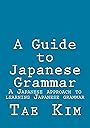

📖 Unlock Japanese fluency with the grammar guide everyone’s talking about!
Tae Kim's 'A Guide to Japanese Grammar' is a compact, durable, and highly practical textbook designed for self-learners. It offers a unique, beginner-friendly approach by introducing grammar in a logical order, supported by interactive features like highlighting, note-taking, and search. Perfect for studying anywhere—from Tokyo parks to trains—this best-selling guide is a top choice for mastering Japanese grammar efficiently.
| Best Sellers Rank | #71,940 in Kindle Store ( See Top 100 in Kindle Store ) #3 in Japanese Language Instruction (Kindle Store) |
L**T
Blue book
I purchased the blue book version, printed in 2014, and it is smaller than the orange one (2012). It is easy to carry around in my purse around Tokyo. I've been studying using this textbook in Tokyo parks, restaurants, coffee shops, on the densha (JR train), while walking.... It has a wax-like coated cover (which is great given that Japan rains a lot) and gives it a nice, soft feel on the hands. I just wish there was a kindle formatted version too. Please, Mr. Kim, onegaishimasu. Personally, my core set for learning Japanese, the cream-of-the-crop best items, is as follows: 1. Genki I and II, including the workbooks, 2nd edition - the textbook for UCLA Japanese classes. Absolute gem of a book. This is your go-to "traditional" textbook. 2. Heisig's Remembering the Kanji - Remember 2000 kanji in 2 months? Yes. It's amazing. 3. Tae Kim's Guide to Japanese Grammar (my cliff notes) - Great refresher for stuff you learned. This book is like the golden notebook that you stole from that A+ student in your college Japanese class. 4. "Japanese" app by Renzo Inc. from the Apple Store. Includes wwwjdic dictionary, all conjugations for every word (volitional, transitive, past, present, polite form, etc.) , a built in flashcard builder, kanji stroke order videos for all kanji, and more from this sweet app. Absolute must purchase. This is like a super-dictionary. Don't have an iPhone? Buy an iPod Touch 5th gen. and get this app. It is worth buying an iPod Touch just for this app. ------------------------------------------------------------------------------- Optional study supplementals which are great for learning Japanese: s1. White Rabbit Press - Kanji Flashcards 1, 2, 3 - best Japanese flashcards around with all the Joyou Kanji. s2. NihonShock's Cheat Sheet Pack - 10 laminated colorful notes of all the vital Japanese grammar s3. Anki - a flashcard program that lets you download shared cards created by other users & allows you to make your own flashcards on the computer.
B**S
English speaker? Self-learning? Buy this not Genki
This book is much better for self-learning than other textbooks. The problem with Genki and others is that they're written for a classroom setting (hence all the group/partner exercises) or with a dedicated tutor. Therefore, grammar nuances aren't readily available but in "A Guide to Japanese Grammar", Tae Kim anticipates and explains common questions that arise for beginner learners in a reassuring, casual tone. The order of how grammar is introduced is different than other textbooks/classes which I think is better for beginner learners. Tae Kim starts off with explaining the very basic building blocks of grammar ("plain" and "informal" forms) and then gradually introduces the complexities of "polite" and "formal" form. Other textbooks start you off with learning sentences in "polite form" and then breaks it down until you learn the "plain form." I found this harder to wrap my head around when I first studied Japanese and wished more books/classes had it like Tae Kim instead. The book is focused on grammar and does require understanding hiragana/katakana and some basic kanji. Personally, I'm okay with that because you get much more grammar material. The book itself is also much easier to reference back to, which was another issue I had with Genki. All in all, it's $20 for an amazing book so just buy it!!
B**S
BEST WAY TO STUDY GRAMMAR
Through immersing in Japanese and using this guide I think this is a lot better than genki. I think genki is great for those in a class and o my want to have class level language ability but I think this book used with MIA mass immersion approach is a lot better it's been recommended by people who reached a high level of fluency and as I'm using it I find it not hard to understand. The best way to learn grammar isn't by writing it over and over using note taking methods or by studying for tests and practicing the language as if it's a formula but by seeing it in immersion in native Japanese content. The grammar points for some things go in depth and kind of build off of each other, not for everything but for grammar points that are relative to another, the cover is really nice a kind of matte material most things are easy to find and the book itself is not too big PLUS the author has this stuff FOR FREE on his website and as a PDF do you don't even really have to buy it. But I still like the printed book it's a good way to remember the grammar by reading it on a physical paper back so I'd definitely recommend it to those wanting to study Japanese like me and I also recommend Remembering the Kanji by James Heisig for kanji characters as well. Thanks for reading and have a nice day/night!
S**R
“Just Press”, so what? It is a great book.
New thought: After I have completed this book, I can tell the most important reason why I recommend it. The book shines new lights. For example, usually Te-form is treated as a "separated" conjugation, but the author of this book divides Te-form into smaller elements: the stems of verbs, and the suffixes. Therefore, almost all conjugations could be derived from the more basic units. Once you master what the stems of verbs are, you could easily conjugate verbs to Te-form, Ta-form and so forth. For me, it is much more methodic than treating each conjugation form as a separated one. It is helpful to construct the impression that all conjugations actually have connections, therefor avoid confusions. Previous thoughts: I have GENKI books and another Japanese grammar book, but I still bought this one. As described, the book is a printout for who prefer having a physical one (or dead trees) in hands. It was printed once I placed order, considering the cost of printing and binding and shipping, I think it is dirty cheap and totally disagree someone giving 3 stars because it is “just press” of free content from the author's website, especially the description has already clearly indicated that. I like the book because it doesn’t have ignoring Roma phonetic notions for whole sentences. I have browsed several Japanese grammar books, and really don’t like their clumsy phonetic notions. If someone even doesn’t want to grasp Hiragana, why bothers to learn grammar? By the way, in addition to assumption that potential readers have already mastered Hiragana, the author would expect they have know the most common Kanji, at least, learning. Otherwise, you may find it is a kind of challenge to begin with the "Basic Grammar". The book is organized in a clear structure of "grounding up", I agree it may make more sense than learning simple expressions first. I'm trying to master a language, not just go to Japan and order some dishes in a Japanese restaurant. Well, the GENKI books begin with a scenario of two students meeting each other, and most books teach this way, but I want to change the point of view, as the author stated, to the point of view of Japanese, because many Japanese expressions don't have direct counterparts in English. I also think that introducing masu-form expressions first is wired in other books, I do want to learn dictionary form of verbs first, then advance to conjugations. Since I have learned some, I mainly take this book as a quick reference easy to shuffle and write down notes, yeah, there are a lot of blank spaces in pages because of layout design. Oh, one more thing, the font size of the book I have suddenly becomes smaller from page 37 (section 3.4 Adjectives). Although I don't care about this issue, I hope the author could modify. And, I prefer to have a wider line space. Anyway, I really appreciate Tae Kim composed such a useful book.
M**P
Informative and thorough book!
Even though there is a free copy of this book available, it is always nice to have a physical copy. The book follows most of the free stuff with all things considered. The only minor problem I had with the book itself was that it was printed in Monee IL, which means the front cover wasn’t flat. A. Several other people have complained about quality from this particular vendor. Other than that, the approach in the book is a little cut and dry and may be a little intimidating for a beginner, but the book is very thorough and informative nonetheless.
K**C
An excellent, alternate and intuitive way to learn Japanese
Tae Kim is a badass. I've been studying Japanese off and on for years, both in a college setting, as weekly classes now that I'm out of college, and plenty of self study as well. But I started hitting a wall when trying to read untranslated manga, especially stuff aimed at younger demographics (re: shounen). There's a ton of slang and other content that doesn't make a lot of sense, even for well-studied academics. Enter Tae Kim's guide (Amazon removes links it seems, just google 'Tae Kim Japanese guide' to find it) I found it via googling a few things that confused me in manga, and Tae has a lot of awesome insights that are intuitive and easy to understand. He helps shed light on certain intricacies of the language that aren't fully explained in textbooks, and the slang sections alone are worth the price of admission. If you have zero Japanese experience it'll help you too, as it starts at the absolute basics, covers a ton of conjugations, everythng you'll need. This product on amazon is essentially a printed version of the online guide - I'm old school and like having physical copies of things to read, so I picked this up. It's the same content as the online guide, so you should easily be able to tell ahead of time if you'd like the print book (stop being lazy and just go look at it! ^_^). I give a 5/5 for the content. Where a star gets docked is for the book printing itself - I can't be certain, but it appears that each book is printed on demand (as the timestamp on the book was right around when I bought it). The problem is, the company chose to print all of the content with a HUGE margin (about 1.5 inches around the content on all side). This is a textbook-sized, thick book already, and having a huge amount of margin does nothing more than add considerable weight to the book. It's not a brick, but this isn't an easy book you can tote around on the bus. Hopefully the publishing company will consider printing the book smaller without the margin; it would be a lot lighter and wouldn't lose any of the value (and the cover is exactly as shown, there's no frills here, so it's not like you'd be missing out on any cover real estate) Regardless, if you've read Tae Kim's online guide and want a physical version, or want to support him (since the online guide is free), this is a great item to pick up.
B**N
Tai Kim or Genki?
Tai Kim reduces all grammatical explanations to the most informal. He leads off with da for State of Being : Kore wa hon da. In increasing order of formality, one could use de aru, desu, or de arimasu. For a question, he just uses intonation: Kore was hon? For verbs, he uses the infinitive form, taberu, not tabemasu. Tai Kim gives explanations of all the basic grammatical forms with this informal usage. It makes the whole process more simple, concise, and logical. For example, fairly early on he uses verbs in a subordinate clause: Jon ga tabeta gohan oishi? (Was the meal that Jon ate tasty?) This construction requires the informal form. After Tai Kim finishes the grammatical basis, then he goes on to show how it can be modified with more polite forms. After all, people don’t actually say Kore wa hon da unless they are implying that you must be awfully stupid not to recognize that it is a book. People actually say Kore wa hon desu. And people don’t usually say Asa gohan taberu, rather Asa gohan tabemasu. Tai Kim only goes on to the more polite forms, though, after he has completed a thorough grounding in Japanese grammar. Genki starts out with desu and tabemasu. It must do this because it must get the students practicing in actual spoken Japanese immediately. It doesn’t have the luxury of giving a complete grammatical summary in the impolite form. This leads to some future complications, where changing back and forth in politeness levels is required, like with the subordinate clause case above. For self-study or review, I find Tai Kim to be the most logical and easiest to understand. For classroom use, it is wholly inappropriate and Genki is the right choice.
M**I
Excellent book for studying Japanese
Excellent book for learning basic Japanese grammar! It starts at the very beginning, and though it's definitely a bit confusing at first, it makes sense to learn grammar the way he teaches it: the hard way. By starting with the basic building blocks, it's much easier to learn how more complex Japanese grammar works. Begins with basic state-of-being grammar, particles, past tense/negative verbs, then goes on to the rest of the more difficult stuff. It makes heavy use of kanji from the very beginning, but don't let that worry you; it uses many of the same words over and over again, and hopefully you're using another source to learn kanji properly (Heisig, Wanikani, etc.) since it definitely doesn't teach them properly. A good guide to be used in conjunction with Genki (or your textbook of choice) for vocabulary; this guide can be used as a backup for grammar explanations or you can choose to entirely ignore what your textbook says and go off of this. It present everything in a pretty straightforward way, the only confusing parts are the example sentences: the English translations are always literal, with no regular English translation that makes sense. A lot of the literal sentences make no sense, and sometimes makes it difficult to understand what the sentence in Japanese (which you already don't understand) means. Overall, it's a great grammar guide. Clear, concise, and thorough.
Trustpilot
1 month ago
1 week ago