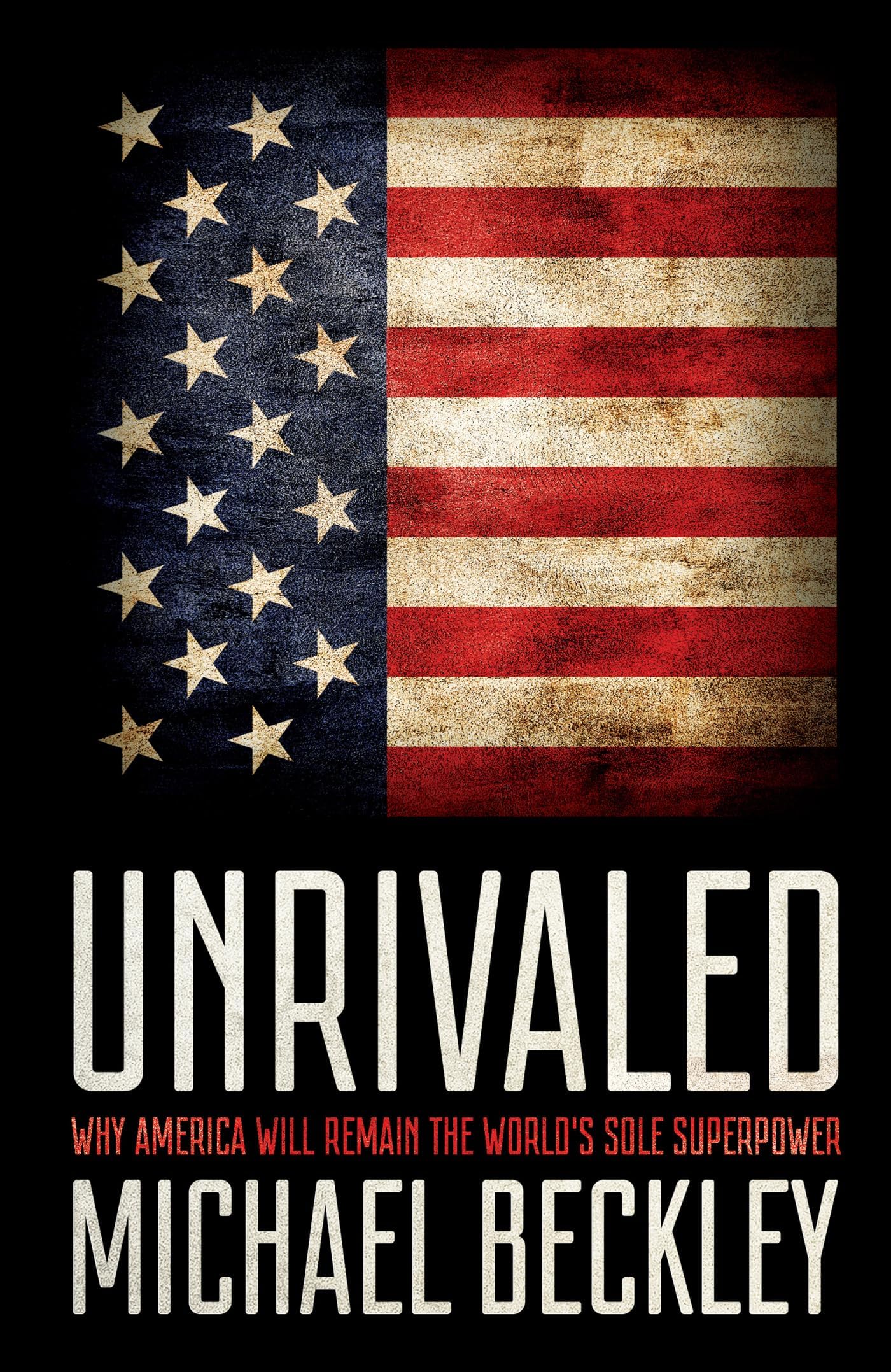
Unrivaled: Why America Will Remain the World's Sole Superpower (Cornell Studies in Security Affairs)
Product ID: 99599483
Desertcart purchases this item on your behalf and handles shipping, customs, and support to Kyrgyzstan.
Beckley demonstrates that no country is poised to upend American primacy, not economically, not militarily, and not technologically.... The evidence he assembles should be part of any serious debate about where we are headed.â• The New York Times The United States has been the world's dominant power for more than a century. Now many analysts believe that other countries are rising and the United States is in decline. Is the unipolar moment over? Is America finished as a superpower? In this book, Michael Beckley argues that the United States has unique advantages over other nations that, if used wisely, will allow it to remain the world's sole superpower throughout this century. We are not living in a transitional, post-Cold War era. Instead, we are in the midst of what he calls the unipolar era—a period as singular and important as any epoch in modern history. This era, Beckley contends, will endure because the US has a much larger economic and military lead over its closest rival, China, than most people think and the best prospects of any nation to amass wealth and power in the decades ahead. Deeply researched and brilliantly argued, this book covers hundreds of years of great power politics and develops new methods for measuring power and predicting the rise and fall of nations. By documenting long-term trends in the global balance of power and explaining their implications for world politics, the book provides guidance for policymakers, businesspeople, and scholars alike. Review: Beckley Pulls No Punches - Michael Beckley presents a very different kind of book about the USA compared to China and other countries in terms of power based on economic, military, and other factors. It is an easy read illustrated with many figures and tables and summary conclusions, It is also well referenced. Many other authors have concluded that The USA is a "has been" empire and that it's continued superpower status has been eroded to the point that it can no longer contain China or do much about China's ambitions in the world. Beckley's arguments show that this is far from true and that today we have a Unipolar situation in which the USA continues to be an unchallenged hegemon and is likely to be for some time. His economic presentations in particular are worth reading as he shows that China is clearly not the economic powerhouse that we think it is and that the cost to China in its slavish support of its state-run industries and maintenance of domestic order is massive. Unlike other studies and books he challenges the notion that if war did break out between the USA and China, the USA would be likely to lose or at best face a stalemate. That is not to say the USA does not have problems, and that these problems over a long period of time could lead to the USA's downfall; in fact, the author delineates several scenarios in which this could occur. Overall, I found the book to be a refreshing account of the geopolitical/economic USA-China situation in which China is not automatically accorded all the usual assumptions that Americans should take their bats and balls and go home. Review: Un buen analisis de por que EEUU va a seguir siendo el unico hegemon por varias decadas mas - Una explicaicon detallada de por que comparar el PIB solo de EEUU contra sus adversarios subestima su capacidad y que factores hacen que EEUU este mejor posicionada para seguir gobernando el mundo las proximas decadas. Su indicador GPD x GDP per capita esta genial para hacer analisis de potencial economico de los paises y tomar decisiones de inversiom, desde la perspectiva de un banquero de inversion.


| Best Sellers Rank | #745,056 in Books ( See Top 100 in Books ) #625 in National & International Security (Books) #16,468 in United States History (Books) |
| Customer Reviews | 4.6 out of 5 stars 173 Reviews |
M**R
Beckley Pulls No Punches
Michael Beckley presents a very different kind of book about the USA compared to China and other countries in terms of power based on economic, military, and other factors. It is an easy read illustrated with many figures and tables and summary conclusions, It is also well referenced. Many other authors have concluded that The USA is a "has been" empire and that it's continued superpower status has been eroded to the point that it can no longer contain China or do much about China's ambitions in the world. Beckley's arguments show that this is far from true and that today we have a Unipolar situation in which the USA continues to be an unchallenged hegemon and is likely to be for some time. His economic presentations in particular are worth reading as he shows that China is clearly not the economic powerhouse that we think it is and that the cost to China in its slavish support of its state-run industries and maintenance of domestic order is massive. Unlike other studies and books he challenges the notion that if war did break out between the USA and China, the USA would be likely to lose or at best face a stalemate. That is not to say the USA does not have problems, and that these problems over a long period of time could lead to the USA's downfall; in fact, the author delineates several scenarios in which this could occur. Overall, I found the book to be a refreshing account of the geopolitical/economic USA-China situation in which China is not automatically accorded all the usual assumptions that Americans should take their bats and balls and go home.
M**Á
Un buen analisis de por que EEUU va a seguir siendo el unico hegemon por varias decadas mas
Una explicaicon detallada de por que comparar el PIB solo de EEUU contra sus adversarios subestima su capacidad y que factores hacen que EEUU este mejor posicionada para seguir gobernando el mundo las proximas decadas. Su indicador GPD x GDP per capita esta genial para hacer analisis de potencial economico de los paises y tomar decisiones de inversiom, desde la perspectiva de un banquero de inversion.
H**V
Unrivaled: Looking Past the Headlines of China’s Growth
Michael Beckley’s Unrivaled is a refreshing entry into a genre that often feels like a long, breathless countdown to inevitable American decline. Instead of joining the chorus of “China is rising, therefore the United States is falling,” Beckley takes a different route, one that feels less like a hype reel and more like a sober audit. His central move is deceptively simple: rather than fixating on China’s aggregate growth, he examines its internal constraints. Demographics, debt, political rigidity, and structural inefficiencies are not treated as minor footnotes but as defining features. It is a bit like being handed a glossy brochure of a luxury vehicle, only for Beckley to pop the hood and start pointing out the engine knocking. The result is not dismissive of China’s capabilities, but it is far less impressed by them than many contemporary analyses. Where the book gains real traction is in its use of historical analogies. Beckley draws on cases of past rising powers that appeared formidable on paper yet faltered under the weight of internal weaknesses. These examples do more than decorate the argument. They reinforce his core claim that power is not simply about size or growth rates, but about sustainability and resilience. It is a useful reminder that history is littered with nations that looked unstoppable right up until they were not. The tone throughout is measured, occasionally dry, and quietly confident. Beckley is not trying to win a shouting match. He is making the case that the United States, for all its flaws, retains structural advantages that are difficult to replicate and even harder to displace. In that sense, the title is less bravado and more thesis statement. That said, the final chapter feels like it took a slightly different flight path. The policy recommendations shift attention toward domestic U.S. issues in a way that, while not unreasonable, feels somewhat detached from the argument that precedes it. One can agree with some of the prescriptions and still notice that they dilute the book’s central claim. If the United States is truly “unrivaled for the foreseeable future,” the sudden urgency to fix a wide range of internal concerns comes across as a bit of a tonal pivot. Not quite contradictory, but enough to make the reader pause and wonder if we have wandered into a different briefing. Still, this is a thoughtful and well-argued work that challenges prevailing narratives without resorting to contrarian theatrics. Beckley does not deny China’s rise, he simply questions how far and how fast it can go. In a field crowded with predictions of upheaval, Unrivaled offers something rarer: a case for continuity, backed by history, data, and a willingness to look past the headline numbers.
M**N
Great book that goes against the mainstream
Excellent book that reveals numerous flaws in our thinking of modern superpowers. It sheds light on the complexity of the debate about the current status of the United States, main risks that the country could face ahead but also reminds us the stock of assets and wealth that this country has, which uniquely position it as a world superpower for decades to come. Great work!
W**H
Convincing Argument Challenges Declinist Perspective on American Empire
Michael Beckley has written an extremely well-researched, original, and very persuasive book challenging the idea that the U.S. Empire is in terminal decline and will be superseded by the Chinese Empire. He looks at 'net' rather than 'gross' power and reveals signals and indicators that will challenge the thinking of even the staunchest of declinists. Although he admits all past historical empires have ultimately declined, he says this time it's different. It's well known that this time it's never different...however, his evidence really makes one think and re-consider and re-calibrate their thinking. He measures power by net stocks of wealth and military assets subtracting for production, welfare, and security costs. He reveals a Chinese 'paper tiger' whose military gap is enormous and whose production costs are several times higher than those of the United States. He also looks at geography, institutions, and demography. America is protected by peaceful oceans whilst China is surrounded by enemies which are costly to defend from. American rule of law increases productivity and innovation whereas China is plagued by corruption. While anything can happen to disrupt US hegemony and the historical cycle points to eventual decline, Dr. Beckley really does provide food for thought and make a convincing case that Pax Americana may indeed last far longer than anyone may have imagined.
E**S
Lincoln was right about so many things...
Folks may not agree with such a positive analysis of the possible future of the United States. It is clear; however, that many factors enter into determining the rise and fall of Empires. At its best the United States represents and Empire of Ideals. At its most base, it follows all the well worn paths to decline. Beginning with the Age of Reagan, the US returned in a number of respects to one of its foundational economic models, the Plantation. Fit for the 20th and 21st century but nevertheless a period of devaluing labor and not investing the future of American Civilization. Beckley dissects a number of trends which point very well in the direction of continued relevance and strength of the US. The future is ours to lose. Lincoln said it very well during his address to the Illinois Young Men's Lyceum in 1838: "At what point then is the approach of danger to be expected? I answer, if it ever reach us, it must spring up amongst us. It cannot come from abroad. If destruction be our lot, we must ourselves be its author and finisher. As a nation of freemen, we must live through all time, or die by suicide." Warren Buffet has also made the point with words this effect: "Those who have bet against the United States have often been disappointed". I would add that such thinking applies not only to foreign rivals but also to members of the American Power Elite who have bet as they have.
F**N
Missing Link
The author integrates political and economic analysis skillfully, and his assessment of China is probably more correct than not. But his military understanding is deficient, especially regarding Russia which despite the usual dismissive swipes at an aging, alcoholic population has made extraordinary advances in weaponry and technology, as evidenced by its performance in Ukraine and Syria. Granted, the Russians cannot project power to hundreds of countries, as the US can, and obviously tbey will never match American spending on defense. But neither do they need to, or wish to. Unlike the US, their geopolitical interests are quite narrow. Butc within that sphere of interest, their capabilities are quite formidable--and in some theaters, perfectly capable of matching the Americans'. The explanation is the Russian genius for science and systems engineering, which against all odds has proven far more important than the limitations of the country.'s economy or the exaggerated dysfunction of its citizens. Indeed, despite never-ending Western sanctions and a supposed economy in tatters, the Russians keep producing missiles, jets and defense systems of extraordinary sophistication--and at a fraction of what the US spends on comparable weapons. Mr Beckley is not much ingterested in any of this, which is a pity. Because the Russians are showing that simple input/output equations--relative to expenditures, soldiers, weapons mass-- do not adequately account for military comparisons any longer.
T**N
More than mere optimism
Michael Beckley’s book is well researched and balanced. He provides more than mere optimism and a counter to books like Michael Pillsbury’s “100 Year Marathon” and Graham Allison’s “Destined for War”. Beckley lays out his argument well and shows that there are better, more nuanced measurements for where America’s advantages lie and where China’s weaknesses actually are. He supports this with a detailed overview of other countries in the Indo Pacific region and details their capabilities and relationship with China. Finally, his recommendations are sound and practical. America will eventually fade as a superpower. But how that happens and when is not determined. We can leave a better legacy and prevent a violent and bloody transition if we pay attention. More military, national security, intelligence and public servants need to read this book.
S**C
A must read book that exposes the truth about America's hidden strength.
Michael Beckley has done a marvelous job in conveying, in detail, why America remains the most powerful and influential country since the end of WWII. Now that I understand this, I can appreciate why both Russia and China won't confront the US other than by stealth - EG cyber and "grey" tactics. The revelations about the economies of China and Russia convince me that there will be an ongoing cold war with the West until they finally go broke. The main unknown is what Xi Jinping or Putin might do out of desperation before their dictatorships sink?
D**O
A well-researched, interesting and very easy to read book.
A well-researched, interesting and very easy to read book. I found it well-grounded in history and current geo-politics and was fascinated by Beckley's conclusions. Although it was mostly current I found some recent events in the US would challenge some of his ideas, although to be fair, he did imply such things. Highly recommended.
Trustpilot
3 days ago
2 months ago