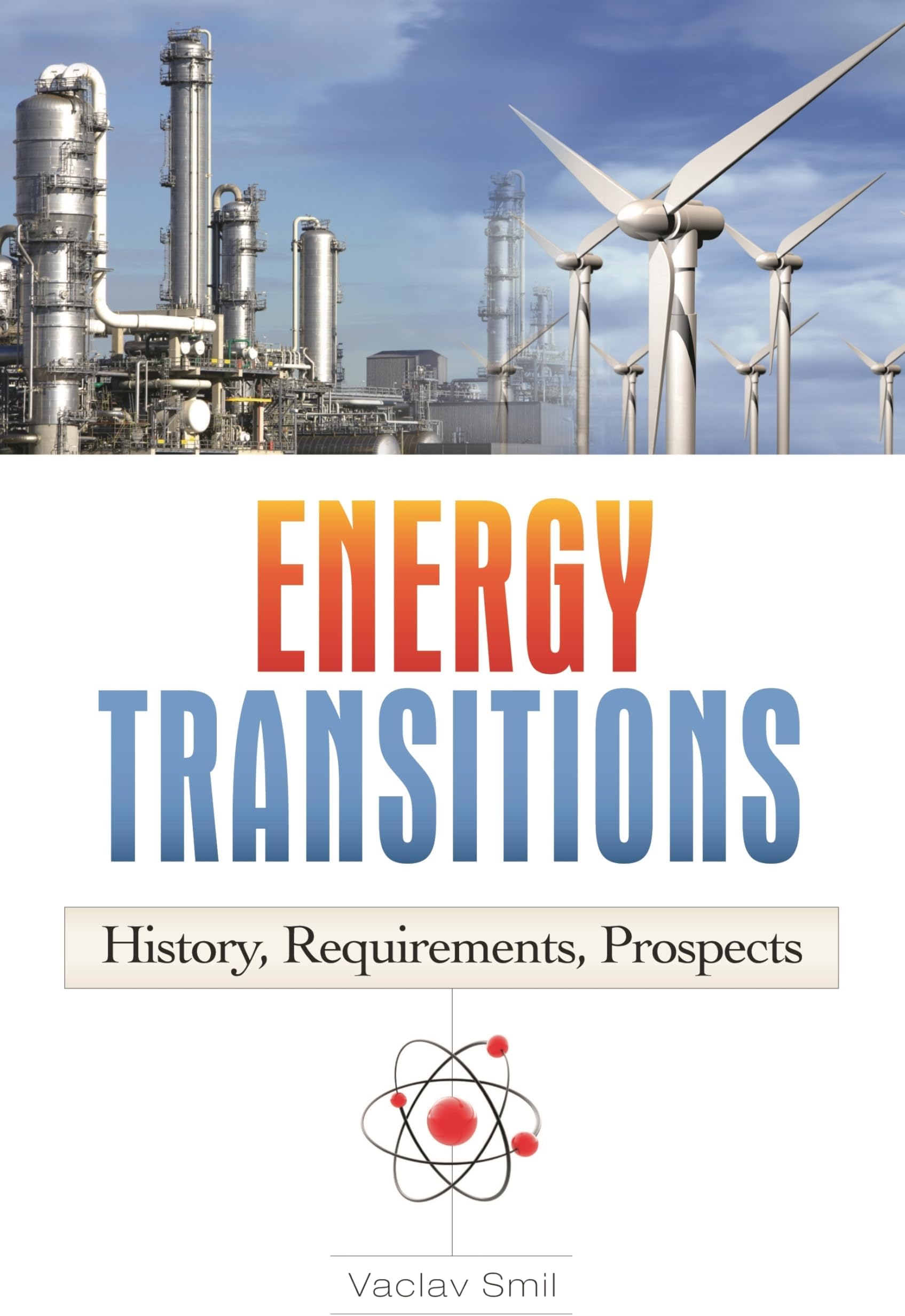
Energy Transitions: History, Requirements, Prospects
Product ID: 9506234
Buy anything from 5,000+ international stores. One checkout price. No surprise fees. Join 2M+ shoppers on Desertcart.
Desertcart purchases this item on your behalf and handles shipping, customs, and support to Kyrgyzstan.
This bold and controversial argument shows why energy transitions are inherently complex and prolonged affairs, and how ignoring this fact raises unrealistic expectations that the United States and other global economies can be weaned quickly from a primary dependency on fossil fuels. Energy transitions are fundamental processes behind the evolution of human societies: they both drive and are driven by technical, economic, and social changes. In a bold and provocative argument, Energy Transitions: History, Requirements, Prospects describes the history of modern society's dependence on fossil fuels and the prospects for the transition to a nonfossil world. Vaclav Smil, who has published more on various aspects of energy than any working scientist, makes it clear that this transition will not be accomplished easily, and that it cannot be accomplished within the timetables established by the Obama administration. The book begins with a survey of the basic properties of modern energy systems. It then offers detailed explanations of universal patterns of energy transitions, the peculiarities of changing energy use in the world's leading economies, and the coming shifts from fossil fuels to renewable conversions. Specific cases of these transitions are analyzed for eight of the world's leading energy consumers. The author closes with perspectives on the nature and pace of the coming energy transition to renewable conversions. Review: El libro fundamental de la transicion energetica. - Es un libro fundamental para entender la complejidad de la actual transición energética. Adicionalmente,la entrega fue muy rápida. Review: A great read - This guy has to all together when it comes to energy. His vision is awesome. I captured some of his quotes for my web site.
| Best Sellers Rank | #1,208,633 in Books ( See Top 100 in Books ) #262 in Oil & Energy Industry (Books) #608 in Environmental Policy #1,284 in Environmental Economics (Books) |
| Customer Reviews | 4.6 out of 5 stars 27 Reviews |
E**E
El libro fundamental de la transicion energetica.
Es un libro fundamental para entender la complejidad de la actual transición energética. Adicionalmente,la entrega fue muy rápida.
M**K
A great read
This guy has to all together when it comes to energy. His vision is awesome. I captured some of his quotes for my web site.
S**R
From Fire to Wire
A**G
Util
Muy bueno
C**M
A significant part of fossil, nuclear, & renewable energies can be used for sustainable farming
Energy transitions that have occurred because of technological progress (from wood to coal to oil and to renewables) may also be driven by government investments in the future. As the author explains many facts and examples, the physics and chemistry of each type of energy, matters not ordinarily considered by the general public, are nearly always the underlying reason for use of one energy source over another. One of the largest sources of primary energy, particularly the chemical energy in plants and wood, is of course solar energy. In a global warming scenario nations in the tropics and temperature latitudes, may be forced to consider whether solar PV and solar thermal energy, or crops and woodlands will be priority for maintenance. A hot world condition may reduce a substantial part of the Great Plains in the US and farmland in China (in areas of similar latitude) to arid lands. At that juncture, new canals and pipelines that transport water from high latitudes (where new rainfall patterns would exist because of the loss of the mid-latitude jet stream and the new importance of the polar jet stream) to temperate farmland would be an option; the other being the large scale construction of solar PV and solar thermal power stations to use sunlight that used to supply crops. Considering this challenge optimistically, though, a third option of canals and solar power stations exists: this would involve canals and drip irrigation pipes that efficiently water the land, and provide water for cover crops to reduce soil erosion and some harvests, and above this irrigated cropland, interspersed solar panels and mirrors would be constructed. The land would be stabilized against erosion and sandstorms, some crop production derived, and the ongoing production of renewable electricity would occur. Other ideas about combining renewable energy and cropland has been proposed, and successfully implemented, with wind power. However, this is unlikely to perform at continental scale because of rare earth shortages and the vulnerability to tornadoes, whereas solar power stations are much closer to the ground and can be shielded with adjustable steel plates and beams, perhaps even with a structure using steel and wood. Our huge economic gains obtained from oil, gas, and coal are unquestioned, and efficiency and energy transitions occur. However, the sunlight necessary for crops which feed a world of 7, 8, or 9 billion people are unlikely to found in the sub-Arctic and sub-Antarctic regions, now matter how advanced greenhouses may become. Thus, the national interests of the US, China, European, and most other nations will be served by maintaining adequate freshwater flows if rainfall in the temperature regions diminishes and if deserts and arid lands spread through most of the mid-latitudes. With good planning and wise use of money, and various treaties and UN guidelines, a substantial part of the money spent on conventional wars will go towards building a vast and historic canal and pipeline system on each continent. With this success, every continent will be sufficient in food production, in water resources, and famine will never destroy one of the world's major powers.
J**.
Great history of energy use
The information about the history of human energy use is informative and concise. Taking figures, where possible, from historical records. An interesting read but remember it was written a decade ago so, as the author astutely points out, the future predictions herein are subject to change. Ten years later, we can see that to be the case.
H**L
Detailed review of the history of energy and realistic look at the future.
The first two thirds of the book is a detailed review of the transition from wood and human power to the 21st century dependence on fossil fuels. Dispells some myths along the way. Paints rather gloomy but realistic picture of the difficulties of transitioning away from fossil fuels, without offering any specific solutions. Very much a technical view of the innevitable changes that he acknowleges must come. Smil only touches lightly on the social, political, and commercial aspects of how to achieve / accelerate the coming transition. Good, realistic background reading.
G**O
Four Stars
The best energy, economics and environmental writer around.
Trustpilot
3 weeks ago
2 weeks ago