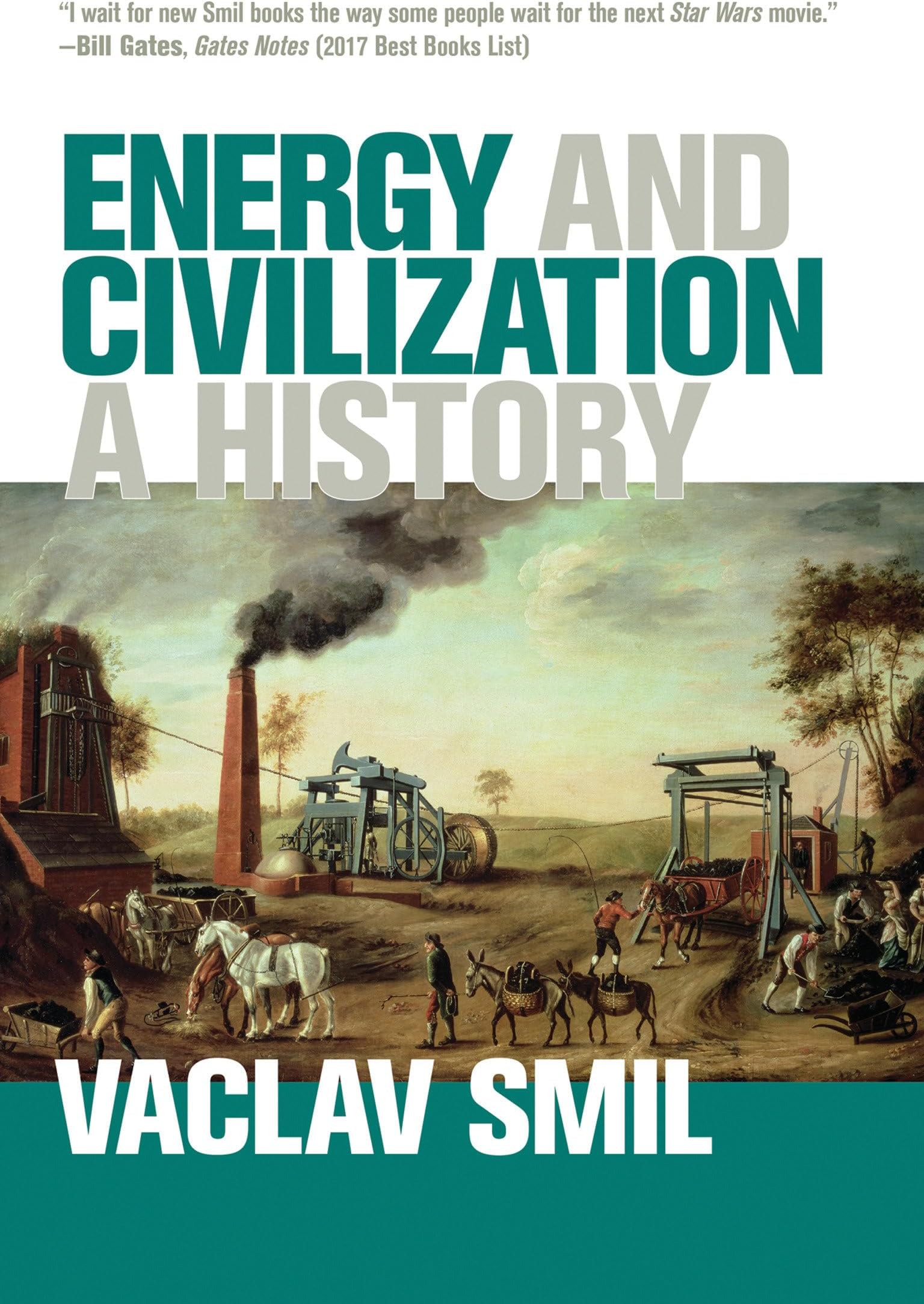
Energy and Civilization: A History (Mit Press)
Product ID: 90025438
Buy anything from 5,000+ international stores. One checkout price. No surprise fees. Join 2M+ shoppers on Desertcart.
Desertcart purchases this item on your behalf and handles shipping, customs, and support to Kyrgyzstan.
A comprehensive account of how energy has shaped society throughout history, from pre-agricultural foraging societies through today's fossil fuel–driven civilization. "I wait for new Smil books the way some people wait for the next 'Star Wars' movie. In his latest book, Energy and Civilization: A History , he goes deep and broad to explain how innovations in humans' ability to turn energy into heat, light, and motion have been a driving force behind our cultural and economic progress over the past 10,000 years. —Bill Gates, Gates Notes , Best Books of the Year Energy is the only universal currency; it is necessary for getting anything done. The conversion of energy on Earth ranges from terra-forming forces of plate tectonics to cumulative erosive effects of raindrops. Life on Earth depends on the photosynthetic conversion of solar energy into plant biomass. Humans have come to rely on many more energy flows—ranging from fossil fuels to photovoltaic generation of electricity—for their civilized existence. In this monumental history, Vaclav Smil provides a comprehensive account of how energy has shaped society, from pre-agricultural foraging societies through today's fossil fuel–driven civilization. Humans are the only species that can systematically harness energies outside their bodies, using the power of their intellect and an enormous variety of artifacts—from the simplest tools to internal combustion engines and nuclear reactors. The epochal transition to fossil fuels affected everything: agriculture, industry, transportation, weapons, communication, economics, urbanization, quality of life, politics, and the environment. Smil describes humanity's energy eras in panoramic and interdisciplinary fashion, offering readers a magisterial overview. This book is an extensively updated and expanded version of Smil's Energy in World History (1994). Smil has incorporated an enormous amount of new material, reflecting the dramatic developments in energy studies over the last two decades and his own research over that time. Review: The perfect text for a history class about Science-Tech-Society as part of STEM curricula - The best text for an undergrad history of energy that I could find in 1990s was 'In the Servitude of Power: Energy through the Ages' by three French, Marxist-influenced academics -- Deleage, Debeir, Hemery. At the time, as I pursued a Ph.D in Interdisciplinary Humanities at FSU with the goal of teaching STS (Science-Tech-Society) at a American Engineering or Architecture school, the Marxist slant was (and is) a taboo point-of-view. Smil does not punctuate his narrative with Marxist critiques at each stage of energy development, concluding that an Era of Renewable energy would require Marxist transformation of society. Certainly a transition from fossil fuels-based to renewable 'Green' tech-based energy has been slow in progressing in the 25 years that have passed (also I was never able to teach history of energy in history depts. as specialized intellectual history nor as STS coursework. I sincerely hope that Smil's less ideologically-driven narrative will be accepted at engineering schools as a much-needed antidote to the conservative view that the costs of transforming fossil-fuel techs is too great to bear. So instead, govt. policy impedes this transition by subsidizing coal & oil so long as these big political donors support politicians who do as they are told. Marxist or liberal bias aside, Europe has progressed toward renewables while the U S govt policy has staggered from pro-renewable to anti-green depending on the what PAC spends most on political ads. Energy and Civiization reads more like a science text than intellectual history but this is ideal for STEM students. For those who might wish a more historical approach to history of tech, check out Boorstin's The Americans: The Democratic Experience ( last of his trilogy). The title is misleading; this is history of U S tech from post- Civil War to 1970s. Wonderfully blends tech history with entertaining narrative, i.e. , oil wild-catting, rise of a statistically-measured society and insurers, etc. With its broad sweep of energy development within world history, Smil could be specialized secondary text for a traditional World Civilization requirement. Also,for those who enjoyed this I'd recommend Diamond's Germs, Guns, and Steel from late 1990s -- it is an extraordinary synthesis of various scientific fields that explains the present-day dominance of science-based Western culture based on environmental circumstances and climate without depending upon racial biases which argue that caucasians are more intelligent than other races. Review: Very unusual book - The author accomplished excellent work on the history of technological means of energy “production” (or rather “transformation” as energy cannot be produced but only transformed). The book covers period going from Stone Age and first societies of hunters and collectors to high ancient civilization (like a Greeks, Romans, Arabic, Chinese…) to European Medieval and of course modern times. The first chapter of the book is dedicated to introduction of energy measurement and measures used throughout the book, chapters 2 to 5 contain actual story of energy transformation in human history. Inventions ranging from more effective animal harnessing to water wheels to electricity generation are described in detail. The author discussed development of household equipment, metal processing and even weapons. Sixth chapter very clearly shows how, in author words, “high-energy civilization” reached the current state of development and how rapid this development has been among other things thanks to using fossil fuels and later a nuclear energy. Negative externalities, like an environment degradation, caused by the high energy consumption are discussed as well. The last chapter concludes and from my point of view it is more philosophical and sociological than historical. The author is thinking about strength of link between energy consumption and state of civilization development. However, I appreciated that this discussion was included since the link certainly exists and it is important to bear it in mind mainly in light of current ongoing changes in world energy mix. As already mentioned in other reviews, I would also point out that the book is rather text book than “easy educational material for everybody”. It is full of figures, graphs and technical words. However, I enjoyed reading the book very much as it enriched my knowledge of history of engineering. I would recommend the book to everybody with at least small technical background and interested in history at the same time.
| Best Sellers Rank | #42,870 in Books ( See Top 100 in Books ) #6 in Energy Production & Extraction #89 in Technology (Books) #216 in Historical Study (Books) |
| Customer Reviews | 4.5 out of 5 stars 1,205 Reviews |
J**L
The perfect text for a history class about Science-Tech-Society as part of STEM curricula
The best text for an undergrad history of energy that I could find in 1990s was 'In the Servitude of Power: Energy through the Ages' by three French, Marxist-influenced academics -- Deleage, Debeir, Hemery. At the time, as I pursued a Ph.D in Interdisciplinary Humanities at FSU with the goal of teaching STS (Science-Tech-Society) at a American Engineering or Architecture school, the Marxist slant was (and is) a taboo point-of-view. Smil does not punctuate his narrative with Marxist critiques at each stage of energy development, concluding that an Era of Renewable energy would require Marxist transformation of society. Certainly a transition from fossil fuels-based to renewable 'Green' tech-based energy has been slow in progressing in the 25 years that have passed (also I was never able to teach history of energy in history depts. as specialized intellectual history nor as STS coursework. I sincerely hope that Smil's less ideologically-driven narrative will be accepted at engineering schools as a much-needed antidote to the conservative view that the costs of transforming fossil-fuel techs is too great to bear. So instead, govt. policy impedes this transition by subsidizing coal & oil so long as these big political donors support politicians who do as they are told. Marxist or liberal bias aside, Europe has progressed toward renewables while the U S govt policy has staggered from pro-renewable to anti-green depending on the what PAC spends most on political ads. Energy and Civiization reads more like a science text than intellectual history but this is ideal for STEM students. For those who might wish a more historical approach to history of tech, check out Boorstin's The Americans: The Democratic Experience ( last of his trilogy). The title is misleading; this is history of U S tech from post- Civil War to 1970s. Wonderfully blends tech history with entertaining narrative, i.e. , oil wild-catting, rise of a statistically-measured society and insurers, etc. With its broad sweep of energy development within world history, Smil could be specialized secondary text for a traditional World Civilization requirement. Also,for those who enjoyed this I'd recommend Diamond's Germs, Guns, and Steel from late 1990s -- it is an extraordinary synthesis of various scientific fields that explains the present-day dominance of science-based Western culture based on environmental circumstances and climate without depending upon racial biases which argue that caucasians are more intelligent than other races.
M**Y
Very unusual book
The author accomplished excellent work on the history of technological means of energy “production” (or rather “transformation” as energy cannot be produced but only transformed). The book covers period going from Stone Age and first societies of hunters and collectors to high ancient civilization (like a Greeks, Romans, Arabic, Chinese…) to European Medieval and of course modern times. The first chapter of the book is dedicated to introduction of energy measurement and measures used throughout the book, chapters 2 to 5 contain actual story of energy transformation in human history. Inventions ranging from more effective animal harnessing to water wheels to electricity generation are described in detail. The author discussed development of household equipment, metal processing and even weapons. Sixth chapter very clearly shows how, in author words, “high-energy civilization” reached the current state of development and how rapid this development has been among other things thanks to using fossil fuels and later a nuclear energy. Negative externalities, like an environment degradation, caused by the high energy consumption are discussed as well. The last chapter concludes and from my point of view it is more philosophical and sociological than historical. The author is thinking about strength of link between energy consumption and state of civilization development. However, I appreciated that this discussion was included since the link certainly exists and it is important to bear it in mind mainly in light of current ongoing changes in world energy mix. As already mentioned in other reviews, I would also point out that the book is rather text book than “easy educational material for everybody”. It is full of figures, graphs and technical words. However, I enjoyed reading the book very much as it enriched my knowledge of history of engineering. I would recommend the book to everybody with at least small technical background and interested in history at the same time.
D**Y
A detailed analysis of how energy and civilization are linked needed to understand climate change
This book is for the nerd that wants to know the specifics of how energy and civilization are linked. The author provides excellent analysis on energy production and use that enables civilization growth and maturity. Without this fundamental knowledge a person may fail to understand the root issue regarding climate change and methods needed to address civilization disparity across the world. The latter section of the book that deals with modern energy sources is less detailed than the former, which was a small disappointment but the fundamental knowledge of how energy and civilization are linked is well established. This book tends toward encyclopedic and builds on each chapter which lends the book more toward classroom material; however, math and science are not difficult to follow and target the average person more. I recommend the book for anyone that prefers to learn from details instead of summaries.
R**G
Human history from a new perspective
The more I read by Smil the more I agree with Bill Gates. Smil is an absolutely brilliant scholar and author with an astounding wealth of knowledge which he manages to convey in an entertaining and engaging way. This book deals with the history of energy in human history from pre-historic times to today which makes for a very fresh and interesting view on human history and civilization. I have rarely learnt more from a single book.
E**S
Thorough, interesting to energy geeks
Smil is a premier authority on energy use. The book is very thorough, has a lot of interesting graphs and tables for true energy geeks to love. I got it on Kindle, it could perhaps be a little more polished editorially, and if the graphics were in color, even better. But those are minor quibbles, definitely worth reading if you're yearning to learn more about the history of and present (up to 2015 I think) state of world energy use. Recommended.
A**R
The calculations back and forth when it comes to Joules/tons/kwh (or even barrels) is very useful for engaging the mind outside speed reading
I am only 70% through the book, knowing that the rest will touch upon the noton that our dependence on a very high consumption of energy based on fossil fuels is unsustainable and that renewables gives only some comfort to this conclusion. As an economist I truly which that this perspective was more commonly available through education, as the available energy influcence on economic wealth and especially a long term perspective on this is severly overlooked in todays financial world. So thumbs up, 5 stars, is given to the author for puting the whole energy history in context, and how vital it is to appreciate our fossil fuel workhorses for now and it also led to my appreciation that we can use the energy surplus as today to prepare for a sustainable future of tomorrow. Even with less energy, it is possible to sustain a civilisation based on "energy helpers" so that living standards are still acceptable. The calculations back and forth when it comes to Joules/tons/kwh (or even barrels) is very useful for engaging the mind outside speed reading. An eye opener for me was the 90% energy conversion for electricity for kinetic energy as opposed to 40% for diesel and 25% for gasoline. Going electric for personal transportation based on renewables really makes sense overall!
C**M
Great topic but poor delivery
I bought this because the author was on Bill Gates' recommended reading list. While it was interesting I just couldn't get into it - the writer's style is just too dry for me (and I've read complex IT texts, federal laws, etc). I understand it's a complex subject I just wish the author hadn't written in a way that seemed like a conversation\lecture that just drones on and on. I really enjoy reading physical books, and have ready many complex topic texts, but this is one I couldn't finish - maybe another reader might find this book stimulating but I found that it may cause drowsiness.
P**S
I love everything about this book
I love everything about this book. Obviously starting with the authority and evidence corralled in the content by Smil, but also the presentation, design, illustration, quality of prose, and even the way notes are presented. This is an object lesson in how to deliver serious content to a general audience. It is highly accessible but never flinches from complex ideas and issues. It is all fact and evidence, pitched at the perfect altitude by a world authority at the peak of his field on one of the most vital issues of our age (and indeed every age). Brilliant.
I**O
Energia e História
São raros os livros que, depois de ler no Kindle, eu compro em papel para ter na minha biblioteca. Os livros do Smil são todos muito bons. Muita informação, muitos dados, muita curiosidade. Para quem, como eu, gosta de História e de Energia, é um livro de leitura obrigatória.
V**A
Es buen libro.
Lo acabo de recibir. Impaciente por leerlo, el autor es muy bueno.
J**.
Rivetting and essential reading
Incredibly informative global historical survey of how energy conversion has been behind all human activities (including staying alive) and of how we have arrived at the astonishing (and appalling) quantities of energy we use per person today and the equally amazing (or appalling) technological changes have that come with it. With no waffle, the author tells us the facts. Essential reading to help us understand how we got where we are and what the options might be ahead.
P**O
Energi och dess omvandlingar och mänsklighetens allt större beroende av elektricitet
Boken borde läsas av många, beslutsfattare, politiker, alla som hoppas att vi kan undgå en klimatkollaps. Det är bra om man har en naturvetenskaplig bakgrund, men inte helt nödvändigt. Intresse att förstå viktiga samband är avgörande. Om det är ont om tid, så kan man starta med kapitel 5, som avhandlar den tekniska utvecklingen sen ungefär 1500, med början i Europa. Energi och dess omvandlingar är förbundna med ekonomin, skriver V Smil med eftertryck. Referenser upptar hela 67 sidor.
R**H
wonderful explanation of Energy & civilization
Will recommend for understanding human development and energy impacts on it. Specially challenges of every energy resource along with benefits
Trustpilot
2 weeks ago
5 days ago