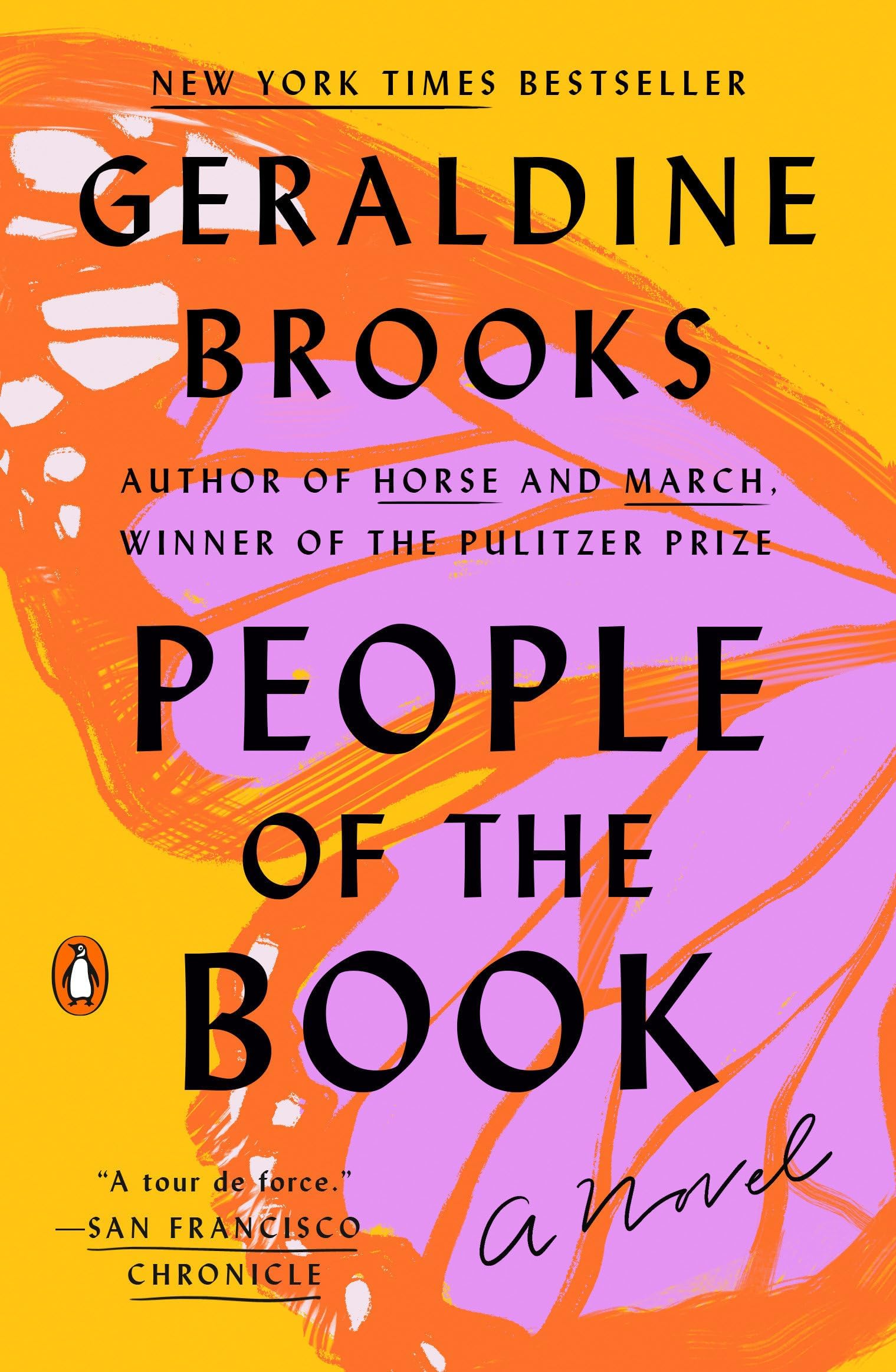
People of the Book: A Novel
Product ID: 8361085
Desertcart purchases this item on your behalf and handles shipping, customs, and support to Kyrgyzstan.
The bestselling novel that follows a rare manuscript through centuries of exile and war, from the author of The Secret Chord and of March , winner of the Pulitzer Prize. Inspired by a true story, People of the Book is a novel of sweeping historical grandeur and intimate emotional intensity by an acclaimed and beloved author. Called “a tour de force” by the San Francisco Chronicle , this ambitious, electrifying work traces the harrowing journey of the famed Sarajevo Haggadah, a beautifully illuminated Hebrew manuscript created in fifteenth-century Spain. When it falls to Hanna Heath, an Australian rare-book expert, to conserve this priceless work, the series of tiny artifacts she discovers in its ancient binding—an insect wing fragment, wine stains, salt crystals, a white hair—only begin to unlock its deep mysteries and unexpectedly plunges Hanna into the intrigues of fine art forgers and ultranationalist fanatics. Review: A Gem of Historical Fiction - It's difficult for me to write a review of this brilliant novel, a gem of historical fiction that is so well-researched and fascinating that I can't praise it enough. Centering around a Jewish Haggadah, a book read at a Jewish passover seder, the reader is swept up in the Hagggadah's history - where it resided, who had it, and what happened to it - over centuries. Beginning in the 15th century and working up to the 20th century in Bosnia, the reader is privy to those who treasured the Haggadah and those who wanted it destroyed. It is 1996 and Hanna Heath, a book preservationist, is in Sarajevo, Bosnia to examine and authenticate this beautiful book and manuscript. The Haggadah is beautifully written in Hebrew and illustrated in the style of medieval texts and the question is whether this Haggadah is authentic or a copy. While in Sarajevo, Hanna meets Ozren Karaman, the Muslim librarian who has rescued this text. Their personal relationship is central to this novel. The novel is divided up into chapters that span from the fifteenth century to the twentieth century, each chapter exploring what happened to the Haggadah during this time. The reader goes through the Spanish Inquisition, WWII, the Bosnian conflict, and the initiation of the Israeli State. Ms. Brooks has done a phenomenal amount of research and has made it fascinating for readers. Added to the historical flavor, we are granted entrance into the personal lives of those who both treasured and abhorred the book. There is Father Vistorini, a drunken Italian priest whose decision about whether to censor the Haggadah is highlighted. At the same time, there is Rabbi Judah Ayreh who has a secret addiction that brings him shame and humiliation. We travel with the partisans during WWII and watch with horror as they attempt to flee their Nazi assassins. I was impressed with how Ms. Brooks wove in the personal elements of her characters. There is Hanna's narcissistic mother who cannot understand or accept Hanna's work. I needed tissues when I read about Ozren's history and pain. I felt the pain that women experienced in the past for being the 'cast-off' gender. This is definitely about 'People of the Book', all of whom had a place in its existence today. What a wonderful and mesmerizing novel this is. Review: People of The Book: a novel of the mystery of history - Geraldine Brooks creates a book about the mystery of history in her novel, 'People of The Book.' The public is used to the Jews being called the people of the book in relation to the Bible. It is about the Jews, but with a twist, adding Christians and Muslims and showing the interdependency of all three throughout history. Two main stories entertwine in this historical adventure story, that of the Sarajevo Haggadah and of its restorer, Hannah. As Hannah sets about restoring the 500-year-old Hagganah, and bits of its past come to light, so does her own opaque past. As she restores, she is restored. A Haggadah is the story of the Passover given at the Seder, the Jewish supper commemorating the great story of the Jewish escape from Egypt under the leadership of Moses.This small, lavishly-illuminated Haggadah was manufactured in Spain 500 years before, rebound in Vienna, Austria in 1894, and has travelled to Sarajevo, survived the 2nd World War destruction of the Nazis of Jews and all things Jewish, and the more recent destructive war between the Bosnians and the Serbs. In 1992, the book was hidden, when museums and libraries became targets in the war. It is now 1996 and it is considered safe enough as hostilities die down, to bring the book out of hiding. Brooks talks about an actual book restored to Sarajevo, and her fiction takes over from there. The Australian-born Hannah is by profession a book conservator of mediaeval manuscripts. Hannah says her job is technical combining science and craftsmanship. But she also has an intuition about the past. She links research and imagination to see into the heads of people who created these great, mediaeval masterpieces, so that she can figure out who they were and how they worked. The Journey of The Book There is a bill of sale to the Sarajevo library in 1894, when a 'Kohen' sold the book to the library. During the 2nd World War, the book was saved and hidden by a Muslim. From 1992 to 1996, it was hidden by a Muslim, the director of the library. Hannah finds a wine stain on a page, a fine white hair in a thread fibre, and a tiny wing of some insect in the binding. She also notices that the book has been made to outfit clasps, used to keep parchment flat, and they are missing. With these few clues and facts about these miniscule objects from the world of science, she embarks on a plausible but imaginative journey about the history of the book. The story takes the reader to Spain, Vienna, and Sarajevo, as the history of the Jews is revealed and their interdependence with the Christians and Muslims is explored. It becomes clear that without that interaction the book couldn't have been created at all. Its history is entertwined with all three religious groups, as is Sarajevo, where a mosque, a synagogue and an Orthodox church all face one another in the same square, in a place where religious tolerance has created the unique Sarajevan society. Hannah's Journey Woven throughout this historical discovery are Hannah's discoveries about her unknown past. As the Haggadah's past is revealed, so is her own. She is the daughter of a neurosurgeon and a father who totally unknown to her. Her mother is a brilliant, cold, calculating, vain, selfish woman who has rejected her daughter because Hannah did not become a neurosurgeon like herself. She has nothing but contempt for her daughter's chosen field and lets her daughter know this on a regular basis. Hannah finds the courage to reject her mother only when, ironically through the mother, she discovers her past, her father's identity and a warm, loving family who accept her and appreciate her as she is. It is also ironic that the cold relationship between mother and daughter exists when they are both restorers in their own right, Hannah of mediaeval manuscripts and her mother, of the engine of the body. Many a woman will recognize this irreconcilable relationship between mother and daughter and read certain passages of scenes between them with tears in her eyes. Once Hannah is over her fear of rejection, and is being healed both through her work and the warmth of her new, true family, she discovers love, a love which has been there for some time, actually, but which took her some time to recognize.As the life of the Haggadah awaited discovery, so did this love of her life patiently await. This is a satisfying novel in that the ending is not a 'happily ever after' event, but one that is full of potential. The Haggadah has been restored and returned to its rightful home. And so has Hannah. This is not a book meant to be kept on a dusty shelf. It is one, like the Haggadah, meant to be shared. If you loan it and it doesn't come back, you'll feel serene, knowing it has begun its own historical journey.

| Best Sellers Rank | #19,445 in Books ( See Top 100 in Books ) #17 in Jewish Historical Fiction #43 in Jewish Literature & Fiction #343 in Contemporary Literature & Fiction |
| Customer Reviews | 4.4 out of 5 stars 11,798 Reviews |
B**Y
A Gem of Historical Fiction
It's difficult for me to write a review of this brilliant novel, a gem of historical fiction that is so well-researched and fascinating that I can't praise it enough. Centering around a Jewish Haggadah, a book read at a Jewish passover seder, the reader is swept up in the Hagggadah's history - where it resided, who had it, and what happened to it - over centuries. Beginning in the 15th century and working up to the 20th century in Bosnia, the reader is privy to those who treasured the Haggadah and those who wanted it destroyed. It is 1996 and Hanna Heath, a book preservationist, is in Sarajevo, Bosnia to examine and authenticate this beautiful book and manuscript. The Haggadah is beautifully written in Hebrew and illustrated in the style of medieval texts and the question is whether this Haggadah is authentic or a copy. While in Sarajevo, Hanna meets Ozren Karaman, the Muslim librarian who has rescued this text. Their personal relationship is central to this novel. The novel is divided up into chapters that span from the fifteenth century to the twentieth century, each chapter exploring what happened to the Haggadah during this time. The reader goes through the Spanish Inquisition, WWII, the Bosnian conflict, and the initiation of the Israeli State. Ms. Brooks has done a phenomenal amount of research and has made it fascinating for readers. Added to the historical flavor, we are granted entrance into the personal lives of those who both treasured and abhorred the book. There is Father Vistorini, a drunken Italian priest whose decision about whether to censor the Haggadah is highlighted. At the same time, there is Rabbi Judah Ayreh who has a secret addiction that brings him shame and humiliation. We travel with the partisans during WWII and watch with horror as they attempt to flee their Nazi assassins. I was impressed with how Ms. Brooks wove in the personal elements of her characters. There is Hanna's narcissistic mother who cannot understand or accept Hanna's work. I needed tissues when I read about Ozren's history and pain. I felt the pain that women experienced in the past for being the 'cast-off' gender. This is definitely about 'People of the Book', all of whom had a place in its existence today. What a wonderful and mesmerizing novel this is.
S**8
People of The Book: a novel of the mystery of history
Geraldine Brooks creates a book about the mystery of history in her novel, 'People of The Book.' The public is used to the Jews being called the people of the book in relation to the Bible. It is about the Jews, but with a twist, adding Christians and Muslims and showing the interdependency of all three throughout history. Two main stories entertwine in this historical adventure story, that of the Sarajevo Haggadah and of its restorer, Hannah. As Hannah sets about restoring the 500-year-old Hagganah, and bits of its past come to light, so does her own opaque past. As she restores, she is restored. A Haggadah is the story of the Passover given at the Seder, the Jewish supper commemorating the great story of the Jewish escape from Egypt under the leadership of Moses.This small, lavishly-illuminated Haggadah was manufactured in Spain 500 years before, rebound in Vienna, Austria in 1894, and has travelled to Sarajevo, survived the 2nd World War destruction of the Nazis of Jews and all things Jewish, and the more recent destructive war between the Bosnians and the Serbs. In 1992, the book was hidden, when museums and libraries became targets in the war. It is now 1996 and it is considered safe enough as hostilities die down, to bring the book out of hiding. Brooks talks about an actual book restored to Sarajevo, and her fiction takes over from there. The Australian-born Hannah is by profession a book conservator of mediaeval manuscripts. Hannah says her job is technical combining science and craftsmanship. But she also has an intuition about the past. She links research and imagination to see into the heads of people who created these great, mediaeval masterpieces, so that she can figure out who they were and how they worked. The Journey of The Book There is a bill of sale to the Sarajevo library in 1894, when a 'Kohen' sold the book to the library. During the 2nd World War, the book was saved and hidden by a Muslim. From 1992 to 1996, it was hidden by a Muslim, the director of the library. Hannah finds a wine stain on a page, a fine white hair in a thread fibre, and a tiny wing of some insect in the binding. She also notices that the book has been made to outfit clasps, used to keep parchment flat, and they are missing. With these few clues and facts about these miniscule objects from the world of science, she embarks on a plausible but imaginative journey about the history of the book. The story takes the reader to Spain, Vienna, and Sarajevo, as the history of the Jews is revealed and their interdependence with the Christians and Muslims is explored. It becomes clear that without that interaction the book couldn't have been created at all. Its history is entertwined with all three religious groups, as is Sarajevo, where a mosque, a synagogue and an Orthodox church all face one another in the same square, in a place where religious tolerance has created the unique Sarajevan society. Hannah's Journey Woven throughout this historical discovery are Hannah's discoveries about her unknown past. As the Haggadah's past is revealed, so is her own. She is the daughter of a neurosurgeon and a father who totally unknown to her. Her mother is a brilliant, cold, calculating, vain, selfish woman who has rejected her daughter because Hannah did not become a neurosurgeon like herself. She has nothing but contempt for her daughter's chosen field and lets her daughter know this on a regular basis. Hannah finds the courage to reject her mother only when, ironically through the mother, she discovers her past, her father's identity and a warm, loving family who accept her and appreciate her as she is. It is also ironic that the cold relationship between mother and daughter exists when they are both restorers in their own right, Hannah of mediaeval manuscripts and her mother, of the engine of the body. Many a woman will recognize this irreconcilable relationship between mother and daughter and read certain passages of scenes between them with tears in her eyes. Once Hannah is over her fear of rejection, and is being healed both through her work and the warmth of her new, true family, she discovers love, a love which has been there for some time, actually, but which took her some time to recognize.As the life of the Haggadah awaited discovery, so did this love of her life patiently await. This is a satisfying novel in that the ending is not a 'happily ever after' event, but one that is full of potential. The Haggadah has been restored and returned to its rightful home. And so has Hannah. This is not a book meant to be kept on a dusty shelf. It is one, like the Haggadah, meant to be shared. If you loan it and it doesn't come back, you'll feel serene, knowing it has begun its own historical journey.
C**N
Haunting, mesmerizing and beautifully written...
I think the mark of a good book is that when you finish reading it, you can't get it out of your mind. The People of the Book by Geraldine Brooks definitely is a good book, and more. It's a haunting, mesmerizing and beautifully written story about the Sarajevo Haggadah. A haggadah is a book of Jewish rites and the Sarajevo Haggadah was written in Spain before the exile of Jews from there in 1492. One of the things that makes this particular haggadah so unique is that it is richly illustrated, which was against Jewish beliefs of the time. Also, the fact that it survived at all is no small miracle. It is known that the haggadah went from Spain to Venice, and then to Vienna before landing in Sarajevo. Twice, it was rescued by Muslim librarians--once during World War II and again during the Bosnian War. Brooks fills in the gaps with an incredible tale that combines historical fact, customs of the day, and her moving fictional characters. People of the Book opens in 1996 when Australian rare book conservator, Dr. Hanna Heath, is tapped by the UN to conserve and restore the famous Haggadah. The things she discovers (an insect wing, a salt stain, a red blotch, a priest's signature, and a hair fragment) will allow Brooks to travel back in history to relate the story of how they came about. Throughout history, the book survives as a witness to the "Inquisition, Nazis, extremist Serb nationalists." Heath is also forced to evaluate and restore her personal life, as she assess the things that are truly important to her and then makes choices that support these values. The combination of Heath's professional and personal revelations provides us with a surprising and heart-warming ending. I especially enjoyed the history associated with People of the Book. I didn't realize how many times in history, Christians, Jews and Muslims lived in relative peace. When Spain expelled the Jews, Venice and Bosnia gave them a home. The Sarajevo Haggadah is a book that transcends all three religions. The Muslim librarian who saved the book during the Bosnian War tells Heath "the haggadah came to Sarajevo for a reason. It was here to test us, to see if there were people who could see that what united us was more than what divides us. That to be a human being matters more than to be a Jew or a Muslim, Catholic or Orthodox." I became a big fan of Geraldine Brooks when I first read Year of Wonders, and then March. Now, People of the Book just reaffirms Brooks' talents as a writer of historic fiction.
J**N
An exciting journey through time, space and culture
Brooks has provided a fascinating premise for taking us through the intersecting history of Jewish, Islamic and Christian culture and interactions, both during times of cooperation and times of horrific destruction. The Sarajevo Haggadah is a fascinating book and I am eager to learn more about it. Brooks has provided a foundation of curiosity and wonder. I highly recommend this book to anyone interested in the overlap of the Abrahamic faiths.
B**L
Compelling Tale, Good Characters, A Flaw or Two
I found this book compelling. I also learned about several historic events and about book conservation. I recommend it. The tale is based on an actual book that survived the Sarajevo seige and the literary device is that a book conservator finds a series of clues in the book, each left by a figure which influenced the book's genesis, or its journey through time and geography. All of this was enjoyable. Betrayal is the underlying theme. One flaw in the book was that the stories of most of the historic characters who made, or moved, or saved, the book were not quite finished. The author introduced them and got you to like them and to see them in the context of their time and place and religion. Then we got to the end of the chapter. In a few cases, we later learn the outcome of the person's essential drama, but it is as if their story was a three act play and each time we see only two acts, and a precis of the the third act. The exception is the Lola character, the most modern of the book's hangers on. Here, we see her longitudinally and in a life in four acts. The fourth act is well developed, but I never got a grip on what was going on with Lola. She is hunted and is, at a pivotal time, betrayed by her own and is inexplicably saved by a Muslim couple. Then, we learn that she is prevented from helping them when they need her help. Then, in another part of the world, she contributes to the twisting resolution of the story line. I cared about her and wanted to know more. Hanna, the modern protaganist, the book conservator, is a character that I did not like. There was an excess of melodrama in her story. She had a lifelong mutual blaming relationship with her mother, and both characters were unidimensional. Hanna's whinning was tiresome. Her romance was similarly tiresome. The subplot about taking some medical records to her mother was silly and contributed nothing. She suffers a betrayal and is overly melodramatic about it. The trajectory of her life is contrived. The resolution of all this is also contrived and, in fact, is a bit confusing. For a book in which the theme is betrayal, we needed time with who the real betrayer was and how that came to be. Whenever a book has this motif (different stories over history), an author sometimes writes the same story in each period. This writer did not. Each clue leads us to a period of betrayal and the stories vary with respect to whether there was a personal risk taken and a kindness done, in the midst of a larger betrayal. When there are heroines in the period, they are universally plucky. When there are heros, they are flawed men. The Catholic Church is consistently evil, which is historically accurate, I believe. Some members of the Islamic faith are saviors. However, as above, I would have liked to have known more about the threads in their lives that moved them to savior-dom. As you can likely see, my analysis and complaining about flaws is within a book that I was quite glad to have read. I was grateful to have experienced a greater and more longitudinal texture to the historic circumstance of Jewish repression and expulsion. I had known the individual facts, but this look at history increased my awareness and understanding of this 500 year horror. The author portrayed repression and expulsion that was harmful to the repressors, making it harder to understand. There is narration of the modern tragedy of Sarajevo that resonates emotionally and was quite well done. It asks the question of what happens to destroy convivencia, or thriving multiethnic societies. You feel the sadness and are not given an answer. (I know there is not an answer, but would have appreciated more texture around why those who benefited from convivencia not only did unspeakable harm to their Jewish populations, but also harmed themselves.)
K**A
Maybe You Should Wait for the Video
People of the Book tells the story of Dr. Hanna Heath, a book conservator, who is called to Bosnia to conserve the Haggadah of Sarajevo, an ancient Jewish prayer book used for the Passover holiday. This particular Haggadah, apparently created in Spain in the 15th century, is the earliest example of a Jewish prayer book with pictures. In the course of analyzing and restoring the Sarajevo Haggadah, Hanna discovers certain artifacts which serve as clues to the Hagaddah's unknown history, including the wing of an insect, a white hair, and a wine/blood stain. The novel is then interspersed with stories (revealed to the reader, but not to Hanna, who also serves as narrator) giving the "real story" behind the artifacts, and in turn, revealing the real story behind the creation and preservation of the book, and its movements from ancient Spain to Bosnia. I found these vignettes giving the "back story" of the Haggadah to be the heart of the novel, and sadly, all too short. Each was wonderfully written, with beautiful descriptions, wonderful plots, vivid imagery and strong characters. They are presented to the reader in reverse chronological order, allowing the history of the Haggadah to be slowly and tantalizingly revealed to the reader. Frankly, had the novel simply been this "back story" without any modern day involvement by Hanna Heath (or a much more circumscribed involvement), I would have given People of the Book a strong FIVE STARS!! In comparison to the wonderful chapters that told the history of the Haggadah, I found Hannah's present day story to be thin, uninteresting and superficial--like placing a layer of pulp fiction over a base of fine literature. The relationship between Hannah and her mother was screechy, like nails on a blackboard. Hanna's love relationship was little more than a caricature. The revelations in Hanna's own life (regarding her lineage, etc) and the last chapter's histrionics (no further explanation, so as to not ruin the "surprise"), seemed overly calculated, and a desperate shot at a movie deal. In fact, I couldn't help feeling that Hanna Heath's whole story was tacked on to the tale of the Haggadah as an afterthought at the insistence of some editor trying to fashion the next DaVinci Code. Even with this serious (serious) failing, I found the story of the Haggadah's history to sufficiently compelling that I would still recommend this book (or see the movie when it comes out....but on video).
E**Y
Great book!
I really enjoyed this book! The Sarajevo Hathaway is real, and Brooks' imagined history of this unique artifact is rich and so well done. It's a sweep through history and a beautiful tribute to "The People of the Book" who have endured much throughout history. It's a great read. Enjoy!
K**Y
Historical fiction novel uncovers multiple stories about the origin of a rare manuscript
Multiple plots, family dramas, and different historical periods feature in this story about a woman’s fight to save a rare book. Hannah Heath, a conservation expert, was asked to repair and analyze a centuries-old book called the Sarajevo Haggadah. She goes to Bosnia and meets the museum director and a man who had saved the book when war broke out in the region. As she works, Hannah discovers clues in the binding that allude to the book’s mysterious origin and former handlers. She finds a white hair, a wine stain, salt crystals, and a desiccated butterfly wing. Intrigued, she calls on experts in different fields to investigate these strange artifacts. She finds the manuscript has made a surprising journey. Hannah realizes too late that she is caught in a conspiracy that could upend her career, reputation, and safety. The author, Geraldine Brooks, has combined multiple stories, but the way she does this is skillful. As each artifact is investigated, the history of how that evidence ended up in the book is revealed. Many individuals of different faiths were involved in the book’s rescue over the centuries, and many risked their lives. With meticulous research, Brooks has written a historical fiction novel about an actual rare manuscript that has survived through the efforts of courageous individuals determined to protect it. Book lovers and historical fiction readers will get caught up in the story.
P**H
Muy buen libro
Excelente libro!
J**E
A special book about a special book
Geraldine Brooks has given us a well-written, highly compelling, complex and enthralling story. Who would think a novel about a book - albeit a rare and special book - could be so exciting? But Geraldine Brooks takes the reader, page by page, leaf by leaf, into the world of rare books and their conservation, the background and possible history of such a book, and on a fascinating, multi-cultural, and labyrinthine journey through the tangles of history, from the Bosnian war in Sarajevo to the Jewish artisans of Andalusia at the time of the Spanish Inquisition, via Vienna in the 19th century and Venice in the 16th, each period highlighted with vivid and resonant characters and scene-setting. The time-travelling is interspersed with the present-day, as the talented but slightly dysfunctional conservationist, Australian Hanna, discovers the secrets of this tantalising book, a 15th-century Jewish Haggadah, and the secret behind her own life. This novel is one of my all-time favourite books and every time I re-read it (on a 2 yearly basis); I always find new nuances of detail or delight in a particular character or setting. The author throws all her considerable knowledge, journalistic experience and technical expertise into this marvellous novel and I think it's her best. And it's all the better for the fact that there really was such a rare book and this could be its story.
J**.
A Compelling Read
OK...I liked HORSE better but this is a very good book. This is a richly imagined piece of historical fiction with a great ending (and endings are often difficult). My grade was an A.... (I gave HORSE an A+.)
.**N
Five Stars
Very impressive.
A**N
People of the Book
Was für ein wunderbares Buch! Im Jahr 1996 wird die verschollen geglaubte Haggadah von Sarajewo (ein religiöses Buch des Judentums) von einer australischen Wissenchaftlerin untersucht. Fast sechs Jahrhunderte haben ihre Spuren auf den Seiten hinterlassen - ein weißes Haar, ein Tropfen Salzwasser, Wein und Blut... - und jede davon erzählt eine eigene Geschichte. Faszinierend und brilliant geschrieben - hat mich schwer beeindruckt und wird mir sicher lange im Gedächtnis bleiben. Für jeden, der Bücher liebt oder an Geschichte interessiert ist. Eines der besten Bücher, die ich in den letzten Monaten gelesen habe. Unbedingt empfehlenswert!
Trustpilot
1 month ago
2 months ago