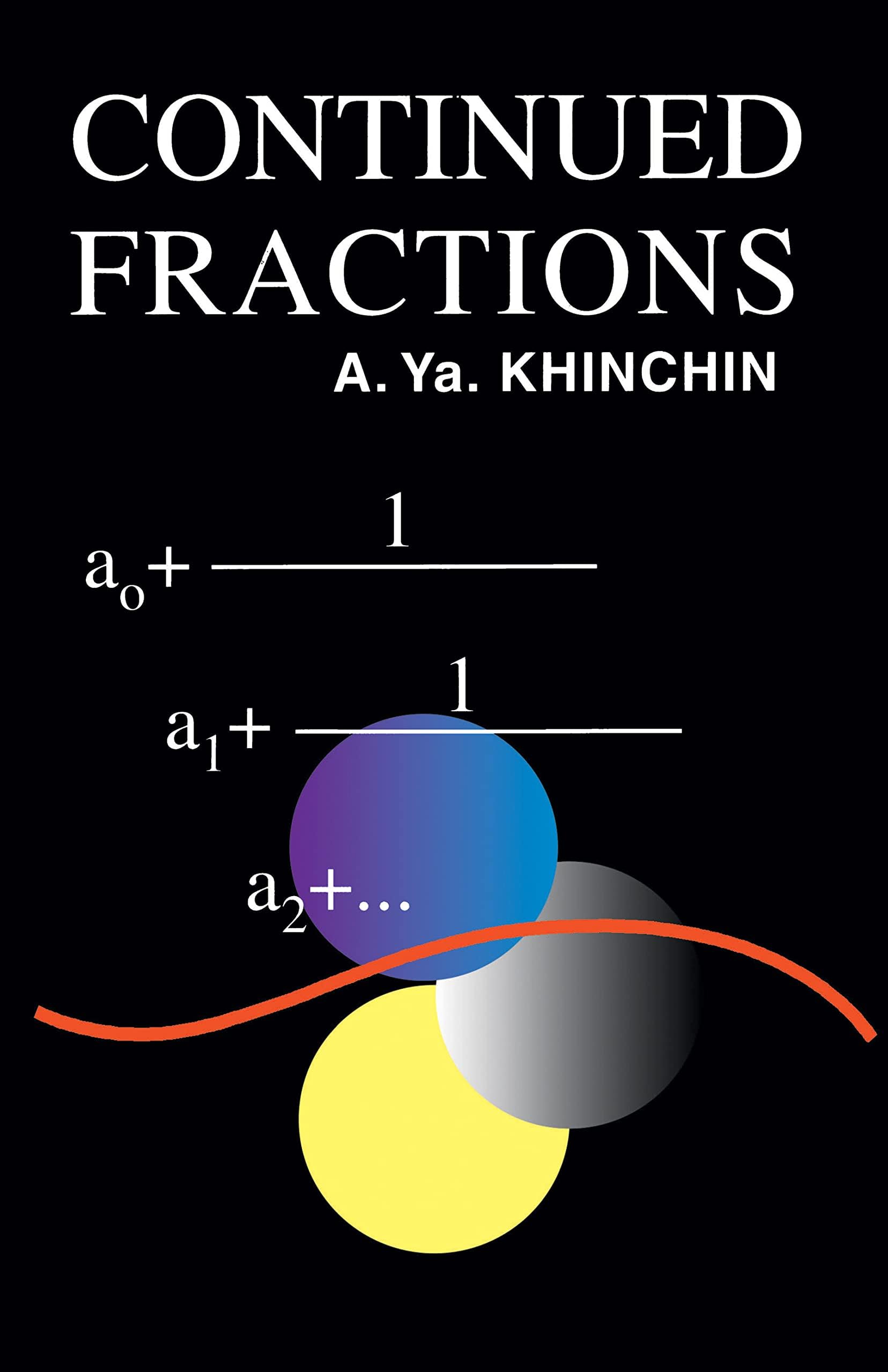
Continued Fractions (Dover Books on Mathematics)
Product ID: 8251253
Desertcart purchases this item on your behalf and handles shipping, customs, and support to Kyrgyzstan.
Buy Continued Fractions (Dover Books on Mathematics) on desertcart.com ✓ FREE SHIPPING on qualified orders Review: Great book - Nice book. Easy to follow. Interesting subject. Review: Classical Work on Number Theory of Continued Fractions - This material in this classic work is mostly accessible to the undergraduate level engineer, mathematics, or other reader with similar background, but a good portion of this book is about measure theory of continued fractions, which is more easily accessed by those who have some mathematics background at the graduate level. Measure theory is the theory of the fraction of the extent of a domain that is mapped from the range of inputs to a function. Measure theory is used primarily by Khinchin and his students, but similar work is posed in terms of probability theory and other contexts by other mathematicians. Once this is understood (and it is hinted at by a footnote or two from the translator), this material becomes as accessible as the rest of the material. The book begins with a minor aside in a proof of convergence of continued fractions that have real partial numerators and denominators, whose partial numerators are all unity, and the sum of whose partial denominators diverges. Since the simple classical number-theoretic continued fractions are the subject of the book, this proof clearly includes all such continued fractions. This minor excursion from number theory and algebra is a significant advantage to this particular book as it provides a bedrock for later rate-of-convergence discussions. The related field of analytic theory of continued fractions that was explored by Riemann, Stieltjes, Tchebychev, Padé, Hamburger, Cesàro, and others that are contemporary to Khinchin (memorable classic by H.S. Wall was published in 1948, long after this book was written), is not ignored entirely.
| Best Sellers Rank | #1,014,215 in Books ( See Top 100 in Books ) #41 in Mathematical Infinity #183 in Number Theory (Books) #483 in Mathematical Analysis (Books) |
| Customer Reviews | 4.4 4.4 out of 5 stars (72) |
| Dimensions | 5.38 x 0.24 x 8.46 inches |
| ISBN-10 | 0486696308 |
| ISBN-13 | 978-0486696300 |
| Item Weight | 10.4 ounces |
| Language | English |
| Print length | 112 pages |
| Publication date | May 14, 1997 |
| Publisher | Dover Publications |
M**N
Great book
Nice book. Easy to follow. Interesting subject.
T**R
Classical Work on Number Theory of Continued Fractions
This material in this classic work is mostly accessible to the undergraduate level engineer, mathematics, or other reader with similar background, but a good portion of this book is about measure theory of continued fractions, which is more easily accessed by those who have some mathematics background at the graduate level. Measure theory is the theory of the fraction of the extent of a domain that is mapped from the range of inputs to a function. Measure theory is used primarily by Khinchin and his students, but similar work is posed in terms of probability theory and other contexts by other mathematicians. Once this is understood (and it is hinted at by a footnote or two from the translator), this material becomes as accessible as the rest of the material. The book begins with a minor aside in a proof of convergence of continued fractions that have real partial numerators and denominators, whose partial numerators are all unity, and the sum of whose partial denominators diverges. Since the simple classical number-theoretic continued fractions are the subject of the book, this proof clearly includes all such continued fractions. This minor excursion from number theory and algebra is a significant advantage to this particular book as it provides a bedrock for later rate-of-convergence discussions. The related field of analytic theory of continued fractions that was explored by Riemann, Stieltjes, Tchebychev, Padé, Hamburger, Cesàro, and others that are contemporary to Khinchin (memorable classic by H.S. Wall was published in 1948, long after this book was written), is not ignored entirely.
D**O
Excellent introduction
The first two chapters are an excellent introduction for the subject. Though the book lacks examples and exercises, the first chapter is very well explained and organised letting us (the begginers) to grasp the main concepts of what continued fractions are.From the middle of chapter two onwards, it gets way more convoluted and the proofs much harder to understand. For the book price it is a very recommendable purchase.
J**O
Review by J. Colannino
Continued fractions are fractions with multiple denominators; e.g., the golden ratio = 1+1/(1+1/(1+..., the square root of 2 = 1+1/(2+1/(2+.... Indeed, all quadratic irrationals have repeating continued fractions, giving them a convenient and easily memorable algorithm. Continued fractions may be truncated at any point to give the best rational approximation. For example 1/pi = 113/355 -- something that is very easy to remember (note the doubles of the odd numbers up to five). Therefore, an excellent approximation for pi becomes 355/113. The fraction approximates pi to an error better than 3E-7, more than accurate enough for any practical use including astronomy. Thus for both transcendental and analytical irrationals, continued fractions are enormously useful. Never heard of them? You're not alone. The first recorded instance of continued fractions was by Lord Brouncker in the 17th century which makes them a relatively new addition to mathematics. Nor are they taught in typical undergraduate scientific curricula. Notwithstanding, if they were discovered by the Pythagoreans, history may have been much different. The Pythagoreans were a mystical sect that believed that all things geometric could be described by rational numbers (i.e., wholes and fractions). Something like the square root of two was clearly geometric (the diagonal of the unit square) yet, irrational. Legend has it that Hippasus (5th century B.C.) was expelled from (or killed by) the Pythagorean school for proving the irrationality of a number such as the square root of 2 or the golden ratio. This ultimately destroyed the Pythagorean religion. Had the theory of continued fractions been discovered at this time, irrationals would have been reduced to infinite fractions of whole numbers and the religion may have well survived until (or perhaps interfered with) the advent of Christianity. This monograph by the Russian mathematician, Aleksandr Khinchin, is a very inexpensive way to obtain a good introduction. The author died in 1959, however, his third edition of the book was translated into English in 1964 and revised in 1997. The monograph is less than 100 pages and organized into three chapters: I. Properties of the Apparatus; II. The Representation of Numbers by Continued Fractions; III. The Measure Theory of Continued Fractions. The book also has a brief and inadequate index. Some of the fascinating things one will learn is that if a/b < c/d then the value (a+c)/(b+d) is always intermediate: a/b < (a+c)/(b+d) < c/d. Repeated application of this algorithm gives an infinitely divisible and ordered sequence of rational numbers; e.g., the infinite sequence 1/1, 1/2, 1/3, 1/4... 0/1 is one such application of the theorem. One can also prove that 355/113 is the best three digit rational approximation to pi -- a result of remarkable accuracy. One will also learn that all rational numbers can be represented by finite continued fractions. For example, 54/17 = 3+1/(5+1/(1+1/2)). Therefore, continued fractions are capable of representing all real numbers: some as finite fractions (e.g. 54/17 or any rational), some as non-terminating repeating fractions (e.g., square root of 2 or any quadratic root), some as non-repeating non-terminating fractions having a pattern [e.g., Euler's constant, e = 2+1/(1+1/(2+1/(1+1/(1+1/(4+1/(1+1/(1+1/(6+....], and others as non-terminating non-repeating fractions without pattern [e.g., pi = 3 + 1/(7+1/(15+1/(1+1/(292+1/(1+1/(1+...]. Regarding the latter, if one can derive an infinite series representation, then it is possible to recast the regular continuing fraction (numerator of 1s) as an irregular continuing fraction having a pattern [e.g., pi = 3+1/(6+9/(6+25/(6+49/(6+...]. Thus, continued fractions are a powerful mathematical device, and this book provides a reasonable if not brief introduction.
J**L
A fun little book with the right formulas
This book is quite short at under 100 pages, but that's a good thing. A real mathematician will probably appreciate the proofs and such. As a hobbyist, I found out everything that I needed to know about continued fractions, convergents and such. An inexpensive, interesting and quick read. Well worth having for the amount of information in it.
R**S
Not bad (for the money)
An OK book. Not technically difficult, basically just high-school algebra. Has a nice proof on page 16 that a finite continued fraction (CF) is a rational number and an infinite one is an irrational number. And around page 48, a proof that the solution of a quadratic equation can be written as a infinite CF. Thereafter is a lot of stuff about convergence and something called measure theory. My one quibble is that it is all theoretical. I was hoping for specific examples - like an infinite continued fraction that equals eg square root of 2 - but there was nothing like that. Fortunately that sort of thing can be found easily with a web search, esp. Wikipedia.
N**S
short, readable, wealth of applications
Short, readable book, wealth of applications, this little gem provides a doorway into deep number theory. Gives insight into transcendence theory, as well as bicycle gearing -- Huygen's problem. There are some minor typographic errors scattered about the text which are annoying, especially for such a typographic challenge as continued fractions. For the price, you can't go wrong.
A**C
Introduction This `Dover' book is an unabridged (1997) English translation of the third Russian reprint (1961). You may come across `Continued Fractions' in other mathematical areas such as Number Theory, Analysis, Probability, and Mechanic's. You may also find 'Continued Fractions' skills are - frustratingly- assumed within general `mathematical techniques' and hard to find a book about its topics? The book only has 95 pages, but it may be helpful if you are already grasp some principles of analysis, series and recursive-based calculations, but it starts from elemental level, so try not too worry. The book has generous mathematical examples and many graphs. Down to basics The book starts from first principles, and allows fundamental skills to be learned. Continued Fractions are positive natural numbers arranged is a way to eventually approximate real numbers and other numerical forms. Quotation: `Continued Fractions' can be applied to best approximate real or complex numbers, functions of one or several variables'. (Page 19) To improve accuracy to any level we wish, try representing a number / series with two series, one being the numerator (P), and another series for the denominator (Q). These can be arranged with inequalities. To sew two series - `P' / `Q'- together allows another series to be created by recursive techniques to keep these stages in step. Summary If you wish to gain more depth, this book increasing in challenging ideas, such as Chapter 3, `The Measure Theory of Continued Fractions' or further. If you try to stick within boundaries of any previous exposure analysis, (especially) series, and recursive calculation concepts, its starts to make better sense but becomes rather involved at times, but it's a rewarding read. It is fine mathematical books at a 2nd hand price.
S**N
Very clear and concise
D**E
A good monograph for anyone to dive into the mysteries of continued fractions
A**R
This little text quickly and tidily explains continued fractions and their properties, and the representation of numbers by continued fractions. The third and most advanced part addresses the development of the measure theory of continued fractions by Russian mathematicians. A classic text, but more accessible expositions of continued fractions can be found in other texts
Trustpilot
5 days ago
1 day ago