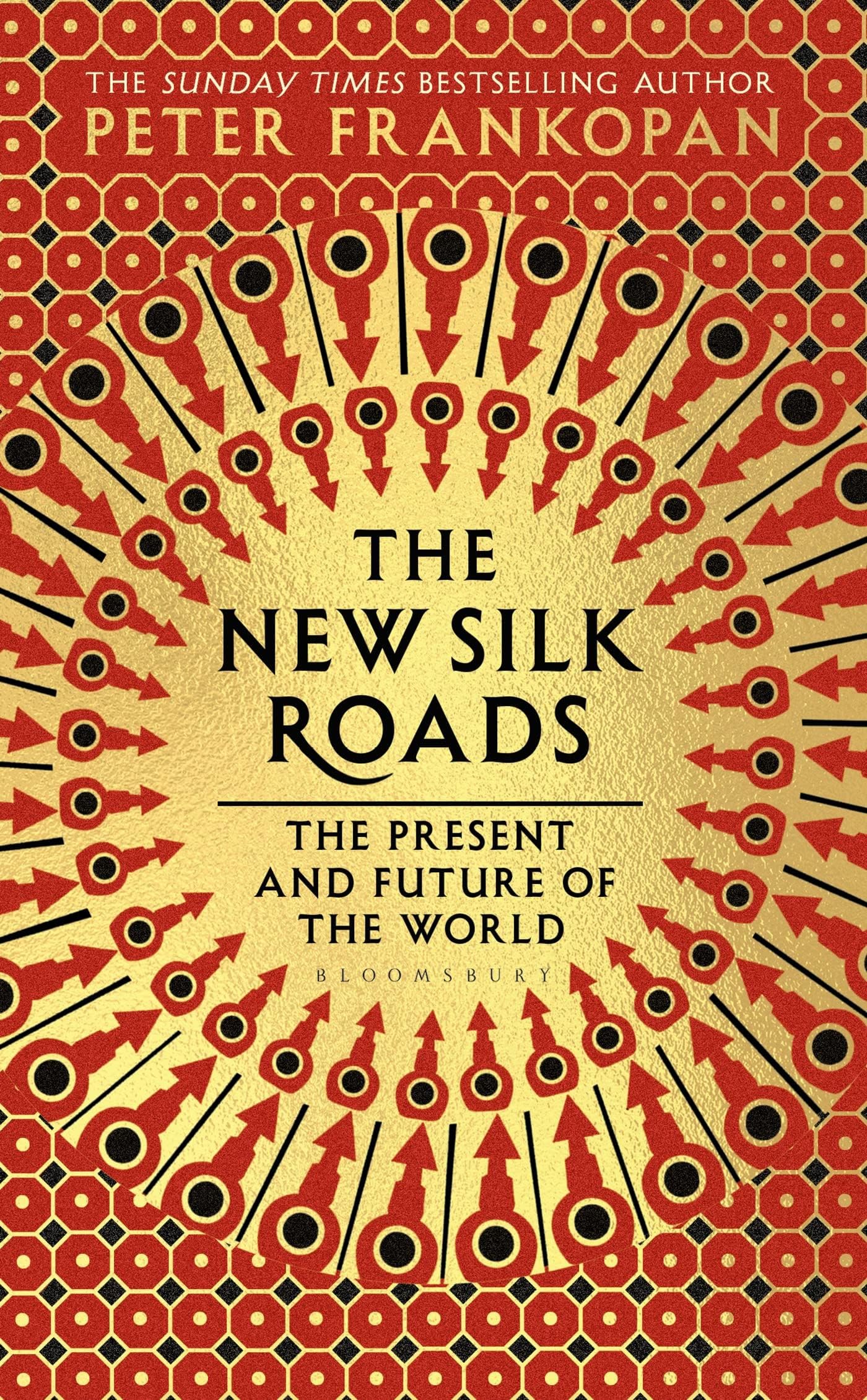
The New Silk Roads: The Present and Future of the World
Product ID: 776257353
Buy anything from 5,000+ international stores. One checkout price. No surprise fees. Join 2M+ shoppers on Desertcart.
Desertcart purchases this item on your behalf and handles shipping, customs, and support to Kyrgyzstan.
The New Silk Roads: The Present and Future of the World : Frankopan, Professor Peter: desertcart.co.uk: Books Review: Good follow up book - This was a good follow up book to the silk roads, bringing it up to date….now reading the earth transformed by the same author Review: Maybe already out of date as China's economy falters? - An interesting book about the future as the centre of world economic power moves ever more quickly from the West to the East, where it always was save for the last three hundred years. China has already overtaken the US economy in terms of purchasing power parity and, barring something unforeseen, will continue to pull ahead given its much larger population. India too is growing rapidly and will add to this phenomenon. The author contrasts the unpredictable strategy of America with the steely focus of China, in particular its Belt and Road initiative in Central Asia and beyond. Although as he points out, things will not always go smoothly, and some may come to regret China’s embrace. Maybe Russia will be one? If China needs more land, the obvious answer seems to be sparsely populated Siberia, some of which the Chinese government will tell you once belonged to China before it was taken from them. The book did read a bit like a load of newspaper articles thrown together, and at times the treaties, economic plans and acronyms were overwhelming, but it does make you think. As we in the West bicker and drift apart (Brexit, ‘America first’, etc ), are we ceding world power to China, and what will the ‘Asian century’ mean for us all? Is China the new red menace or will it be a force for co-operation as the US becomes more unilateralist and is forever entangled in conflicts in the Middle East and elsewhere? Empires, territorial or economic, have always risen and fallen. Why should the future be any different?
| Best Sellers Rank | 24,961 in Social Sciences (Books) |
| Customer reviews | 4.4 4.4 out of 5 stars (1,731) |
| Dimensions | 20.3 x 25.4 x 4.7 cm |
| ISBN-10 | 1526609614 |
| ISBN-13 | 978-1526609618 |
| Item weight | 318 g |
| Language | English |
| Print length | 336 pages |
| Publication date | 15 Nov. 2018 |
| Publisher | Bloomsbury Publishing PLC |
S**S
Good follow up book
This was a good follow up book to the silk roads, bringing it up to date….now reading the earth transformed by the same author
D**D
Maybe already out of date as China's economy falters?
An interesting book about the future as the centre of world economic power moves ever more quickly from the West to the East, where it always was save for the last three hundred years. China has already overtaken the US economy in terms of purchasing power parity and, barring something unforeseen, will continue to pull ahead given its much larger population. India too is growing rapidly and will add to this phenomenon. The author contrasts the unpredictable strategy of America with the steely focus of China, in particular its Belt and Road initiative in Central Asia and beyond. Although as he points out, things will not always go smoothly, and some may come to regret China’s embrace. Maybe Russia will be one? If China needs more land, the obvious answer seems to be sparsely populated Siberia, some of which the Chinese government will tell you once belonged to China before it was taken from them. The book did read a bit like a load of newspaper articles thrown together, and at times the treaties, economic plans and acronyms were overwhelming, but it does make you think. As we in the West bicker and drift apart (Brexit, ‘America first’, etc ), are we ceding world power to China, and what will the ‘Asian century’ mean for us all? Is China the new red menace or will it be a force for co-operation as the US becomes more unilateralist and is forever entangled in conflicts in the Middle East and elsewhere? Empires, territorial or economic, have always risen and fallen. Why should the future be any different?
M**N
The penalties of isolationism and the power of globalism
We are living in the Asian century already, at a time when the movement of global economic, and therefore military, activity is moving from the west to the east at an astonishing speed. Peter Frankopan sees, all across Asia, a strong sense of states trying to work together and to elide their interests while putting differences behind them. Chief among these is the ‘Belt and Road Initiative’, President Xi of China‘s signature economic and foreign policy, which uses the ancient Silk Roads – and their success – as a matrix for Chinese long term planning. Since the project was announced in 2013, nearly $1 trillion has been promised for infrastructure investments, mainly in the form of loans, to around 1,000 projects. Peter Frankopan describes in some detail the Roads to the East, being Russia, Pakistan, India and the Middle East; the Road to the Heart of the world including Iran, Kazakstan, Turkmenistan, Uzbekistan , Afghanistan, Georgia and Turkey. One reason for the optimism across the heart of Asia is the immense natural resources of the area. The Middle East, Russia and Central Asia account for 70% of proven oil resources, 65% of natural gas resources, 75% of silicon, 85% of rare earths like yttrium, dysprosium, and terbium, which are essential for super-magnets, batteries, actuators and laptops, and 80% of world heroin production. But Frankopan maintains the Initiative is not just driven by raw materials. As opposed to Trump’s inconsistent and adversarial behaviour, he maintains that President Xi’s international relations are based on win-win cooperation. He is moving to fill a vacuum left by the US and Europe’s isolationist and self- indulgent politics and to provide Chinese leadership that emphasises the benefits of mutual cooperation. The Initiative is by no means plain sailing. The rivalry with the US and the imposition of sweeping tariffs by Trump is examined, military disputes in the South China Seas, the conflict between India and Pakistan and the risks of indebtedness and non payment of loans are all discussed. Peter Frankopan contrasts the collaborative approach of the Chinese with the arbitrary, isolationist and short term nature of Trump’s foreign policies. And quotes numerous examples of the contradictions of US strategy. For instance, Saudi Arabia has become the pillar of US policy in the Middle East. One reason is its oil wealth but another is the prodigious amount of money it spends on US weapons. But Russia is active in wooing Saudi Arabia, including fighting alongside it in Syria. With the US’s Countering America’s Adversaries Through Sanctions Act, US arms sales are prohibited to any nation that buys Russian weapons. This means that if Saudi Arabia, Turkey and others can be persuaded by Moscow to switch allegiances, then they fall decisively out of Washington’s orbit. Compared to the Silk Roads and Asia, Europe is not so much moving at a different speed as in a different direction. Where the story of Asia is about increasing connections, improving collaboration and deepening cooperation, in Europe the story is about separation, the re-erection of barriers and ‘taking back control.’ Brexit provides good example of this, but so do rising anti-EU movements in Italy, Germany, Poland, Hungary and elsewhere – and support by hundreds of thousands of people for independence in Scotland and Catalonia. Frankopan quotes King Zhao who ruled China nearly 2,500 years ago and declared ‘a talent for following the ways of yesterday is not sufficient to improve the world of today.’ Understanding what is driving change is the first step in being able to prepare and adapt to it. The fact is that the Silk Roads are rising. How they develop, evolve and change will shape the world of the future. Hard to argue. Certainly a sobering and topical book.
S**T
The shifting of the economic center of gravity from the West to Eurasia
The present book follows the magisterial book by the same author titled 'The Silk Roads', published in 2015 which justifiably enjoyed phenomenal success. The present book describes the impressive developments in the intervening four years in Eurasia in dramatic opposition to what is happening in the West. We are witnessing a striking narrative whereby the world is spinning in two different directions: decoupling and going it alone in the West and developing ties and tying together in Eurasia. While many activities, projects and institutions, embracing different countries are taking place and participating in Eurasia during this period, I shall focus my attention to the Belt and Road initiative promoted and financed by China because it is by far the most ambitious in scale and financing. China's President Xi Jinping articulated his vision on the Belt and Road initiative in a speech at Nazarbayer University, Kazakhstan. He said that people of various countries along the ancient Silk Road have jointly written a chapter of friendships that has been passed to this very day. Study of the Silk Roads showed that people of different races, beliefs and cultural backgrounds are fully capable of sharing peace and development. It was time, he said, to forge closer communities, deepen cooperation and expand development space in the Eurasian region. To do so required taking several joint steps, such as improving policy communication, upgrading transport links, promoting unimpeded trade and enhancing monetary circulation. The time had come to re-invigorate the Silk Roads. By the middle of 2015 the China Development Bank, one of the country's key financial institutions, declared that it had reserved $890 bn to spend on some 900 projects mainly focusing on transportation, infrastructure and energy. Six months later, the Export-Import Bank of China announced that it had began financing more than 1,000 projects in forty-nine countries as part of the Belt and Road initiative. Presently, over eighty countries participate in the initiative. These include the Central Asian Republics, the countries of the South and South East Asia, those of the Middle East, Turkey and Eastern Europe - as well as states in Africa, and the Caribbean. With a combined population of 4.4 billion, those living along the new Silk Roads between China and the Eastern Mediterranean account for more than 63 percent of the world's population, with a collective total of $21 tr - or 29 per cent of total global output. The potential is made clear by a recent report by the Asian Development Bank, which estimates that infrastructure needs in developing Asia and the Pacific will exceed $22.6 trillion through 2030 or $1.5 trillion per year, if the region is to maintain growth momentum, with that figure rising to $1.7 trillion per year if climate-mitigation is included. What is happening in the West is captured by an apt comment by the President of the European Council, Donald Tusk: what worries me, he said, is the fact that the rules - based international order is being challenged not by the usual suspects but by its main architect and guarantor, the US. And where the story in Asia is about increasing connections, collaboration, and deepening cooperation, in Europe the story is about separation, the re-erection of barriers and 'taking back control'. Br exit provides a good example of this, but so do rising populist, xenophobic, extreme right, anti-EU movements in France, Germany, Italy, Poland, Hungary and elsewhere and the support by hundreds of thousands for independence in Scotland and Catalonia. I conclude the review with what epitomizes surrealist politics and economics in the West. After president Trump pulled out of the Iran nuclear deal (the JCPOA agreement) unilaterally while the EU adhered to the agreement, the American administration imposed sanctions to companies maintaining business with Iran. To counter that, on the suggestion of the President of the European Commission, Jean-Claude Junker, the EU imposed fines for companies that ceased to do business with Iran. It is hard to think of a more appropriate way to show how the West has lost its way.
E**D
EXCELLENT VALUE
D**M
I never knew so much about the road and route. The book has opened my eyes. English language is top notch
M**I
The pages seem good, I am yet to read it after finishing one of the other books I bought, I can't wait!
T**O
Um livro de atualidade para compreender o que se passa no mundo e grave erros de alguma governos ainda presos a uma realidade que já se foi. Explica bem o início da transferência do poder imperial do oeste para o leste.
K**M
Definitely recommended reading for all current events followers
Trustpilot
1 month ago
2 months ago