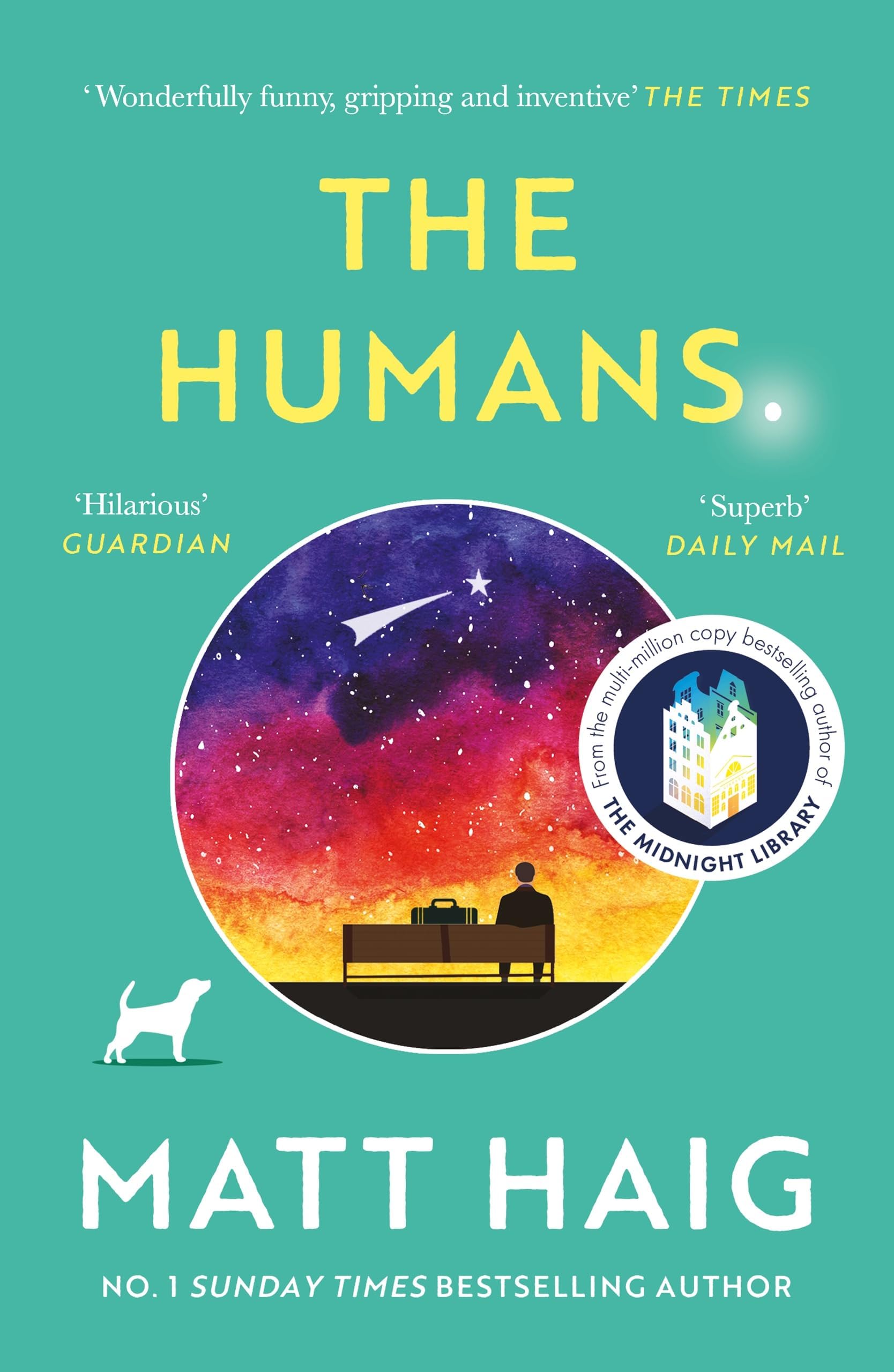

👽 Discover what it truly means to be human—before everyone else does!
The Humans by Matt Haig is a bestselling literary fiction novel (#2,304 in genre) with a 4.4-star rating from over 29,000 readers. Told from the perspective of an alien sent to Earth, it humorously and thoughtfully explores human nature, mortality, and happiness, making it a compelling and conversation-starting read for millennials seeking depth and relatability.
| Best Sellers Rank | #3,907,309 in Books ( See Top 100 in Books ) #2,143 in Genre Literature & Fiction |
| Customer Reviews | 4.4 out of 5 stars 29,583 Reviews |
M**K
Thought-Provoking Adventure Even if Science Fiction Novels are Not a Typical Reading Choice!
Science fiction novels are a rare choice for me. However, I read The Midnight Library and enjoyed it tremendously. I also read Mr. Haig's succeeding novel, The Life Impossible, and pre-ordered The Midnight Train. So, I decided to read some of his earlier novels. The Humans did not disappoint! Like his other novels I have read, it builds an uplifting, thought-provoking, and engaging story based on a creative premise with bits of humor sprinkled throughout. (I am on to read How to Stop Time and ordered his first three novels. I also sent copies of The Midnight Library to my sisters and recommended it to friends.)
D**J
A novel in the spirit of the TV show “Resident Alien”
“I wondered if this was how people always talked to each other or if it was just unique to spouses.” (loc 863) This clever book is the literary equivalent of the TV show “Resident Alien” -- a creature from another galaxy arrives on planet Earth with a mission to kill, but he finds himself both baffled and intrigued by earthlings as he lives an undercover existence among us. The book is his first-person account of the experience, written after the fact, intended for his employers back on his home planet. It’s a funny, often goofy, invitation to poke fun at ourselves – and explore along the way the meaning of life, what’s important, and what is not. The story sags a little as it approaches the halfway point. The humor starts to feel tired, Haig tries a little too hard to be deep, and the ending is both predictable and a little clunky. But it’s a fun read, and it’s clear it comes from the author’s heart. There are a few too many (unnecessary) f-bombs to bring this book into a high school classroom. That’s a pity – the story, I suspect, would resonate with young people.
O**Y
A Paean To Human Happiness
I read a lot of books, one or two a week. I don't tend to review them because I know my reactions are personal, and attempting to assign a number of stars is torturous. However, every year or so, one truly stands out for me and I find myself recommending it to everyone I know. A couple of years ago, it was *Defending Jacob* by William Landay. In the past year, it was *The Humans* by Matt Haig. I was initially interested in reading *The Humans* because the topic reminded me of "3rd Rock From The Sun", one of my all-time favorite TV sitcoms (at least the first season). Both premises are based on an outsider's interpretation of the human condition. The TV show was hilarious; this book is less so, but it has its moments. It is basically the story of an alien coming to earth on a serious mission. However, I found myself laughing almost to tears at one point as the alien was attempting to interpret a dog's conversation based on facial expressions since he couldn't decipher the dog's spoken language. The scene involves peanut butter. The alien has never experienced joy. Then on earth he discovers music! He is mesmerized by Debussy, feeling he has captured all the most beautiful aspects of the universe in his music ... but, then, wow, the alien hears the Beach Boys! And discovers the aforementioned peanut butter! And poetry! Etc. Mainly it is about what it is to be human and how it is our mortality that makes happiness possible. At one point the alien marvels that he has said "me" -- it has always before been "we". (That was thrilling.) I have inspired at least a dozen friends to read this book, and so far I think everyone likes or loves it, but for all different reasons. Some liked the collectivist vs. individual aspect, like I did. Some liked the human joy aspect, as I also did. One friend was just thrilled with all the wise observations that the alien made, his unique point of view. Another was tickled by all the Emily Dickenson quotes and references, most not attributed, and most of which, I must admit, I missed. One friend chose it for his book club, and said it was a success, both because people liked it and because it inspired lively discussion. Be aware that the novel starts slowly and is rather dark. I wasn't liking it at first, and others said the same thing. My cousin put it aside for several weeks, not enjoying it, then picked it back up one day, and stayed up most of the night with it, enthralled. The alien isn't likeable. His mission is to murder. But once the story is set, it is a compelling read, and one I will revisit. It is an easy read, but interesting and thought-provoking, at times touching, at times profound. The idea that mortality is essential to human happiness is not a theme often explored. The book is a paean to human happiness.
K**T
Eye opening, thought provoking, & satisfying!
I never do this but here goes. I read some reviews good and not so good. The criticism that everything is stated so “on point” and bluntly? This is being written in the words of a non-emotional efficient being. Thus, he’s blunt. Matter of fact and Intentionally so. Also, a complaint is that the aliens who were attempting to preserve peace were hypocritical (on their long worn trajectory of preserving peace at any cost) devoid of emotion and thus “not caring”. This is an obvious observation and I imagine an hypocrisy for the reader to pick up on, furthering the Alien’s discernment of what matters and from whose perspective, not an error in the plot or concept. It is a baked in observation of how the performing of habits causes the loss of sight of the true reason behind them, Alien or human. The good points - well defined characters from, once again, the objective eye of an alien who slowly notices nuances and amalgams forming to create a unique person and more importantly the human experience. The alien had a fresh start on an old earth. It truly is a journey by observing and weighing, deciding and adjusting and asking “WHY.” This book does not need to be perfect because it illustrates human life and alien life (who knows about it?) as not being perfect and that perfection is subjective and undefined against the scope of such complex and unique beings. I loved this book, just how he transformed (without any spoiler) - it is really, to me, what life can give you when you hand destiny the nutcracker and think outside the galaxy.
R**A
Insightful, but not engaging
I shouldn’t compare this to ‘The Midnight Library’, but I didn’t love ‘The Humans’ as much. I found the book filled with wise passages and observations, but the story was lengthy and monotonous at times. I wasn’t really invested in the alien’s story after entering the thick of the plot. I did find Gulliver’s storyline quite moving. I was also interested in Isobel, who represents countless women who have been relegated to the margins of history and the home. It’s a very well written book, it’s quirky (which I appreciate), but I was not engaged and often wondered off mentally while reading.
M**Y
Maths to kill for
All visible objects, man, are but as pasteboard masks. But in each event--in the living act, the undoubted deed - there, some unknown but still reasoning thing puts forth the mouldings of its features from behind the unreasoning mask. If man will strike, strike through the mask! Herman Melville First off, let me say that I kind of liked the book. It was a sweet (if slightly sappy) love story about a godlike creature from beyond the stars that gave up immortality for love – the love of a woman, the love of the “finite spaces” that make up the story. A little like City of Angels… But what truly ignited my interest was in the afterward. The author says he got the idea for the book during a period in his life punctuated by anxiety attacks. These “spells” are characterized by a sense of unreality, dissociation and a whole host of physical symptoms. But what really makes these episodes “special” is the unrelenting perception of a meaningless universe. We’ve all heard about the ravages of bipolar disorder or the crippling effects of schizophrenia. But in panic disorder, one looks at the world through a telescope backwards. You see everything projected in your eye in all its tininess and everything means nothing. You are a dust speck looking out on an infinite, meaningless space. There’s no value, no “reasoning thing” – good or evil – that lies behind that pasteboard façade. But the book asserts otherwise. It takes the position of the Melville quote. The main character breaks through the façade of time and distance to find “the reasoning thing.” And that was apparently love, family and a sense of belonging. Perhaps that was the author’s wish, to live in such a world. The issue of mathematical truth plays an interesting counterpoint to this position. The main character was sent to earth to erase all traces of a proof of the Riemann hypothesis developed by a Cambridge mathematician. The idea is that the proof could unlock a torrent of scientific advancement that would propel an an immature, violent species into the stars sowing havoc along the way. So the proof had to be erased, and the man and his family as well. Anyone who has worked in abstract mathematics knows its utter sterility. Are we really amazed to learn that there is some order to the placement of primes on the real number line? Think about the proof of the irrationality of the square root of two. Assertion that the root is rational leads to a fatal contradiction in the nature of reality. Is this meaning? It gets worse in physics, where the delusion of reality becomes broadened. According to the “Standard Model” the meaninglessness of phase in a wave function satisfying the quantum mechanical wave equation “requires” the existence of photons. But the thing of it is this. Photons exist, whether or not we know what necessity propels them into existence. If Einstein hadn't realized the equivalence of mass and energy, we'd still have atomic bombs - remember the Curies, Otto Hahn and Lise Meitner? The building blocks of destruction are at hand. We just have to pick them up and put them together. So the universe evolves out of necessities beyond human meaning, beyond human feeling. Is that the knowledge that drove Riemann, Cantor and their colleagues to madness? Probably not. More than likely, it was the necessity to concentrate so hard with such focus that something just snapped. Or, just maybe, people drawn to that line of work are, by nature, prone to panic disorder or have self-destructive tendencies to begin with. In any event, the book paints an alternate universe in which love and community are possible (though not assured.) Is this a fantasy, a pasteboard mask? I guess we all just have to puzzle that one out for ourselves. But if you look at it at this angle, the book transcends its somewhat worn plot line. It was worth the read.
L**7
Only Human
He was Andrew Martin famous Cambridge mathematician who was taken away by the “hosts” and replaced by an alien version of Andrew Martin. The aliens were brilliant but had no idea how to make the exchange without drawing attention, as in clothes for the alien imposter would have made his transition far less complicated. Andrew’s wife Isobel simply said, “It’s all right,” and cared for him at home. Meanwhile the alien Martin was supposed to dispose of research and kill anyone who had knowledge of it including Martin”s wife and son. So many complications the Vonndarians (or some name very similar) hadn’t considered, one being that human life was interesting enough to want to watch, and in some ways very compelling. The new Andrew Martin liked his new family and did not wish to end them. Did you ever notice that people come to a different country and discover wonderful things that the people who live there take for granted? There’s a lot of discoveries of human life that we take for granted that a new human might find richly rewarding and it’s both poignant and sometimes funny. This was one of the most different and interesting books I have read in along time, and maybe we all need to appreciate the joys of being human a little more. Five stars for great writing and excellent creativity. I loved it!
A**E
Debussy + dogs + Emily Dickinson = the key to the secrets of the Universe
A beautiful collection of universal truths (literally from the universe, but not ours) wrapped in a captivating story. A British professor, Andrew Martin, solves a mathematical enigma involving prime numbers that will change life on our planet forever. Another life form in a galaxy far away solved this enigma centuries ago (or more-I'm bad at remembering precise numbers.). The alien civilization sends an emissary to Earth who takes over the physical body of Andrew Martin. This alien's mission is to destroy the mathematical proof and anyone who knows about it, starting with Martin's wife and teenage son. As I read the book, I wanted to highlight, underline and make notes in the margins because there were so many profound and eloquent statements and questions, but I couldn't pause to do that because I was obsessed with the characters and the story. I laughed out loud. I cried. I grew so much smarter and wiser. (Can't promise I'll hang on to all that and apply it to my life, but I'll at least try.) The alien life-form that exists inside the body of Andrew Martin starts out motivated by hatred and he's on a mission of destruction, based on the beliefs of the civilization he's been a part of forever. Life in his galaxy is so perfect, no one questions anything. Mathematics is their religion and they have no physical or emotional connection to each other, also no death, disease or pain. Their lives are perfect. Alien Andrew reminds me of Huckleberry Finn when he realizes that Jim is human, like himself, after taking for granted, for his whole life, that slaves were not as human as their white owners and to think of them as human was a crime. I realize that I'm favorably prejudiced toward Alien Andrew because he grows to value the same things that I value, among them: family, Emily Dickinson, Debussy and dogs. His pilgrim observations of everything we take for granted are sometimes hilarious and sometimes life changing if you take them to heart. I need to read it again, and this time highlight and make those notes. I'm stunned and enlightened and it feels good.
Trustpilot
2 weeks ago
2 weeks ago