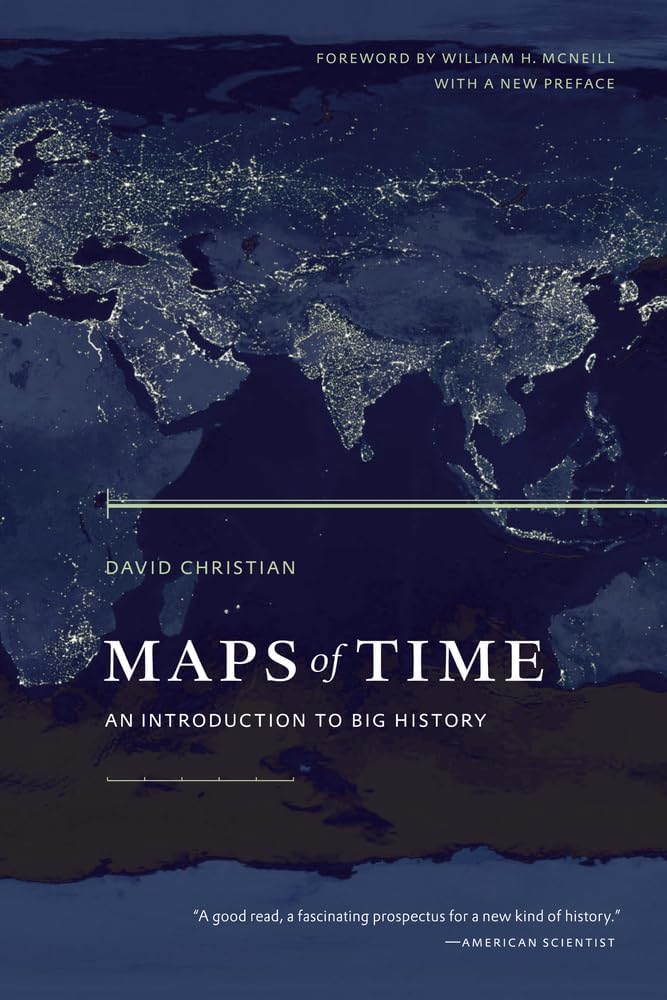
Maps of Time: An Introduction to Big History (Volume 2) (California World History Library)
Product ID: 7558483
Buy anything from 5,000+ international stores. One checkout price. No surprise fees. Join 2M+ shoppers on Desertcart.
Desertcart purchases this item on your behalf and handles shipping, customs, and support to Kyrgyzstan.
An introduction to a new way of looking at history, from a perspective that stretches from the beginning of time to the present day, Maps of Time is world history on an unprecedented scale. Beginning with the Big Bang, David Christian views the interaction of the natural world with the more recent arrivals in flora and fauna, including human beings. Cosmology, geology, archeology, and population and environmental studies―all figure in David Christian's account, which is an ambitious overview of the emerging field of "Big History." Maps of Time opens with the origins of the universe, the stars and the galaxies, the sun and the solar system, including the earth, and conducts readers through the evolution of the planet before human habitation. It surveys the development of human society from the Paleolithic era through the transition to agriculture, the emergence of cities and states, and the birth of the modern, industrial period right up to intimations of possible futures. Sweeping in scope, finely focused in its minute detail, this riveting account of the known world, from the inception of space-time to the prospects of global warming, lays the groundwork for world history―and Big History―true as never before to its name. Review: A Profound Thesis - David Christian, a trained historian, is one of the leading proponents of the relatively new concept of Big History, which I view as a sea-change in the way humans will begin to view not only the world but our place in it and what we might expect to come in the future. His work presents a truly monumental and profound thesis and a drastically new framework for where humankind fits into the universe. Of the broad variety of works I’ve read in the past several decades, it is simply one of the most interesting and cohesive theses I’ve come across, and I highly and unreservedly recommend it to everyone I know. I’d put it on par or above works like Jared Diamond’s Guns, Germs, and Steel and Matt Ridley’s The Rational Optimist among others for its broad impact on how I now view the world. For scientists and researchers it has the potential to be the philosophical equivalent of The Bible and in fact, like many religious texts, it is in effect a modern day “creation myth,” albeit one with a scientific underpinning. Christian’s work was initially brought to my attention by an article in the Chronicle of Higher Education by Jeffrey R. Young in which he mentioned that Bill Gates was a big fan of Christian’s work and had recommended it himself at a TED conference. (Gates is now also a financial supporter of Christian’s Big History Project.) I myself was aware of the Learning Company’s generally excellent coursework offerings and within a few weeks got an audio copy of the course of forty-eight lectures to listen to on my daily commute. I’ve now devoured both his rather large text on the subject as well as a lecture series he created for a course on the subject. Below are brief reviews of the two works.The magnum written opus Maps of Time: An Introduction to Big History is an interesting change of reference from a historical perspective combining the disciplines of physics, cosmology, astronomy, geology, chemistry, microbiology, evolutionary theory, archaeology, politics, religion, economics, sociology, and history into one big area of contiguous study based upon much larger timescales than those traditionally taken in the study of historical time periods. Though it takes pieces from many disciplines, it provides for an interesting, fresh, and much needed perspective on who humans are and their place in not only the world, but the entire universe. By looking at history from a much broader viewpoint (billions of years versus the more common decades or even just a few centuries) one comes away with a drastically different perspective on the universe and life. I’d highly recommend this to any general reader as early as they can find time to read through it, particularly because it provides such an excellent base for a variety of disciplines thereby better framing their future studies. I wish I had been able to read this book in the ninth or tenth grade or certainly at the latest by my freshman year in college – alas the general conception of the topic itself didn’t exist until after I had graduated from university. Although I have significant backgrounds in most, if not all, of the disciplines which comprise the tapestry of big history, the background included in the book is more than adequate to give the general reader the requisite introductions to these subjects to make big history a coherent subject on its own. This could be an extremely fundamental and life-changing book for common summer reading programs of incoming college freshman. If I could, I would make it required reading for all students at the high school level. Fortunately Bill Gates and others are helping to fund David Christian’s work to help introduce it more broadly at the high school and other educational levels. Within David Christian’s opus, there is also a collection of audio lectures produced by The Learning Company as part of their Great Courses series which I listened to as well. The collection of forty-eight lectures is entitled Big History: The Big Bang, Life on Earth, and the Rise of Humanity (Great Courses, Course No. 8050). It provides a much quicker philosophical overview of the subject and doesn’t delve as deeply into the individual disciplines as the text does, but still provides a very cohesive presentation of the overall thesis. In fact, for me, the introduction to the topic was much better in these audio lectures than it was in the written book. Christian’s lecture style is fantastic and even better than his already excellent writing style. "Because of the scale on which we look at the past, you should not expect to find in it many of the familiar details, names, and personalities that you’ll find in other types of historical teaching and writing. For example, the French Revolution and the Renaissance will barely get a mention. They’ll zoom past in a blur. You’ll barely see them. Instead, what we’re going to see are some less familiar aspects of the past. … We’ll be looking, above all, for the very large patterns, the shape of the past." --David Christian In the audio lectures Christian highlights eight major thresholds which he uses as a framework by which to view the 13.4 billion years of history which the Universe has presently traversed. Then within those he uses the conceptualization of disparities in power/energy as the major driving forces/factors in history in a unique and enlightening way which provides a wealth of perspective on almost every topic (scientific or historical) one can consider. This allows one to see parallels and connections between seemingly disparate topics like the creations of stars and the first building of cities or how the big bang is similar to the invention of agriculture. I can easily say that David Christian’s works on big history are some of the most influential works I’ve ever come across – and having experienced them, I can never see our universe in the same naive way again. For those interested in taking a short and immediate look at Christian’s work, I can recommend his Ted Talk “The History of Our World in 18 Minutes” which only begins to scratch the surface of his much deeper and profound thesis: Given how profound the topic of big history is, I’m sure I’ll be writing about and referring to it often. Review: Universal history on a logarithmic timescale - If you represented the history of the universe on a logarithmic time-scale, the contents of this book is what this history would look like. In contrast to the untransformed time-scale, in which “not much” seems to happen - after the major "birth pangs" of the first few minutes of the Big Bang and the subsequent seemingly sedate evolution of stars and galaxies - until the last few days of the cosmic calendar (see Carl Sagan for the one year cosmic calendar and David Christian’s 13 year cosmic calendar), the logarithmic timescale would shrink the earlier times and magnify the later times which are “more relevant” to us as modern human beings, who have only been around for the blink of an eye on the cosmic time-scale. David Christian clarifies in the Introduction of Maps of Time that Big History is more than “just another story” in that it is based on scientific evidence (it is “closer to truth”, so to speak), but it is not “absolute truth” in that it is based on current dominant paradigms which are subject to change and modification Thus, we must take Big History not as “truth” but as the a “modern creation myth”, more than “just another story” but less than “absolute truth”. These clarifications are important. Big History also does not profess to an expertise in the various fields it covers. Rather, it is a “bird’s eye” view of universal history that tends to look at the “big trends” while the details of each specialized field fade out due to scale. The dominant notion of Big History is that these trends guide us to certain unifying principles. The first underlying principle is related to the second law of thermodynamics (entropy) and energy flows – as detailed by Eric Chaisson (see his work “Cosmic Evolution”). It deals with how order and complexity can arise in a universe ruled by increasing entropy. One possibility (attributed to Ilya Prigogine) is that increasingly complex structures (including humans and societies) may arise due to the fact that they act, in a sense, as less resistant (or if you will, more conductive) conduits of increasing entropy (which aligns with the idea that greater flows occur on the largest gradients). So, on a physical level, human beings and societies may best be considered as “dissipative structures” unwittingly aligned with the forces of increasing entropy in the quest for greater order. Underlying the whole of Big History, but never explicitly stated, is the principle of universal evolution (universal Darwinism). One can see this more explicitly by replacing the term “collective learning” with “cultural evolution”. What Maps of Time (and Big History) leaves unstated and unexamined are its own axioms. These include: • The Reality assumption: we are not living in a simulation. • The Comprehensibility assumption: Phenomenal reality is comprehensible by the human mind and its methods (i.e., the patterns that the Brain-Mind detects are “real”). • The Copernican assumption: There is nothing special about our place in the universe (other than we happen to be on the top of the ratcheted ladder of complexity, so far as we know). • The Natural Laws assumption: Reality is governed by natural laws. • The Causality assumption: The natural laws reveal causal influences. • The Non-duality assumption: We do not need to posit anything beyond nature to explain phenomena. What makes Big History a legitimate field (and research endeavor), rather than a synthesis of knowledge, is its examination of reality on a different scale and its search for unifying patterns. Each “threshold” of universal history has it fundamental principle. At its heart, though, Big History is about history, and that takes up the largest portion of the book. Here, David Christian proposes agriculture as the fundamental technology of the Agrarian era and “power over people”, exaction of tribute, and Malthusian cycles as the unifying explanatory principles of this era. Similarly, the unifying principle of the Modern era seems to be consumer capitalism and the business cycle, but this is now set to collide with its own “Malthusian barrier” of ecological resources and impacts. Although it receives brief mention, human "nature red in tooth and claw" fades out at these large scales. Underlying all the increase in complexity is the increase in connectivity and networking, which is the “scarlet thread” running through all of history. Finally, Christian addresses the predictive ability of Big History. Overall, Big History is a historical endeavor, a scientific endeavor, and also (not least, although least recognized in the book) a philosophical endeavor. In its unifying agenda, Big History needs to integrate not only history and science but also philosophy. Philosophy would be useful to guide its axioms, methods, and agenda. .
| Best Sellers Rank | #279,647 in Books ( See Top 100 in Books ) #184 in Cosmology (Books) #3,299 in Nature & Ecology (Books) #4,324 in World History (Books) |
| Customer Reviews | 4.5 out of 5 stars 193 Reviews |
C**H
A Profound Thesis
David Christian, a trained historian, is one of the leading proponents of the relatively new concept of Big History, which I view as a sea-change in the way humans will begin to view not only the world but our place in it and what we might expect to come in the future. His work presents a truly monumental and profound thesis and a drastically new framework for where humankind fits into the universe. Of the broad variety of works I’ve read in the past several decades, it is simply one of the most interesting and cohesive theses I’ve come across, and I highly and unreservedly recommend it to everyone I know. I’d put it on par or above works like Jared Diamond’s Guns, Germs, and Steel and Matt Ridley’s The Rational Optimist among others for its broad impact on how I now view the world. For scientists and researchers it has the potential to be the philosophical equivalent of The Bible and in fact, like many religious texts, it is in effect a modern day “creation myth,” albeit one with a scientific underpinning. Christian’s work was initially brought to my attention by an article in the Chronicle of Higher Education by Jeffrey R. Young in which he mentioned that Bill Gates was a big fan of Christian’s work and had recommended it himself at a TED conference. (Gates is now also a financial supporter of Christian’s Big History Project.) I myself was aware of the Learning Company’s generally excellent coursework offerings and within a few weeks got an audio copy of the course of forty-eight lectures to listen to on my daily commute. I’ve now devoured both his rather large text on the subject as well as a lecture series he created for a course on the subject. Below are brief reviews of the two works.The magnum written opus Maps of Time: An Introduction to Big History is an interesting change of reference from a historical perspective combining the disciplines of physics, cosmology, astronomy, geology, chemistry, microbiology, evolutionary theory, archaeology, politics, religion, economics, sociology, and history into one big area of contiguous study based upon much larger timescales than those traditionally taken in the study of historical time periods. Though it takes pieces from many disciplines, it provides for an interesting, fresh, and much needed perspective on who humans are and their place in not only the world, but the entire universe. By looking at history from a much broader viewpoint (billions of years versus the more common decades or even just a few centuries) one comes away with a drastically different perspective on the universe and life. I’d highly recommend this to any general reader as early as they can find time to read through it, particularly because it provides such an excellent base for a variety of disciplines thereby better framing their future studies. I wish I had been able to read this book in the ninth or tenth grade or certainly at the latest by my freshman year in college – alas the general conception of the topic itself didn’t exist until after I had graduated from university. Although I have significant backgrounds in most, if not all, of the disciplines which comprise the tapestry of big history, the background included in the book is more than adequate to give the general reader the requisite introductions to these subjects to make big history a coherent subject on its own. This could be an extremely fundamental and life-changing book for common summer reading programs of incoming college freshman. If I could, I would make it required reading for all students at the high school level. Fortunately Bill Gates and others are helping to fund David Christian’s work to help introduce it more broadly at the high school and other educational levels. Within David Christian’s opus, there is also a collection of audio lectures produced by The Learning Company as part of their Great Courses series which I listened to as well. The collection of forty-eight lectures is entitled Big History: The Big Bang, Life on Earth, and the Rise of Humanity (Great Courses, Course No. 8050). It provides a much quicker philosophical overview of the subject and doesn’t delve as deeply into the individual disciplines as the text does, but still provides a very cohesive presentation of the overall thesis. In fact, for me, the introduction to the topic was much better in these audio lectures than it was in the written book. Christian’s lecture style is fantastic and even better than his already excellent writing style. "Because of the scale on which we look at the past, you should not expect to find in it many of the familiar details, names, and personalities that you’ll find in other types of historical teaching and writing. For example, the French Revolution and the Renaissance will barely get a mention. They’ll zoom past in a blur. You’ll barely see them. Instead, what we’re going to see are some less familiar aspects of the past. … We’ll be looking, above all, for the very large patterns, the shape of the past." --David Christian In the audio lectures Christian highlights eight major thresholds which he uses as a framework by which to view the 13.4 billion years of history which the Universe has presently traversed. Then within those he uses the conceptualization of disparities in power/energy as the major driving forces/factors in history in a unique and enlightening way which provides a wealth of perspective on almost every topic (scientific or historical) one can consider. This allows one to see parallels and connections between seemingly disparate topics like the creations of stars and the first building of cities or how the big bang is similar to the invention of agriculture. I can easily say that David Christian’s works on big history are some of the most influential works I’ve ever come across – and having experienced them, I can never see our universe in the same naive way again. For those interested in taking a short and immediate look at Christian’s work, I can recommend his Ted Talk “The History of Our World in 18 Minutes” which only begins to scratch the surface of his much deeper and profound thesis: Given how profound the topic of big history is, I’m sure I’ll be writing about and referring to it often.
A**L
Universal history on a logarithmic timescale
If you represented the history of the universe on a logarithmic time-scale, the contents of this book is what this history would look like. In contrast to the untransformed time-scale, in which “not much” seems to happen - after the major "birth pangs" of the first few minutes of the Big Bang and the subsequent seemingly sedate evolution of stars and galaxies - until the last few days of the cosmic calendar (see Carl Sagan for the one year cosmic calendar and David Christian’s 13 year cosmic calendar), the logarithmic timescale would shrink the earlier times and magnify the later times which are “more relevant” to us as modern human beings, who have only been around for the blink of an eye on the cosmic time-scale. David Christian clarifies in the Introduction of Maps of Time that Big History is more than “just another story” in that it is based on scientific evidence (it is “closer to truth”, so to speak), but it is not “absolute truth” in that it is based on current dominant paradigms which are subject to change and modification Thus, we must take Big History not as “truth” but as the a “modern creation myth”, more than “just another story” but less than “absolute truth”. These clarifications are important. Big History also does not profess to an expertise in the various fields it covers. Rather, it is a “bird’s eye” view of universal history that tends to look at the “big trends” while the details of each specialized field fade out due to scale. The dominant notion of Big History is that these trends guide us to certain unifying principles. The first underlying principle is related to the second law of thermodynamics (entropy) and energy flows – as detailed by Eric Chaisson (see his work “Cosmic Evolution”). It deals with how order and complexity can arise in a universe ruled by increasing entropy. One possibility (attributed to Ilya Prigogine) is that increasingly complex structures (including humans and societies) may arise due to the fact that they act, in a sense, as less resistant (or if you will, more conductive) conduits of increasing entropy (which aligns with the idea that greater flows occur on the largest gradients). So, on a physical level, human beings and societies may best be considered as “dissipative structures” unwittingly aligned with the forces of increasing entropy in the quest for greater order. Underlying the whole of Big History, but never explicitly stated, is the principle of universal evolution (universal Darwinism). One can see this more explicitly by replacing the term “collective learning” with “cultural evolution”. What Maps of Time (and Big History) leaves unstated and unexamined are its own axioms. These include: • The Reality assumption: we are not living in a simulation. • The Comprehensibility assumption: Phenomenal reality is comprehensible by the human mind and its methods (i.e., the patterns that the Brain-Mind detects are “real”). • The Copernican assumption: There is nothing special about our place in the universe (other than we happen to be on the top of the ratcheted ladder of complexity, so far as we know). • The Natural Laws assumption: Reality is governed by natural laws. • The Causality assumption: The natural laws reveal causal influences. • The Non-duality assumption: We do not need to posit anything beyond nature to explain phenomena. What makes Big History a legitimate field (and research endeavor), rather than a synthesis of knowledge, is its examination of reality on a different scale and its search for unifying patterns. Each “threshold” of universal history has it fundamental principle. At its heart, though, Big History is about history, and that takes up the largest portion of the book. Here, David Christian proposes agriculture as the fundamental technology of the Agrarian era and “power over people”, exaction of tribute, and Malthusian cycles as the unifying explanatory principles of this era. Similarly, the unifying principle of the Modern era seems to be consumer capitalism and the business cycle, but this is now set to collide with its own “Malthusian barrier” of ecological resources and impacts. Although it receives brief mention, human "nature red in tooth and claw" fades out at these large scales. Underlying all the increase in complexity is the increase in connectivity and networking, which is the “scarlet thread” running through all of history. Finally, Christian addresses the predictive ability of Big History. Overall, Big History is a historical endeavor, a scientific endeavor, and also (not least, although least recognized in the book) a philosophical endeavor. In its unifying agenda, Big History needs to integrate not only history and science but also philosophy. Philosophy would be useful to guide its axioms, methods, and agenda. .
N**E
Big History-From cosmology to the present
Big history was different from other interpretive looks at global history. Looking at the Earth from a global perspective maintained the social and political constructs of countries, regions, hemispheres, or areas. Developing big history as a modern “creation myth” allowed Christian to tie together modern scientific scholarship from cross-disciplinary sources. This attempted to give students an understanding of history beyond Earth; in opposition to diverse other methods that divided the Earth into separate entities. By elaborating on creation myth, big history historians released the student from having to be bound by the constraints of terrestrial perspectives. Some key concepts of the big history approach include the ideas of increasing complexity. David Christian and Fred Spier devoted over a quarter of their work to expound on the transfer of energy from simplicity to complexity and how these shifts in the universe led to life on Earth and eventually to humans. These conditions became possible under what Spier has called the “Goldilocks Principle.” Spier, “points to the fact that the circumstances must be just right for complexity to exist.”As these previous concepts were interrelated, they led to the emergence of everything. From their emergence, Christian defined several threshold moments. These include: the big bang, the formation of stars, the creation of galaxies, the emergence of our solar system and subsequent Earth, the origins of life on earth, the introduction of hominids and evolution of humans, and development of both the agricultural and industrial revolutions. The thresholds that emerged over the last 13 billion years have made, “the human species…arguably the most complex biological organism in the known universe.” Christian calculated that humans consume one hundred times the needed energy to survive. Increased complexity has defined human development from the agricultural revolution through the exponential growth of population and energy consumption of the last two hundred years. Spier’s and Christian’s main argument for sustainability lies in the increased energy flow required to maintain growth that eventually leads to decay in the theoretical framework physicists call entropy. Pedagogically focused on introducing these concepts to their students, big history delineates potential future courses of human development. Some critiques argue that Christian placed too much emphasis on entropy to outline the decay of complexity. Spier supported Christian in his approach by analyzing trends of human complexity and argued that if humans do not maintain equilibrium with their environment, complexity will revert back to a simpler form, allowing for a decay of complexity and a collapse of humanity. This decline, following the threshold of industrialization over the last two hundred years, will reach their apex and either, by optimistic measures, remain stable and constant, or reverse causing chaos and decline. In making their students aware of the risks of unchecked consumption of non-renewable resources, big history historians place the future decay or sustainability of energy flow in the hands of everyone and gives them a role in their global future. This may inspire big history students to become more proactive in environment causes for the sake of humanities’ collective future.
T**A
Must have book, encyclopaedia of our world, our universe and our reason for being here.
There are gaps in our knowledge of the world and its beginnings and possible endings, but they are getting smaller as our perspectives get larger. This is a big book about the biggest questions we still have and the answers that are still being discovered and delivers the most comprehensive and easily readable account of where we are now that I have read to date. The references and reading lists offered as the voyage of discovery continues are invaluable and comprehensive. David Christian has captured a way of delivering and explaining what we know and what we might yet know of our history which propels us into the future with truth and understanding at our side and wonder in front of us. This is a great read and a fantastic adventure.
E**F
A very important book on Big History
This is one of the most important books I've read in 65 years of life. It covers history from the Big Bang and goes on to when the universe will fade away as the physicists predict. Of course the most complex part of the book is the genesis of life with particular focus on the brief span we homo sapiens sapiens have been around and interpreted the goings on from beginning to end. It leaves us with a question on the role we are playing in altering the biosphere. I found this book a delight to read and have alongside one a laptop so that salient points of history, anthropology, science could be explored further. Christian is an historian though he has pulled enormous amounts of information from academic disciplines to elaborate and illustrate his text. The footnoting is extensive.
A**R
14 Billion Years in a book
In Maps of Time, David Christian kicks off with the big bang and galaxy formation. He describes the creation of our sun and solar system. He walks us through the evolution of life on earth and the arrival of homo sapien. And he educates us on our development from hunter gatherer to farmer to industrialist to information technology creator. This book is a huge undertaking. And it's delivered brilliantly. So impressed was Bill Gates that he is personally funding Christian and team to bring Big History to every school on the planet. The sooner that happens the better! But in the meantime, get yourself a cup of coffee, and sit down with this brilliant book.
D**3
Worth a read for history geeks
This book was very informative from a historical and sociological point of view. Though I found it repetitive at times it kept me reading and very interested in its topics. As the author states in the introduction, many of the most interesting points in history are necessarily skimmed over for the point of big history. A definite read for history geeks.
S**H
The modern model
Intellectually stimulating, rapid-fire journey, the "powers of 10" movie specialized for history buffs. Some of the material I found superficial/generalized to be of substance, but the author acknowledges that can be the nature of Big History. An ambitious book which talks directly to ideas that most historians only philosophically discuss. A charge of inductive reasoning would not be far fetched, ie. cherry picking of facts to support prefigured models. Excellent overview of Big History and World History ideas and methods and themes. Annotated bibliographies at the end of each chapter, and large one at the end of the book, are very good for further exploration, most book recommendations are recent (1990s and early 2000s). Despite criticisms learned some new and important perspectives and recommend it highly.
I**O
A grande história do universo
Os mapas do tempo dão uma bela visão geral da nossa grande história. O início, há cerca de 13 bilhões de anos, o sistema solar, há aproximadamente 4 ou 5 bilhões de anos, o início da vida. Descrevendo, com riqueza de detalhes o que sabemos e o que não sabemos a respeito deste processo. O foco, é claro, somos nós, os humanos. A agricultura, as primeiras cidades, os sistemas políticos e tributários, a revolução industrial e as diversas mudanças geográficas dos núcleos de concentração e troca de informações. Chama a atenção os ciclos de expansão e colapso de algumas civilizações. A incrível explosão demográfica dos últimos cem anos (na chamada revolução moderna) deve nos servir de alerta para a possibilidade de um próximo colapso. Essa afirmação é minha e não do autor. De qualquer forma, mesmo sendo muito denso, com muita informação de difícil compreensão, recomendo fortemente a leitura. A nossa história é fascinante.
R**A
A Must for people into the big narritives
Fantastic book! But its only fantastic if you already have prior knowledge of astronomy, physics, history and geography. Even if you don't, it can be a great learners book I think, you know reading up and about all the terms you don't know. It has its problems and critics but its still a fantastic attempt at Big History. If you still have trouble understanding then there is a module on coursera.org with the same name by David Christian. That's pretty helpful too and is basically based on the book. Its still unlike any big history book I've read and I have read quite a few.
P**S
Qualidade gráfica
Preço incompatível com a qualidade do produto: 1- Papel tio papel jornal 2- Todas as ilustrações em preto e branco e em papel jornal
V**1
Four Stars
Great academic text
M**C
Worth the Effort
Starts off quite fascinating but tends to drag on about 2/3 of the way through. Initially you'll be struggling to put it down but by the end you'll be struggling to pick it up. Overall quite an informative treatment of a very ambitious subject though. A high level history of everything from the big bang up to predictions about the possible future is almost by definition a large scale topic. If you can wade through some of the dull parts, you'll come away glad you read it. Because of its immense scope, there is probably something new and interesting for almost all readers.
Trustpilot
1 month ago
1 day ago