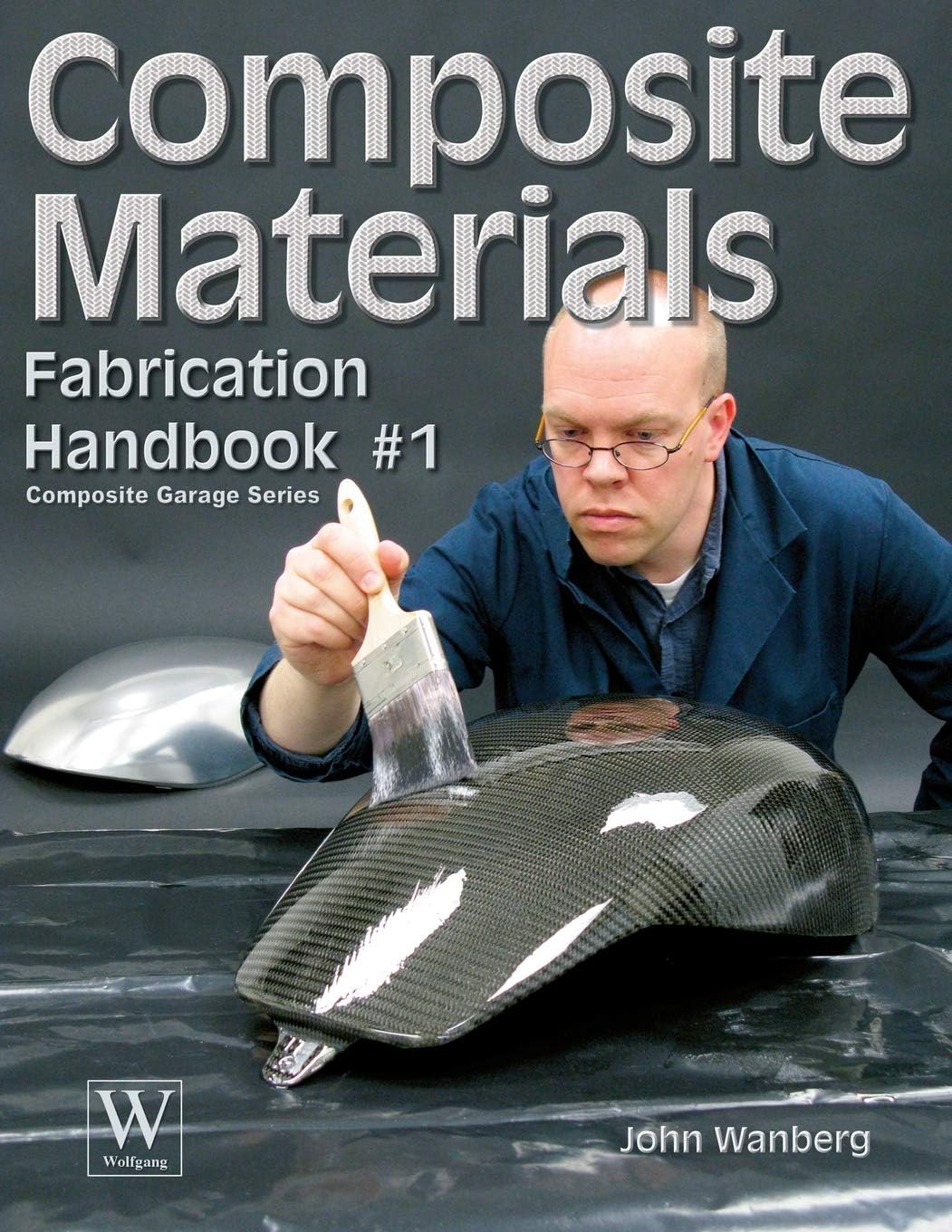
Composite Materials: Fabrication Handbook #1 (Composite Garage Series)
Product ID: 721406
Buy anything from 5,000+ international stores. One checkout price. No surprise fees. Join 2M+ shoppers on Desertcart.
Desertcart purchases this item on your behalf and handles shipping, customs, and support to Kyrgyzstan.
While most books on composites approach the subject from a very technical standpoint, this book presents practical, hands-on information about these versatile materials. From explanations of what a composite is to demonstrations on how to actually utilize them in various projects, this book provides a simple, concise perspective on molding and finishing techniques to empower even the most apprehensive beginner. Topics include: what is a composite, why use composites, general composite types, and where composites are typically used. The basics section also includes information on choosing the best resin/fiber system and the different types of both resin and fiber. Health and safety is a major consideration for any composite book. Author John Wanberg covers threats to both breathing and skin contact and how those contacts can be avoided when working with modern composite materials. First-time composite workers will need a work space, and this book describes how to setup a shop that is both composite-friendly and safe. Once the shop is established, it's time to begin using typical wet-layup and molding techniques. Creating useful composite parts starts with a good design, a topic that must be mastered before useful parts can be manufactured. Among the useful parts demonstrated here are both motorcycle and automotive components. The construction of these parts is documented in step-by-step fashion with an abundance of photographs - no step is left out. Any part created in a mold must be first removed from the mold, and second, finished and trimmed. Surface sanding and finishing makes up an entire chapter, ensuring that the composite parts you manufacture are not only light and extremely strong, but good looking as well. Review: Excellent introductory guide--major pluses, only a few minuses - As it states in its introduction, this book is intended as a PRACTICAL, hands-on guide to learning the basics of working with composites. It spends almost no time on designing composite structures and instead focuses on the actual techniques you need to learn in order to build those structures yourself. It begins by describing the most common materials and how and why they are used, then moves on to safety (very important) and helpful tools, and then into how to actually make some basic composite structures via various wet layup techniques. To me, one of the strong points of this book is that it isn't too discipline-specific, i.e. it doesn't seem to have a bias toward any one type of structure. Almost every other book from which I've tried to learn some of these basic techniques has been aimed toward building either an airplane or a boat of some sort, and used examples (and terminology) specific to them. This book might have just a *slight* bias toward automobiles, but that's it. By showing how to lay up a flat panel, a tube and a couple of other structures, it shows several basic techniques that can be applied to a wide variety of projects. It also shows how to make different types of molds, the pros and cons of different types of resin (and how to choose the best one depending on what you're trying to build) and different types of reinforcement. And it shows a variety of finishing techniques as well, which I've rarely seen in any of the books I've encountered in the five-plus years I've been working with composites--including a couple I *wish* I had learned much sooner. Another strong point is the clear COLOR photographs, which are consistently well composed and well lit, so you can actually see what's really going on. Every photo and diagram also has a descriptive caption, which are consistently excellent. My only quibble, and it's a very small one, is that the photos sometimes run ahead of the text by a couple of pages. But even if you just follow the photos (there are hundreds of them), you will still get a very good idea of the process being shown. One other observation: Many of the photos are arranged six to a page (two across and three down) and read in order down the left-hand column, then back to the top of the right-hand column. It was a bit confusing at first, as I would've expected to read across the page first and then down to the next row. But again, that's easy enough to get used to--and the photos are numbered. The author's language is conversational and informal throughout, a perfect match for a practical guide. Also, the paper is thick and glossy, the layout is clean, uncluttered and easy to read, and the perfect-bound construction seems well done. So the book should last for quite a while. If you're looking for a book that covers many of the basics, but geared toward aviation and with a somewhat more theoretical approach, check out Composite Basics by Andrew C. Marshall. But if you're looking for a consistently superior guide to the basics of working with composites, Composite Materials Fabrication Handbook is the one you want. NOTE: This book (Fabrication Handbook #1) covers basic wet layups only. It does NOT cover prepregs, compression molding, vacuum bagging or resin infusion. However, those topics and others are covered in Composite Materials Fabrication Handbook #2 by the same author, which is just as good as Handbook #1 and also worth every penny. Do what I did and just buy both at the same time. You won't regret it. Review: Quick read, super informative, and perfect amount of technical - This book (paperback) is an intro to the world of composites related to carbon fiber, fiberglass, and kevlar and covers all you would need to get started on simple production. It goes through the tools needed, terminology, molding, materials to use and in what combination/order, and all sorts of techniques to produce basic parts. It is a guide through the composite world and shares a lot of tips and tricks to get going. I would highly recommend this book and have order the other 3 in the series to continue with my knowledge of composites. Lots of high quality pictures to show exactly what is going on. Pair this with youtube tutorials and you will be started in no time.
| Best Sellers Rank | #1,473,223 in Books ( See Top 100 in Books ) #311 in Car Customization |
| Customer Reviews | 4.4 out of 5 stars 206 Reviews |
J**3
Excellent introductory guide--major pluses, only a few minuses
As it states in its introduction, this book is intended as a PRACTICAL, hands-on guide to learning the basics of working with composites. It spends almost no time on designing composite structures and instead focuses on the actual techniques you need to learn in order to build those structures yourself. It begins by describing the most common materials and how and why they are used, then moves on to safety (very important) and helpful tools, and then into how to actually make some basic composite structures via various wet layup techniques. To me, one of the strong points of this book is that it isn't too discipline-specific, i.e. it doesn't seem to have a bias toward any one type of structure. Almost every other book from which I've tried to learn some of these basic techniques has been aimed toward building either an airplane or a boat of some sort, and used examples (and terminology) specific to them. This book might have just a *slight* bias toward automobiles, but that's it. By showing how to lay up a flat panel, a tube and a couple of other structures, it shows several basic techniques that can be applied to a wide variety of projects. It also shows how to make different types of molds, the pros and cons of different types of resin (and how to choose the best one depending on what you're trying to build) and different types of reinforcement. And it shows a variety of finishing techniques as well, which I've rarely seen in any of the books I've encountered in the five-plus years I've been working with composites--including a couple I *wish* I had learned much sooner. Another strong point is the clear COLOR photographs, which are consistently well composed and well lit, so you can actually see what's really going on. Every photo and diagram also has a descriptive caption, which are consistently excellent. My only quibble, and it's a very small one, is that the photos sometimes run ahead of the text by a couple of pages. But even if you just follow the photos (there are hundreds of them), you will still get a very good idea of the process being shown. One other observation: Many of the photos are arranged six to a page (two across and three down) and read in order down the left-hand column, then back to the top of the right-hand column. It was a bit confusing at first, as I would've expected to read across the page first and then down to the next row. But again, that's easy enough to get used to--and the photos are numbered. The author's language is conversational and informal throughout, a perfect match for a practical guide. Also, the paper is thick and glossy, the layout is clean, uncluttered and easy to read, and the perfect-bound construction seems well done. So the book should last for quite a while. If you're looking for a book that covers many of the basics, but geared toward aviation and with a somewhat more theoretical approach, check out Composite Basics by Andrew C. Marshall. But if you're looking for a consistently superior guide to the basics of working with composites, Composite Materials Fabrication Handbook is the one you want. NOTE: This book (Fabrication Handbook #1) covers basic wet layups only. It does NOT cover prepregs, compression molding, vacuum bagging or resin infusion. However, those topics and others are covered in Composite Materials Fabrication Handbook #2 by the same author, which is just as good as Handbook #1 and also worth every penny. Do what I did and just buy both at the same time. You won't regret it.
A**R
Quick read, super informative, and perfect amount of technical
This book (paperback) is an intro to the world of composites related to carbon fiber, fiberglass, and kevlar and covers all you would need to get started on simple production. It goes through the tools needed, terminology, molding, materials to use and in what combination/order, and all sorts of techniques to produce basic parts. It is a guide through the composite world and shares a lot of tips and tricks to get going. I would highly recommend this book and have order the other 3 in the series to continue with my knowledge of composites. Lots of high quality pictures to show exactly what is going on. Pair this with youtube tutorials and you will be started in no time.
S**H
Good place to start, but missing information. The book is also laid out wierd.
There is a lot of good information in this book as the other reviewers have said and I do recommend getting it if you are interested in learning about composites, basic mold making, and general wet lay techniques. There are however 2 things I really don't like about this book. This first is that the example pictures referred to in the text is often a few pages away. You can't flip through the book looking for pictures and then read about that picture on that same page, it's often back a few pages. Secondly, it appears as if the book is missing information. There are pictures of the demolding process for a multi piece mold yet the instructions are very incomplete. It does talk about bolting the mold together and unmodling it, but it doesn't talk about the actual construction of the multi-piece mold.
A**R
Very good book
This is an excellent book on the subject. It gives brief but clear explanations and goes into just enough detail to understand the concepts, while still being very clear and concise. I feel like after having read this book I am ready to start working with composites. My only complaint is that vacuum-bagging is not covered in this book, and is described as a more advanced method. I see it is covered in the second book, which I suspect I will buy at some point.
M**M
DON'T BUY THE KINDLE VERSION!
DON'T BUY THE KINDLE VERSION! It is missing countless pictures and the tables are nearly unreadable.The book itself is well written and thorough but with half the pictures missing in each chapter it really ruins the book.
P**A
Really excellent
I need to get up to speed on this manufacturing technique really soon for a major school project I'm working on. After watching some youtube videos I realized I needed some more detail. This book is really excellent. The first half is detailed information about the types of products available and why you'd use one over the other. The second half is step-by-step procedures showing how to use them. Just what I needed.
A**T
A very good introduction
This book is a very good introduction to the practical side of working with composites. It covers the strengths and weaknesses of the most commonly used fibers (carbon, kevlar, glass) and matrixes (epoxy, polyvinyl, polyester) and tells you how to perform the most common lay-up methods. Design of composite parts is not covered. As an introduction to composites, this book will be very helpful for anyone who wants to build composite parts but wonders how to go about it.
P**M
Good Coverage of Non-structural Composites
Books 1 and 2 provide good photo-coverage of composite introduction and fabrication. Step-by-step details are clearly depicted from the making of simple parts to production tooling. All are done in non-technical, easy-to-understand fashion. Be aware though, as stated on the covers, these books are in the "garage series" and are geared towards hands-on fabrication (as opposed to design). The emphasis is towards cosmetic rather than high-efficiency structural applications. So if your interests are towards building hood scoops, cycle fenders, etc, you will find these books highly informative. If your interest are towards aerospace or racecar structural composites where high-strength and light-weight are paramount, look elsewhere. Also, if you are looking for information on technical design of composites, look elsewhere.
D**I
Brief but illustrative
Someone once wrote, the main thing is to keep the main thing a main thing. This is the handbook that gonna give you the good basic overall picture. If the one wants to go deeper into topic, I believe other sources would need to be find. Or just get your hands dirty …
A**Y
covers real world techniques in a clear manner
Excellent pics help explain the text. Like a community college course in a small textbook!! Great!!!
A**R
Excelente libro
Excelente libro, explica detalladamente todas las técnicas básicas. Desde herramientas, tipos de fibra cuidados y procesos de manufactura, totalmente recomendable!!
M**S
inglese tecnico non sempre compresibile
le foto sono molto utili e fatte bene e descrivono passo dopo passo le azioni da intraprendere. Manuale pratico con indicazioni utili per l'attrezzatura da utilizzare e i prodotti però non sempre facili da individuare. Per una più semplice e completa spiegazione sia pratica che teorica consiglio il libro di Emiliano Benvenuti semplice e intuitivo, con tabelle e descrizione dei materiali e prodotti con le caratteristiche fisiche e chimiche di facile comprensione. Le tecniche attuabili sono descritte in maniera facile e applicabile sin da subito.
D**R
Five Stars
A good no nonsense guide to Composites
Trustpilot
2 weeks ago
1 month ago