We remain fully operational. Our teams are working around the clock to ensure your deliveries continue safely.

DOWNLOAD THE APP


Customer Services
Copyright © 2025 Desertcart Holdings Limited
DOWNLOAD THE APP
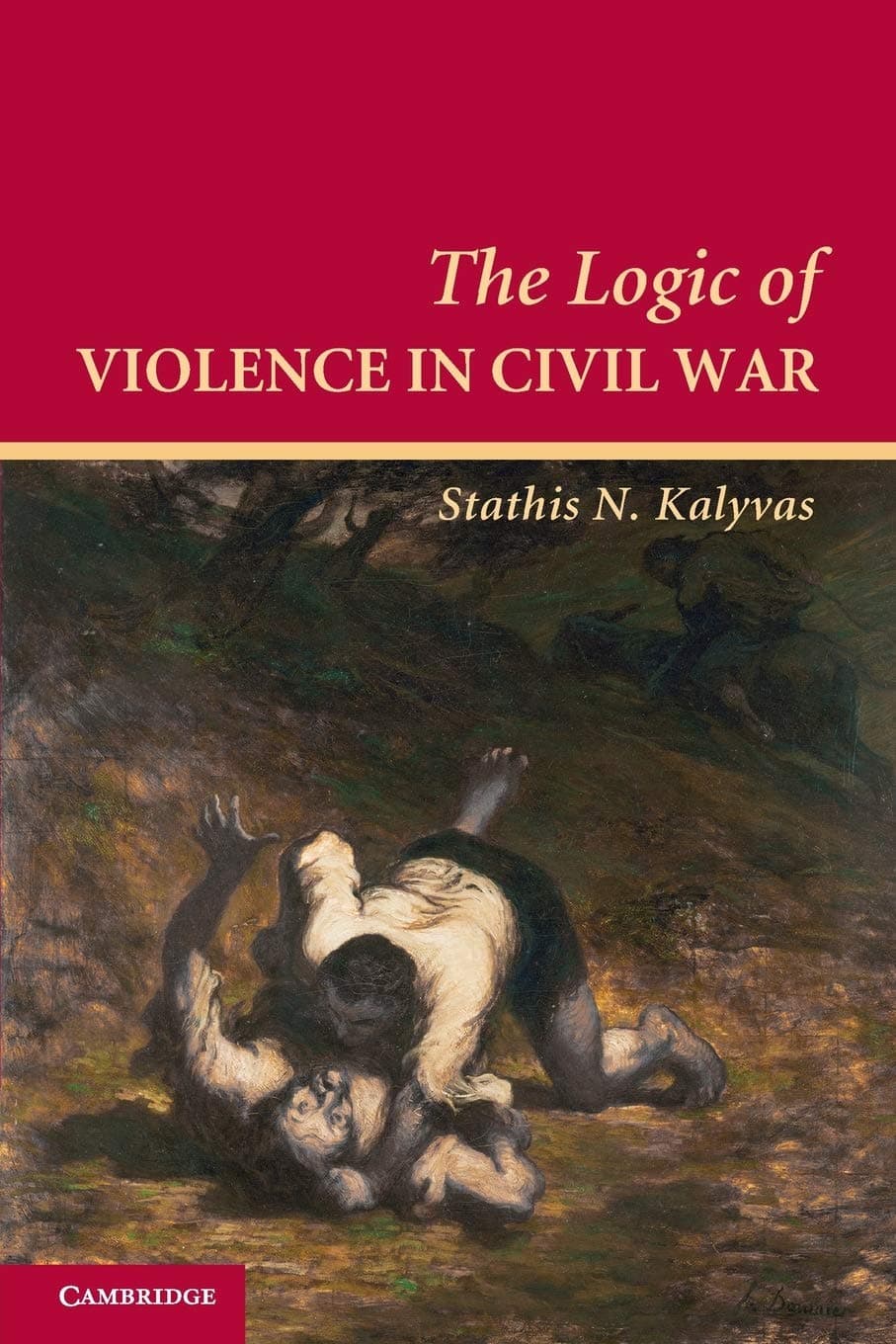


The Logic of Violence in Civil War (Cambridge Studies in Comparative Politics) [Kalyvas, Stathis N.] on desertcart.com. *FREE* shipping on qualifying offers. The Logic of Violence in Civil War (Cambridge Studies in Comparative Politics) Review: The best book on civil war violence out there! - Kalyvas"s logic of violence in civil war is a superbly researched account of what causes violence in civil war and how state and non state actors are likely to use violence in certain situations. Like the author, I have also been deeply disturbed by the fact that civil wars can turn family, friends, and neighbors against each other, causing violence between those who have the closest relationships. The author logically explains this disturbing phenomenon as a function of predominately private conflicts, and revenge played out using either the incumbent (government) or insurgent forces as agents of violence. Ordinary citizens are unlikely to engage in violence themselves but often denounce or inform on their neighbors to either the government or insurgent side to remove a business rival, resolve a personal conflict, or settle a family feud. This disturbing facet of civil wars suggest that personal conflict and petty grievances play a major and often overlooked role in causing violence beyond the more cited social, ideological, and political reasons. The author's research also suggest that the presence of permanent military forces by one party in a town ensures and leads to control over an area regardless of that areas animosity towards the occupier. As a civil war drags on most people tend to cooperate with the party that has local supremacy regardless of political and ideological beliefs because they want to survive and see the violence end. This point is especially important for counterinsurgents because it suggests that control and local supremacy may be more important that "hearts and minds" campaigns that are intended to shift political allegiance. The book shows that this phenomenon is not unique to a certain war or culture but that it has occurred in nearly every civil war. I highly recommend this book for anyone interested in the dynamics of violence in civil war and insurgencies and counterinsurgency. This book is not an easy read and I only recommend this book to readers who have had read extensively about civil wars and have a vested interest in understanding what takes place. For those who read the book, it will challenge the most commonly held views on what causes violence in a civil war and may change your perspective on human nature. Review: Excellent, Logical, annotated thesis on violence in civil wars. - This is a detailed, heavily annotated, extremely logic based thesis on the etiologies of violence in civil wars. There are many examples included of many civil wars. Very few of the examples are graphic in nature. Symmetrical and asymmetrical wars are examined separately. Each chapter posits postulates which are examined both by logical analysis and references at least twenty civil wars in the last hundred years to arrive at hypotheses which are tested against the history, e.g. The Mau Mau, Philippine, Greek situations. Deeper history civil wars also frequently serve as a fund of examples, I.e. Verdene in the French Revolution and the American Revolution, and the American Civil War, especially the Missouri situation. Unless you are up for logical analysis of history, this is a heavy read. The book is well written by a man who obviously knows the topic, and has done related original research on the Greek Civil War. It would make great gift for a history graduate student, or student in a military academy.
| Best Sellers Rank | #508,169 in Books ( See Top 100 in Books ) #69 in Non-US Legal Systems (Books) #157 in Comparative Politics #530 in Violence in Society (Books) |
| Customer Reviews | 4.6 4.6 out of 5 stars (66) |
| Dimensions | 6.14 x 1.15 x 9.21 inches |
| Edition | 1st |
| ISBN-10 | 0521670047 |
| ISBN-13 | 978-0521670043 |
| Item Weight | 1.54 pounds |
| Language | English |
| Part of series | Cambridge Studies in Comparative Politics |
| Print length | 510 pages |
| Publication date | May 1, 2006 |
| Publisher | Cambridge University Press |
L**D
The best book on civil war violence out there!
Kalyvas"s logic of violence in civil war is a superbly researched account of what causes violence in civil war and how state and non state actors are likely to use violence in certain situations. Like the author, I have also been deeply disturbed by the fact that civil wars can turn family, friends, and neighbors against each other, causing violence between those who have the closest relationships. The author logically explains this disturbing phenomenon as a function of predominately private conflicts, and revenge played out using either the incumbent (government) or insurgent forces as agents of violence. Ordinary citizens are unlikely to engage in violence themselves but often denounce or inform on their neighbors to either the government or insurgent side to remove a business rival, resolve a personal conflict, or settle a family feud. This disturbing facet of civil wars suggest that personal conflict and petty grievances play a major and often overlooked role in causing violence beyond the more cited social, ideological, and political reasons. The author's research also suggest that the presence of permanent military forces by one party in a town ensures and leads to control over an area regardless of that areas animosity towards the occupier. As a civil war drags on most people tend to cooperate with the party that has local supremacy regardless of political and ideological beliefs because they want to survive and see the violence end. This point is especially important for counterinsurgents because it suggests that control and local supremacy may be more important that "hearts and minds" campaigns that are intended to shift political allegiance. The book shows that this phenomenon is not unique to a certain war or culture but that it has occurred in nearly every civil war. I highly recommend this book for anyone interested in the dynamics of violence in civil war and insurgencies and counterinsurgency. This book is not an easy read and I only recommend this book to readers who have had read extensively about civil wars and have a vested interest in understanding what takes place. For those who read the book, it will challenge the most commonly held views on what causes violence in a civil war and may change your perspective on human nature.
G**R
Excellent, Logical, annotated thesis on violence in civil wars.
This is a detailed, heavily annotated, extremely logic based thesis on the etiologies of violence in civil wars. There are many examples included of many civil wars. Very few of the examples are graphic in nature. Symmetrical and asymmetrical wars are examined separately. Each chapter posits postulates which are examined both by logical analysis and references at least twenty civil wars in the last hundred years to arrive at hypotheses which are tested against the history, e.g. The Mau Mau, Philippine, Greek situations. Deeper history civil wars also frequently serve as a fund of examples, I.e. Verdene in the French Revolution and the American Revolution, and the American Civil War, especially the Missouri situation. Unless you are up for logical analysis of history, this is a heavy read. The book is well written by a man who obviously knows the topic, and has done related original research on the Greek Civil War. It would make great gift for a history graduate student, or student in a military academy.
A**.
The logic of civil war? 'Touch my job, I'LL BEAT YOUR ASS!'
The logic of civil war? 'Touch my job, I'LL BEAT YOUR ASS!'
M**N
which is all to the good. As an erstwhile practitioner
Appears to build upon that venerable study by Leites and Wolf, Rebellion and Authority, Rand 1970, which was informed by the Vietnam War, which is all to the good. As an erstwhile practitioner, my experience (Vietnam, as well) tells me that moving a conceptual discussion of insurgency/counterinsurgency off a "hearts and minds" focus and squarely onto an examination of the ways in which control determines the behavior of the population, more accurately reflects reality. Adducing evidence from a wide spectrum of conflicts, Kalyvas succeeds in systematizing how this phenomenon occurs, including, inter alia, the "cascade effect" of generating loyalty on the part of family members to the side which conscripts their son into its armed service or militia. This was observed in Vietnam, but Kalyvas cites other examples to show wide applicability of this mechanism.
K**G
Outstanding book & fascinating read
Kalyvas' analysis is strongly supported by both anecdotal evidence as well as statistics (where those are available). He lays out his arguments clearly, but also lays out what work has to still be done to deepen the understanding of violence - especially aimed at civilian populations. Outstanding book & fascinating read.
D**F
Useful in understanding insurgency and counterinsurgency
My previous reading most pertinent to the topic of this book would be counterinsurgency doctrine and operational practices, this book is extremely useful to better understanding insurgency and counterinsurgency and understanding the fundamental dynamics of civil war that are so difficult to comprehend. I highly recommend this book to those with similar interests.
D**A
Five Stars
Great book for conflict studies
F**Y
Kalyvas is the best on civil war from the quantitative side
Kalyvas is the best on civil war from the quantitative side. His work is rigorously grounded in quantitative assessments of homicides in civil war. From this, he builds an excellent theory that is rigorous yet holistic enough to be useful to practitioners.
M**T
Wonderfully provocative and challenging
C**Z
I spend a lot of money on books and they often come in a poor condition. I have spent a long time trying to acquire this specific book and it came scuffed up and with apparent water damage. This is unacceptable.
F**D
This is one of most thought-provoking works on civil war I have ever read. Too many accounts of civil conflicts are a collection of atrocity stories, explaining nothing, or binary narratives of good guys v bad guys, the definition of which determined by your political persuasion. Most accounts do little to explain violence, let alone try to predict when it might happen. This book eschews such approaches and attempts to explain the underlying logic of violence. To simplify the theory, violence in civil war correlates to the degree of control a warring party exerts on any given territory ‘parties’ here meaning, incumbents (governments) and insurgents. Taking Greece as his principal example, but illustrated by many examples of conflicts, he shows how violence is not random but concentrated in zones most subject to contestation by the warring parties. Where incumbents or rebels are dominant, violence is scarce. Where neither incumbents nor rebels are in overall control, say a situation where incumbent forces rule during the day, the rebels at night, a ‘balance of power’ is achieved and violence is restrained. It is the leading edge of conflict, in areas where incumbents and rebels are challenging the other side for territory they control, or defending territory from challenges, that violence is most intense. This sounds like a mechanistic explanation but it isn’t. He tackles issues of motivation. Few people in civil wars actually do the killing. The taboo against taking life with one’s own bare hands stays strong, even in civil war. Instead, people use denunciation, to settle scores, a tactic that can lead to the demise of the denouncer’s victim, without the getting one’s hands dirty. Distance from the consequences of one’s act keeps conscience at bay. The combatants do much killing on the basis of informers. The discussion of the interaction between denunciation and violence is a fascinating one. The practice, like violence, corresponds to the degree of control either side exerts. In areas where there is a balance of power, there is less of it, because the denouncer fears retaliation from the victim’s relatives or confederates. This question also has bearing on how we tend to understand civil wars. Most accounts posit a binary division such as Catholics v Protestants in Northern Ireland, Hutu v Tutsi in Rwanda, Left v Right during the Spanish Civil War, to name just a few. These divisions are real enough but do they cause violence or are they an effect? Digging deeper, the reality is more complex. Under these ‘master cleavages’ at the macro level lie many ‘micro cleavages’, between families, relatives, villages, cutting in numerous directions. Governments and their rebel opponents nail their colours to their ideological masts. Are those who follow the flags true believers? No, that does not follow. Followers’ allegiances and motivations are much more complex and fluid. Defection and pragmatism are common features of civil war. Rather than conceptualising conflict as between two blocs of contenders, one should look for alliances between the macro at strategic level and the micro at the local. The leaders may believe in the overt, spoken ideological reasons for fighting (or might not) but the followers’ allegiances are often tactical; they have their own motivations often for wanting to fight. They will talk the talk but walk a different walk. Iraq is a prime example. It should come as no surprise as to why the Americans were able to buy off their Sunni opponents in Iraq. It is said that war is a continuation of politics by other means and that politics is local. This book shows, in its discussion of macro and micro cleavages, that the same considerations apply to civil war. That brings me to another key observation the book makes, on the intimate origins of much violence. Students of crime have long known that most murderers know their victims. The same observation applies to the perpetrators and victims of violence in civil war. This is contrary to received wisdom but this makes sense in the light of the macro/micro cleavages, discussed above, and the role of denunciation. A lot of this has origins in social and interpersonal conflict preceding the conflict. Though it is an academic text, it is suitable for lay readers, willing to make the time and effort to assimilate its ideas. It gets past literary clichés about violence, ‘the horror, the horror,’ and so on and shows that violence has a pattern. It is not meaningless. It helped me understand features of contemporary conflicts. It’s no surprise that the exemplary violence of the Islamic State is greatest in the areas which it is seeking to take. It is less violent in areas it controls. Assad’s apologists should not make too much fodder of the fact that he controls major cities. In civil wars, incumbents usually control cities (as the French did in Algeria and the Americans in Vietnam) but that is no predictor of victory. Overall, I have given this five stars not because it is always the most readable of books but because of the quality and originality of its ideas.
D**Y
The excellence of Kalyvas' approach to understanding how civil wars take on a "life" of their own is only matched by the author's ability to sustain the reader's interest with clear, authoritative, and flowing prose. The examples used by the author to illustrate his thesis, together with the logical structure of the text, allow the reader to grasp the central concepts without difficulty. The contents themselves are pure gold. This book goes a long way to explaining why civil wars are so universally vicious and messy.
B**A
I bought this book as part of my degree. The delivery was fast and the item was well protected. I also found the price cheaper than in the high street, plus it is sent you your house.
Trustpilot
3 days ago
2 weeks ago