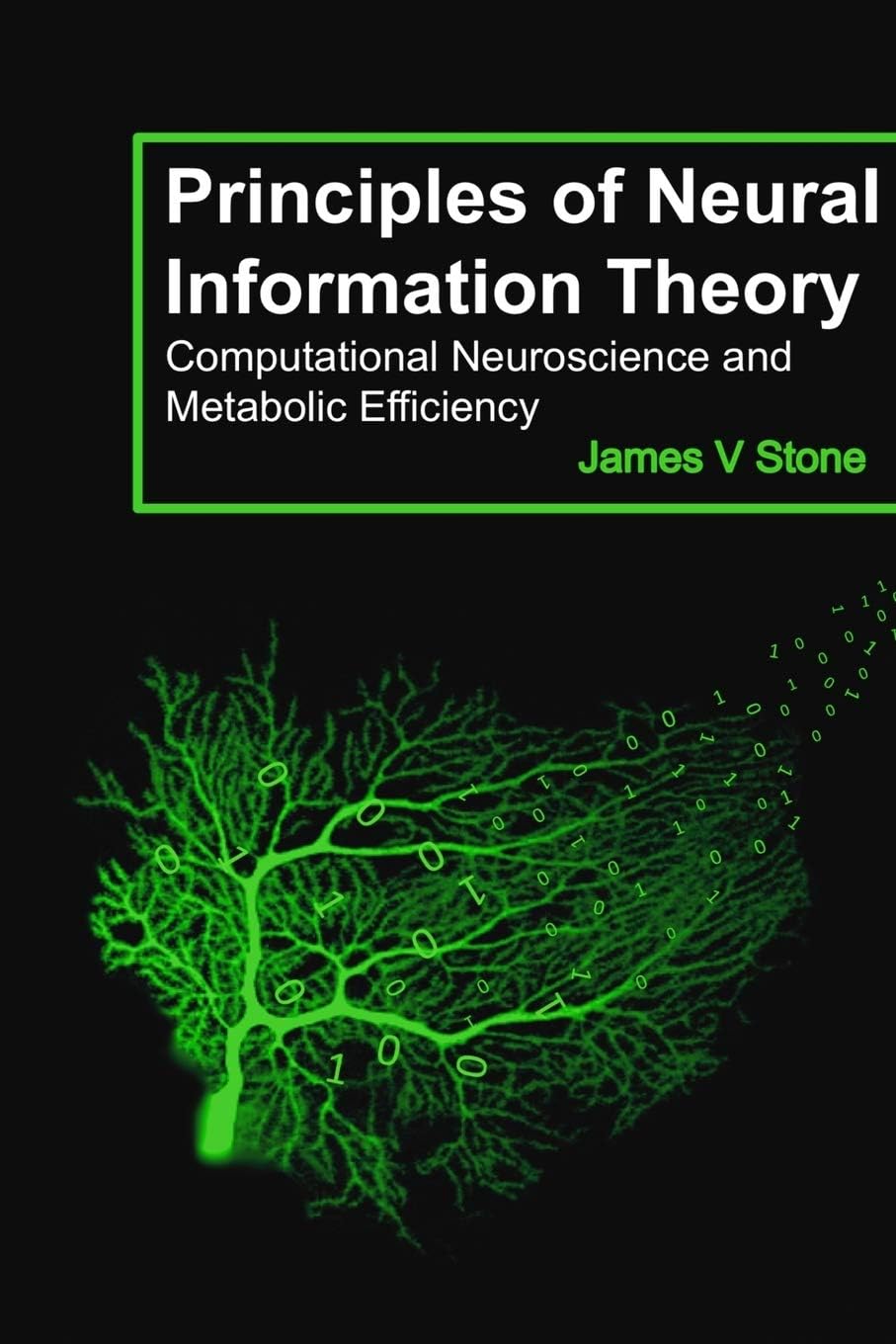
Principles of Neural Information Theory: Computational Neuroscience and Metabolic Efficiency (Tutorial Introductions)
Product ID: 70416110
Buy anything from 5,000+ international stores. One checkout price. No surprise fees. Join 2M+ shoppers on Desertcart.
Desertcart purchases this item on your behalf and handles shipping, customs, and support to Kyrgyzstan.
The brain is the most complex computational machine known to science, even though its components (neurons) are slow and unreliable compared to a laptop computer. In this richly illustrated book, Shannon's mathematical theory of information is used to explore the computational efficiency of neurons, with special reference to visual perception and the efficient coding hypothesis. Evidence from a diverse range of research papers is used to show how information theory defines absolute limits on neural processing; limits which ultimately determine the neuroanatomical microstructure of the eye and brain. Written in an informal style, with a comprehensive glossary, tutorial appendices, and a list of annotated Further Readings, this book is an ideal introduction to the principles of neural information theory. Review: Have you been paying attention? - This book, along with Principles of Neural Design, is what you gift your best rival. You gift it with a card reading, "race you to the top", even though there are a thousand avenues to further examine once every phoneme written between the two texts is devoured—that is to say finishing the books are only (the best) beginnings, and everyone finds their own pinnacle. Don’t let the pages-to-price ratio deter you, what James V Stone has done in this succinct account of exactly what the esteemed reviewers claim is worth more than entire University courses to those with an active imagination rendering each formalism, example, and accessible explanation the author elegantly synthesizes from the most prominent neuroscience-related literature of the past few generations. More, the concise argument orients the minds of those who’ve already deeply considered the literature as well as guide the approach to primary text for newcomers. This type of work defines career goals. Review: Its Information Theory applied to the human brain! - Another home run by Mr Stone. Great concepts condensed to an easy to digest format with fun examples showing how one might derive things like bits per second at the neuron level. Great fun!
| Best Sellers Rank | #673,961 in Books ( See Top 100 in Books ) #113 in Neuroscience (Books) #2,380 in Biology (Books) |
| Customer Reviews | 4.6 out of 5 stars 62 Reviews |
C**N
Have you been paying attention?
This book, along with Principles of Neural Design, is what you gift your best rival. You gift it with a card reading, "race you to the top", even though there are a thousand avenues to further examine once every phoneme written between the two texts is devoured—that is to say finishing the books are only (the best) beginnings, and everyone finds their own pinnacle. Don’t let the pages-to-price ratio deter you, what James V Stone has done in this succinct account of exactly what the esteemed reviewers claim is worth more than entire University courses to those with an active imagination rendering each formalism, example, and accessible explanation the author elegantly synthesizes from the most prominent neuroscience-related literature of the past few generations. More, the concise argument orients the minds of those who’ve already deeply considered the literature as well as guide the approach to primary text for newcomers. This type of work defines career goals.
C**.
Its Information Theory applied to the human brain!
Another home run by Mr Stone. Great concepts condensed to an easy to digest format with fun examples showing how one might derive things like bits per second at the neuron level. Great fun!
K**N
Fantastic book
This is a great introductory text. I highly recommend it for students and others interested in learning how information theory can be applied to understanding neural systems.
P**N
Clear, compact, and up-to-date
A clear, compact, and up-to-date survey of the efficient coding hypothesis and related principles of neural design. An invaluable guide to the background needed to read current primary literature. I particularly appreciated the discussion of color opponency.
C**N
Great book!
The book “Principles of Neural Information Theory” by James V Stone is written in a way that it serves as a great introduction into this topic for students as well as for senior researchers. The author uses many examples of the visual system to describe general principles of information, neural coding, computational neuroscience, and much more. Thus, this book is written for every neuroscientist concerned with these topics - and a must-read for every visual neuroscientist. Peter Sterling wrote in his comment about this book “I only wish I'd had this text as a student!”. In fact, I couldn't agree more with this statement.
A**R
Clear and well written
Clear and well written text that is accessible for many people.
Trustpilot
1 month ago
1 month ago