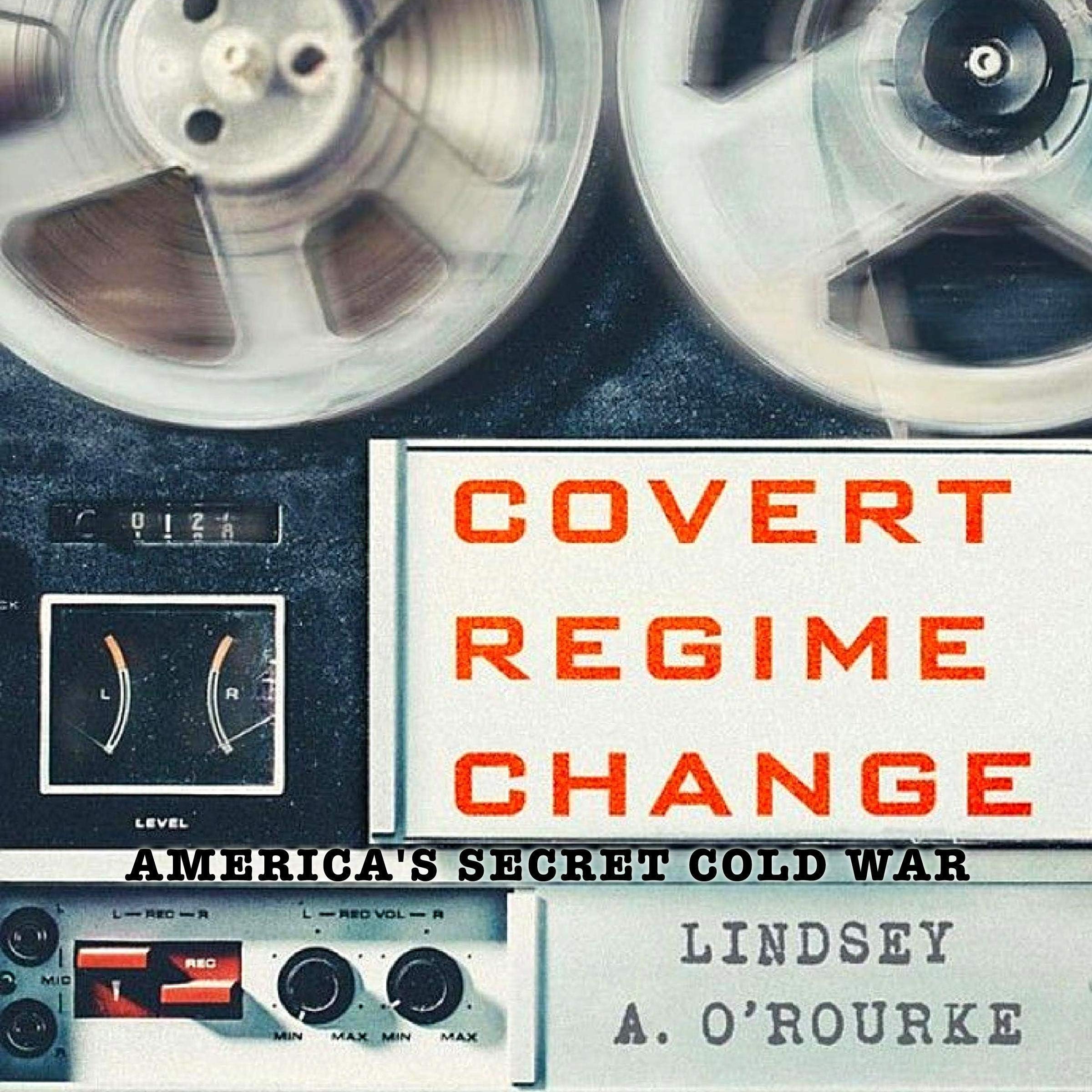
Covert Regime Change: America's Secret Cold War: Cornell Studies in Security Affairs
Product ID: 647531709
Desertcart purchases this item on your behalf and handles shipping, customs, and support to Kyrgyzstan.
States seldom resort to war to overthrow their adversaries. They are more likely to attempt to covertly change the opposing regime, by assassinating a foreign leader, sponsoring a coup d’état, meddling in a democratic election, or secretly aiding foreign dissident groups. In Covert Regime Change , Lindsey A. O’Rourke shows us how states really act when trying to overthrow another state. She argues that conventional focus on covert cases misses the basic causes of regime change. O’Rourke provides substantive evidence of types of security interests that drive states to intervene. Covert Regime Change assembles an original dataset of all American regime change operations during the Cold War. This fund of information shows the United States was 10 times more likely to try covert rather than overt regime change during the Cold War. Her dataset allows O’Rourke to address three foundational questions: What motivates states to attempt foreign regime change? Why do states prefer to conduct these operations covertly rather than overtly? How successful are such missions in achieving their foreign policy goals? The book is published by Cornell University Press. The audiobook is published by University Press Audiobooks. Review: You need to be interested in the subject - it is not a fiction! - Extremely detailed insight into how regimes are changed forcefully by using internal actors. Review: Long-winded at times, but worthwhile - A bit heavy going. Could be more concise and better structured to more effectively convey information; but saying that, I listened to the audiobook. Maybe it is easier to digest in written format.
A**U
You need to be interested in the subject - it is not a fiction!
Extremely detailed insight into how regimes are changed forcefully by using internal actors.
A**J
Long-winded at times, but worthwhile
A bit heavy going. Could be more concise and better structured to more effectively convey information; but saying that, I listened to the audiobook. Maybe it is easier to digest in written format.
W**E
Excellent study of US covert operations against other countries
Lindsey A. O’Rourke is Associate Professor of Political Science at Boston College. In this deeply researched book, she examines the US record of covert efforts at regime change between 1947 and 1989. She writes, “the United States pursued a remarkable number of regime changes during the Cold War (1947-89) and … the vast majority of these interventions were conducted covertly - sixty-four covert interventions compared to six overt ones. Twenty-five of America’s covert operations saw a US-backed government assume power, whereas the remaining thirty-nine failed to achieve that goal.” Only eight out of these sixty-four covert interventions aimed to promote a democratic revolution within an authoritarian state. In forty-four cases, the USA aided authoritarian leaders. As she notes, “America’s covert operations habitually violated norms of justified intervention: Washington installed brutal dictators. It broke international law. It collaborated with many unsavory organizations, including violent secessionist movements, authoritarian death squads, religious extremists, Mafioso, drug traffickers, and numerous groups known to have committed mass killings.” So, unsurprisingly, their effects were bad: “states targeted in a covert regime change operation appear less likely to be democratic afterward and more likely to experience civil war, adverse regime changes, or human rights abuses.” And, as she also points out, “covert conduct also allows US leaders to bypass the War Powers Act, which requires congressional approval for any deployment of US armed forces for more than sixty days.” (Wouldn’t ‘break’ be more accurate than ‘bypass’?) She points out that “the British launched the first covert operation against the Soviet Union. Indeed, despite their wartime alliance, the United Kingdom began preparing for a postwar confrontation with Moscow, before the end of hostilities, by establishing contact with anti-Soviet partisan bands in the Baltic states. … From 1945 through 1954, British intelligence maintained extensive connections with these groups, providing them with arms, intelligence, and training for penetration missions against the Soviet Union in the hopes of inciting a major rebellion.” George Kennan admitted that “The danger of war is vastly exaggerated in many quarters. The Soviet Government neither wants nor expects war in the foreseeable future.” Naturally, he did not acknowledge that he had done much to hype this war danger, particularly with his notorious ‘Long Telegram’. When the former head of Nazi military intelligence for the Eastern Front, Reinhard Gehlen, approached US army officials in May 1945, “strategic concerns trumped moral ones. Gehlen’s organization grew to include hundreds of ex-Nazis, who provided key intelligence, contacts to right-wing émigré groups throughout Eastern Europe, logistical support, and labor for America’s covert rollback missions. Over the next decade, the US government spent at least $200 million and employed around 4,000 staff to rebuild Gehlen’s organization.” In September 1948, the US government set up the Office of Policy Coordination [OPC] “to undertake the full range of covert activities incident to the conduct of secret political, psychological, and economic warfare together with preventive direct action (paramilitary activities) …” O’Rourke notes that “According to some accounts, the Marshall Plan gave 5 percent of its funds to the OPC roughly $685 million in total - to gather intelligence and covertly, fund, train and arm resistance fighters.” President Reagan set up the National Endowment for Democracy [NED] in 1983. It claims to be impartial, concerned only to assist in developing democratic procedures. Not so; she cites William Robinson: “U.S. policymakers claim that they are interested in process (free and fair elections) and not outcome (the results of these elections); in reality the principal concern is outcome.” The NED’s first director Allen Weinstein admitted, “A lot of what we do today was done covertly twenty-five years ago by the CIA.” O’Rourke observes, “While technically an NGO [Non-Governmental Organisation], the NED’s relationship with the US government is extensive: 99 percent of the NED’s total revenue comes from US governmental agencies, and the State Department must first approve of all NED grants.” She explains: “the NED’s NGO status … serves a useful purpose: it allows the NED to pursue US-government sanctioned objectives while allowing the government to distance itself from those actions and plausibly deny its role in specific NED programs.” ‘Plausibly’? Imagine the US response if a Russian or Chinese body claimed to be an NGO when its government provided 99 per cent of its funds! The USA now runs NED programs in more than ninety countries.
S**S
Well researched
Very detailed is apt for serious reading and research not a quick read
A**E
And people still believe in Democracy 😂
Just read it!
J**E
Relaciones Internacionales Geopolítica Realismo
Excelente
G**A
A importância da reestruturação da ONU na garantia do direito de autodeterminação das nações.
Uma taxonomia documentada que desperta reflexões éticas sobre os meios geopolíticos utilizados para a obtenção de fins questionáveis para a continuidade da hegemonia e a defesa dos interesses nacionais.
A**R
Really boring
This has got to rate as the most boring book I have ever had the misfortune of purchasing.
Trustpilot
2 weeks ago
2 months ago