
Buy anything from 5,000+ international stores. One checkout price. No surprise fees. Join 2M+ shoppers on Desertcart.
Desertcart purchases this item on your behalf and handles shipping, customs, and support to Kyrgyzstan.
📖 Read, Reflect, Revolutionize!
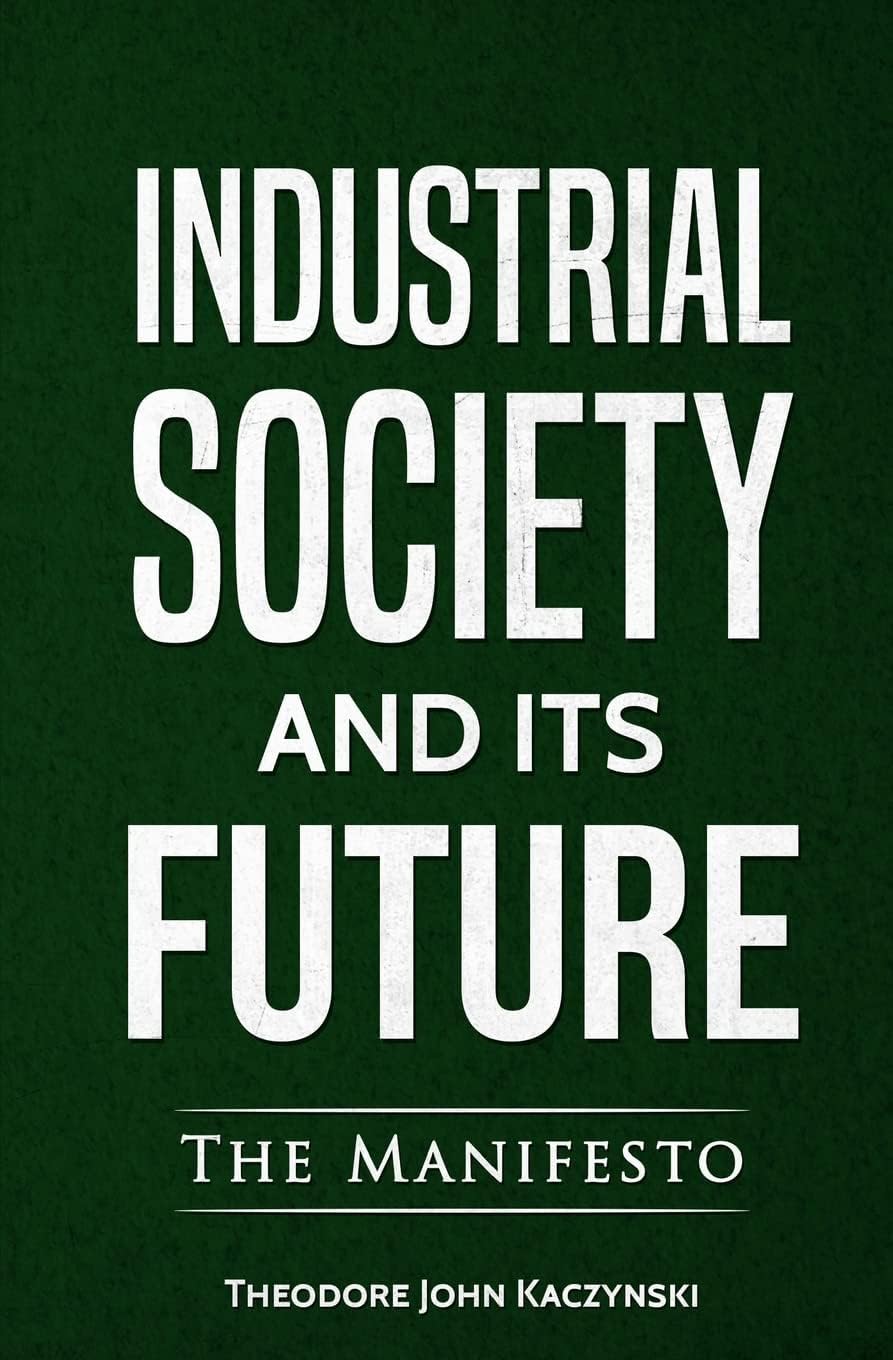
Industrial Society and Its Future is a provocative manifesto that critiques modern technological society, exploring its effects on human freedom and social structures. With over 300 pages of insightful essays, this work challenges readers to rethink their relationship with technology and its implications for the future.
| Best Sellers Rank | #1,335,433 in Books ( See Top 100 in Books ) #1 in Anarchism #698 in Social Aspects of Technology #1,036 in Terrorism (Books) |
| Customer Reviews | 4.7 out of 5 stars 2,791 Reviews |
R**Y
Ted was right..
ted makes alot of very good points in this book. he touches on many subjects, but maintains that this isn't a political revolution but a revolution against the tech industry as a whole. he talks about the dangers of leftism and the like. It's hard to tell what his political leanings are. As i read the book, it seemed to me he was constantly going after the left, whereas only one area (maybe 4 lines), declaring "conservatives are fools". Ted argues that urban living, (cities) and environmental destruction negatively impacts humans, and makes us more stressed/depressed etc. amazing that this book was written over 30 years ago, and the ideas in the book, (he even talks about AI, (by the way it's something i detest). it's just amazing that he could basically see so far into the future. I have a feeling he was very brilliant, and just had enough of society, that he wanted to retreat and be left alone in his cabin. sad, because he could have done so much and went far. he actually skipped two grades in school, and was enrolled at Harvard at age 16.
K**E
You should buy this
Super duper cool and amazing :3
M**O
Very Interesting book - A look into Ted Kaczynski mind.
A very good read if you want insight on the mind of Ted Kaczynski. Without spoiling this book, you hear alot about his opinion on the world, and what he thinks its future will be. His opinion on American politics on both the left and right, and his opinion and beliefs on different aspects of the government and what he thinks the outcome to his opinions will be. If you like history and like understanding or getting to know the mind of people (Ted Kaczynski in this case), this is a book I would recommend!
A**R
Brilliant
You can tell the author had an IQ of 160. I was impressed with the clarity of thought and how accessible the writing is- and how forward thinking he was. This was written in the 90s and so much of what he wrote about has come to pass. As to all the reviewers who wrote that Kaczynski had good points “BUT”: check out the reviews for Marx’s Communist Manifesto. How many people are over there are saying that Marx had really good ideas “but”? The Communists were responsible for the deaths of untold millions of people- Stalin, Pol Pot, Mao. Nobody makes excuses for THEM. They shrug it off with “If you want to make an omelet, you need to break some eggs.” Kaczynski was right. The Internet Age in collaboration with Big Pharma and Corporate America has done a lot of damage to our society- they have eroded our freedoms and our privacy. It’s an awesome book. Two thumbs up.
B**R
We miss you Teddy
Excellent read. Had to get it in paperback. He truly was ahead of his time. Many of the problems he outlined have only worsened over years and become even more obvious.
W**E
The Unabomber Revisited
I first picked up the Unabomber’s Manifesto in 2001 at the Anarchist’s Bookstore on Haight Street in San Francisco. I was immediately put off by the author’s assertion that “Leftists” were to blame for society’s ills. I’d been fascinated by the story of Ted Kaczynski because dropping out of society and hiding in a shack in the woods appealed to me, but after reading a few pages, I wrote him off as a right-wing nut who lost the plot and got sick in the head. And, of course, what Kaczynski did was gruesome and abhorrent. I don’t mean to condone it at all. But, 24-years later, I now see that I should have kept on reading the manifesto. By “Leftists,” Kaczynski means neoliberal apologists of every political stripe. In other words, people who believe that technology-driven global capitalism will eventually accomplish every sort of collective goal and address every need, progressive or materialistic, but often both. If Kaczynski were alive today, he would be appalled to see that people now believe that productivist capitalism will inevitably produce technology that will clean up the trail of destruction that it has created, as if the processes of consumption and excretion might be magically reversed by the “free market.” Techno-futurism, they call it. Kaczynski thinks and writes like an engineer. The upside of this is that his precise and rigorous analysis led him to an array of conclusions that, I believe, were ahead of their time. He’s not an historian, but he reversed engineered the present and discovered the main themes in the last 500 years of socio-political evolution: increased collectivism and control, large-scale psychological manipulation, and an increasingly unsustainable use of resources. He sees that our ballooning, technology-enabled existence is out of step with our evolutionary skills and threatens our existence in the near term. The elegant solution: Instead of fighting over politics at the eleventh hour, simply remove the technology that made it all possible. The downside of Kaczynski’s writing style is that he often fails to define his terms or only remembers to define them later. For instant, he finally struggles with the term “Leftists” at the end. He talks about technology for 200 paragraphs before he admits there are different categories of technology. He also often slides between statements that reflect generally known scholarship and personal observation that reflect present-day culture and not a deep understanding of his topic. He leaves many vital topics unexplored in the race to get to his conclusions. Nonetheless, his carefulness is surprising and makes the work worth reading. He admits, for example, that a pro-nature, anti-technology revolution will not work unless it comes in parity with a disaster or a clear breakdown in the system of global production. He also admits that a revolution that aims to replace the current leadership is undesirable. He wants people to go back to living in - and he puts in caps - SMALL GROUPS. I agree that would be preferable. I’m afraid most of us won’t get to stick around and see that though.
S**U
Organizational-dependent technology strips man of autonomy, freedom, and self-reliance.
I've recently read Ted Kaczynski's manifesto in full. The main argument about how leftism bolsters the technological-industrial order was well-defended. Leftism stems from feelings of inferiority and "oversocialization", which refers to excessively following societal norms and feeling guilt over minor transgressions. Ted also established his most kernel claim of the "power process", which encompasses the autonomous goal-oriented processes central to human nature (e.g., hunting, farming, etc.); however, after industrialization, man has disrupted the power process with surrogate activities such as highly specialized scientific endeavors, mass media, and so on, and this led to great lack of fulfillment, higher prevalence of mental illness, and loss of connection with nature. Leftists see themselves as rebels, but they are in fact the biggest supports of the technological-industrial system due to treating their "activism" as a "surrogate activity" in their power process, and feminism and minority rights are merely pretexts for their insatiable totalitarian drive for power, always inventing new problems, which merely strengthens the industrial order with greater loss of autonomy. Ted draws a distinction between small-scale technology and organization dependent technology, and the main distinction lies in that the latter requires a massively interconnected technological system to sustain. For example, any individual can learn to create a bronze shovel, but you need an industrial system to create a refrigerator due to the manufactured parts necessary. Ted also spends much time analyzing how prior to industrialization, man's life was oriented to fulfill the power process (e.g., cattle herder, farmer, etc. bringing food to table), but industrialization led to disruption of the power process, stripping man of his autonomy, by forcing him to become "educated" in supporting the interconnected industrial system. The system will never accommodate itself to man, and man has to change himself to accommodate the system. This is a concerning thought because we are heading in the direction of genetic engineering of human beings. In short, organization-dependent technology have led to these immense issues: breakdown of local communities, loss of autonomy, overcrowding, loss of privacy, lack of fulfillment, future genetic engineering, and so on. I have only given a rough summary.
D**C
A letter from a cabin in Montana
Who speaks for the wolf? Freedom.
Trustpilot
2 weeks ago
1 month ago