Buy anything from 5,000+ international stores. One checkout price. No surprise fees. Join 2M+ shoppers on Desertcart.
Desertcart purchases this item on your behalf and handles shipping, customs, and support to Kyrgyzstan.
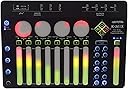
๐ถ Elevate Your Sound Game with K-Mix!
The Keith McMillen K-737 K-Mix Audio Interface/Mixer is a cutting-edge USB-powered audio interface and programmable mixer designed for professionals and enthusiasts alike. With its ยตPre preamps, it delivers exceptional audio quality, while its robust control surface ensures durability and ease of use. Compatible with both Mac and Windows, the K-Mix offers flexible routing and per-channel DSP, making it an ideal choice for studio, stage, and band environments.
| ASIN | B015XIHBP0 |
| Audio Input | USB |
| Best Sellers Rank | 72,444 in Musical Instruments & DJ ( See Top 100 in Musical Instruments & DJ ) 280 in MIDI Controller |
| Brand Name | Keith McMillen |
| Connectivity Technology | 1/4 jack, Auxiliary, Mini USB, USB Micro-B, XLR |
| Customer Reviews | 3.8 3.8 out of 5 stars (152) |
| Global Trade Identification Number | 00013964759488 |
| Included Components | International USB power suply, K-Mixer, Quick start guide, USB A to Mini USB cable, USB A to USB Micro-B cable |
| Item Type Name | K-Mix |
| Item Weight | 726 g |
| Manufacturer | Keith McMillen |
| Manufacturer Part Number | 01-90009 |
| Model Number | K-737 |
| Number of Channels | 8 |
| Output Connector Type | USB |
| Power Source | USB Powered |
| Product Warranty | 2 year manufacturer. |
| UPC | 642892801305 013964759488 |
| Unit Count | 1.0 count |
S**N
Excellent Product for my needs - Session Drummer 3 in Sonar X2
Arrived very quickly, excellent price, very high quality and beautifully functional. Downloaded editor and set up patch 60 to drive 8 MIDI drum patterns in Sonar's Session Drummer 3. A little bit confusing over note numbers. Working brilliantly using front 8 switches. Will use 5 rear switches for individual drums. Unit can do much more than this! Robust, compact, clear bright lights on switches. Extremely pleased. Obviously a product like this is for particular needs, so advise researching and making sure you know how you would use it. There are alteratives, but I have separate expression pedals, so this complemented them well.
A**O
A device straight from Star Trek
I always imagined a mixer where the channel faders were actually the LED VU meters themselves but until the KMix this was just an idea straight out of science fiction. This is one of those rare devices that works exactly how you hoped it would. Although Windows support was a bit delayed after its initial release, it is rock solid under Windows 10 as an 8 input, 10 output audio interface and you can set buffering to permit fairly low latencies, around 5-6ms on a not-particularly powerful laptop, playing instruments through Reaper. I've had this unit about 3 years now I think and it has never ever malfunctioned in any way. It was a thoughtful touch that the headphone output is configurable as a separate stereo pair of outs, which makes this perfect in a home studio. It's also the first audio interface I've had - of several over the years - where noise due to ground loops is completely absent, the preamps are very quiet. As a bonus, it also acts as a control surface, which means that within Reaper I can control mute, solo, channel gain, pan, transport and scrubbing as well as switch between plugins directly from the KMix. The control surface plugin for Reaper is completely free (search kmix reaper to find it). You can just switch between control surface mode and mixer mode from the unit front panel, which is very handy. The only very minor negatives I could raise would be that the button legends are quite small though of course backlit and that the preamps could benefit from a switchable attenuator for very hot signals, but that's nitpicking since obviously you can just plug an inline pad into a channel in that situation. It would also be great if KMI ever produce a version where all 8 input channels can handle mic and line inputs, at present you have two mic/line channels and the rest at line level, but this is pretty much the case for most audio interfaces anyway, and you can always hook up an external preamp if you needed more mic-level channels. The mixer is very capable, with inline parametric EQ, noise gate and compressor on every channel, and they work extremely well. Also it supports multiple switchable 'scenes' so you can save an entire setup and recall it at the touch of a button - the sort of thing only available otherwise on high-end digital mixers. There is nothing quite like this unit on the market and considering that an audio interface with this number of ins and outs is already getting close to the price of the KMix, given you also get a decent mixer and control surface included, in something the size of a paperback book, with no moving parts, hence, rugged and reliable - well, what's not to like. One of those rare products that I have not been disappointed with in any way.
A**X
Unreliable USB, unreliable sliders, what a shame ...
I'd always wanted one of these, but what a disappointment. I'm gonna keep this short, but basically I sent it back and got a refund. The faders are rubbish; you have to press really hard to get them to move and are totally imprecise; also one of the faders wouldn't got to zero unless you gave it a really hard thumb push; totally unreliable. The USB connection would work sometimes; not others; so just couldn't rely on that either. The pads are multi-touch; but not simultaneously; so you cannot use this as a proper Ableton launchpad. I could go on. Personally, I think KMI should have had a new edition out a long time ago which fixed a lot of these problems. Also note that KMI sell reconditioned units for under half price. I see these are 'out of stock' now. So, gutted about the product, but happy with the way KMI and Amazon dealt with the refund!
A**R
Excellent, compact and very flexible.
Great mixer, plenty of inputs and midi.
S**0
Can't connect to midi without paying more for the midi expander
Not fit for purpose. In order to connect to a midi synth, you need to pay an extra 55 or so quid for the 'midi expander'.
R**F
5 years of constant use. Various issues. Could have been great.
I have owned mine for nearly 5 years after buying it at release. It has been on nearly every day and often overnight for this entire time. The Good: Its small, the desktop software for it is simply brilliant and very easy to use to see where to route sends, adjust gain, fiddle with compressors and reverb etc. I never have problems getting signal in and the right wet/dry mix sent out to pedal effects etc. Can't fault reliability after nearly 5 years apart from I once dropped some heavy headphones and that was enough to break the front headphone socket where a light piece of plastic inside snapped, so I can no longer push headphones in but I actually don't use the socket now. For a few years they kept firmware and software updates coming which was good, however for a mixer and audio interface there was not much of a reason to update. Having used other audio interfaces I don't think I have ever found an admin desktop config tool as good as the K-Mix one. Very clean and simple to access the detail. Other efforts from companies like focusrite are not as easy to follow. The Bad: It is not capable of being an audio interface without some clever work on ground loops and related buzzing issues. I only use it as a non-computer connected mixer because everything I tried when connecting it to the USB of 3 different Mac's I have owned in the last 5 years has resulted in buzzing feedback. I put this down to it not having a dedicated power supply and when it draws power on the USB hub from the computer you get heavy buzz. Its OK connected to a mains USB type socket with sharp clarity and no hum, so I then feed its output into a Focusrite USB audio interface. In many ways this non-computer attached way of working with it has suited me anyway, but it's annoying to have to re-connect it to adjust menu settings. The rubber sliders promise a lot but they are fiddly to squish and use. Small really sliders would have been so much better, perhaps with the lighting along the edge of the sliders. However, I don't think the rubber ones are that bad, I did manage some live recording and using them to bring in drums etc and they did OK if pushed hard enough. The rubber coating over all of the case is corroding and getting sticky in the last year. From 2014 to 2016 lots of midi/synth tech companies started coating everything with a rubber-like paint. I have several of these and the rubber is now breaking down and getting oily and sticky. This K-Mix frankly look rubbish and dusty within a few months because you can't clean them. Whoever thought it was a good idea to rubberise synth and midi kit was not thinking straight because they get dirty and corrode. My K-mix feels like it has been placed next to a food mixer and sprayed with sticky oil. I let it get dusty because the dust takes away some of the sticky feel but it looks rubbish now which is a real shame. What V2 needs to be: Some real sliders or better working rubber ones that are smoother to use. Independant mains transformer power and not USB 4 sends rather than 3. A couple of mini 3.5mm inputs to cater for kit like Volca's or other small synths. USB C type connection for the audio interface. Stronger headphone socket. Some rotary dials for volume. Don't coat it in rubber material. So just a plain easy to clean plastic box would be ideal. Make it even smaller.
D**T
Pedaliera midi insostituibile. Massima versatilitร .
R**T
La housse ne dure pas bien longtemps. Il faut s'en faire une plus rรฉsistante soi-mรชme ce qui est un peu dommage.
M**V
I never write reviews but this one deserves it. I bought this for OBS to change scenes and control chrome/acrobat/logic at the same time while playing guitar. I tried first with midi commander, but it froze all the time, and only offered 8 buttons per bank. This has FORTY possible foot switch options per bank, and they are silent! Iโve never seen anything like it before. The recordings I did with the other pedal are almost ruined because of the noise it made switching scenes. The ease, speed and dexterity this allows in navigating was well beyond my expectations, I can feel exactly where am without looking, and without making mistakes. The possibilities this has opened up for me with streaming/recording are huge. As for the reviews about it being so hard to program, I took an hour to read the manual and had it done within the next. Downsides, expensive and was long to arrive, but when it did it was like Christmas. Recommended.
F**Y
Why so few reviews? It's probably because people hate to "close", as I do. First the good news. This is the most versatile and original set of pads you can imagine, it's not locked in to one DAW or setup. Now the bad news: same thing. It's not locked in, so you have to map it. There are some good presets for a handful of programs, like two for Live, and for Tractor and for Logic, and Reason, and drum pad mode, and you fill in the details. It can output one or 4 note-ons with velocity (one per corner) for each of 16 pads, and map pressure to a selectable MIDI Continuous Controller (CC) in each corner (grid mode), or (in Drum Mode) map two CCs in x-y mode across the pad, and a single CC for pressure. Each pad can be either in Grid or Drum Mode. They light up automatically in colors, or you can send MIDI messages to directly control the lights. The various sliders and rotaries add a lot of possible CC messages you can choose(with the included editor), and some of the surfaces can be assigned multiple banks. That all together is a preset. There are 16 preset memories, and the editor can save/load them to disk. There are options like "return CC value to zero" or "stay where released" for each sensor, and thresholds, sensitivity, ceilings, all the good stuff. It's really something, a something you have to integrate with your setup, and the bad news is that it takes creative planning and then using their minimalistic and confusing editor to set it all up. Some people complain that there aren't enough ready-to-go configs. Others complain that the company has not released enough of the interface specs so they could control the Quneo from their own programs and scripts. For the Quneo to be easy to integrate would require that the company put as much brainpower into the editor as they put into the hardware. And that hasn't happened. But here's the bottom line. You can spend close to a hundred bucks for just a lightweight toy pad-thing with velocity sensing. ALL pads react to "touch" that way. But the Quneo also reacts to pressure, in so many clever ways. I use it mostly for percussive sounds in drum mode, 16 pads in a bank, with note+velocity on the hit, then pressure ("aftertouch") emits MIDI CC 11 (Expression), and the X-Y raises mod wheel values when I roll my finger up, and "foot controller" (MIDI CC 4) when I roll my finger to the right, and drop them both to 0 when I release. I use the sliders to control volume on 4 MIDI channels, and the big horizontal slider to control Pan. One of the round pads I use as a sustain (CC 64) "pedal". This is a very simple setup, copy-pasted from pad to pad, but it's very useful. The point is this: you can make the Quneo do a LOT more than that (they are also coming out with new firmware soon). But given that it costs only a hundred bucks more than a toy pad-thing, and is cheaper than a serious set of pads, I think that even if you do nothing more than the above with it, and even if the company isn't exactly on the front line of customer service, and even though the little micro-USB jack is ridiculous, you'll have a good thing. The pads' response is very programmable, they really feel great, the Quneo itself is very sturdy (see Beer and 2 story drop test on YouTube). You'll find all sorts of uses for it. One thing I don't believe is practical is to expect the Quneo to replace a Mackie Control type fader array. If you already have faders, continue to use them, the Quneo is for different purposes, like clip launching, being a tactile modeling clay type interface for a softsynth, controlling just a few specialized mixer parameters, etc. As to the micro-USB jack, get a couple of better cables, and, preferably before one breaks off, attach a small plate, say 1" by 1/2", to the bottom of the Quneo sticking out under the plug so it can't be wiggled or snapped off when you put it down on an uneven surface. Then it's fine. It's a great little unit that opens up a lot of possibilities. It's like our brains, they say, even at 1/100th of potential are OK. It doesn't have to be plug-and-play for EVERYTHING immediately.
G**N
The 12 Step Chromatic Keyboard Foot Controller is a modern take on MIDI "bass pedal" synths such as the venerable Moog Taurus and it's offspring such as the Korg MPK-130, Roland PK5 (or 6 or others). Companies like Elka (a glorious analog synth vendor from back in the day) and Studiologic also have some competive products of this variety. The 12 Step differs in many respects. Chiefly it is far smaller. Rather than keys, rubberized, lighted soft pedals are configured in the same arrangement as one octave of a well-tempered piano. It would be one thing if the 12 Step simply played in a chromatic scale, but here the beauty of this unit is evident. The 12 step features tons of presets giving capabiilites such as diatonic 3rds, 4ths,, 5ths, and extended intervals like 9ths. This means that one key pressed plays one note plus the harmony set by the user. Diatonic triads are also available, not to mention a slew of other settings like legato, polyphonic etc. Furthermore, each key has after-touch capability, bending, pitch shifting and a variety of change controls. The unit is powered over USB, meaning only a laptop is required. For want of a laptop, a powered hub or KMI's MIDI Expander with USB wall wart are available. The Set List of presets (and there are hundreds) can be programmed (along with any firmware updates) by the free 12 Step utility for Windows or Mac OS. Having owned and used both Korg MPK-130 and Roland PK5, I can say honestly that this small unit is an upgrade. Though small in size, the keys are comfortable to access. The back-lighting is a very good feature, meaning no more fluorescent tape a-la Geddy Lee and Alex Lifeson. It is made out durable polymer and should be quite resilient. I have successful used it to trigger soft synths in Cubase and Ableton Live, plus standalone synths like SampleTank or Korg M1. It's great for iOS Synths like Nave, Sunrizer or Korg Module (I used a Focusrite iTrack Dock for power and connectivity). With the optional KMI Expander I am able to control the Korg Krome 88 and trigger not only notes but any RPPR sequences. There are even presets for Ableton Live clip launching. I can attest that KMI's customer service is spot-on, delivering friendly personal responses to any of my inquiries. All in all this is fast becoming my secret weapon and I highly recommend it.
Trustpilot
3 weeks ago
1 month ago