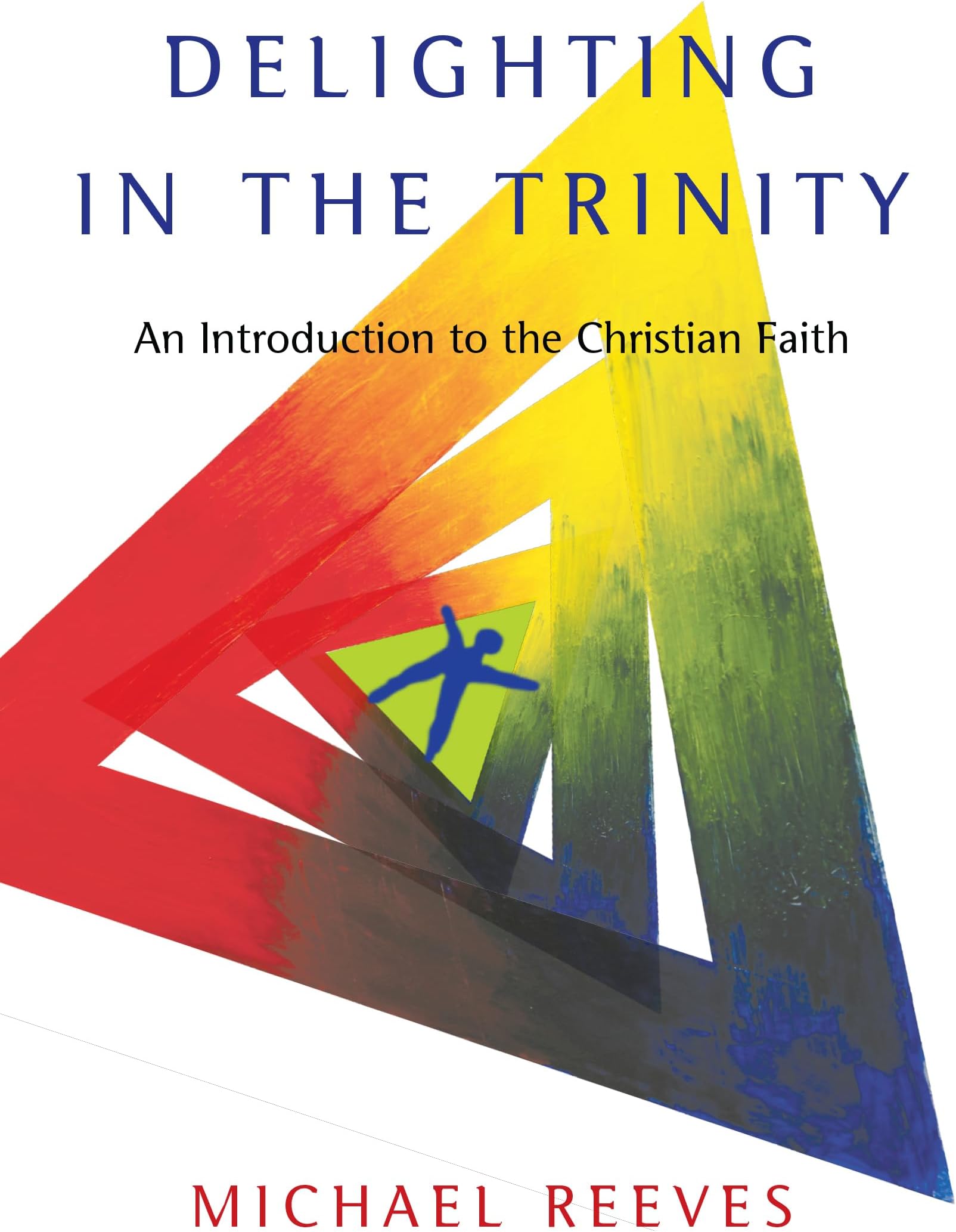
Delighting in the Trinity: An Introduction to the Christian Faith
Product ID: 5906071
Buy anything from 5,000+ international stores. One checkout price. No surprise fees. Join 2M+ shoppers on Desertcart.
Desertcart purchases this item on your behalf and handles shipping, customs, and support to Kyrgyzstan.
Delighting in the Trinity: An Introduction to the Christian Faith [Reeves, Michael] on desertcart.com. *FREE* shipping on qualifying offers. Delighting in the Trinity: An Introduction to the Christian Faith Review: Delighting in the Trinity: An Introduction to the Christian Faith - Delighting in the Trinity: An Introduction to the Christian Faith IVP Academic 2012 By Michael Reeves Reviewed by Jack Kettler Bio: Michael Reeves, (PhD, King's College) is an author, theologian, historian and professor who teaches at Wales Evangelical School of Theology (WEST) and is the director of Union, a WEST initiative that puts the theological academy back in the local church context. He previously served as theological adviser for the Universities and Colleges Christian Fellowship in the United Kingdom where he oversaw the Theology Network, a theological resources website. He was also associate minister at All Souls Church, Langham Place. Reeves is the author of books such as Delighting in the Trinity, The Unquenchable Flame, Discovering the Heart of the Reformation, The Breeze of the Centuries, On Giants Shoulders and The Good God. What others are saying: “Even many Christians find the Trinity confusing, but Delighting in the Trinity is the clearest and best written explanation I've ever read.” (Marvin Olasky, World Magazine, June 29, 2013) “Michael Reeves's Delighting in the Trinity is an enjoyable introduction to the doctrine of the Trinity. . . . [It's] a great read. . . . This book would be useful for working with non-Christians seeking to understand Christianity. It would also serve the Christian who wants a better understanding of why the Trinity was not the invention of 'bored monks on rainy afternoons.'” (New Horizons, April 2013) “Michael Reeves . . . has produced a powerful and concise treatment of the trinity in Delighting in the Trinity. One of the strengths of this volume is its practicality and accessiblity. One of the most exciting aspects of this book is Reeves' skill in helping readers understand what it means to enjoy God and understand the doctrine of the trinity to be a demonstration of 'the beauty, the overflowing kindness, the heart-grabbing loveliness of God.'" (R. Albert Mohler Jr., Preaching, March/April 2013) “It's not often one reads a book on trinitarian theology that is deeply insightful and wonderfully witty at the same time, but this is such a volume. Filled with careful thought and wise application, Reeves provides a most accessible book for those who are trying to understand what difference it makes that we are trinitarian.” (Kelly M. Kapic, Covenant College) “The Trinity is often regarded as an esoteric and intimidating doctrine, over the heads of rank-and-file Christians. What are laypeople and students to make of the theologians' unfathomable utterances about how the Father, Son and Spirit constitute one God? The answer: Start by reading this book. Michael Reeves unpacks the significance of the Trinity for Christian life with a straight-shooting, conversational style honed by years of student ministry. But don't let the panache fool you. There is substance here that outweighs that of books much harder to understand. Read this book. Look up all the Bible passages it quotes. Let the Spirit use it to help you to see the Scriptures―and most of all, to see God the Trinity―in a new way. I cannot recommend it highly enough.” (Donald Fairbairn, Robert E. Cooley Professor of Early Christianity, Gordon-Conwell Theological Seminary, and author of Life in the Trinity) My Thoughts: First off, this is how the introduction and chapter layout look: Chapter layout Introduction: Here Be Dragons? 1. What Was God Doing Before Creation? 2. Creation: The Father’s Love Overflows 3. Salvation: The Son Shares What Is His 4. The Christian Life: The Spirit Beautifies 5. “Who Among the Gods Is Like You, O Lord? Conclusion: No Other Choice To start, this work is nothing short of extraordinary! It is has both a devotional aspect and powerful apologetic combined! The apologetic value of the book for Muslims and Arians is enormous. From the Introduction we read: “You see it in the Bible, where the Lord God of Israel, Baal, Dagon, Molech and Artemis are completely different. Or take, for example, how the Qur’an explicitly and sharply distinguishes Allah from the God described by Jesus: “Say not ‘Trinity.’ Desist; it will be better for you: for God is one God. Glory be to Him: (far exalted is He) above having a son.” (Surah 4.1710). “Say: ‘He, Allah, is One. Allah is He on Whom all depend. He begets not, nor is He begotten. And none is like Him.’” (Surah 112). “In other words, Allah is a single-person God. In no sense is he a Father (“he begets not”), and in no sense does he have a Son (“nor is he begotten”). He is one person, and not three. Allah, then, is an utterly different sort of being to the God who is Father, Son and Spirit. And it is not just incompatibly different numbers we are dealing with here: that difference, as we will see, is going to mean that Allah exists and functions in a completely different way from the Father, Son and Spirit. All that being the case, it would be madness to settle for any presupposed idea of God. Without being specific about which God is God, which God will we worship? Which God will we ever call others to worship? Given all the different preconceptions people have about “God,” it simply will not do for us to speak abstractly about some general “God.” And where would doing so leave us? If we content ourselves with being mere monotheists, and speak of God only in terms so vague they could apply to Allah as much as the Trinity, then we will never enjoy or share what is so fundamentally and delightfully different about Christianity.” (pp. 17, 18 introduction) This short selection from the introduction is amplified and the implications developed and expanded many times over throughout the book. For example, consider some more gems from this book in the next three quotes: “Just so, the Father would not be the Father without his Son (whom he loves through the Spirit). And the Son would not be the Son without his Father. He has his very being from the Father. And so we see that the Father, Son and Spirit, while distinct persons, are absolutely inseparable from each other. Not confused, but undividable. They are who they are together. They always are together, and thus they always work together. That means that the Father is not “more” God than the Son or the Spirit, as if he had once existed or could exist without them. His very identity and being is about giving out his own fullness to the Son. He is inseparable from him. It also means there is no “God” behind and before Father, Son and Spirit.” (34) “Therein lies the problem: how can a solitary God be eternally and essentially loving when love involves loving another? In the fourth century B.C., the Athenian philosopher Aristotle wrestled with a very similar question: how can God be eternally and essentially good when goodness involves being good to another? His answer was that God is, eternally, the uncaused cause. That is who God is. Therefore he must eternally cause the creation to exist, meaning that the universe is eternal. This way God can be truly and eternally good, for the universe eternally exists alongside him and eternally he gives his goodness to it. In other words, God is eternally self-giving and good because he is eternally self-giving and good to the universe. It was, as always with Aristotle, ingenious. However, once again it means that for God to be himself, he needs the world. He is, essentially, dependent on it to be who he is. And, even though technically “good,” Aristotle’s god is hardly kind or loving. He does not freely choose to create a world that he might bless; it is more that the universe just oozes out of hi.” (40-41) “The seventeenth-century Puritan theologian John Owen wrote that the Father’s love for the Son is “the fountain and prototype of all love. . . . And all love in the creation was introduced from this fountain, to give a shadow and resemblance of it.” Indeed, in the triune God is the love behind all love, the life behind all life, the music behind all music, the beauty behind all beauty and the joy behind all joy. In other words, in the triune God is a God we can heartily enjoy—and enjoy in and through his creation.” (62) In closing: From the final chapter: “Who Among the Gods Is Like You, O Lord?” “For the last two hundred years or so, atheism in the West has been marching forward with ever more confidence and power. Its cries have not only heartened the person on the street who would simply rather do without God and religion; they have also inspired a new, ultra-aggressive squad of “antitheists.” (109) This final chapter along with Reeves’ closing comments are extremely valuable in dealing with atheistic mistaken beliefs about the triune God. Bibliophiles, this book is for you. Review: A Delightful Read - I don't know Michael Reeves, but I picture him as outgoing, personable, and winsome - a gift of grace to us. He wants this book to be “about growing in our enjoyment of God and seeing how God's triune being makes all his ways beautiful. It is a chance to taste and see that the Lord is good, to have your heart won and yourself refreshed” (p. 9), which, of course, are great goals. Towards this end, he writes with a wider audience in mind than theologians like Barth or Volf, but Reeves's gifts are properly suited to his task at hand, and he’s able to make the thoughts of these major theologians digestible to the common person. He approaches his goal, as a scholar, teacher, and historian; however, he writes Delighting in the Trinity primarily a preacher and exhorter, attacking his thesis from every angle, and repeatedly so. He’s sometimes brilliant, witty and humorous, and able to take complex concepts and bring them into every day life, igniting the reader's soul in the process towards living for Christ. All these things are the sign a good teacher and preacher. Further, this book's concepts would be easily digestible by many Christians, hungry enough to learn about the Trinity, and contains ideas that are foundational to the faith of all Christians, hence the subtitle: an Introduction to the Christian Faith. His mystical, relational, Spirit filled Christian life may be foreign to some, but his thoughts in this area are refreshing, balanced, and properly nuanced and not often enough written about by those within his stream of theology. I did find him, at times, however, to be a bit too pedantic, dry, or basic. But, he really worked hard not to be so and my “lethargic moments” in the book may have been due to having read similar thoughts before or that time I read this book after a long day and a full meal. The book would have been better with an index, but having to reread a few sections over again, when in search of a recently read point, wasn’t so bad. This pastor can easily recommend M. Reeves’s book; it would especially be a helpful for you, if you: • Desire an introduction to Trinitarian theology. • Delight in Jonathan Edwards, Religious Affections, etc. but are uncomfortable with the over arching tones of the sermon “Sinners in the Hands of an Angry God.” • Want another reason for going to the mission field, other than God is sending heathen to Hell, unless I do something. • Are a preacher, whose sermons are stuck on do, do some more, and then do it again. • Are a believer, who needs to be reminded that God is working to complete his love in you and won’t quit until you are fully in his arms. Reeves, takes several of the heroes of Reformed theology – Calvin, Edwards, Spurgeon et al – and quotes from their works but consistently declares throughout the entire book: “God's innermost being (hypostatis) is an outgoing, loving, life-giving being … He is not a God who hoards his life, but one who gives it away, as he would show in that supreme moment of his self-revelation on the cross.” (45) If sin is “love turned in on itself,” then God is entirely other than this characteristic; he’s the One whom love of the other is central to his being, an eternal self-existent love that was before creation and intrinsically part of the Triune relationship of Father, Son, and Holy Spirit. “The only thing that counts is faith expressing itself through love. "God is love. Whoever lives in love lives in God, and God in him.” (Gal 5:6; 1 John 4:16)



| Best Sellers Rank | #6,329 in Books ( See Top 100 in Books ) #4 in Christian Systematic Theology (Books) #31 in Christian Church History (Books) #190 in Christian Spiritual Growth (Books) |
| Customer Reviews | 4.8 4.8 out of 5 stars (2,449) |
| Dimensions | 5.5 x 0.5 x 8.25 inches |
| ISBN-10 | 0830839836 |
| ISBN-13 | 978-0830839834 |
| Item Weight | 7.2 ounces |
| Language | English |
| Print length | 135 pages |
| Publication date | July 18, 2012 |
| Publisher | IVP Academic |
J**R
Delighting in the Trinity: An Introduction to the Christian Faith
Delighting in the Trinity: An Introduction to the Christian Faith IVP Academic 2012 By Michael Reeves Reviewed by Jack Kettler Bio: Michael Reeves, (PhD, King's College) is an author, theologian, historian and professor who teaches at Wales Evangelical School of Theology (WEST) and is the director of Union, a WEST initiative that puts the theological academy back in the local church context. He previously served as theological adviser for the Universities and Colleges Christian Fellowship in the United Kingdom where he oversaw the Theology Network, a theological resources website. He was also associate minister at All Souls Church, Langham Place. Reeves is the author of books such as Delighting in the Trinity, The Unquenchable Flame, Discovering the Heart of the Reformation, The Breeze of the Centuries, On Giants Shoulders and The Good God. What others are saying: “Even many Christians find the Trinity confusing, but Delighting in the Trinity is the clearest and best written explanation I've ever read.” (Marvin Olasky, World Magazine, June 29, 2013) “Michael Reeves's Delighting in the Trinity is an enjoyable introduction to the doctrine of the Trinity. . . . [It's] a great read. . . . This book would be useful for working with non-Christians seeking to understand Christianity. It would also serve the Christian who wants a better understanding of why the Trinity was not the invention of 'bored monks on rainy afternoons.'” (New Horizons, April 2013) “Michael Reeves . . . has produced a powerful and concise treatment of the trinity in Delighting in the Trinity. One of the strengths of this volume is its practicality and accessiblity. One of the most exciting aspects of this book is Reeves' skill in helping readers understand what it means to enjoy God and understand the doctrine of the trinity to be a demonstration of 'the beauty, the overflowing kindness, the heart-grabbing loveliness of God.'" (R. Albert Mohler Jr., Preaching, March/April 2013) “It's not often one reads a book on trinitarian theology that is deeply insightful and wonderfully witty at the same time, but this is such a volume. Filled with careful thought and wise application, Reeves provides a most accessible book for those who are trying to understand what difference it makes that we are trinitarian.” (Kelly M. Kapic, Covenant College) “The Trinity is often regarded as an esoteric and intimidating doctrine, over the heads of rank-and-file Christians. What are laypeople and students to make of the theologians' unfathomable utterances about how the Father, Son and Spirit constitute one God? The answer: Start by reading this book. Michael Reeves unpacks the significance of the Trinity for Christian life with a straight-shooting, conversational style honed by years of student ministry. But don't let the panache fool you. There is substance here that outweighs that of books much harder to understand. Read this book. Look up all the Bible passages it quotes. Let the Spirit use it to help you to see the Scriptures―and most of all, to see God the Trinity―in a new way. I cannot recommend it highly enough.” (Donald Fairbairn, Robert E. Cooley Professor of Early Christianity, Gordon-Conwell Theological Seminary, and author of Life in the Trinity) My Thoughts: First off, this is how the introduction and chapter layout look: Chapter layout Introduction: Here Be Dragons? 1. What Was God Doing Before Creation? 2. Creation: The Father’s Love Overflows 3. Salvation: The Son Shares What Is His 4. The Christian Life: The Spirit Beautifies 5. “Who Among the Gods Is Like You, O Lord? Conclusion: No Other Choice To start, this work is nothing short of extraordinary! It is has both a devotional aspect and powerful apologetic combined! The apologetic value of the book for Muslims and Arians is enormous. From the Introduction we read: “You see it in the Bible, where the Lord God of Israel, Baal, Dagon, Molech and Artemis are completely different. Or take, for example, how the Qur’an explicitly and sharply distinguishes Allah from the God described by Jesus: “Say not ‘Trinity.’ Desist; it will be better for you: for God is one God. Glory be to Him: (far exalted is He) above having a son.” (Surah 4.1710). “Say: ‘He, Allah, is One. Allah is He on Whom all depend. He begets not, nor is He begotten. And none is like Him.’” (Surah 112). “In other words, Allah is a single-person God. In no sense is he a Father (“he begets not”), and in no sense does he have a Son (“nor is he begotten”). He is one person, and not three. Allah, then, is an utterly different sort of being to the God who is Father, Son and Spirit. And it is not just incompatibly different numbers we are dealing with here: that difference, as we will see, is going to mean that Allah exists and functions in a completely different way from the Father, Son and Spirit. All that being the case, it would be madness to settle for any presupposed idea of God. Without being specific about which God is God, which God will we worship? Which God will we ever call others to worship? Given all the different preconceptions people have about “God,” it simply will not do for us to speak abstractly about some general “God.” And where would doing so leave us? If we content ourselves with being mere monotheists, and speak of God only in terms so vague they could apply to Allah as much as the Trinity, then we will never enjoy or share what is so fundamentally and delightfully different about Christianity.” (pp. 17, 18 introduction) This short selection from the introduction is amplified and the implications developed and expanded many times over throughout the book. For example, consider some more gems from this book in the next three quotes: “Just so, the Father would not be the Father without his Son (whom he loves through the Spirit). And the Son would not be the Son without his Father. He has his very being from the Father. And so we see that the Father, Son and Spirit, while distinct persons, are absolutely inseparable from each other. Not confused, but undividable. They are who they are together. They always are together, and thus they always work together. That means that the Father is not “more” God than the Son or the Spirit, as if he had once existed or could exist without them. His very identity and being is about giving out his own fullness to the Son. He is inseparable from him. It also means there is no “God” behind and before Father, Son and Spirit.” (34) “Therein lies the problem: how can a solitary God be eternally and essentially loving when love involves loving another? In the fourth century B.C., the Athenian philosopher Aristotle wrestled with a very similar question: how can God be eternally and essentially good when goodness involves being good to another? His answer was that God is, eternally, the uncaused cause. That is who God is. Therefore he must eternally cause the creation to exist, meaning that the universe is eternal. This way God can be truly and eternally good, for the universe eternally exists alongside him and eternally he gives his goodness to it. In other words, God is eternally self-giving and good because he is eternally self-giving and good to the universe. It was, as always with Aristotle, ingenious. However, once again it means that for God to be himself, he needs the world. He is, essentially, dependent on it to be who he is. And, even though technically “good,” Aristotle’s god is hardly kind or loving. He does not freely choose to create a world that he might bless; it is more that the universe just oozes out of hi.” (40-41) “The seventeenth-century Puritan theologian John Owen wrote that the Father’s love for the Son is “the fountain and prototype of all love. . . . And all love in the creation was introduced from this fountain, to give a shadow and resemblance of it.” Indeed, in the triune God is the love behind all love, the life behind all life, the music behind all music, the beauty behind all beauty and the joy behind all joy. In other words, in the triune God is a God we can heartily enjoy—and enjoy in and through his creation.” (62) In closing: From the final chapter: “Who Among the Gods Is Like You, O Lord?” “For the last two hundred years or so, atheism in the West has been marching forward with ever more confidence and power. Its cries have not only heartened the person on the street who would simply rather do without God and religion; they have also inspired a new, ultra-aggressive squad of “antitheists.” (109) This final chapter along with Reeves’ closing comments are extremely valuable in dealing with atheistic mistaken beliefs about the triune God. Bibliophiles, this book is for you.
P**N
A Delightful Read
I don't know Michael Reeves, but I picture him as outgoing, personable, and winsome - a gift of grace to us. He wants this book to be “about growing in our enjoyment of God and seeing how God's triune being makes all his ways beautiful. It is a chance to taste and see that the Lord is good, to have your heart won and yourself refreshed” (p. 9), which, of course, are great goals. Towards this end, he writes with a wider audience in mind than theologians like Barth or Volf, but Reeves's gifts are properly suited to his task at hand, and he’s able to make the thoughts of these major theologians digestible to the common person. He approaches his goal, as a scholar, teacher, and historian; however, he writes Delighting in the Trinity primarily a preacher and exhorter, attacking his thesis from every angle, and repeatedly so. He’s sometimes brilliant, witty and humorous, and able to take complex concepts and bring them into every day life, igniting the reader's soul in the process towards living for Christ. All these things are the sign a good teacher and preacher. Further, this book's concepts would be easily digestible by many Christians, hungry enough to learn about the Trinity, and contains ideas that are foundational to the faith of all Christians, hence the subtitle: an Introduction to the Christian Faith. His mystical, relational, Spirit filled Christian life may be foreign to some, but his thoughts in this area are refreshing, balanced, and properly nuanced and not often enough written about by those within his stream of theology. I did find him, at times, however, to be a bit too pedantic, dry, or basic. But, he really worked hard not to be so and my “lethargic moments” in the book may have been due to having read similar thoughts before or that time I read this book after a long day and a full meal. The book would have been better with an index, but having to reread a few sections over again, when in search of a recently read point, wasn’t so bad. This pastor can easily recommend M. Reeves’s book; it would especially be a helpful for you, if you: • Desire an introduction to Trinitarian theology. • Delight in Jonathan Edwards, Religious Affections, etc. but are uncomfortable with the over arching tones of the sermon “Sinners in the Hands of an Angry God.” • Want another reason for going to the mission field, other than God is sending heathen to Hell, unless I do something. • Are a preacher, whose sermons are stuck on do, do some more, and then do it again. • Are a believer, who needs to be reminded that God is working to complete his love in you and won’t quit until you are fully in his arms. Reeves, takes several of the heroes of Reformed theology – Calvin, Edwards, Spurgeon et al – and quotes from their works but consistently declares throughout the entire book: “God's innermost being (hypostatis) is an outgoing, loving, life-giving being … He is not a God who hoards his life, but one who gives it away, as he would show in that supreme moment of his self-revelation on the cross.” (45) If sin is “love turned in on itself,” then God is entirely other than this characteristic; he’s the One whom love of the other is central to his being, an eternal self-existent love that was before creation and intrinsically part of the Triune relationship of Father, Son, and Holy Spirit. “The only thing that counts is faith expressing itself through love. "God is love. Whoever lives in love lives in God, and God in him.” (Gal 5:6; 1 John 4:16)
P**I
What a delightful book. You can truly delight in our God who is indeed three in one. Thank you Mike Reeves and I thank God for you. This book has drawn me closer to the Lord more than ever before. Highly recommend it to Christians and non Christians. The Former will draw closer to the Saviour and the latter will come to know the true God and will give his or her life to God. A small message for Mike Reeves Philippians 1: 3
V**N
Every chapter is edifying. Loved reading. Must read.
C**H
Having just finished this book as part of a masters assignment, I am in two minds. I love that the author, Michael Reeves preposed a thesis and the call to see God in a broader context. I am however left wanting. This was a taste test, but it did little to satisfy. He seeks to show how seeing God as triune impacts on all aspects of our thinking and living. I found however, that he does not address some of the real issues or engage with the tension of life. This then acted more like a primer. I would love there to be a longer more exhaustive conversation based on his wonderings. If God is triune, then is there anyone left out? Will God fail to save the broken and the hurt? How can those that have rejected God based on the broken relationships within their own families trust a God who is a father? What of those that have had their lives ripped apart by rape and sexual abuse by parents and siblings; how can we bridge the gap between their understandings of parenting and God's... Didn't God the father in-fact give his son up to be killed - how can we trust a father that did that? If God’s wrath is reserved for those that commit genocide, where is the line? At which point is God’s judgement and wrath reserved, contained or set loose? Does the grace and forgiveness offered by Jesus extend to only those that encounter him in this life by a missionary and repent, or has God been his own missionary where disciples feet have not yet tread? What about children that have not heard the Gospel? Does a triune God leave them to suffer for an eternity? These questions of course, need more pages and volumes to breathe; their absence however leave the book with a sense of naivety. The result is that the real world applications to his proposition are left without an answer or even the awareness that there needs to be an openness to an answer.
P**N
This book is a wonderful treatment of the love of God as evident in the reality of the Trinity and the call to delight in the reality of that love.
J**N
Je suis rendu au chapître 4. Je suis boulversé par ma lecture. Surtout sur l'aspect OUTGOING du Père au chapitre 3. La présentation du péché contre l'amour ne m'a jamais été enseigné d'une si belle façon que par la trinité. Je lis doucement. L'amour de Dieu m'interpelle. En tant que pasteur et évangéliste, cela va boulverser mon approche.
Trustpilot
1 month ago
1 day ago