

Desertcart purchases this item on your behalf and handles shipping, customs, and support to Kyrgyzstan.
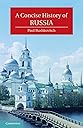
Accessible to students, tourists, and general readers alike, this book provides a broad overview of Russian history since the ninth century. Paul Bushkovitch emphasizes the enormous changes in the understanding of Russian history resulting from the end of the Soviet Union in 1991. Since then, new material has come to light on the history of the Soviet era, providing new conceptions of Russia's pre-revolutionary past. The book traces not only the political history of Russia, but also developments in its literature, art, and science. Bushkovitch describes well-known cultural figures, such as Chekhov, Tolstoy, and Mendeleev in their institutional and historical contexts. Though the 1917 revolution, the resulting Soviet system, and the Cold War were a crucial part of Russian and world history, Bushkovitch presents earlier developments as more than just a prelude to Bolshevik power.
| Dimensions | 5.5 x 1.17 x 8.5 inches |
| Edition | New |
| Isbn 10 | 0521543231 |
| Isbn 13 | 978-0521543231 |
| Item Weight | 1.32 pounds |
| Language | English |
| Part Of Series | Cambridge Concise Histories |
| Print Length | 518 pages |
| Publication Date | December 5, 2011 |
| Publisher | Cambridge University Press |
User
Excellent source for developing an understanding of the complex Russian history
The author does an incredible job covering the history of this very complex country from the dark ages to today. And unlike many history books, he accomplishes this by just the right amount of detail and facts, thus keeping interest level high. I've always found Russian history fascinating, and this book was the best I've found on Russia. Some have complained the author jumps back and forth too much in time, but I found that to be one of the books strong points. When he is talking about the politics and chronology of events leading to a major event, he covers that over the appropriate time frame. But then when talking about culture or art, he tends to cover those topics separately. For me, trying to integrate too much into the same time period is more confusing than taking a couple or three cuts at it. But everybody has their own way of absorbing information. For me, the author allowed me to learn a ton I didn't know before, even though I've read several books on this topic.It's fairly lengthy, but then again, some books would be this lengthy while only covering 200-300 years while this one covers 1500 years or so.
User
Russian literature and arts were intricately intertwined with the thrust towards the 1917 Revolution
This is not exactly "concise" as the title promises, since the book is a very densely-packed 460 pages long. The writing is complex and sometimes difficult to follow. I found myself re-reading sentences, or sometimes whole paragraphs to be sure I understood what Paul Bushkovitch was trying to say.That said, this is definitely worth reading. One of the things I found enlightening is the way the author was able to demonstrate that Russian literature and arts were intricately intertwined with the thrust towards the 1917 Revolution. I was surprised at this, and initially skeptical, but came away with a greater vision of the origins of the communist revolution. The book may be dense, but it is packed with information and a unique point of view about the underpinnings of modern Russian historical development. The portions of the book about Russian history prior to the Romanovs are useful, but a bit vague. This is probably because the facts themselves are sparse and ambiguous.I am a big fan of the Cambridge history series, and this does not disappoint. If you are interested in Russian history, I recommend this. Be prepared to pay careful attention, though. This is not for the casual reader.
User
TO THE POINT
As an undergraduate I took a strong minor in world history, particularly of Russia. However, as do many things with time, my grasp of Russian history has faded. I purchased this Concise History as a review to support my post-retirement infatuation with great Russian Literature. And it did so beyond my expectations. I keep it as a handy reference as I read Tolstoy, Dostoevsky, Gogol, Pasternak, etc. Concerning Pasternak, I found "A Concise History of the Russian Revolution" to be a useful supplement to Dr. Zhivago.The text is very readable and addresses my needs very well. There are some Russian words that, when anglicized, baffle me, so I keep my smartphone internet handy.I recommend this text to anyone wanting an understanding of a millennium of Rus/Russian history without the time or inclination to delve into it's deep scholarship. Thumbs up!
User
What you need to know
I'm just a little over halfway through with this concise history, but I have already learned many amazing things about Russian tsars, composers and writers. Why I didn't buy this book several months ago, I don't know. If you want to get up to speed on everything Russian after a misspent youth, this is the book. Buy it. Read it. Be edified!
User
An essential history
Bushkovitch’s concise history of Russia is a primer for beginning a study of that enormously complex history. Readers new to Russian history will make discoveries on almost every page and those acquainted with Russia will find reminders of deep connections and resonances. Written in clear prose without pretense. Russia’s Orthodox Church has a sense of apartness and place that deeply colored the region’s culture and sense of self.The collision between Modern Europe and Russian values had and still has lasting consequences.
User
Good overall history with some redundancy
This book provides a good general grounding in Russian history from the medieval period until the start of the Putin era. The author appears strongest in covering the last 150 years, though his interpretation of Russian history presents it more as a tragic and sympathetic place than other historians might. The only noticeable shortcoming (aside from inconsistent copy editing) is the significant redundancy in covering events as part of a general history in one chapter, as part of a history of culture in another chapter, and as part of some specific political or economic development in another chapter. This is jarring for a reader that completes the work in order, but is likely a concession to the needs of university coursework assignments.
User
Very well organized
The book does an amazing job tying events and outcomes together that are not necessary happening at the same time and makes it make sense. It is a clear and concise history of russia (as the title says) that stays focused on the topic, but will also dive into other related issues and topics (rather perfectly done) to give context. A great book and I would recommend to anybody who wants a clear and detailed analysis of russian history!
User
Thorough, Not Easy to Read
Bushkovich does indeed give a concise history of Russia. On many occasions, the Crimea War for example, I wished for more detail. But in fairness to the author, covering a thousand years or so of history is no simple task - many details are going to end up on the cutting room floor. I also found the reading difficult with a prose I would describe as awkward, with many run on sentences. Finally, rather than the few grainy black and white photos, I would’ve much preferred maps, as many places like Harbin, and Port Arthur are not commonly known places.
User
Good buy
Good buy
User
Let's understand each other
Great introduction to the subject.Need to understand this country better than we do now
User
Carlosg
Buen libro para aprender la historia básica de Rusia. Es un relato historico preciso y concreto. El autor no ahonda en rumores o historias que no sean relevantes en términos historicos.
User
Excelente
Gran libro para introducirse a la historia de Rusia. Escrito de manera que para el lector resulta agradable e informativo
User
Probably a good place to start exploration
Decent and minimally biased short survey or Russian history. Probably a good place to start exploration.
Trustpilot
3 weeks ago
4 days ago
3 weeks ago
1 day ago