Desertcart purchases this item on your behalf and handles shipping, customs, and support to Kyrgyzstan.
💾 Modernize your legacy gear with GoTEK’s USB floppy emulator—because vintage tech deserves a future.
The GoTEK SFR1M44-U100 is a 3.5-inch USB floppy drive emulator designed to replace traditional 1.44MB floppy disks with USB flash drives. Featuring a 34-pin floppy interface and 5V power supply, it supports up to 1000 partitions, transfers data at 500 kbps, and includes a built-in 32-bit Cortex-M4 CPU for reliable performance. Perfect for embroidery machines, industrial equipment, and vintage music instruments, it offers plug-and-play installation and requires USB drives formatted in FAT12 for seamless integration.
| ASIN | B0762NCHC6 |
| Additional Features | Plug and Play |
| Best Sellers Rank | #11 in Floppy & Tape Drives |
| Brand | GoTEK |
| Built-In Media | USB floppy drive emulator |
| Cache Memory Installed Size | 1.44 |
| Color | Grey |
| Compatible Devices | PC |
| Compatible Video Game Console Models | Microsoft Xbox 360, Microsoft Xbox One, Microsoft Xbox SERIES S, Microsoft Xbox SERIES X, Nintendo Switch, Sony PlayStation 4, Sony PlayStation 5 |
| Connectivity Technology | USB |
| Customer Reviews | 4.5 out of 5 stars 346 Reviews |
| Data Transfer Rate | 0.06 megabytes_per_second |
| Enclosure Material | ABS |
| Form Factor | 3.5-inch |
| Hard Disk Description | Solid State Drive |
| Hard Disk Form Factor | 3.5 inches |
| Hard Disk Interface | USB 1.1 |
| Hard-Drive Size | 1.44 MB |
| Hardware Connectivity | USB |
| Hardware Platform | PC |
| Installation Type | Internal Hard Drive |
| Item Dimensions L x W x Thickness | 4.8"L x 3.9"W x 1"Th |
| Manufacturer | Gotek |
| Mfr Part Number | 並行輸入品 |
| Model Name | SFR1M44-U100 |
| Model Number | 並行輸入品 |
| Number of Items | 1 |
| Read Speed | 18 bytes_per_second |
| Special Feature | Plug and Play |
| Specific Uses For Product | data storage |
| UPC | 727670341232 |
R**R
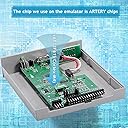
Artey (AT32F415) Chip, Compatible with Flashfloppy
Performance is overall really good in comparison to using a floppy drive connected to a floppy 34-pin cable/controller. For example, using Microsoft Windows 98 with the Gotek multiple floppy disk images and a Flashfloppy FF.CFG file with host defined (host=pc98), wait times are within seconds, versus the default minute for floppy disk detection times! Opting for Flashfloppy firmware rather than the default Gotek firmware, is not a simple task, however is relatively still somewhat easy while noticing several sporadic documentation omitted instructions . (eg. Specific enumerated jumper pins for programming mode; Formatting adding at least one FAT32 partition, rather than formatting entire flash device FAT32; Documenting all flashing methods of the Artey AT32F415 chip, just use simple USB-A to USB-A cable DFU flash/upload method; And initially add floppy images to root directory only, no sub-directories.) Successfully using the Gotek flashed Flashfloppy device with a Verbatim 32GB flash nano thumb USB storage media. Flashfloppy firmware is stated as creating a more easily handled Gotek device, rather than resorting to the Gotek foreign software for formatting and storing floppy images to USB storage media. Flashfloppy firmware mostly generic FAT32 format, then copy floppy images to USB media. (eg. drag-drop or copy-paste) Installing Flashfloppy 1) Requires purchasing a unique USB-A male to USB-A male cable, for flashing using the DFU bus. (eg. dfu-util) 2) Jumper two pins (eg. Boot jumper and 3v pins), enabling programming mode for the Artey chip. I opted for soldering header pins, rather than unsafely using a piece of wire. (eg. 2.54 mm single row male header, could likely use double row header.) Subsequently requires using female to female header jumper wires. 3) Attach one USB-A male end to preferably a USB hub port, the other end of the USB-A male to the front Gotek device USB-A female port. Watch activity logs for proper USB port logging. 4) Get Flashfloppy download compressed (eg. zip) file, unzip, verify the dfu sub-directory with at415 image exists. 5) Linux, install dfu-util, check the Gotek device is connected and properly detected using "dfu-util -l" incantation. Augment the following command arguments if connecting more than one device, otherwise one device should use the following incantations. 6) Linux, un-protect the Artey chip, will exit with error, wait a good several seconds to minute afterwards, # dfu-util -D /home/roger/src/flashfloppy/flashfloppy-3.44/dfu/flashfloppy-at415-st105-3.44.dfu -a 0 -s 0x08000000:unprotect:force 7) Linux, upload flashfloppy firmware, # dfu-util -D /home/roger/src/flashfloppy/flashfloppy-3.44/dfu/flashfloppy-at415-st105-3.44.dfu -a 0 8) Repeat commands as necessary, until dfu-utils indicates uploading firmware. 9) Disconnect the Gotek device and disconnect the jumper wires, and attach regular power, verify F-F display confirms a good upload. 10) Format a USB flash removable media with FAT32, so that the device has one partition. (eg. /dev/sde1) Enable the boot and LBA flags! Copy a 1.44 MB floppy disk image to the root directory of the USB flash media. (eg. Microsoft DOS or Windows 98 DOS boot disk image) 11) Connect the Gotek device to a motherboard, attach the USB flash media; if a "Rib" displays, power-off and re-attach the floppy cable, ensuring not upside down. 12) As of this stage, the device should be working. If using on a PC platform, for quicker accesses, create a DOS formatted FF.CFG file and add "host=pc-dos" option for indicating PC platform image file types, or other platform type. As of this stage, likely will notice the absolute uneasy silence of the Gotek device (eg. no floppy disk drive sounds, aside from dancing two digit LED display, and will be likely desiring adding a speaker. (eg. piezo transducer/disc) May also opt for installing an ordinary white OLED 0.96 display for more descriptive feedback for floppy image file names and a rotary switch for fast forward/backward while navigating many floppy images. I'll likely most certainly install the piezo disc/speaker, and possibly OLD 0.96 screen, not sure about the rotary dial switch as I only have few floppy images. People having 100s of floppy disk era games usually opt for the rotary dial switch.
J**K
Couldn't be better
Excellent product as is, made magnificent by flashing it with FlashFloppy. If you're unsure if you want it, yes, you want it.
H**S
It works.
It works with standard floppy cables and with KOOBOOK 1Pcs 1.44MB 3.5" Floppy Drive Connector 34 PIN 34P to USB Cable Adapter (Amazon). Several observations. Using it with the USB KOOBOOK adapter in Window flipping between floppy images is not detected. You have to eject the USB connection and plug it back in... With the USB adapter in linux (fedora 44), the floppy disk swap is detected. Another linux "feature" is creating FD images on the device (while using the USB adapter). When you copy and image to the floppy device... it works like a real floppy drive. When you "dd" to /dev/sdx it runs at USB 2 speed.. Anyway, also... test and be careful. Having multiple images on this device is a little difficult to manage. If the GoTEK would only display the volser of the selected floppy image in an LCD display...
C**.
Emulate a floppy drive with a USB stick.
Great for emulating 1.44MB floppy drives as long as you don't write a bunch of data to the disk - the buffer on the device is too small. Great with the FlashFloppy firmware. Easy to install the FlashFloppy firmware.
A**C
A must have for anyone with systems expecting a floppy drive
I've used this emulator for loading startup disks for installing Windows 95 & 98. You can format a flash drive (the older the better) as a 1.44Mb floppy disk and you'll be able to go back and forth between a modern PC and the GoTEK easily.
A**Y
Into retro computing? Buy this!!
Recently I've gotten very involved in retro computing. But in 2020, messing with tiny floppy disks is absolutely no fun. Bad sectors, dirty drives, it's just not a great experience. Enter this thing. It allows you to easily turn any old USB drive into 1000 floppy disks, and just push a button to swap between them. It works on any old PC or other devices that use floppy disks for storage (synths, etc). Some notes about the default firmware that's on the device: * The software to use the device is... interesting and a bit annoying. * It's Windows only. * It will only work with DOS and devices that support DOS. With that said, it's trivial to flash a replacement firmware onto this device that turns it into an absolute POWERHOUSE (FlashFloppy, Google it). It just requires VERY minor soldering skills (my toddler could probably do it) and a USB-A to A cable like this: https://www.amazon.com/Rankie-Cable-Type-1-Pack-Feet/dp/B01KRO8D20/ With the replacement firmware you get: * WAY easier to manage from basically anywhere, Mac, Linux, Windows, etc. * Able to use it with other old devices like Amigas. * Can easily replace the simple LCD with a full-featured OLED screen, again with MINOR soldering skills. In all, a massive value for the money even if you just keep the stock firmware.
P**N
Works as advertised, but is fussy
Getting images onto the USB stick was a bit fussy, I found that letting the GoTek format the USB stick was the easiest way to get it in a state I could transfer images to it. It would be a TREMENDOUS improvement if they added an OLED display that would show the volume name of each "disk", so you don't have to rely on more draconian means to keep track. It works, but is surprisingly just as slow as a normal floppy. The 1.44MB drives require the more advanced controller that can do 500Kbit/s, I can tell you that this does not come close to achieving that speed. The fastest floppy drive I ever used was an old Toshiba 1.44MB drive back in the 90's, there was something magical about that drive and it transferred data very fast, faster than the typical 22KB/s.
R**I
Pleasant surprise
My floppy failed in my last 80s pc. So I shopped. Found this. Fast delivery. About 15 minutes to physically install. I plugged in a stuck to the usb and it didn’t work. Back to the instructions that are way above my skill set . But then , I plugged in a new unused memory stick and formatted . Bingo , worked immediately. It’s slow but I’m sure that’s because my old machine is slow . But wow , breathing a little more life in this old machine . Great value , great idea , thank you
Trustpilot
3 weeks ago
5 days ago