We remain fully operational. Our teams are working around the clock to ensure your deliveries continue safely.

DOWNLOAD THE APP


Customer Services
Copyright © 2025 Desertcart Holdings Limited
DOWNLOAD THE APP

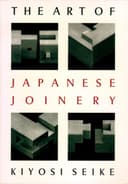
The Art Of Japanese Joinery [Seike, Kiyosi] on desertcart.com. *FREE* shipping on qualifying offers. The Art Of Japanese Joinery Review: functioning words: "the ART of..." not "how-to" - I inherited this book from my father and enjoyed perusing it from time-to-time. I loved that book dearly, and so, decided to share it with others by donating it to our local library. Another reviewer was correct that it is not a typical "how-to" book, but it is an inspirational art book of classic Japanese joinery. The reason there is little "how-to" information here is because there are so many ways to accomplish these joints; by machine, entirely by hand, or with jigs and many combinations thereof. Also, the only people interested in this type of work are those who simply find it fascinating or are expert craftsmen. In either case, extraneous "how-to" info is not needed. The book is beautiful, unique, and about an arcane subject, so it has high merit solely in that respect. If you love this type of thing, it is for you and highly recommended. Gorgeous photographs of intricate, hand-crafted joinery are intriguing for some of us woodworkers, even if we never intend to use these joints. And for those of who have made some of these joints, the excellent examples provide a high benchmark for grading our own efforts. Most of the joinery in this book was cut by hand with traditional Japanese hand tools: Dozuki saws, chisels and wooden planes. Part-time "Home" craftsmen may find these examples inspiring, intimidating or outright depressing in comparison to their own work. My father was a world-class craftsman ( a violin repairman and pattern-maker) so he made many of these joints just for practice, although the methods he chose would undoubtedly differ from traditional Japanese woodworker's ways. The few joints in here that I found practical use for were the construction joints that help isolate vibration while maintaining structural integrity. Although these timber-framing joints are intended to provide flexible-yet-strong houses in earthquake-prone Japan, they are also useful in building recording-studios where sound-transmission through joist-conduction must be minimized. I suspect that very few construction workers would have the confidence in their skills to cut some of these complex joints into an expensive 60-foot glue/ lam beam as I did. Of course, I would have never risked that without practicing the joints first on less expensive material with the expert help of my father. If you build recording studios, or want an Earth friendly yet Earthquake resistant home, you may find practical applications for timber framing joinery within. Although I have not heard of many architects using this joinery, I have thought of other applications. The metal-free joinery ( without nails or screws) in this volume could solve some design problems in structures that contain super-powerful magnets for nuclear medicine or particle physics labs. If you want a "gee-whiz! YOU TOO can create these fancy joints with simple techniques and cheap tools" type of book, look elsewhere. This is not a book for the Sears Table-saw crowd. This is a magnificent tome for an elite group of artisans and art-lovers. Review: Good for inspiration - Their woodworking skills are way beyond mine. But it’s a great book for some inspiration. Give me some ideas for future projects.
| Best Sellers Rank | #649,605 in Books ( See Top 100 in Books ) #25 in Carpentry #42 in Woodworking Projects (Books) #1,671 in Arts & Photography Criticism |
| Customer Reviews | 4.6 out of 5 stars 743 Reviews |
G**R
functioning words: "the ART of..." not "how-to"
I inherited this book from my father and enjoyed perusing it from time-to-time. I loved that book dearly, and so, decided to share it with others by donating it to our local library. Another reviewer was correct that it is not a typical "how-to" book, but it is an inspirational art book of classic Japanese joinery. The reason there is little "how-to" information here is because there are so many ways to accomplish these joints; by machine, entirely by hand, or with jigs and many combinations thereof. Also, the only people interested in this type of work are those who simply find it fascinating or are expert craftsmen. In either case, extraneous "how-to" info is not needed. The book is beautiful, unique, and about an arcane subject, so it has high merit solely in that respect. If you love this type of thing, it is for you and highly recommended. Gorgeous photographs of intricate, hand-crafted joinery are intriguing for some of us woodworkers, even if we never intend to use these joints. And for those of who have made some of these joints, the excellent examples provide a high benchmark for grading our own efforts. Most of the joinery in this book was cut by hand with traditional Japanese hand tools: Dozuki saws, chisels and wooden planes. Part-time "Home" craftsmen may find these examples inspiring, intimidating or outright depressing in comparison to their own work. My father was a world-class craftsman ( a violin repairman and pattern-maker) so he made many of these joints just for practice, although the methods he chose would undoubtedly differ from traditional Japanese woodworker's ways. The few joints in here that I found practical use for were the construction joints that help isolate vibration while maintaining structural integrity. Although these timber-framing joints are intended to provide flexible-yet-strong houses in earthquake-prone Japan, they are also useful in building recording-studios where sound-transmission through joist-conduction must be minimized. I suspect that very few construction workers would have the confidence in their skills to cut some of these complex joints into an expensive 60-foot glue/ lam beam as I did. Of course, I would have never risked that without practicing the joints first on less expensive material with the expert help of my father. If you build recording studios, or want an Earth friendly yet Earthquake resistant home, you may find practical applications for timber framing joinery within. Although I have not heard of many architects using this joinery, I have thought of other applications. The metal-free joinery ( without nails or screws) in this volume could solve some design problems in structures that contain super-powerful magnets for nuclear medicine or particle physics labs. If you want a "gee-whiz! YOU TOO can create these fancy joints with simple techniques and cheap tools" type of book, look elsewhere. This is not a book for the Sears Table-saw crowd. This is a magnificent tome for an elite group of artisans and art-lovers.
D**E
Good for inspiration
Their woodworking skills are way beyond mine. But it’s a great book for some inspiration. Give me some ideas for future projects.
R**N
Great Book
If you want to learn about Japanese joinery this is an excellent choice. If you want to make Japanese joints, then I would say this should be an essential companion book to "The Complete Japanese Joinery" by Hideo Sato & Yasua Nakahara, which is a much more hands on how-to treaty. There are some nice b/w photos of temple architecture in Nara & shimane, followed by 57 beautiful b/w photos of various complex joints all crafted with expert precision. The text describes the function, splicing, and connecting of joints. Again this is not a technical manual per se, but if you are interested in the subject there is limited choices and I personally love this book.
K**.
Great coffee table book on joinery
The images are beautiful, but I was hoping for more of a mechanical description for each type of join. This book is far more about the artistry rather than the methods.
J**E
Beautiful photos, NOT a how to
As other reviewers have said, this is definitely not a how to. But the photos are incredible and any serious wood worker is sure to appreciate them!
B**Y
Great informative book.
Found this book very interesting. I purchased for my dad. He liked it as well.
V**E
Gift for Master Woodworker
Purchased for a friend who is a master woodworker. He appreciated getting it.
G**N
Nice Book, But not really
As a wood worker, a great book to add to your collection but you will learn very little from it. I was hoping for more Sashimono examples with tech drawings, not page after page of explaining the art of Japanese joinery
Trustpilot
1 month ago
1 week ago