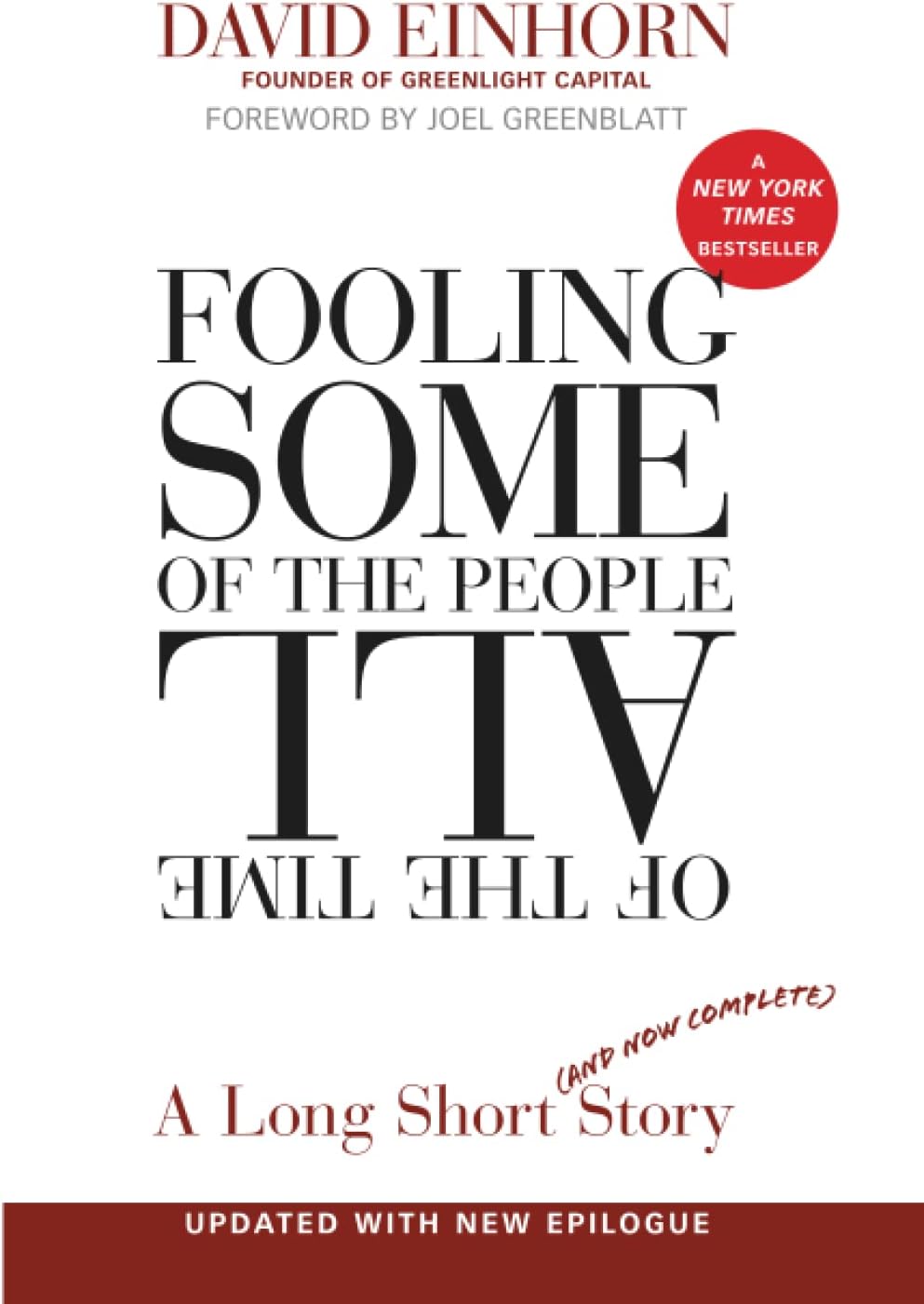
Fooling Some of the People All of the Time, A Long Short (and Now Complete) Story, Updated with New Epilogue
Product ID: 5403472
Buy anything from 5,000+ international stores. One checkout price. No surprise fees. Join 2M+ shoppers on Desertcart.
Desertcart purchases this item on your behalf and handles shipping, customs, and support to Kyrgyzstan.
desertcart.com: Fooling Some of the People All of the Time, A Long Short (and Now Complete) Story, Updated with New Epilogue: 0884443254417: Einhorn, David, Greenblatt, Joel: Books Review: Mandatory reading for all citizens of all countries - David Einhorn has given us a remarkable gift in this book. The work that he does each day, and which he has so carefully and capably revealed in detailed and documented fashion in this book, provides immeasurable benefit to each and every one of us every single day. I am sincerely grateful to David Einhorn for his relentless effort to hold the misbehaving stewards of our wealth and resources accountable for their misdeeds. It is an added bonus that he decided to devote a significant amount of his valuable time to providing this account of his work and his discoveries of the behavior of the many other players in the Allied fraud case. Since their arrival, hundreds of years ago, the capital markets have evolved organically as generations of humans have gradually built the markets to transfer the ownership of the world's resources from the few, privileged families who once controlled the world, to the many. In the process, these markets have improved the visibility and transparency with which we are all able to observe, understand and influence the critical decisions which result in the eventual allocation of resources. As a result, the improvement in allocation of resources toward serving us all as individuals has delivered previously unimaginable improvements in human well-being and freedom from oppression and exploitation by those few at the top of the pyramid. And yet, while these improvements are real and remarkable, the progress made possible by the organic evolution and functioning of these capital markets continues to be held back by people who claim to be protecting us and serving us. I've long wondered whether those people, who work in the many organizations and agencies identified in this book, are inherently 'evil' and desire to prevent humanity from obtaining the benefits which could be made available to all by enabling the ongoing development and expansion of capital markets in the developed and undeveloped world as they regulate the few who seek to control and regulate the many, or are simply 'clueless' and fail to understand and recognize the role that capital markets play in bringing these benefits (in spite of overwhelming evidence visible to anyone who travels from the developed (where capital markets have grown and evolved) to the undeveloped countries (where the power-hungry have successfully fended of the organic development and influence of local and international capital markets)). With this book, I now see that it is a combination of both, but there is much more of the former behavior than I suspected in the journalists, analysts, regulators, supervisory organizations, and throughout the government in the USA. Given the evident greatness of the US economy and society in relation to so many other countries, I can only conclude that these problems are even more pronounced in many other countries. Only by exposing this behavior, and demonstrating how it undermines the functioning of the capital markets upon which so much of our modern material well-being depends, can we hope to continue to progress and enjoy the phenomenal benefits that await us as these markets deepen and improve. David Einhorn's contribution to this ongoing improvement is enormous, and yet will go almost entirely unnoticed by the billions of beneficiaries of his efforts. Even more unjust, a very vocal few of those beneficiaries will continue to declare him and other similar hedge fund activists to be the villains, while they themselves hypocritically work against us all in the name of 'protecting' us. (Typed on a phone, please excuse the typos) Review: A brilliant (but FRIGHTENING) book - This is an investment book that should not be missed (as long as your accounting and financial analysis skills are well-honed -- the critical analysis is detailed). This would be excellent reading for a CFA/MBA/CPA. David Einhorn writes the detailed story of his investigations into malfeasance at Allied Capital. He makes the case, with all the back-up detail, that this company is essentially a "Ponzi" scheme (like a financial chain-letter). Allied books SBA (and other Federal Agency) guaranteed loans, violating origination-risk criteria, front-ending income, managing and delaying loan write-downs while inflating earnings on the pretext of lack of objective value impairment (though they do manage to write-down their equity investments earlier!), increasing portfolio size which hides higher bad-debt experience on seasoned loans which they do not disclose, and distributing capital (if the accounting had been more conservative) through increasing dividends funded by new equity. All this, as well as documented fraud. These technical details and analysis are worth the price of admission alone. However, the most frightening thing about the book is the lack of interest in the Allied malfeasance shown by the SBA and the SEC, Congressional oversight committees, sell-side analysts and journalists, all for their own self-serving reasons. If you had any faith in government by-and-large acting in our best interests before, this book could well destroy that act of faith. As well as the Allied Capital story (most of the book), the early chapters describe how Greenlight Capital (David's Hedge Fund) works. That's a fascinating revelation in its own right. What is most impressive, though, about the book is the quality of analysis David has done. Why are Hedge Funds who sometimes run short-positions so reviled these days by regulators? David is anything but a shoot-from-the-hip trader, neither is there any indication whatsoever he is trying to manipulate the market in Allied stock with rumours (everything is backed up with hard evidence and detailed analysis). By the way, David is the person who publically took on the ex-CFO of Lehman and won. If you are a financially sophisticated shareholder in Allied Capital, please do read this book -- you most probably won't be afterwards. At the end of the book, I was left with one puzzling question: why has David devoted so much of his time to researching and telling this story (early on in the events, he even says he thought of quitting because it was becoming so time-consuming)? It's almost as if he is now a dog with a financial bone and just can't let go any more. Admittedly, he's doing us all a big favor in the process (and has agreed to give any proceeds from his short position to charity, so he has no personal conflict of interest). If anyone from the management of Allied Capital or SEC enforcement reads this review and thinks of bringing a lawsuit, do think again. I am only summarising David's book, which is in the public domain, and I never have had, neither do I, nor will I ever have any position in Allied Capital's stock. But then, of course, as David makes the point near the end, the SEC only seems to be interested in high visibility enforcement when a big company has actually failed (Enron, Worldcom), unlike Allied Capital (yet!), or it involves a well known figure (Martha Stewart). Where is the justice that we are all supposed to put our faith in? Many congratulations, David. I hope there can be more financial books of this quality in the future.
| Best Sellers Rank | #123,003 in Books ( See Top 100 in Books ) #23 in Private Equity (Books) #36 in Business Investments #52 in Business Ethics (Books) |
| Customer Reviews | 4.5 4.5 out of 5 stars (736) |
| Dimensions | 6 x 1.4 x 8.9 inches |
| Edition | 1st |
| ISBN-10 | 0470481544 |
| ISBN-13 | 978-0470481547 |
| Item Weight | 2.31 pounds |
| Language | English |
| Print length | 448 pages |
| Publication date | December 7, 2010 |
| Publisher | Wiley |
K**R
Mandatory reading for all citizens of all countries
David Einhorn has given us a remarkable gift in this book. The work that he does each day, and which he has so carefully and capably revealed in detailed and documented fashion in this book, provides immeasurable benefit to each and every one of us every single day. I am sincerely grateful to David Einhorn for his relentless effort to hold the misbehaving stewards of our wealth and resources accountable for their misdeeds. It is an added bonus that he decided to devote a significant amount of his valuable time to providing this account of his work and his discoveries of the behavior of the many other players in the Allied fraud case. Since their arrival, hundreds of years ago, the capital markets have evolved organically as generations of humans have gradually built the markets to transfer the ownership of the world's resources from the few, privileged families who once controlled the world, to the many. In the process, these markets have improved the visibility and transparency with which we are all able to observe, understand and influence the critical decisions which result in the eventual allocation of resources. As a result, the improvement in allocation of resources toward serving us all as individuals has delivered previously unimaginable improvements in human well-being and freedom from oppression and exploitation by those few at the top of the pyramid. And yet, while these improvements are real and remarkable, the progress made possible by the organic evolution and functioning of these capital markets continues to be held back by people who claim to be protecting us and serving us. I've long wondered whether those people, who work in the many organizations and agencies identified in this book, are inherently 'evil' and desire to prevent humanity from obtaining the benefits which could be made available to all by enabling the ongoing development and expansion of capital markets in the developed and undeveloped world as they regulate the few who seek to control and regulate the many, or are simply 'clueless' and fail to understand and recognize the role that capital markets play in bringing these benefits (in spite of overwhelming evidence visible to anyone who travels from the developed (where capital markets have grown and evolved) to the undeveloped countries (where the power-hungry have successfully fended of the organic development and influence of local and international capital markets)). With this book, I now see that it is a combination of both, but there is much more of the former behavior than I suspected in the journalists, analysts, regulators, supervisory organizations, and throughout the government in the USA. Given the evident greatness of the US economy and society in relation to so many other countries, I can only conclude that these problems are even more pronounced in many other countries. Only by exposing this behavior, and demonstrating how it undermines the functioning of the capital markets upon which so much of our modern material well-being depends, can we hope to continue to progress and enjoy the phenomenal benefits that await us as these markets deepen and improve. David Einhorn's contribution to this ongoing improvement is enormous, and yet will go almost entirely unnoticed by the billions of beneficiaries of his efforts. Even more unjust, a very vocal few of those beneficiaries will continue to declare him and other similar hedge fund activists to be the villains, while they themselves hypocritically work against us all in the name of 'protecting' us. (Typed on a phone, please excuse the typos)
N**N
A brilliant (but FRIGHTENING) book
This is an investment book that should not be missed (as long as your accounting and financial analysis skills are well-honed -- the critical analysis is detailed). This would be excellent reading for a CFA/MBA/CPA. David Einhorn writes the detailed story of his investigations into malfeasance at Allied Capital. He makes the case, with all the back-up detail, that this company is essentially a "Ponzi" scheme (like a financial chain-letter). Allied books SBA (and other Federal Agency) guaranteed loans, violating origination-risk criteria, front-ending income, managing and delaying loan write-downs while inflating earnings on the pretext of lack of objective value impairment (though they do manage to write-down their equity investments earlier!), increasing portfolio size which hides higher bad-debt experience on seasoned loans which they do not disclose, and distributing capital (if the accounting had been more conservative) through increasing dividends funded by new equity. All this, as well as documented fraud. These technical details and analysis are worth the price of admission alone. However, the most frightening thing about the book is the lack of interest in the Allied malfeasance shown by the SBA and the SEC, Congressional oversight committees, sell-side analysts and journalists, all for their own self-serving reasons. If you had any faith in government by-and-large acting in our best interests before, this book could well destroy that act of faith. As well as the Allied Capital story (most of the book), the early chapters describe how Greenlight Capital (David's Hedge Fund) works. That's a fascinating revelation in its own right. What is most impressive, though, about the book is the quality of analysis David has done. Why are Hedge Funds who sometimes run short-positions so reviled these days by regulators? David is anything but a shoot-from-the-hip trader, neither is there any indication whatsoever he is trying to manipulate the market in Allied stock with rumours (everything is backed up with hard evidence and detailed analysis). By the way, David is the person who publically took on the ex-CFO of Lehman and won. If you are a financially sophisticated shareholder in Allied Capital, please do read this book -- you most probably won't be afterwards. At the end of the book, I was left with one puzzling question: why has David devoted so much of his time to researching and telling this story (early on in the events, he even says he thought of quitting because it was becoming so time-consuming)? It's almost as if he is now a dog with a financial bone and just can't let go any more. Admittedly, he's doing us all a big favor in the process (and has agreed to give any proceeds from his short position to charity, so he has no personal conflict of interest). If anyone from the management of Allied Capital or SEC enforcement reads this review and thinks of bringing a lawsuit, do think again. I am only summarising David's book, which is in the public domain, and I never have had, neither do I, nor will I ever have any position in Allied Capital's stock. But then, of course, as David makes the point near the end, the SEC only seems to be interested in high visibility enforcement when a big company has actually failed (Enron, Worldcom), unlike Allied Capital (yet!), or it involves a well known figure (Martha Stewart). Where is the justice that we are all supposed to put our faith in? Many congratulations, David. I hope there can be more financial books of this quality in the future.
P**E
Story of a Tenacious Short Seller With Overwhelming Detail on Allied Capital's Fraud
The book is a interesting story of how a public company, Allied Capital, chose to fight transparency and misrepresent its financial position in an extreme fashion to inflate its stock price. In Fooling Some of the People All of the Time, the tenacious hedge fund manager turned author, chronicles his fight to expose the fraud while detailing the unresponsiveness of the authorities. The book serves a purpose in outlining Allied's questionable activities but most readers won't benefit from pouring over the level of detail provided. In my opinion, the true objective of this book was to satisfy the author's desire to show that he was indeed correct in his battle with Allied despite the fact the CEO and CFO were never charged with any wrongdoing. Its entertaining nonetheless. Like many books, Fooling Some of the People All of the Time is actually many stories in one. The main theme maps out the labyrinthine fraud perpetrated by a business development company and its portfolio companies. Parallel to this story, is the saga of a hedge fund manager who clung to his short investment in Allied for an amazing amount of time -- several years. At the same time, he had to confront incompetent regulators who turned their attention to him, his fund and its short selling activities. With the smell of a grand conspiracy theory, the author describes a series of questionable events across several agencies that suggest key government personnel were not doing their jobs. Einhorn deserves a great deal of credit for tenaciously sticking with his convictions. Yet, the story could be shortened significantly without sacrificing much of the crucial content. Personally, I would love to see more stories of corporate fraud like Fooling Some of the People All of Time.
G**S
Très décevant. J'avais trouvé ce livre sur une liste de bons ouvrages sur les turpitudes comptables. C'est le récit d'un gestionnaire de fonds qui vend à découvert et se bat pour le justifier. Le livre aurait pu tenir sur 10 pages. Il y a des transcriptions d'échanges téléphoniques, de lettres, etc. Et finalement, très peu d'analyse comptable.
D**F
Once started it's hard to stop reading ..... until the end .... Very very interesting. A great opening on the secret world of investments and corporate America. also useful from a professional perspective, if you work in those industries. Bravo David.
A**R
Esse livro é simplesmente sensacional. É o case de short selling mais bem documentado da história! Tem todas as nuances e sutilezas que podem suceder no mercado, e a análise do David Einhorn é simplesmente sublime. Se você quer trabalhar na CVM ou como analista de equity, compre ontem!
A**R
A classic pure-value investor, this book is written by the hedge fund manager himself which means a lot to me. There is a lot of technical jargon so prior accounting knowledge is necessary to make it through this book. Einhorn knew what was going on at Lehman long before the crisis started and the book gives valuable insight into the relationship between private sector lenders and Washington.
P**L
The number of reviews I've left on Amazon could probably be counted on one hand. This is one of them. Straight off the bat it becomes clear that Einhorn is intelligent and talented at his job. Despite being written by a hedge fund manager, 'Fooling Some...' reads well and the story unfolds at a pace neither too fast causing a sense of overwhelm, nor too slowly leading you to wonder when the hell it gets started. It could easily pass as a fiction as the events come across as so outlandish, yet Einhorn leads you through the proceedings in a friendly and matter-of-fact way. Some passages come across as dispassionate or 'cold' and, personally, this adds to the narrative because it's how I imagine Einhorn to be if you sat down and he told you the story in person. He wouldn't be animated or outraged at management's actions, he'd just tell you what he did, Allied's reactions and then proceed to justify why he went short. This built the excitement. The 'finance' is only 1/2 the story here, so this can be enjoyed by a die-hard finance nerd interested in forensic accounting, through to the casual stock market enthusiast who likes to watch a bit of Bloomberg every now and then. After I finished, my grandfather (in his 80s) borrowed it and raced through. Einhorn is a perfect guide through a scandalous story; by the end of the book you'll be rooting for his corner and you'll be only too tempted to re-read it.
Trustpilot
1 month ago
2 weeks ago